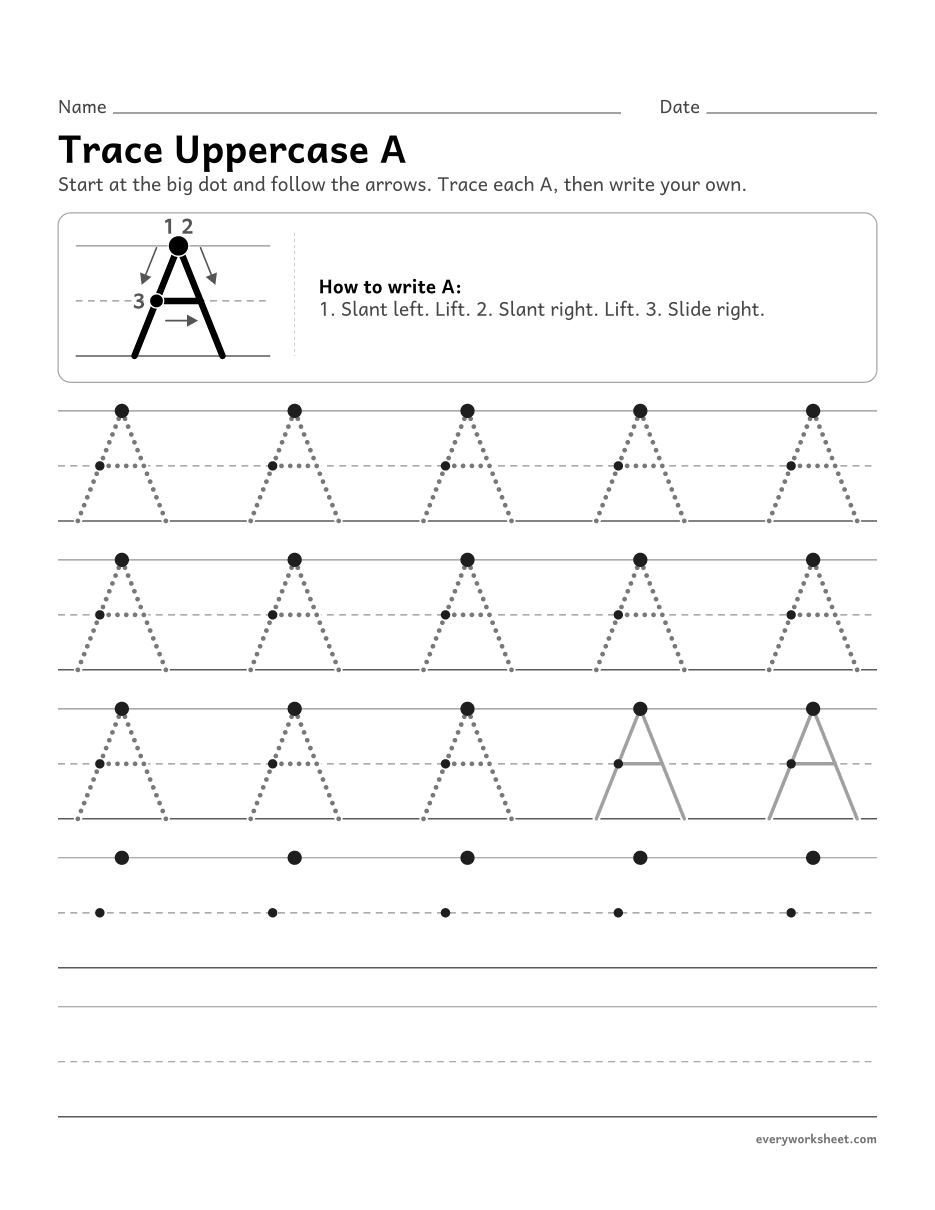
 View larger
Letter A Worksheets
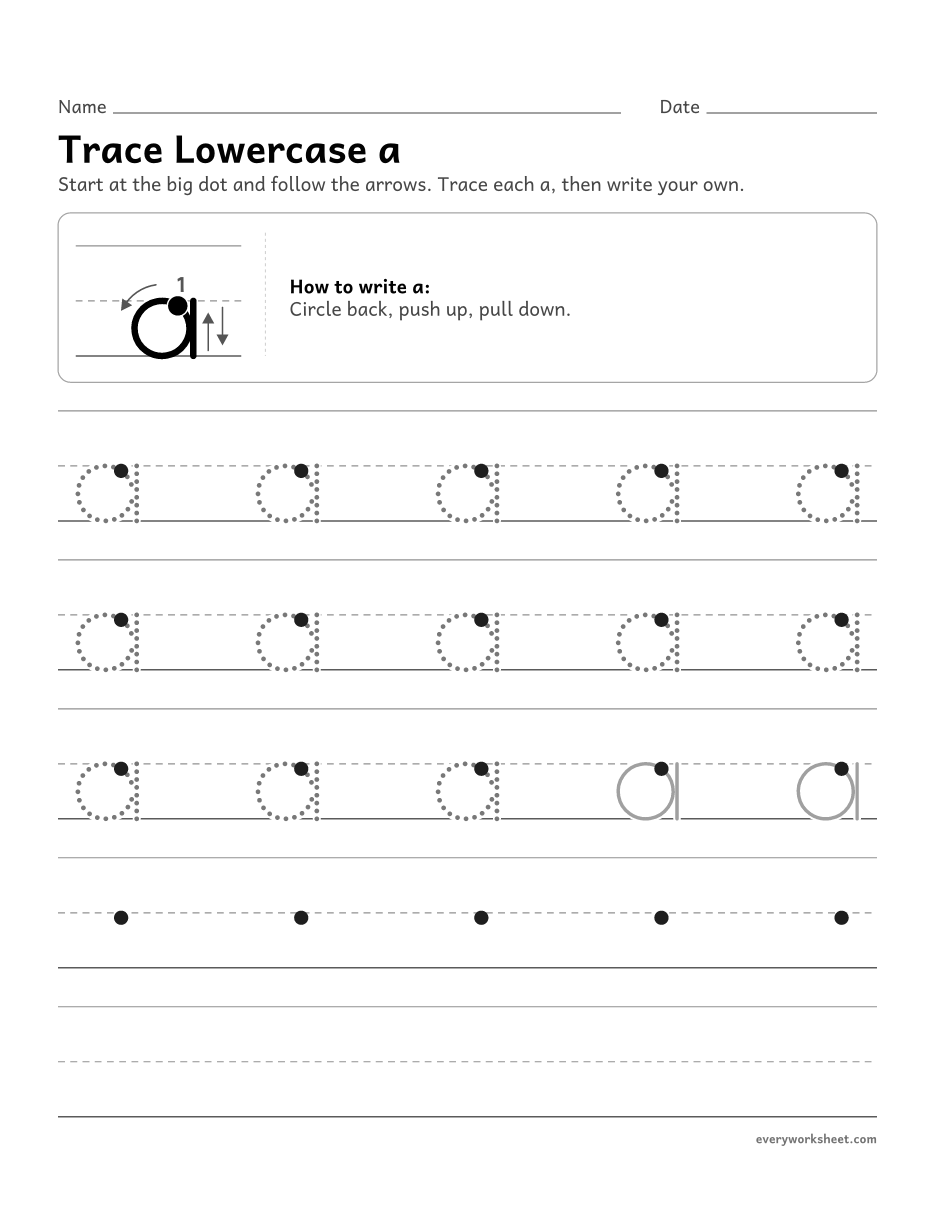
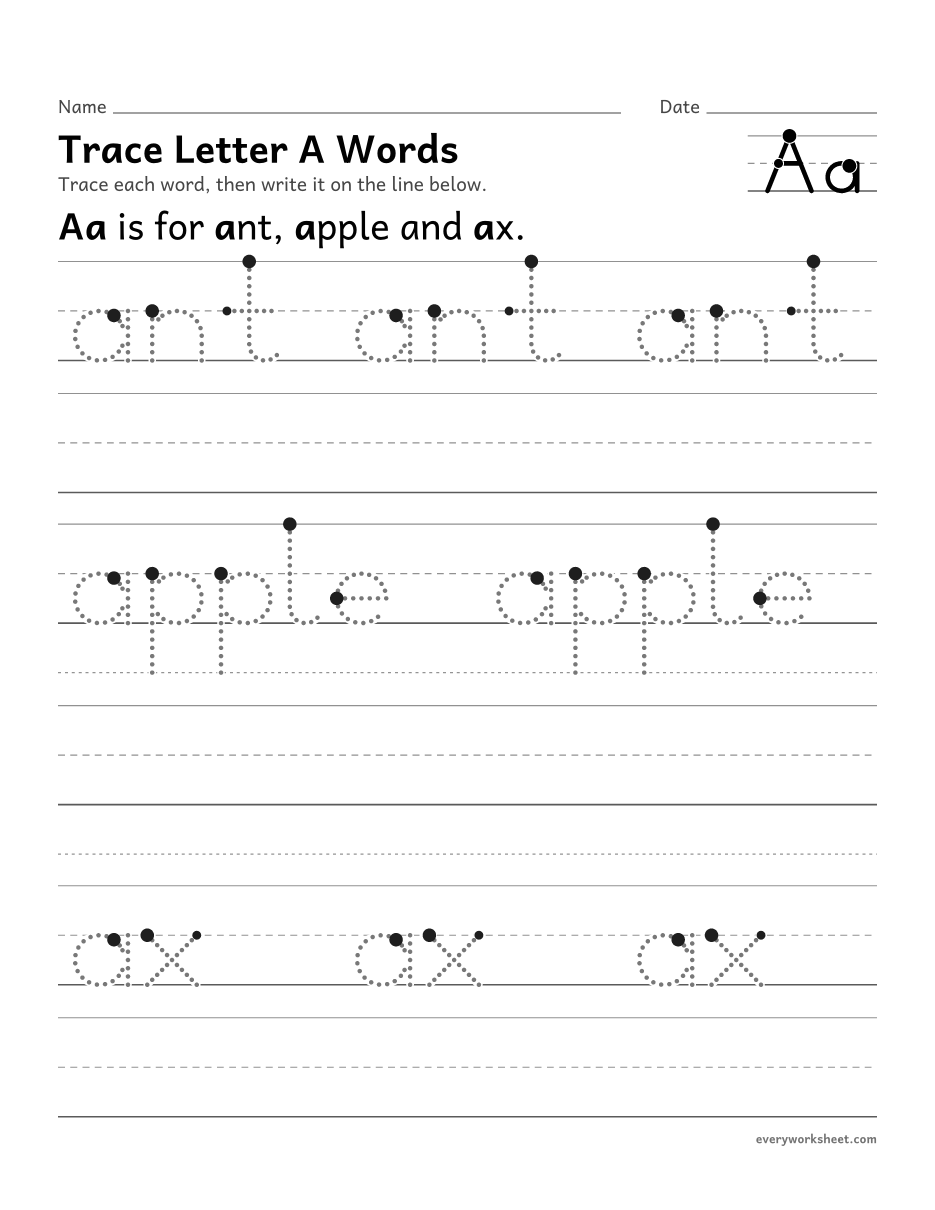
Trace uppercase A and lowercase a, trace the words ant, apple and ax, and circle every A and a in a letter hunt.
Slant, slant, slide.
How to form uppercase ADownload the Letter A worksheets
 View larger
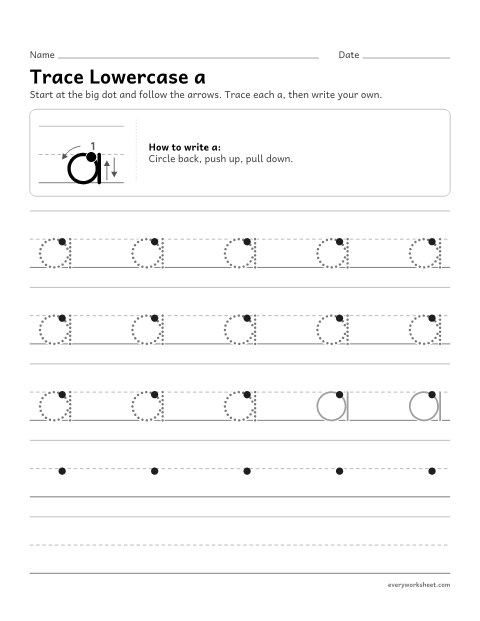 View larger
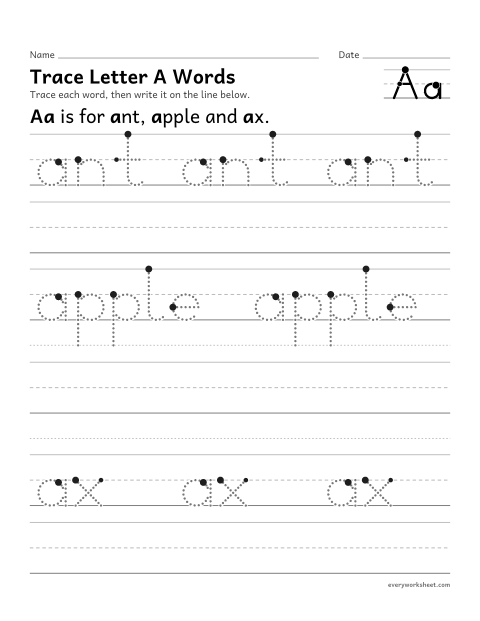 View larger
 View all 2 pages
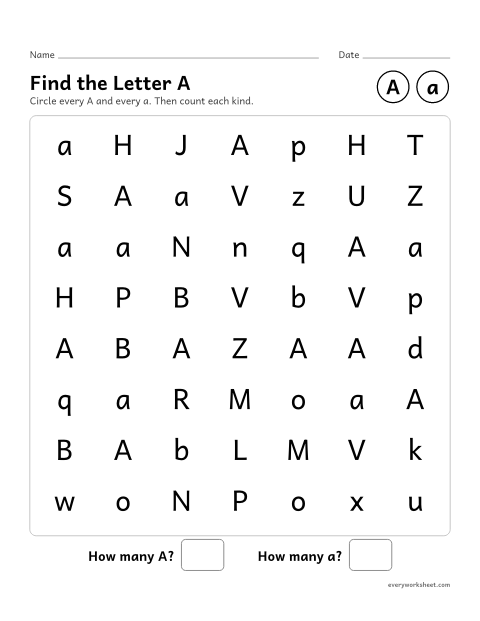
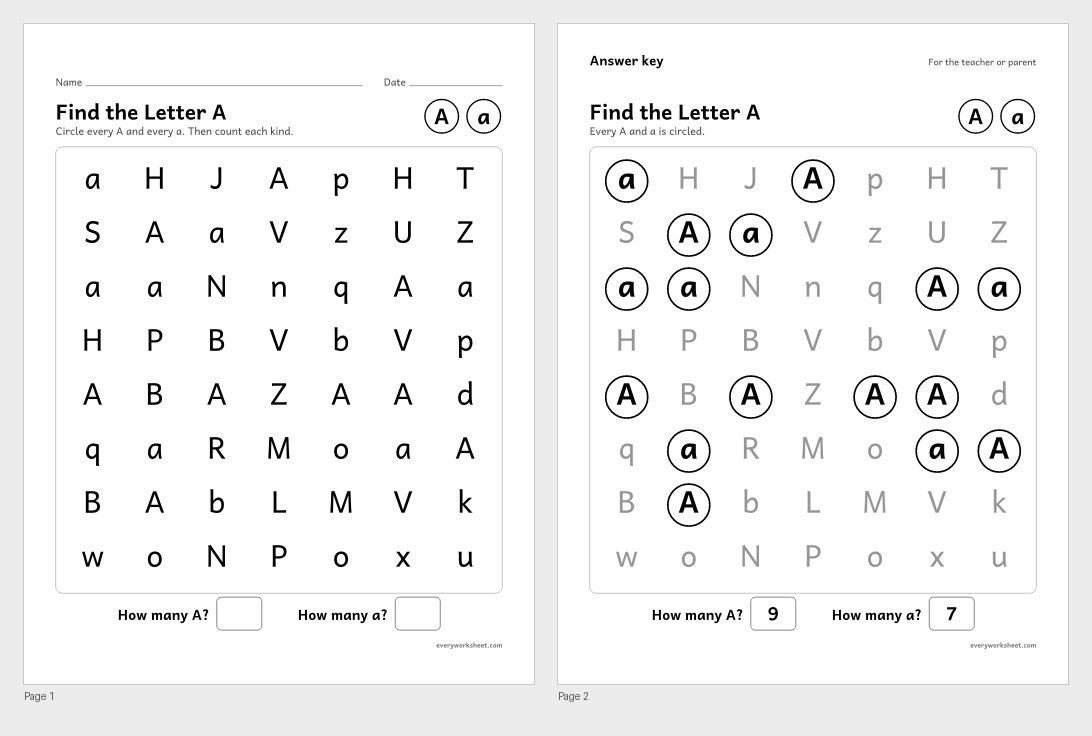
Find the letter A
Recognizing uppercase A and lowercase a
Answer key on page 2
2 pages55 KB
Print at 100% (actual size) for the cleanest tracing lines.
More letters
About these letter A worksheets
These letter A worksheets take a kindergartner from a first careful trace to writing A on their own. There are four free PDFs: uppercase A tracing, lowercase a tracing, a words page for ant, apple and ax, and a letter hunt where children circle every A and a. In all three words, A makes its short sound, /a/, the sound at the start of apple.
Uppercase A is three straight lines, so most children get close on the first day. The hard part is landing both slants at the same point on the top line and putting the crossbar on the dashed midline instead of up by the point. Lowercase a is a different job: it starts with a circle that goes backward, the same move children will use again for c, d, g, o and q.
Standards
CCSS.ELA-LITERACY.L.K.1.APrint many upper- and lowercase letters.CCSS.ELA-LITERACY.RF.K.1.DRecognize and name all upper- and lowercase letters of the alphabet.
How to use them
- Start with the uppercase page. Have your child put a finger on the start dot of the big model A and trace it while you say the steps out loud. Then move to the pencil rows.
- On the lowercase page, watch the first two letters closely. If the circle goes the wrong way (clockwise), stop, model it again, and have your child trace a few circles in the air before trying the next one.
- Use the words page as a sound check: say ant, apple and ax, stretching out the first sound, before tracing each word.
- Finish with the letter hunt. Count the circled letters together, then check against the answer key on page 2.
Teaching tips for A
- Uppercase A: start at the top line and slant down to the left. Lift, go back to the same point, and slant down to the right. Lift and slide right along the dashed midline, from one slant to the other. Saying “slant, slant, slide” while writing helps children keep the order. Say it while writing: “1. Slant left. Lift. 2. Slant right. Lift. 3. Slide right.”
- Lowercase a: start just below the dashed midline on the right side. Circle back to the left all the way around. Without lifting, push up to the midline, then pull a straight line down the right side of the circle to the baseline. Say it while writing: “Circle back, push up, pull down.”
- Watch for these mix-ups: slants that never meet at the top, a lowercase a with no line (that is an o), and a line so tall it reaches the top line (that is a d).
- Books often print a two-story a with a hook over the top. Tell your child both shapes are the letter a: we read both, and we write the simple one.
- Quick activities: build an A tent with two pencils and a crayon across the middle; dot an ant trail along a big A for your child to follow with a finger.
Questions about letter A
Why doesn’t my child’s lowercase a look like the a in books?
Many books use a two-story a, which has a hook over the top. For handwriting, children learn the one-story a, a circle and a line, because it is easier to form and uses the same circle-back stroke as c, d, g, o and q. Point out both shapes when you read together so neither one is a surprise.
Is A a good letter to start handwriting with?
A works well for a letter of the week, but it isn’t the easiest letter to write. Slants are harder than straight lines, so a child who is new to holding a pencil may find L, T, I, E and H easier. The worksheets work in any order.
Should my child learn uppercase or lowercase A first?
Most classes practice both in the same week. Uppercase A is easier to form, but lowercase a is the one children read and write most, so it deserves more practice over the year.