 View larger
Letter E Worksheets
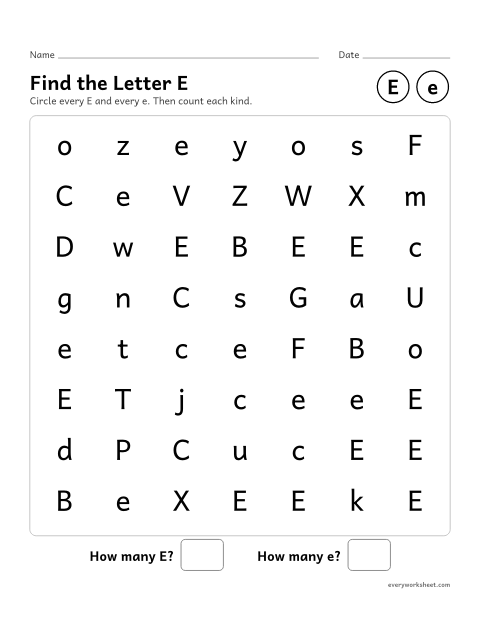
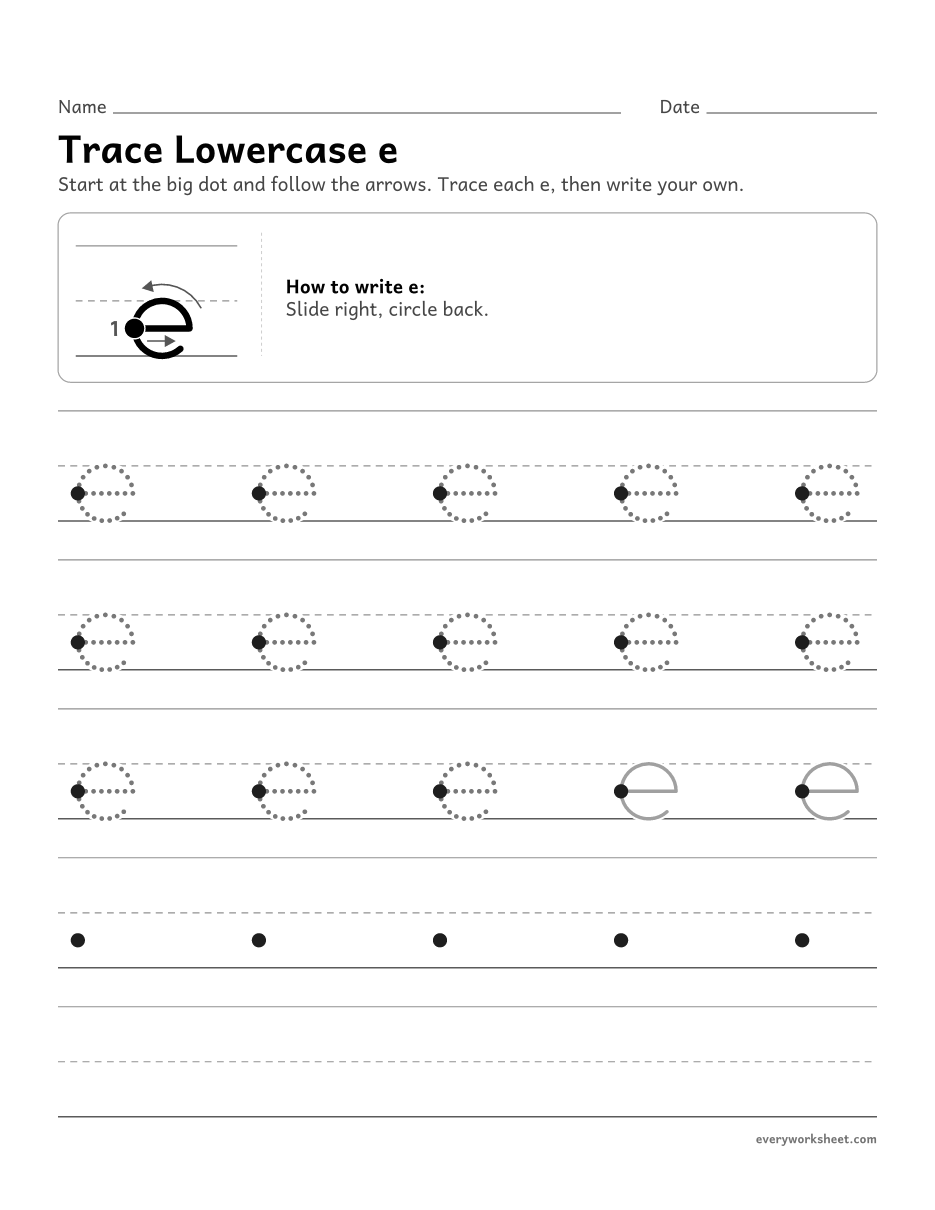
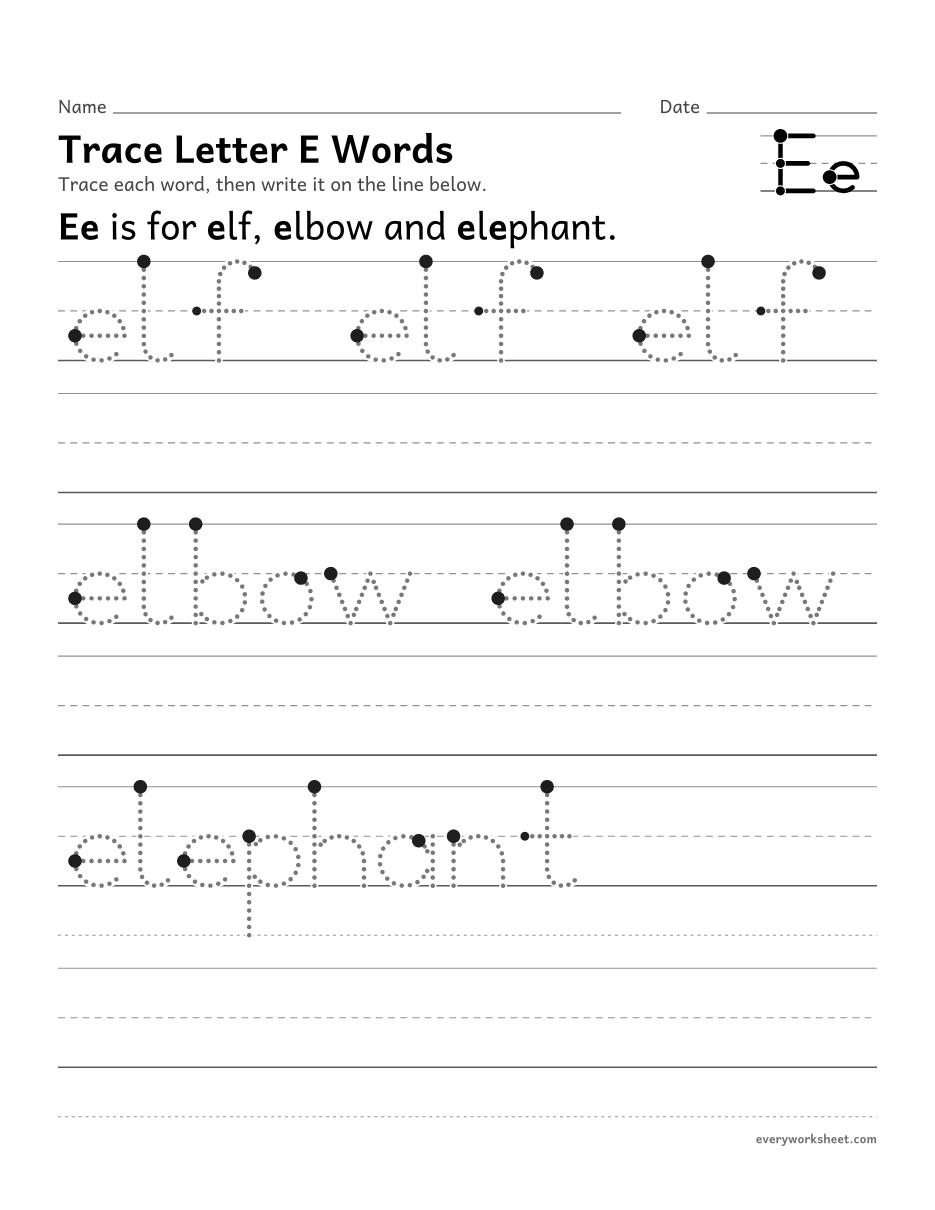
Trace uppercase E and lowercase e, trace the words elf, elbow and elephant, and circle every E and e in a letter hunt.
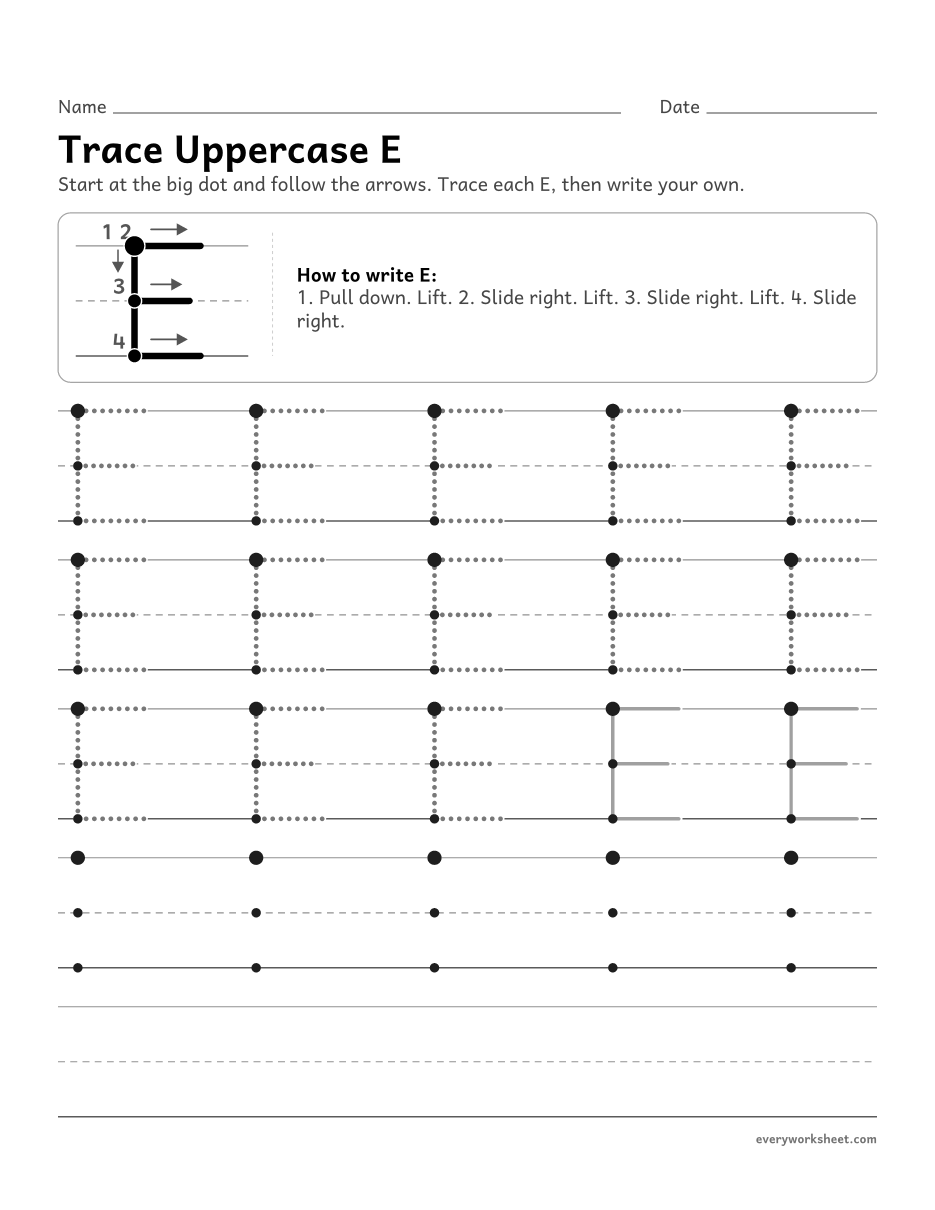
Down, then slide, slide, slide.
How to form uppercase EDownload the Letter E worksheets
 View larger
 View larger
 View larger
 View all 2 pages
Find the letter E
Recognizing uppercase E and lowercase e
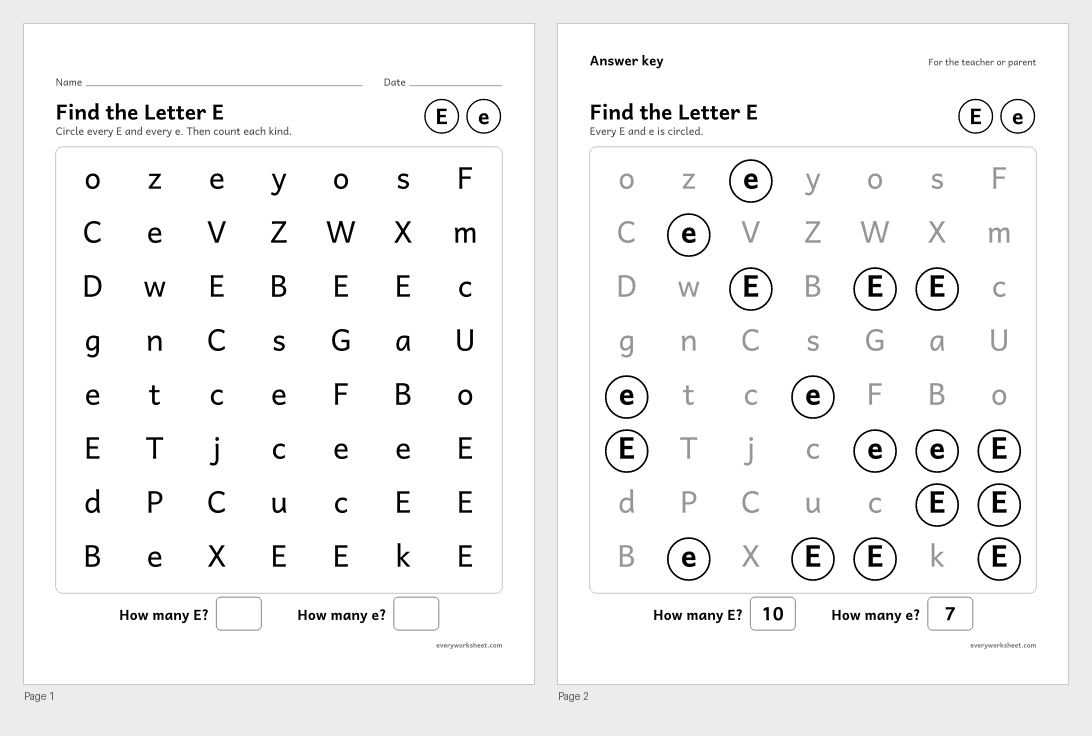
Answer key on page 2
2 pages54 KB
Print at 100% (actual size) for the cleanest tracing lines.
More letters
About these letter E worksheets
These letter E worksheets give kindergartners steady practice with a letter that looks simple but has a few traps. Your child traces uppercase E and lowercase e, traces the words elf, elbow and elephant, and finds every E and e in a letter hunt with an answer key. In all three words, E makes its short sound, /e/, as in elf.
Uppercase E is all straight lines, but children often add a fourth or fifth arm. Lowercase e is unusual: it is the only lowercase letter that starts with a straight line across, halfway between the dashed midline and the baseline. That starting point is worth teaching on purpose.
Standards
CCSS.ELA-LITERACY.L.K.1.APrint many upper- and lowercase letters.CCSS.ELA-LITERACY.RF.K.1.DRecognize and name all upper- and lowercase letters of the alphabet.
How to use them
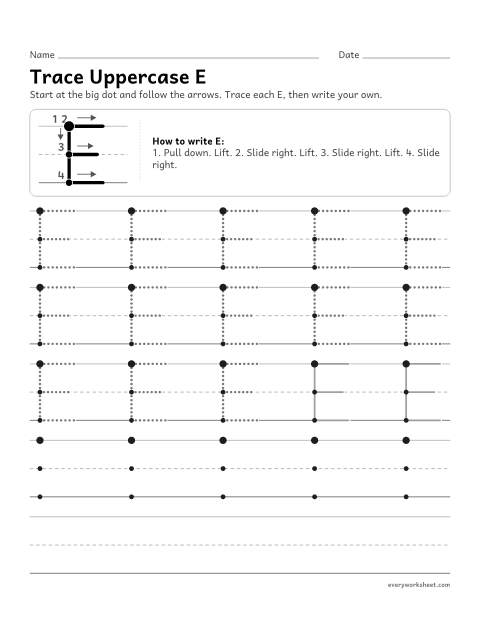
- On the uppercase page, have your child count the arms out loud after each letter: top, middle, bottom. Three arms, no more.
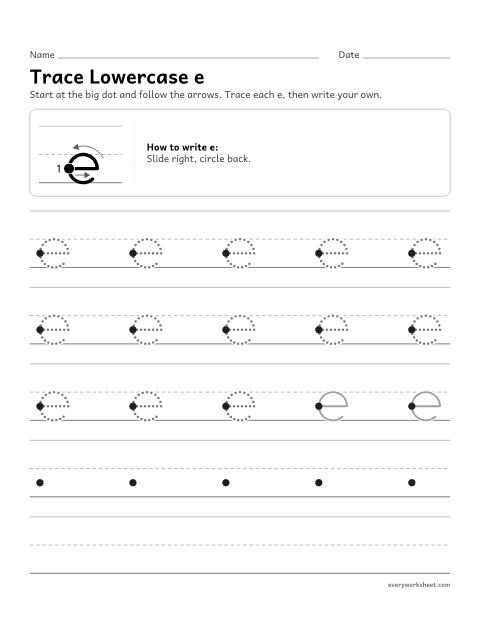
- Before the lowercase page, point to the start dot halfway between the dashed midline and the baseline. Your child slides right first, then circles back.
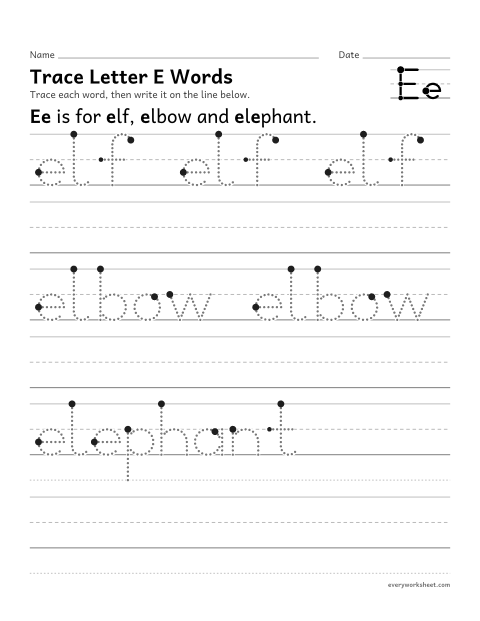
- Say elf, elbow and elephant with an exaggerated /e/ before tracing each word. Short e and short i sound close, so slow, clear modeling helps.
- Finish with the letter hunt and check it against the answer key.
Teaching tips for E
- Uppercase E: start at the top line and pull down straight to the baseline. Lift and slide right along the top line. Lift and slide right along the dashed midline; this arm is a little shorter. Lift and slide right along the baseline. Say it while writing: “1. Pull down. Lift. 2. Slide right. Lift. 3. Slide right. Lift. 4. Slide right.”
- Lowercase e: start halfway between the dashed midline and the baseline, on the left. Slide right, then circle back up over the top, around the left side, and stop before the curve closes at the bottom. Say it while writing: “Slide right, circle back.”
- Common mix-ups: an E with extra arms, arms that don’t touch the line, and a lowercase e that starts on the curve and ends with the line, which often looks like a backward 9.
- Quick activities: build E from four craft sticks and count them; draw an egg shape, then add a line across it to turn the egg into an e; play “eggs in a basket,” dropping a paper egg into a basket only when you say a word that starts with /e/.
Questions about letter E
My child keeps adding extra lines to E. How do I fix it?
Teach E as a counting letter: one line down, then three arms. Have your child say “1, 2, 3” as they slide each arm. Building the letter from four sticks also shows that the number of pieces never changes.
Why is short e hard for kindergartners to hear?
Short e and short i are close together in the mouth, so pen and pin can sound alike to a five-year-old. Drop your jaw a little on the e to exaggerate it, and practice with pairs like pen and pin, pet and pit, or ten and tin.
Why does lowercase e start in the middle?
Because it begins with its straight line, which runs across the middle of the circle. Starting there lets children write e in one smooth stroke. If your child starts on the curve instead, the e usually comes out lopsided or backward.