 View larger
Letter F Worksheets
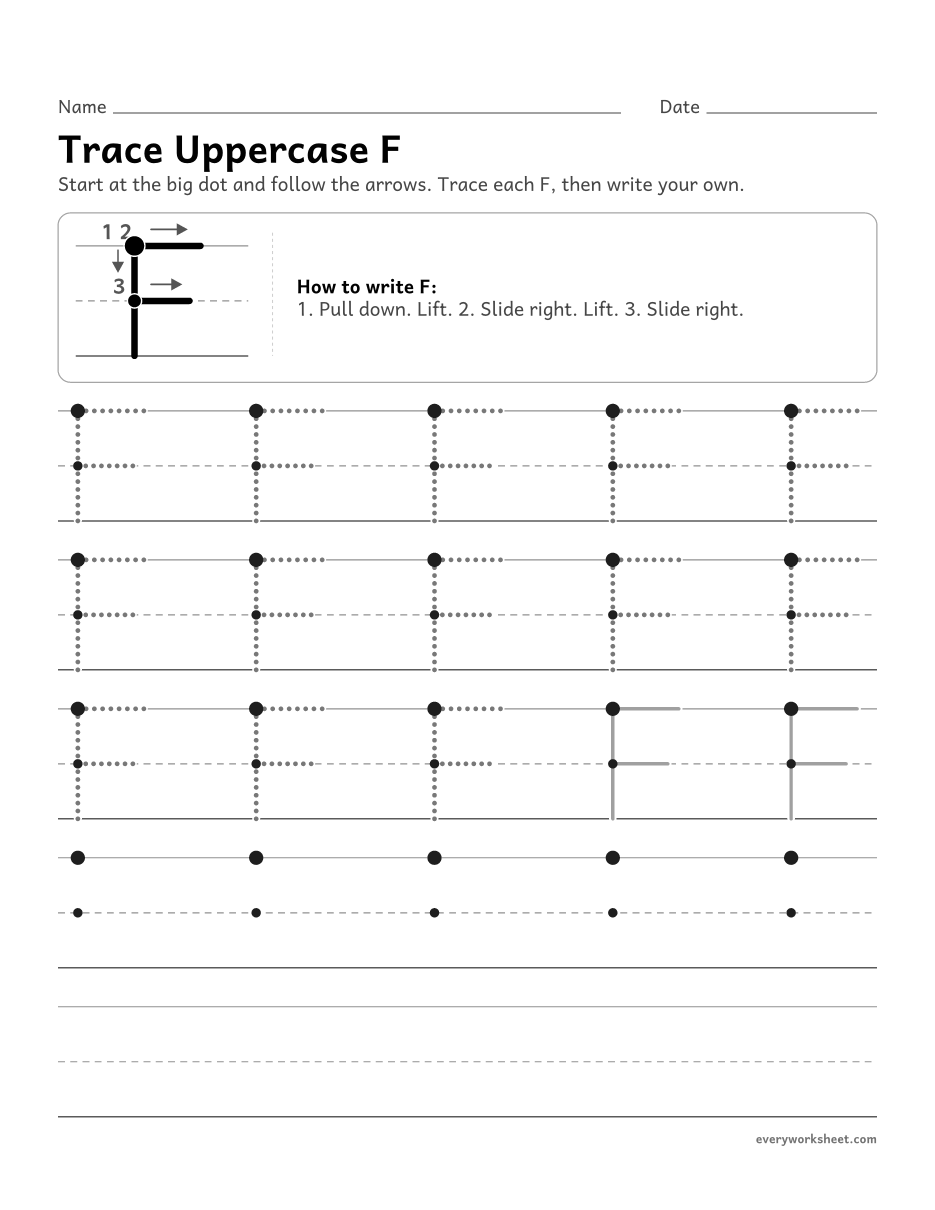
Trace uppercase F and lowercase f, trace the words fish, fan and fox, and circle every F and f in a letter hunt.
Down, then slide, slide.
How to form uppercase FDownload the Letter F worksheets
 View larger
 View larger
 View larger
 View all 2 pages
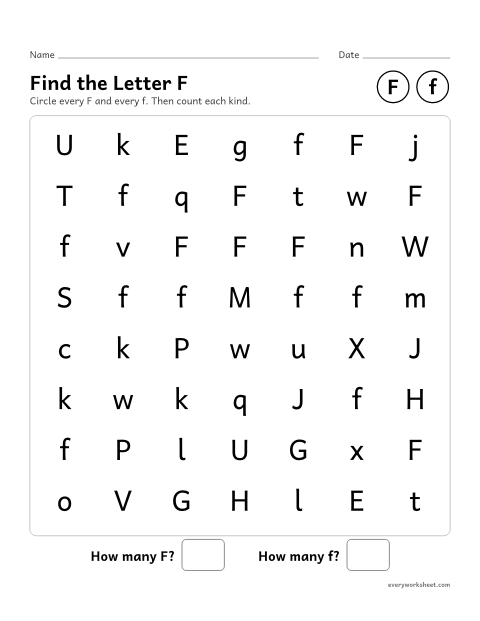
Find the letter F
Recognizing uppercase F and lowercase f
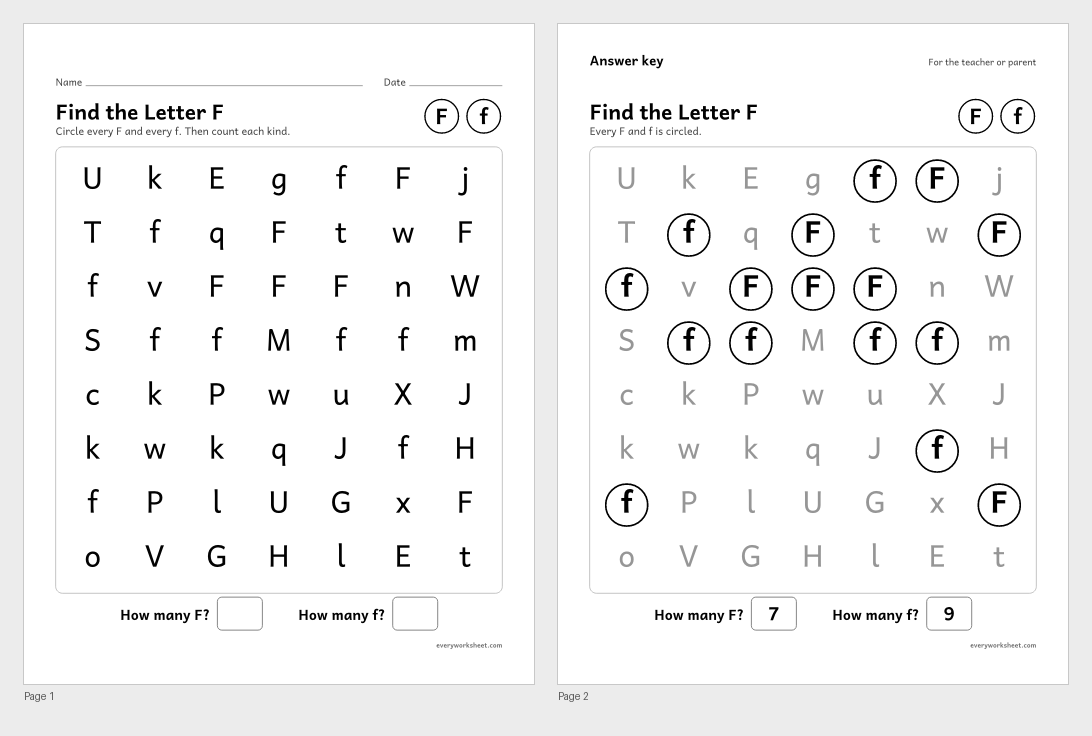
Answer key on page 2
2 pages55 KB
Print at 100% (actual size) for the cleanest tracing lines.
More letters
About these letter F worksheets
These letter F worksheets practice the shape and sound of F with four free PDFs: uppercase F tracing, lowercase f tracing, a words page with fish, fan and fox, and a letter hunt with an answer key. F says /f/, the sound of air pushed out between the top teeth and the bottom lip.
Uppercase F is an E without its bottom arm, so if your child knows E, F comes quickly. Lowercase f is trickier. It is a tall letter that starts with a small hook just below the top line, and the hook has to curve the right way. Its crossbar sits on the dashed midline.
Standards
CCSS.ELA-LITERACY.L.K.1.APrint many upper- and lowercase letters.CCSS.ELA-LITERACY.RF.K.1.DRecognize and name all upper- and lowercase letters of the alphabet.
How to use them
- If your child has already done E, put the two capitals side by side before the uppercase page and ask what F is missing.
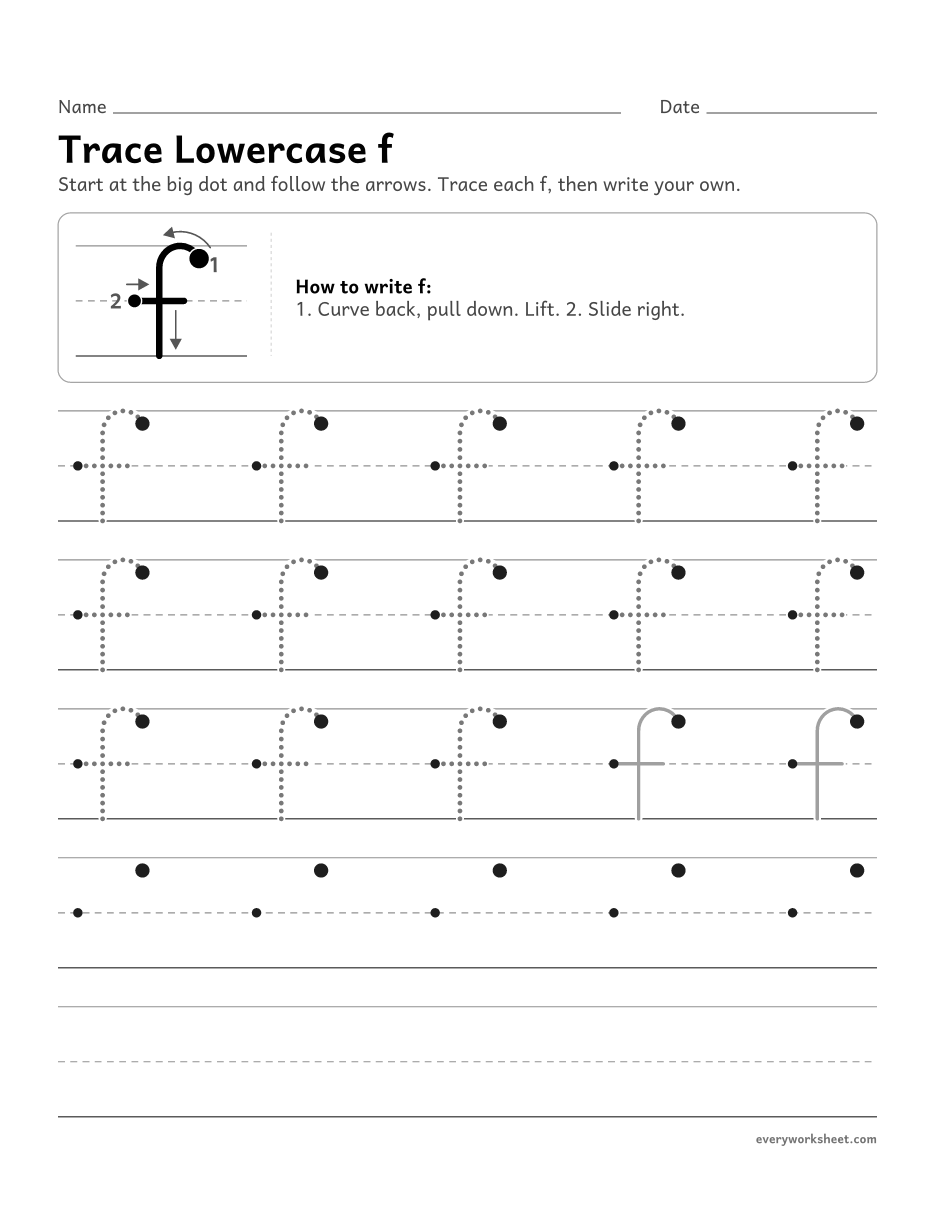
- On the lowercase page, have your child trace only the hook a few times, starting at the dot and curving up and over to the left, before tracing whole letters.
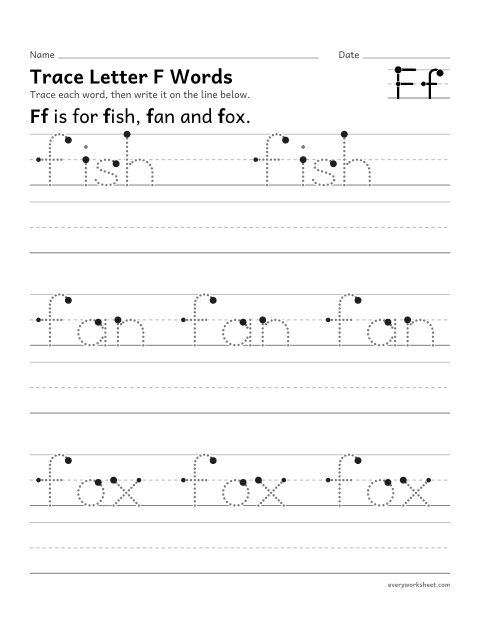
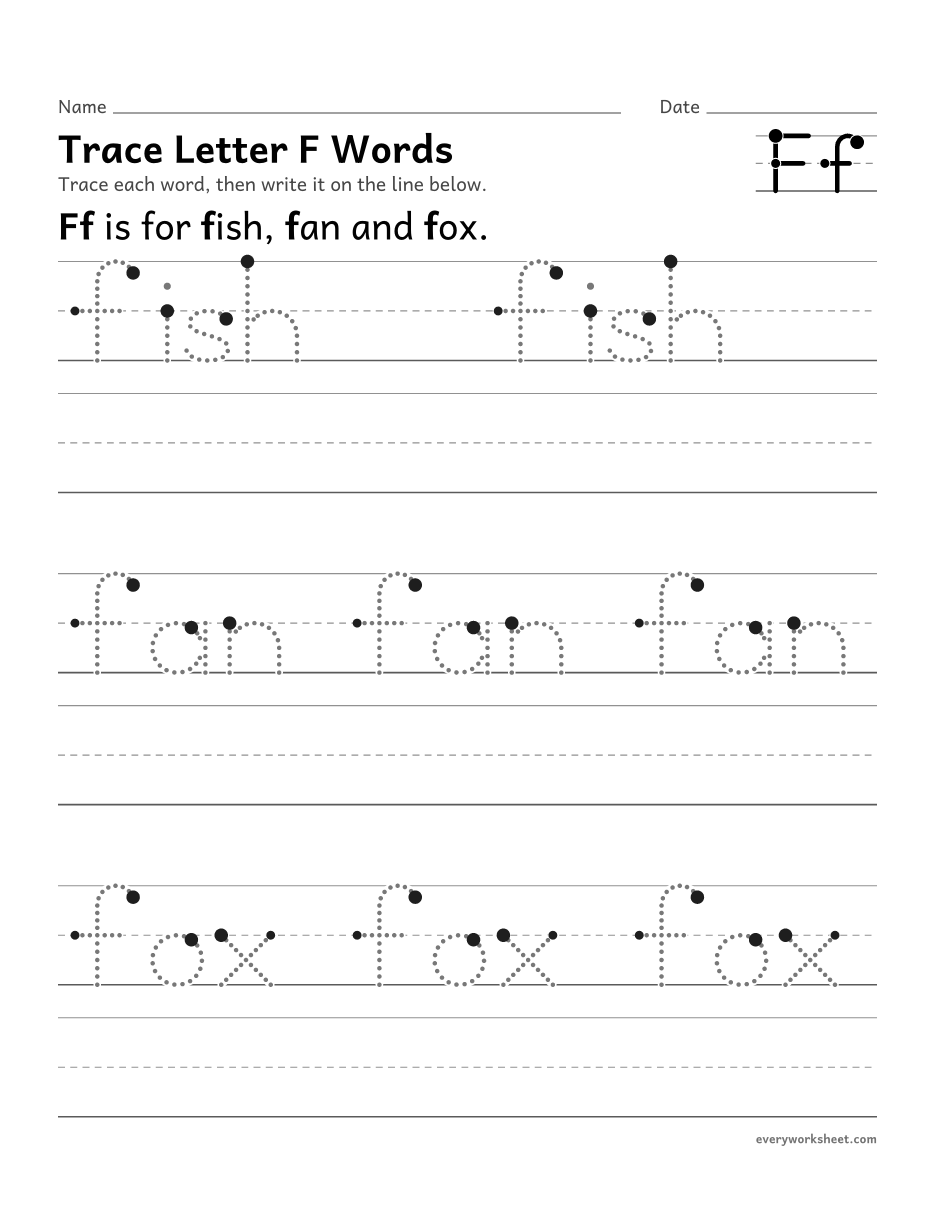
- Trace fish, fan and fox. Hold a hand in front of your mouth to feel the steady stream of air in /f/. It keeps going as long as you have breath, unlike /b/ or /p/.
- Finish with the letter hunt, then check the count on the answer key.
Teaching tips for F
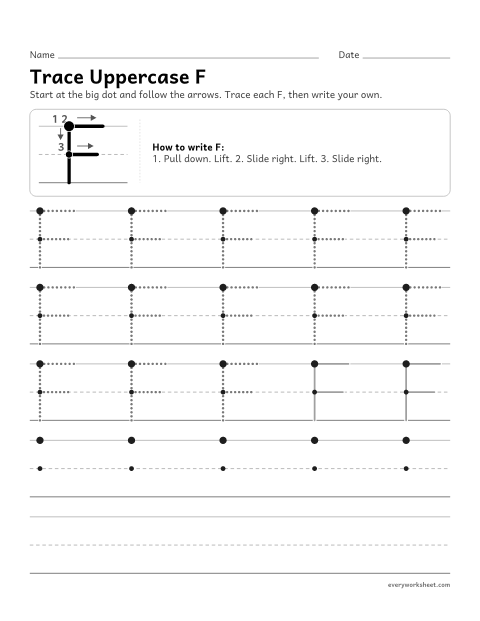
- Uppercase F: start at the top line and pull down straight to the baseline. Lift and slide right along the top line. Lift and slide right along the dashed midline. Say it while writing: “1. Pull down. Lift. 2. Slide right. Lift. 3. Slide right.”
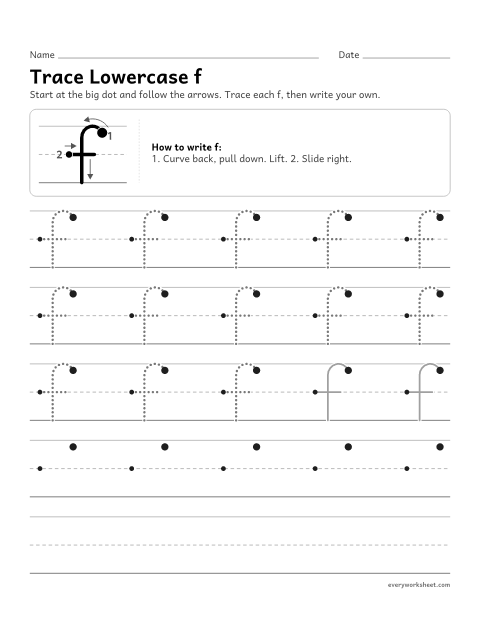
- Lowercase f: start just below the top line, a little to the right of where the line will go. Curve back, up and over to the left, then pull down straight to the baseline. Lift and slide right across the dashed midline. Say it while writing: “1. Curve back, pull down. Lift. 2. Slide right.”
- Candy cane cue: lowercase f looks like a candy cane with a bar across it, and the hook hangs to the right.
- Common mix-ups: the hook curving the wrong way, a lowercase f that starts at the midline (too short), and an F with a bottom arm added, which makes it an E.
- Quick activities: make F from three craft sticks, one long and two short; blow a feather or a cotton ball across the table and say /fff/ the whole way.
Questions about letter F
How is lowercase f different from t?
Both are tall letters with a cross on the dashed midline. The difference is where the hook goes: f has a hook at the top that curves over to the left, and t starts with a straight line from the top line and hooks forward at the bottom. If your child’s f has no hook, ask them to find the start dot again.
Why do some children write f backward?
The hook is the only part of f that shows its direction, and it is small. Practicing the hook on its own, starting at the dot each time, builds the habit. Reversals like this are common in kindergarten and usually fade with practice.