 View larger
Letter Y Worksheets
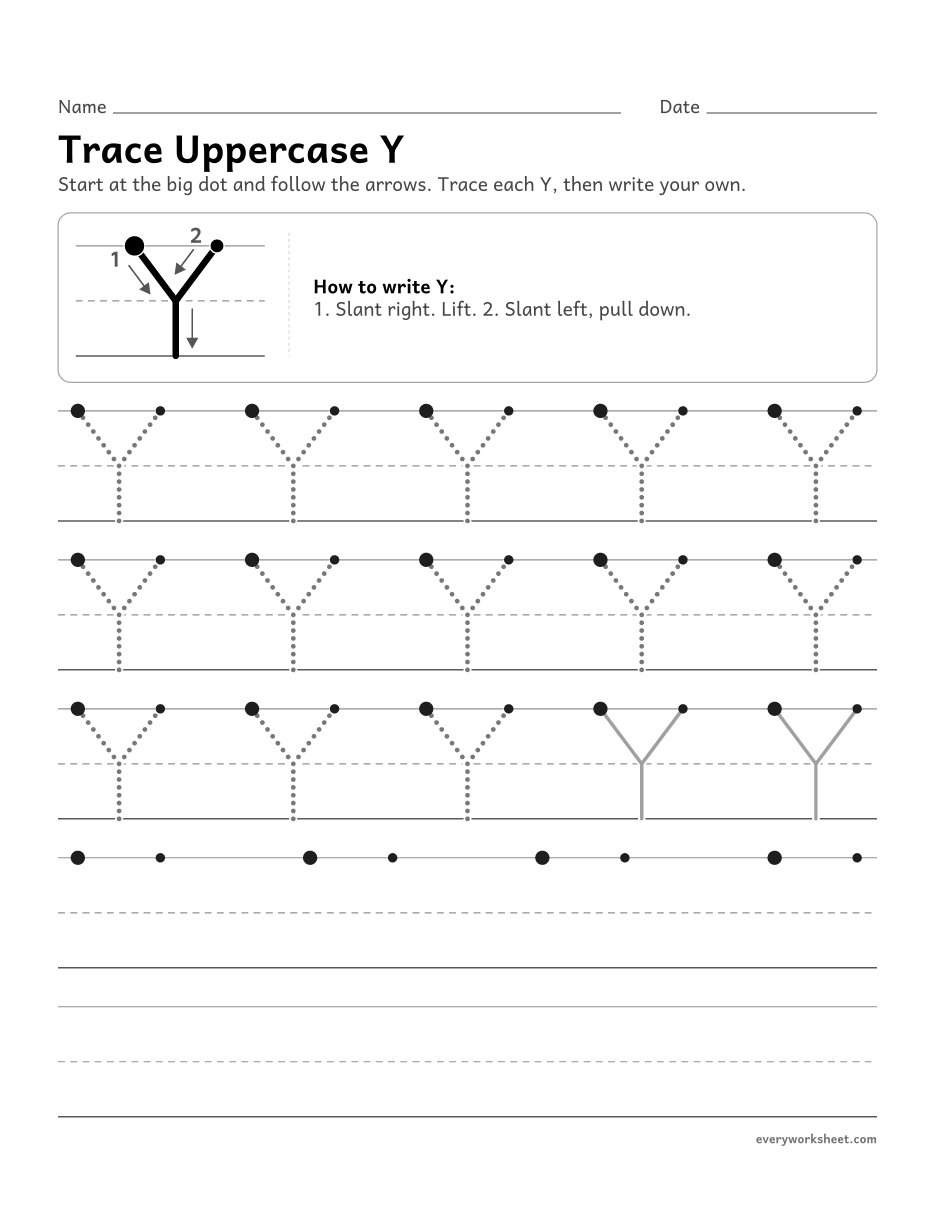
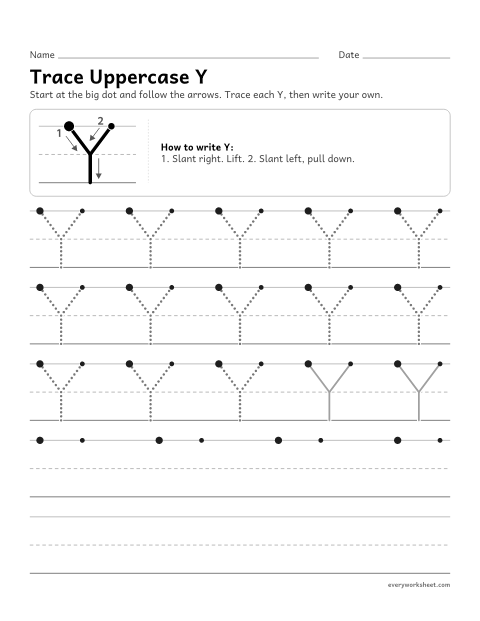
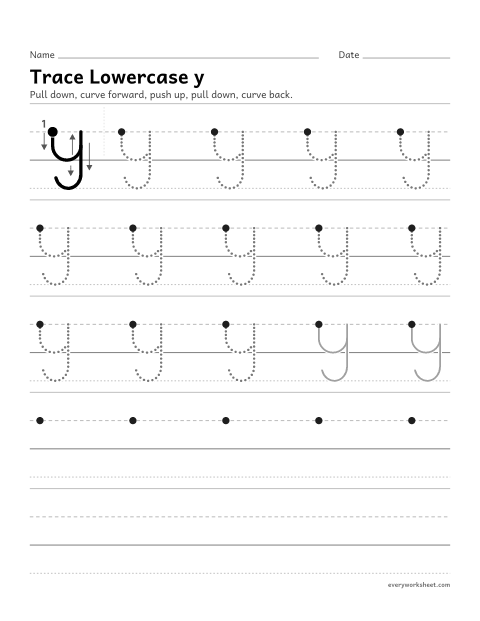
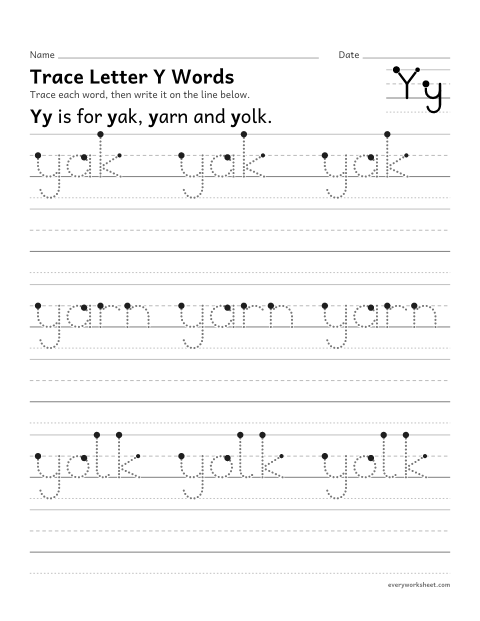
Trace uppercase Y and lowercase y, trace the words yak, yarn and yolk, and circle every Y and y in a letter hunt.
YSlant, slant, pull down.
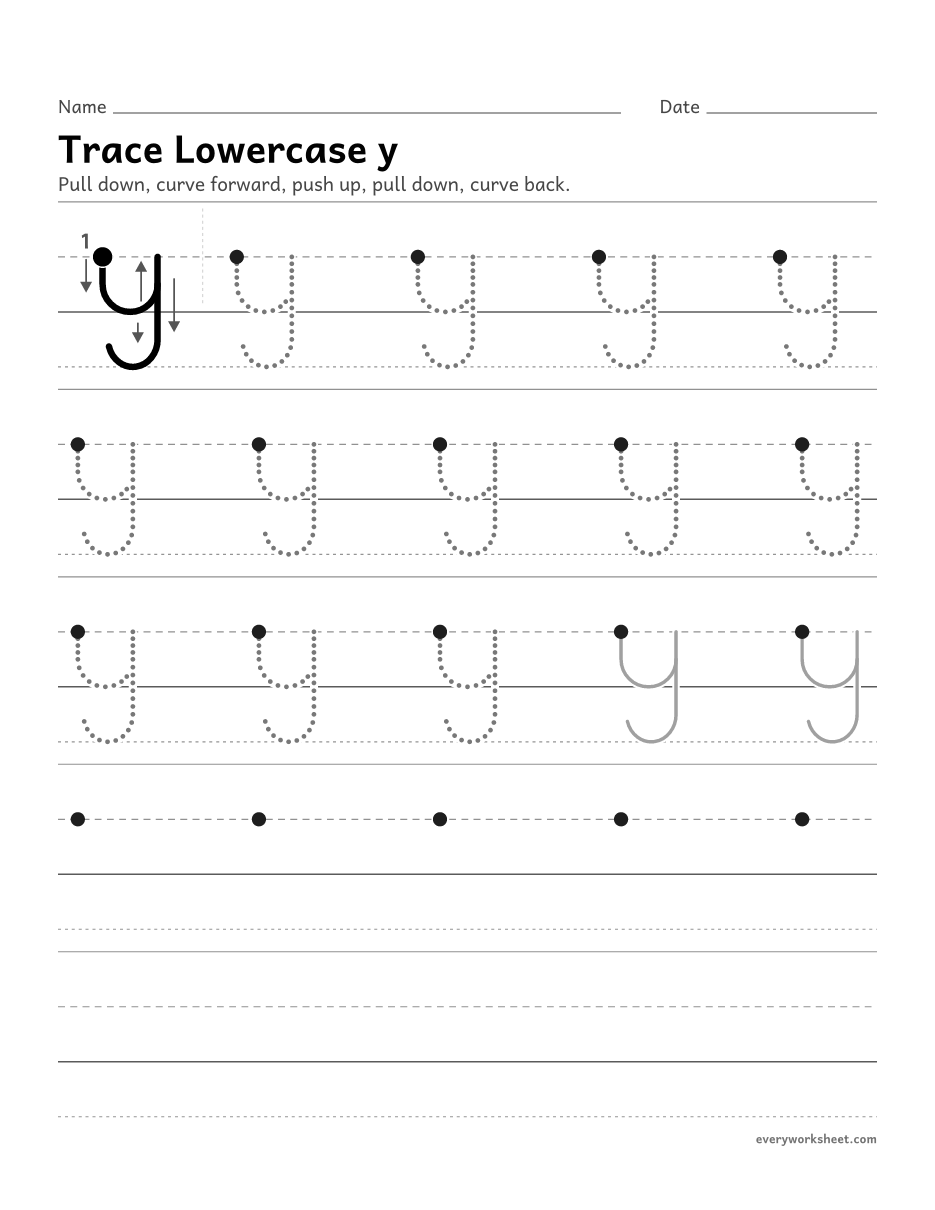
yDown, curve, up, down, curve back.
How to form Y and yDownload the Letter Y worksheets
 View larger
 View larger
 View larger
 View all 2 pages
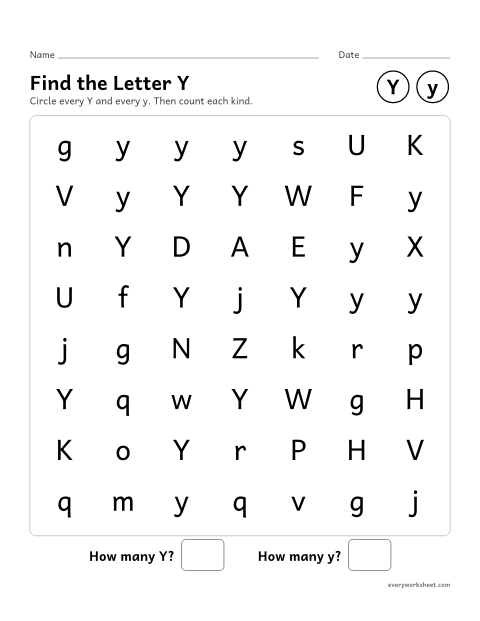
Find the letter Y
Recognizing uppercase Y and lowercase y
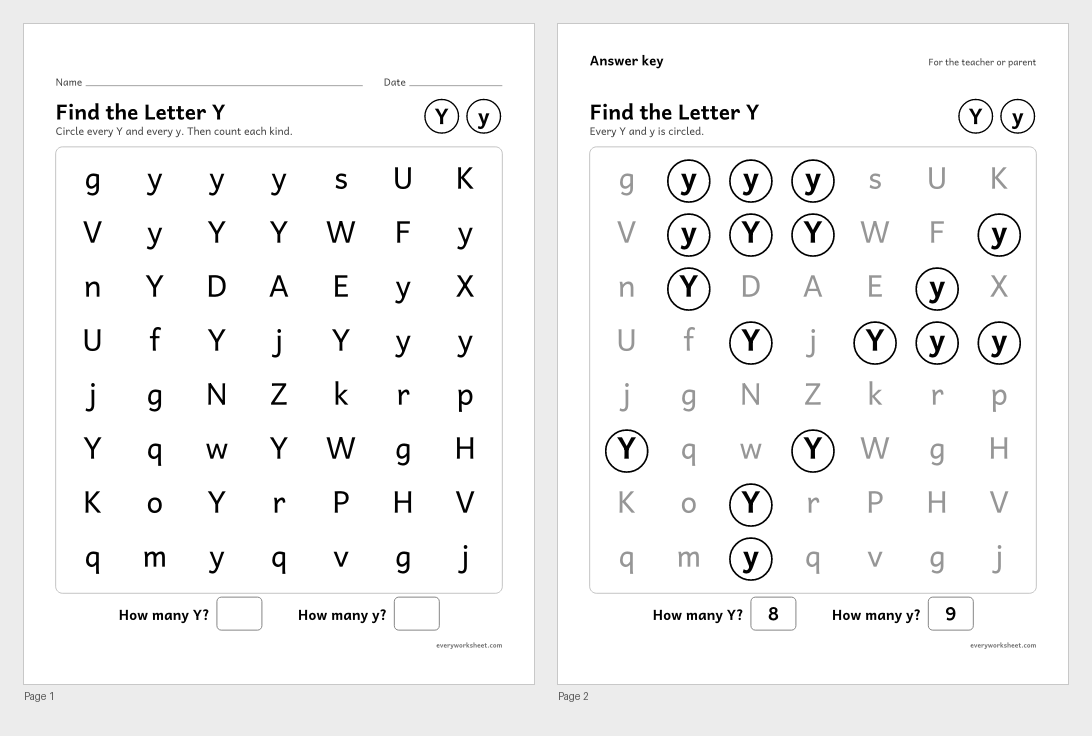
Answer key on page 2
2 pages55 KB
Print at 100% (actual size) for the cleanest tracing lines.
More letters
About these letter Y worksheets
These letter Y worksheets cover uppercase Y, lowercase y, the words yak, yarn and yolk, and a letter hunt with an answer key. At the start of a word, Y makes the /y/ sound, as in yes.
Uppercase and lowercase y are built differently: capital Y is three straight lines, lowercase y is a u with a long tail. The capital is two short slants that meet at the middle, with a straight line down to the baseline. The lowercase is a short slant and a long slant. The long one runs through the baseline into the space below it and curves back to the left at the bottom, like the tails of g and j. That tail is what sets y apart from v.
Standards
CCSS.ELA-LITERACY.L.K.1.APrint many upper- and lowercase letters.CCSS.ELA-LITERACY.RF.K.1.DRecognize and name all upper- and lowercase letters of the alphabet.
How to use them
- On the uppercase page, have your child make the two short slants first, meeting at the middle, then pull straight down.
- Before the lowercase page, point to the space below the baseline and show where the long slant curves back to the left.
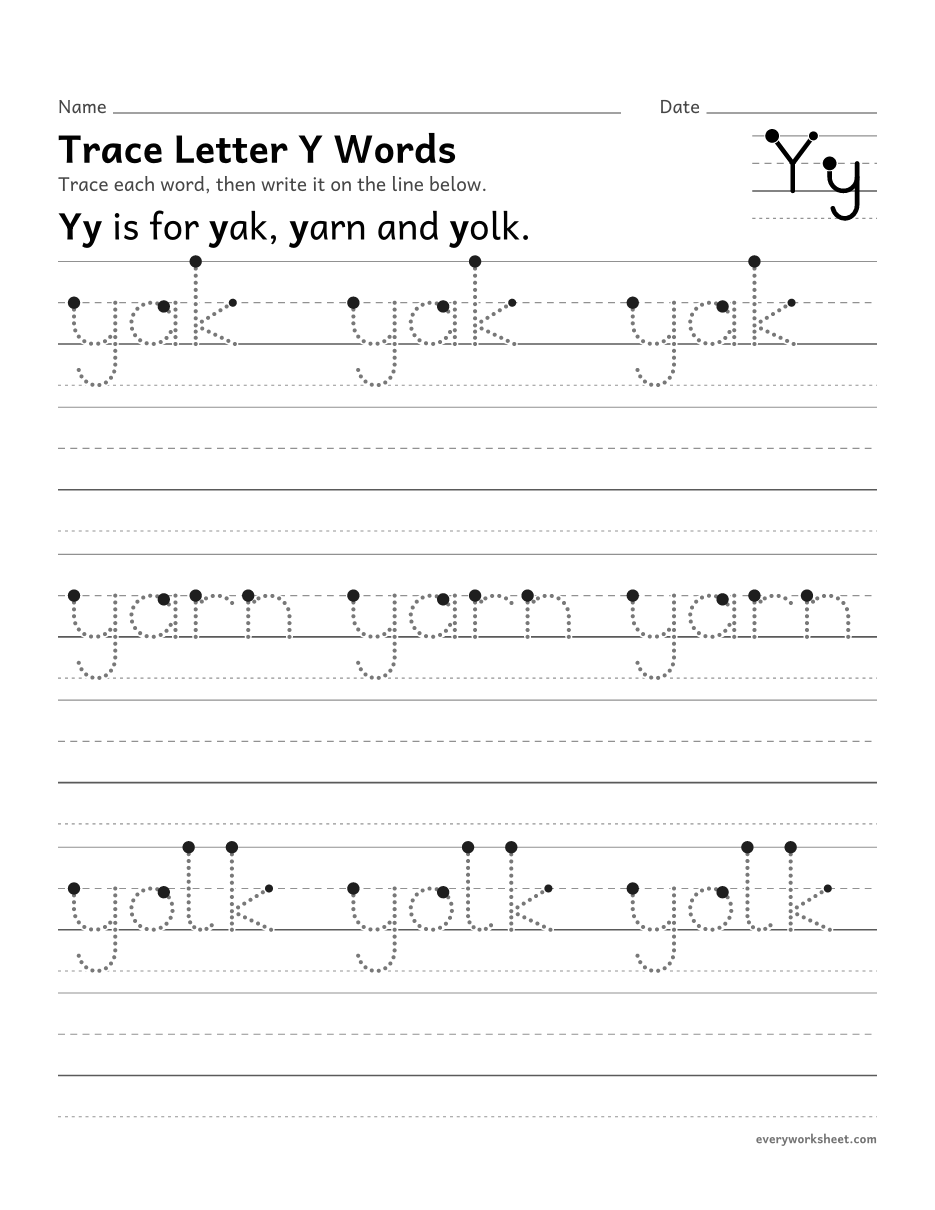
- Trace yak, yarn and yolk. Say each word with a big /y/, and see if your child can think of another /y/ word, like yellow or yum.
- Finish with the letter hunt and check it with the answer key.
Teaching tips for Y
- Uppercase Y: start at the top line on the left and slant down to the right to the dashed midline. Lift, start at the top line on the right, slant down to the left to meet the first line, and pull down straight to the baseline. Say it while writing: “1. Slant right. Lift. 2. Slant left, pull down.”
- Lowercase y: start at the dashed midline on the left, pull down, and curve forward along the baseline like a u. Without lifting, push up to the midline, then pull straight down below the baseline and curve back to the left on the line below, like the tail of g. Say it while writing: “Pull down, curve forward, push up, pull down, curve back.”
- Common mix-ups: a y without its tail (that is u), a lowercase y that sits on the baseline, and a capital Y whose arms meet too high or too low.
- Quick activities: lay three pieces of yarn on the table to build a capital Y, then rearrange them into a lowercase y; stretch your arms up in a Y and say /y/.
Questions about letter Y
Why does lowercase y go below the line when capital Y doesn’t?
Lowercase letters with tails, including y, use the space under the baseline. Capital letters all sit on the baseline.
Is y a vowel?
Sometimes. At the start of a word, as in yes and yak, y is a consonant that says /y/. Later, children learn that y can also act as a vowel in words like my and happy.