 View larger
Letter D Worksheets
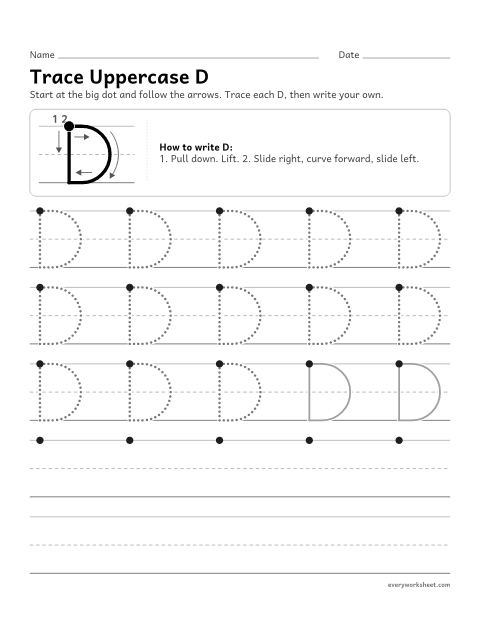
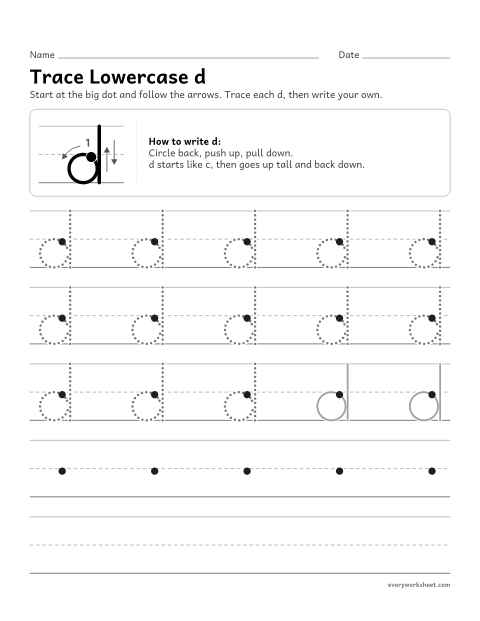
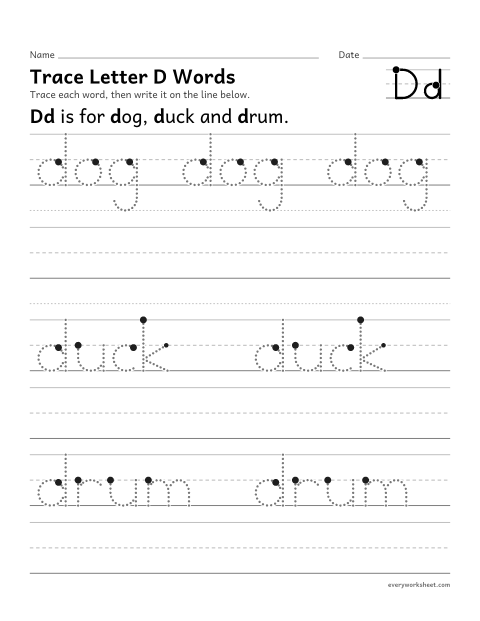
Trace uppercase D and lowercase d, trace the words dog, duck and drum, and circle every D and d in a letter hunt.
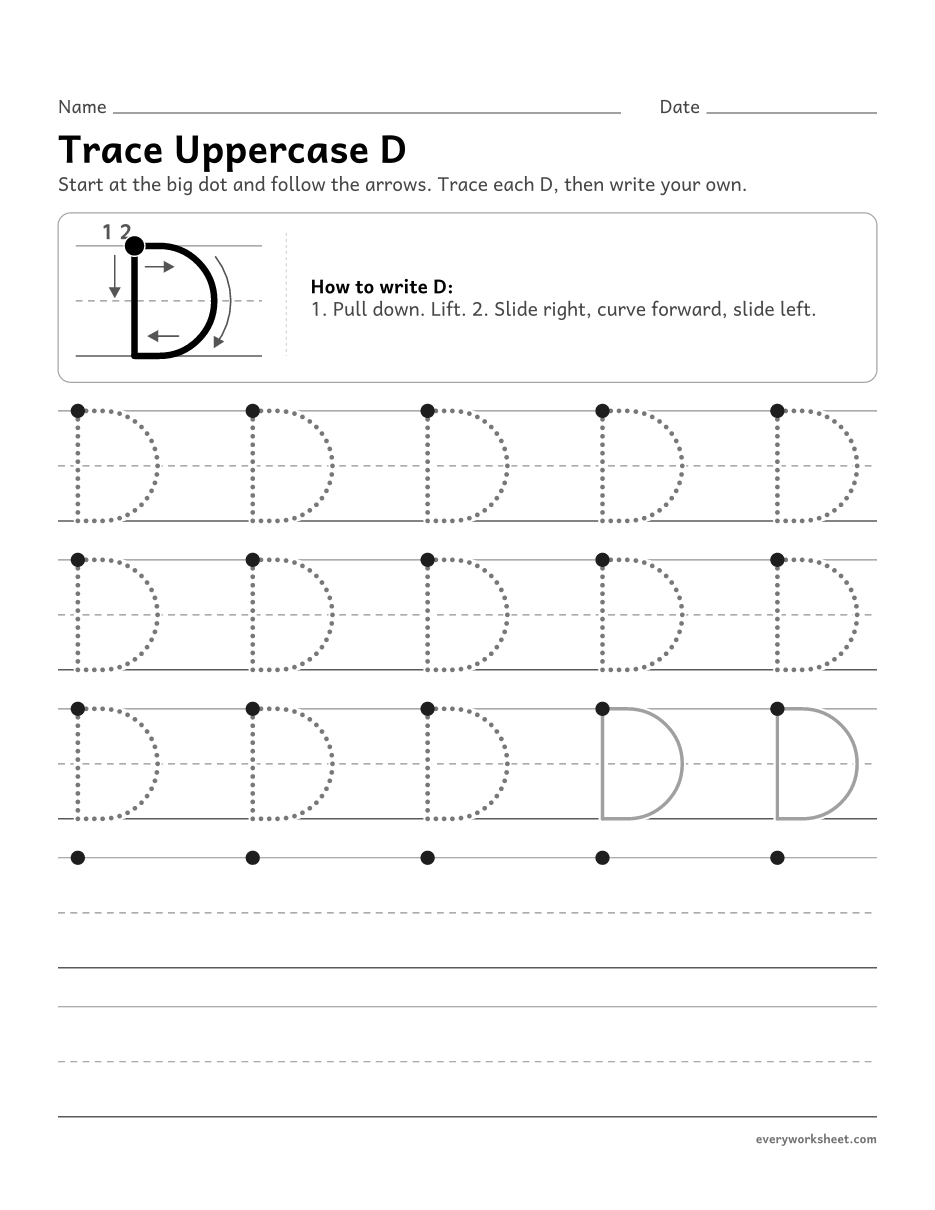
Down, back up, one big curve.
How to form uppercase DDownload the Letter D worksheets
 View larger
 View larger
 View larger
 View all 2 pages
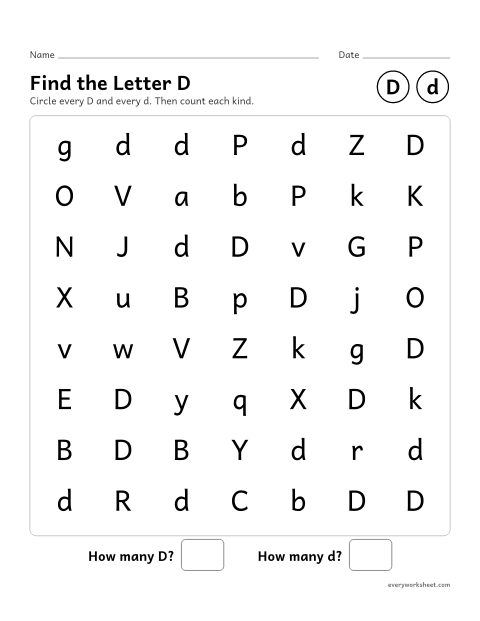
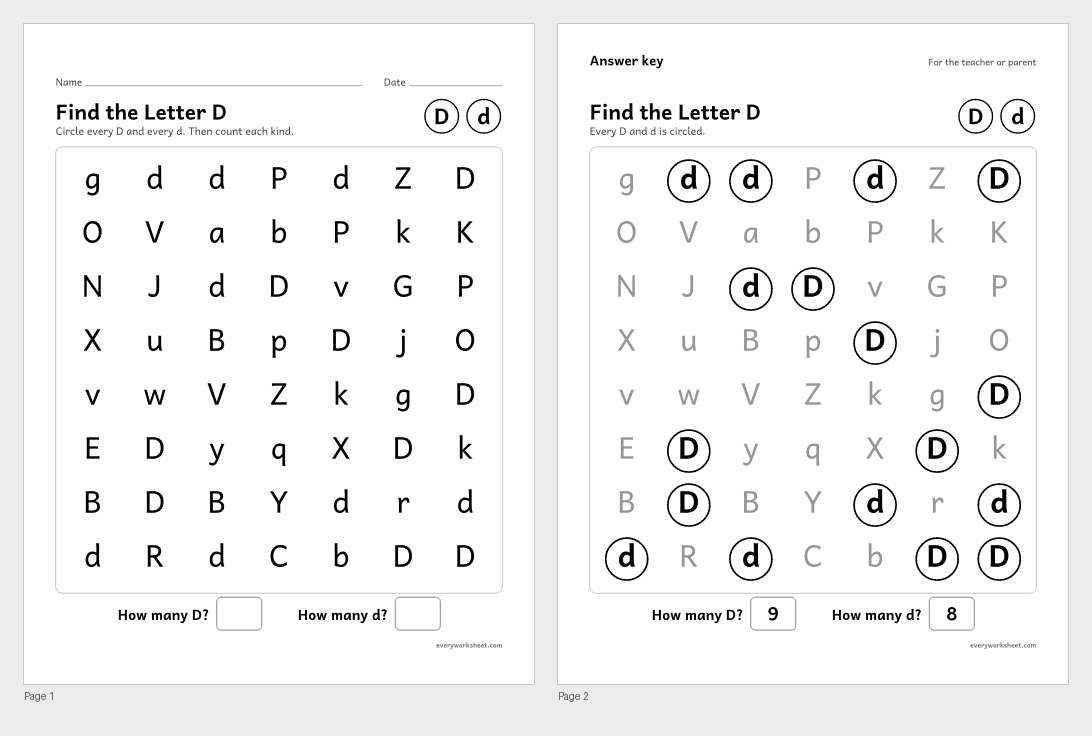
Find the letter D
Recognizing uppercase D and lowercase d
Answer key on page 2
2 pages55 KB
Print at 100% (actual size) for the cleanest tracing lines.
More letters
About these letter D worksheets
These letter D worksheets help your child form D, hear it and find it. There are tracing pages for uppercase D and lowercase d, a words page with dog, duck and drum, and a letter hunt with an answer key. D makes the /d/ sound, a quick tap of the tongue just behind the top teeth, with the voice on.
D has a twist: uppercase D and lowercase d face opposite directions. The capital’s curve is on the right; the lowercase d has its circle on the left and its tall line on the right. Children who learn d as “c first, then a tall line” have a much easier time keeping it apart from b.
Standards
CCSS.ELA-LITERACY.L.K.1.APrint many upper- and lowercase letters.CCSS.ELA-LITERACY.RF.K.1.DRecognize and name all upper- and lowercase letters of the alphabet.
How to use them
- Trace the uppercase page first and talk about the shape: a straight back and a big round front.
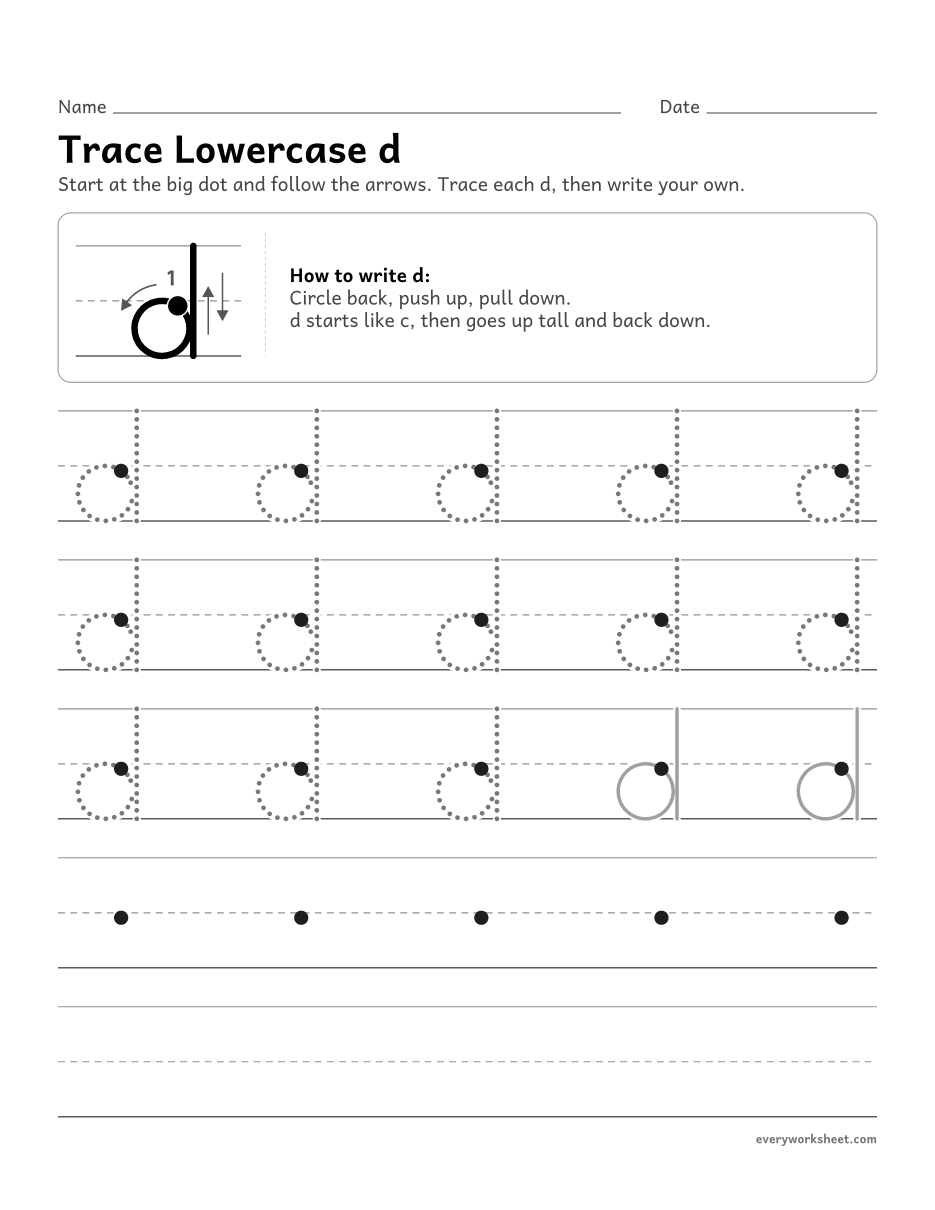
- Before the lowercase page, write a c and ask your child to turn it into a d by adding a tall line on the right, from the top line down to the baseline. Then start the tracing rows.
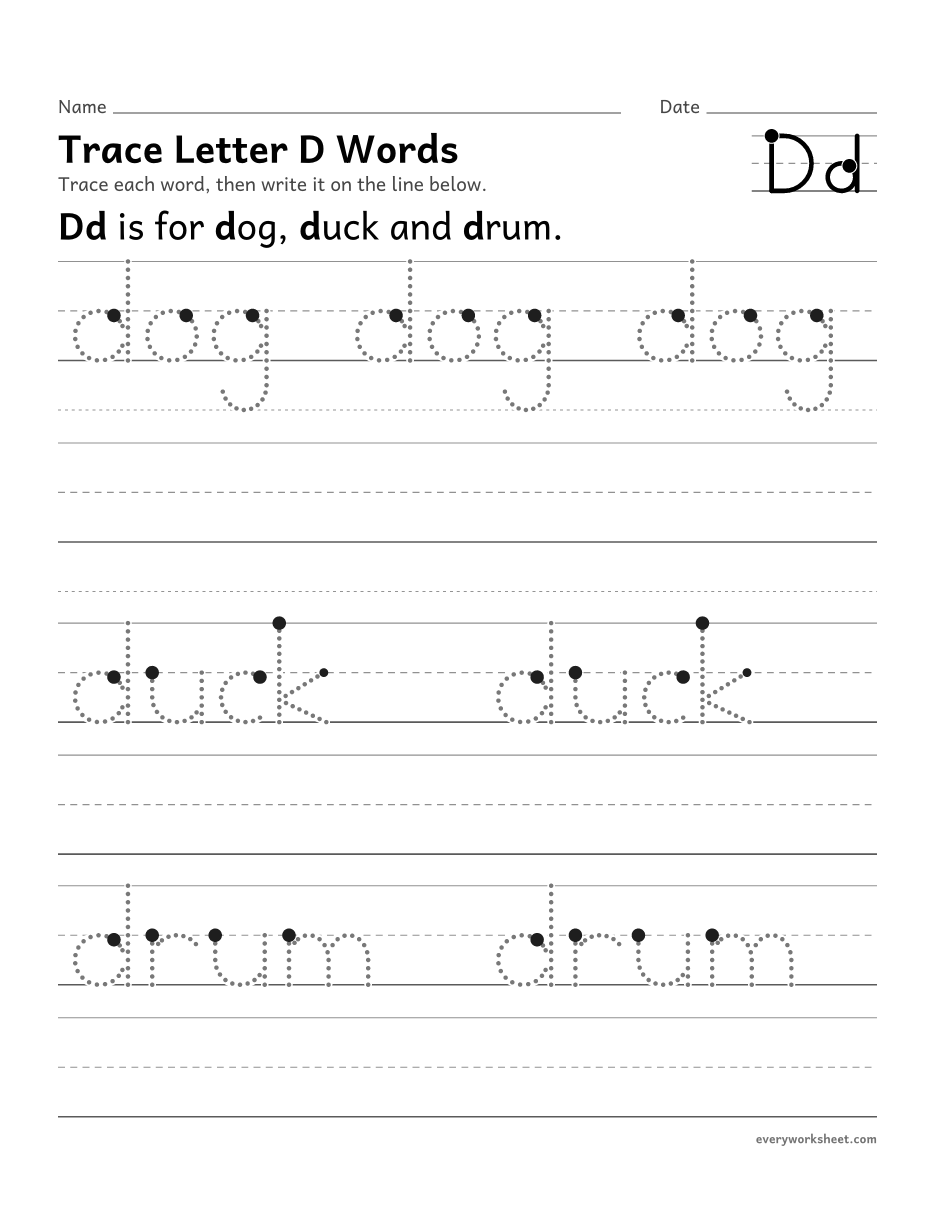
- On the words page, have your child tap a pretend drum as they say the /d/ at the start of each word.
- Do the letter hunt last. Lowercase d and b are easy to confuse here, so ask your child to say “c first” for each d they circle.
Teaching tips for D
- Uppercase D: start at the top line and pull down straight to the baseline. Lift, go back to the top, slide right a little, curve forward all the way down, and slide left to meet the line at the baseline. Say it while writing: “1. Pull down. Lift. 2. Slide right, curve forward, slide left.”
- Lowercase d: start just below the dashed midline and circle back all the way around, like a closed c. Without lifting, push straight up to the top line, then pull down straight along the right side of the circle to the baseline. Say it while writing: “Circle back, push up, pull down.” d starts like c, then goes up tall and back down.
- The “c comes before d” cue works twice: c comes before d in the alphabet, and every lowercase d begins with a c.
- Common mix-ups: writing b for d, a line that starts at the midline instead of the top line (that makes an a), and a capital D with its curve on the left.
- Quick activities: roll a playdough ball and a snake and put them together as a d, with the snake on the right; march around the room tapping a pretend drum and saying a /d/ word on every step.
Questions about letter D
Why do capital D and lowercase d face different ways?
They come from different shapes, so they don’t follow one rule. Teach them separately: the capital is a line and a big curve, the lowercase is a c with a tall line. Saying the steps out loud is more reliable than trying to remember which way the letter faces.
What is the best way to stop b and d reversals?
Teach a consistent starting point. Lowercase d starts with a circle, lowercase b starts with a tall line. If your child pauses before writing d, prompt “What do we make first?” rather than correcting the finished letter.
How is /d/ different from /t/?
Your mouth does the same thing for both. The difference is the voice: put a hand on your throat and you feel a buzz for /d/ but not for /t/. Children who mix up d and t in spelling often need to hear the difference before they can write it.