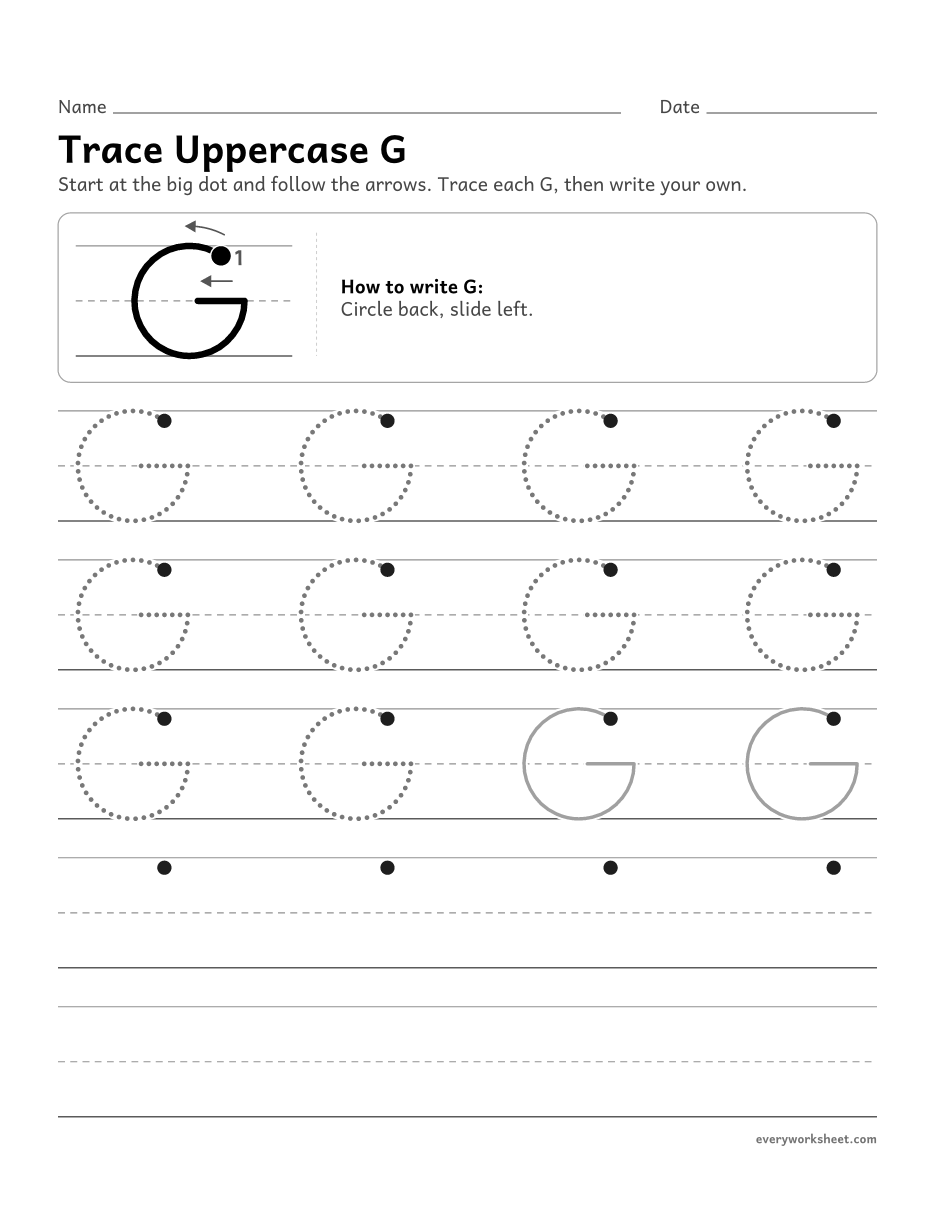
 View larger
Letter G Worksheets
Trace uppercase G and lowercase g, trace the words goat, gum and gift, and circle every G and g in a letter hunt.
Circle back, add a shelf.
How to form uppercase GDownload the Letter G worksheets
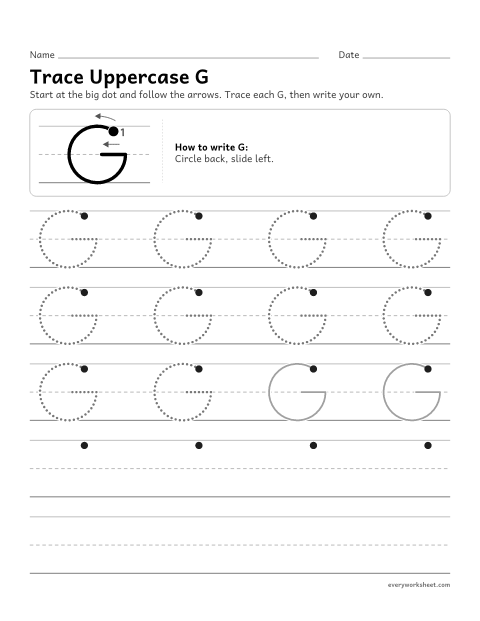 View larger
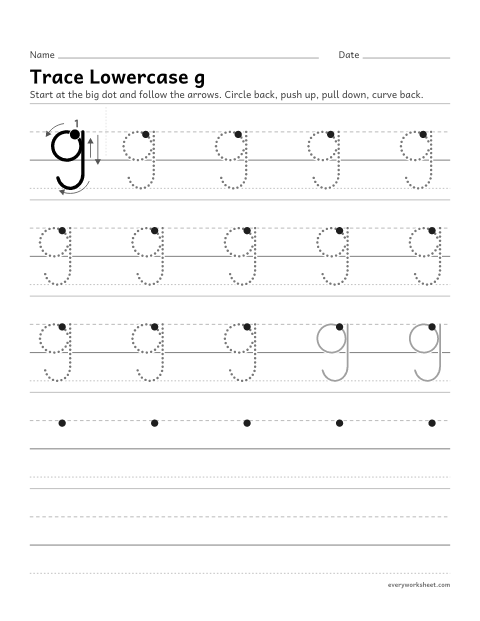 View larger
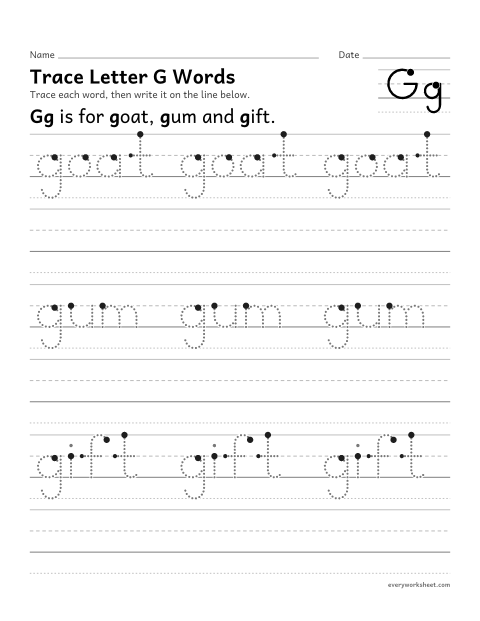 View larger
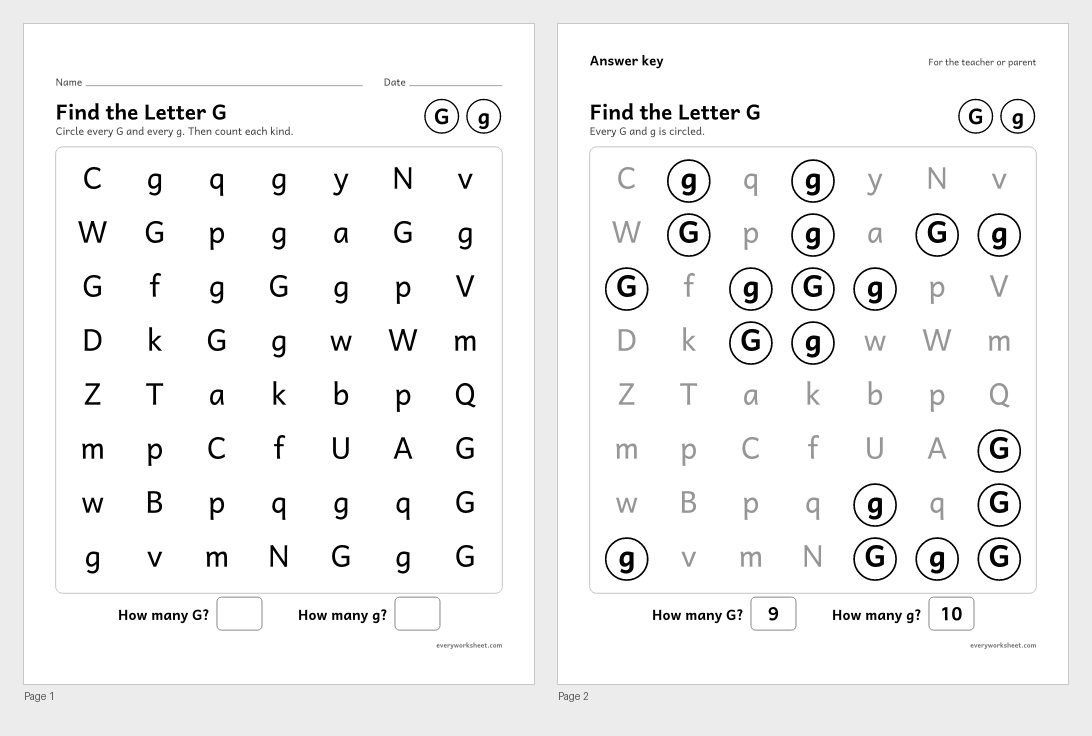
 View all 2 pages
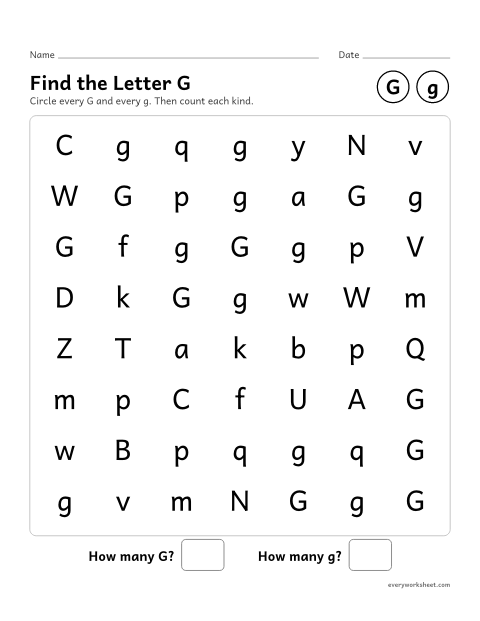
Find the letter G
Recognizing uppercase G and lowercase g
Answer key on page 2
2 pages55 KB
Print at 100% (actual size) for the cleanest tracing lines.
More letters
About these letter G worksheets
These letter G worksheets cover uppercase G, lowercase g, the words goat, gum and gift, and a letter hunt with an answer key. In these words G makes its hard sound, /g/, made at the back of the throat. It is the sound at the start of go.
Both forms of G build on the circle-back stroke from C. Capital G is a C that keeps going a little farther, then adds a short shelf at the middle. Lowercase g is a circle plus a line that drops below the baseline and hooks back to the left, so it is a good time to show your child the space under the baseline that g, j, p, q and y use.
Standards
CCSS.ELA-LITERACY.L.K.1.APrint many upper- and lowercase letters.CCSS.ELA-LITERACY.RF.K.1.DRecognize and name all upper- and lowercase letters of the alphabet.
How to use them
- Warm up with a few capital C’s, then trace the uppercase G rows. Each G is a C that comes back up to the middle and adds its shelf.
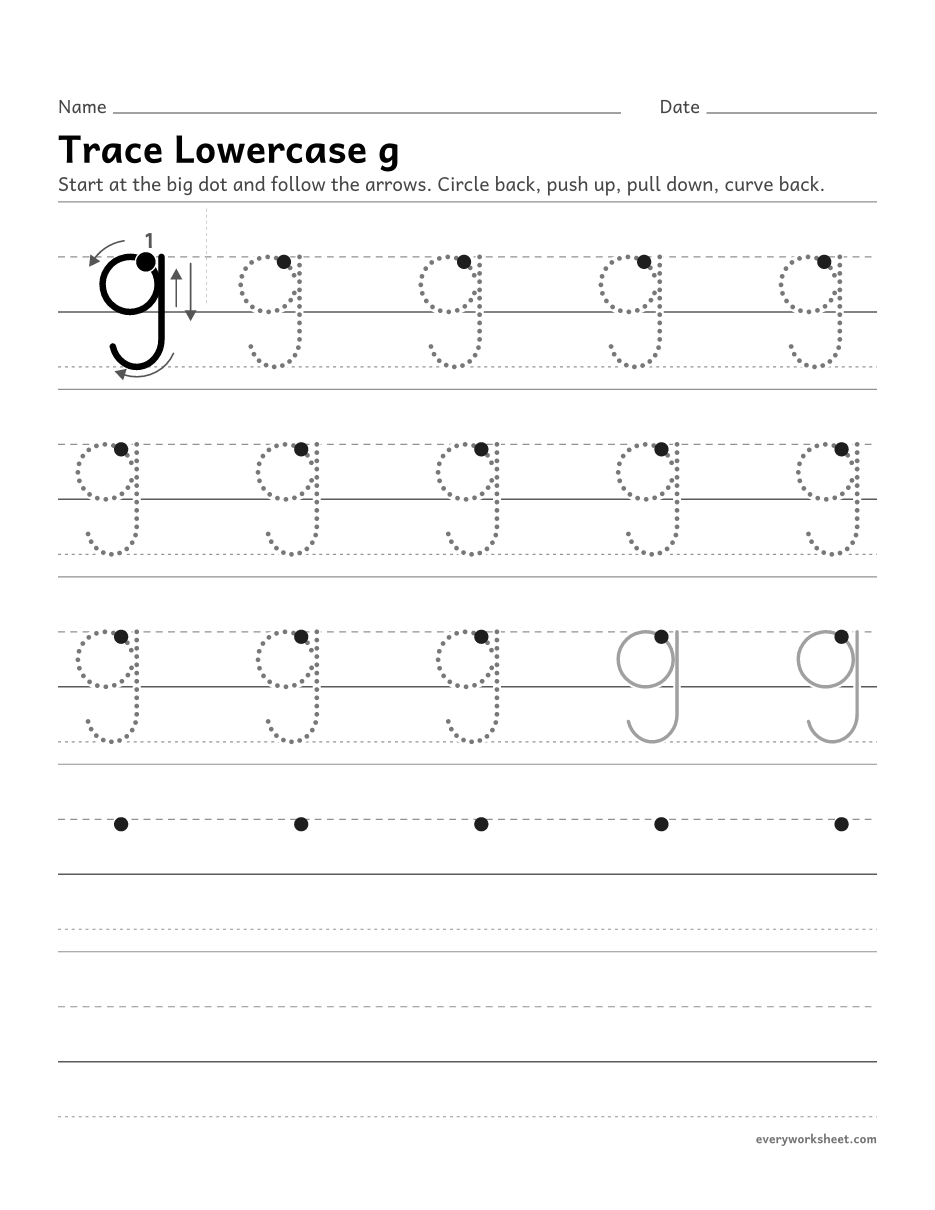
- Before the lowercase page, run a finger along the line below the baseline and explain that some letters have tails that hang down into this space.
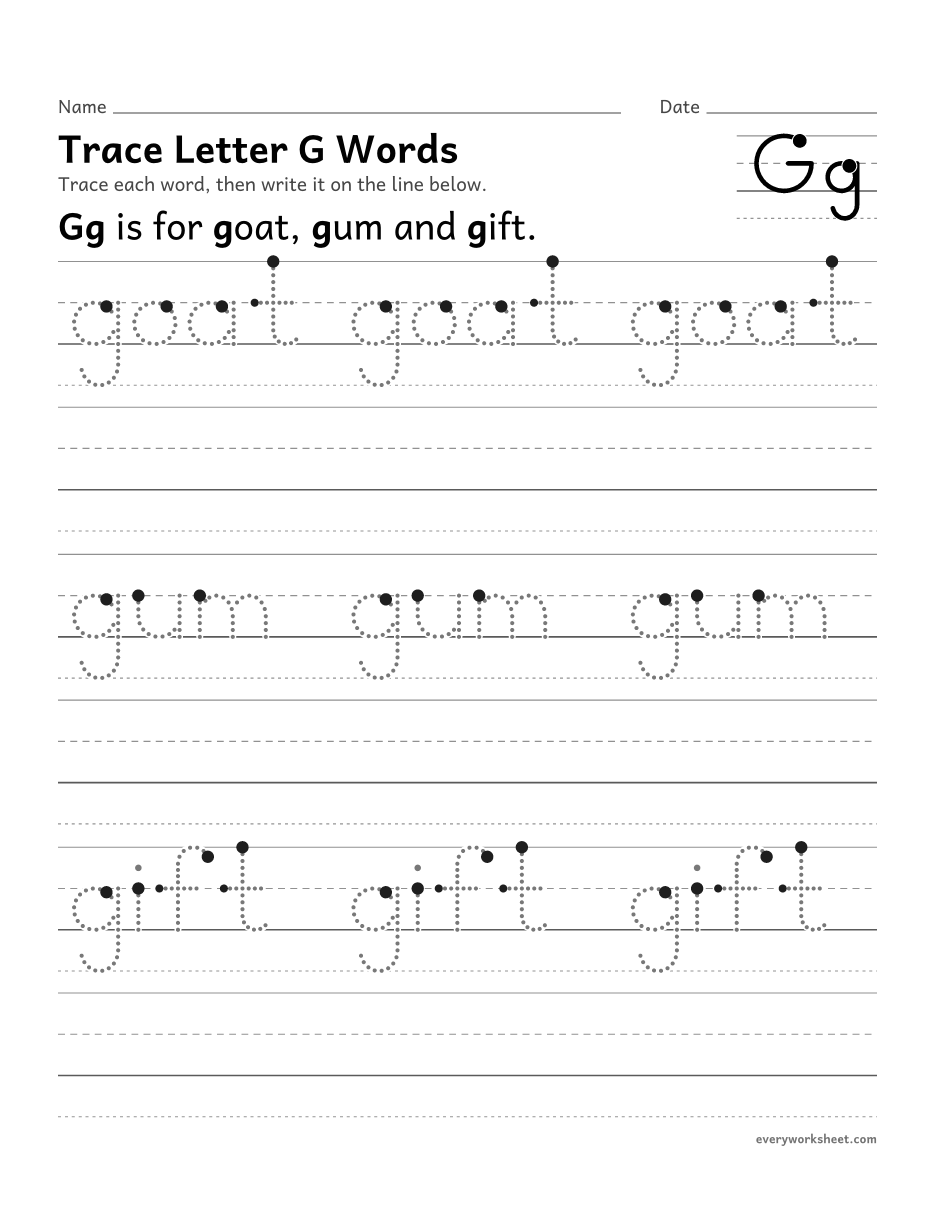
- Trace goat, gum and gift. In each word, have your child point to the tail of the g and check that it goes below the baseline.
- Finish with the letter hunt and check with the answer key.
Teaching tips for G
- Uppercase G: start just below the top line on the right side and circle back like a C. Keep going around until you reach the middle of the right side, then slide left to make a short shelf. Say it while writing: “Circle back, slide left.”
- Lowercase g: start just below the dashed midline and circle back all the way around. Without lifting, push up to the midline, pull down straight past the baseline, and curve back to the left to make the tail. Say it while writing: “Circle back, push up, pull down, curve back.”
- Common mix-ups: g and q (g’s tail curves back to the left; q’s turns up to the right), g and 9, a tail that turns right instead of left, and a tail that stops on the baseline.
- Many books print a g with a closed loop at the bottom and a small ear on top. Show your child that it is still a g, and that we write the simpler shape.
- Quick activities: make g’s in a tray of sand or salt while saying “circle, line, hook”; play “goat says g,” where your child bleats only when they hear a word starting with /g/.
Questions about letter G
Why does the g in books look different from the one my child writes?
Many typefaces use a two-story g with a loop at the bottom. For handwriting, children learn a circle with a hooked tail because children can form it with the same strokes they use for a and d. Both are the letter g.
Where should the tail of g go?
Below the baseline, then curving back to the left. The circle part sits between the dashed midline and the baseline, just like a or o, and the tail hangs underneath.
Does G always say /g/?
No. Before e, i or y it sometimes says /j/, as in gem and giraffe. Kindergartners learn the hard /g/ sound first; the soft sound comes later.