 View larger
Number Bonds Worksheets
Part-part-whole practice for kindergarten: blank number bond templates and a mat, every way to make 3 to 10, missing parts, ten frame bonds and making 10.
Download the number bonds worksheets
Number bonds worksheets
 View larger
 View larger
 View all 2 pages
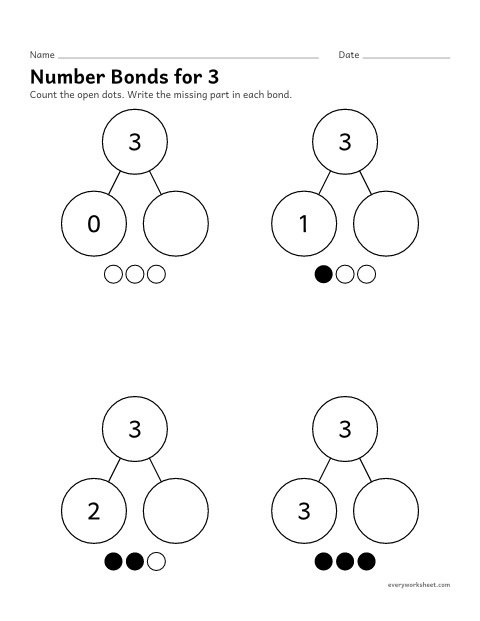
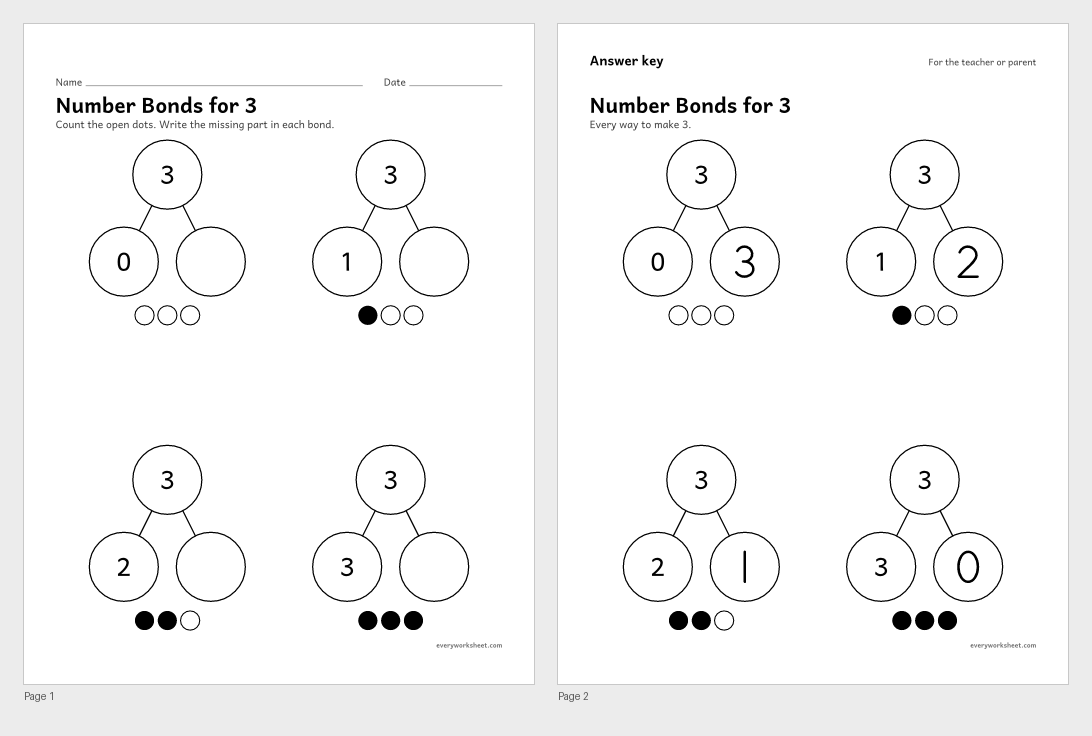
Number bonds for 3
Every way to split 3 into two parts
Answer key on page 2
2 pages28 KB
 View all 2 pages
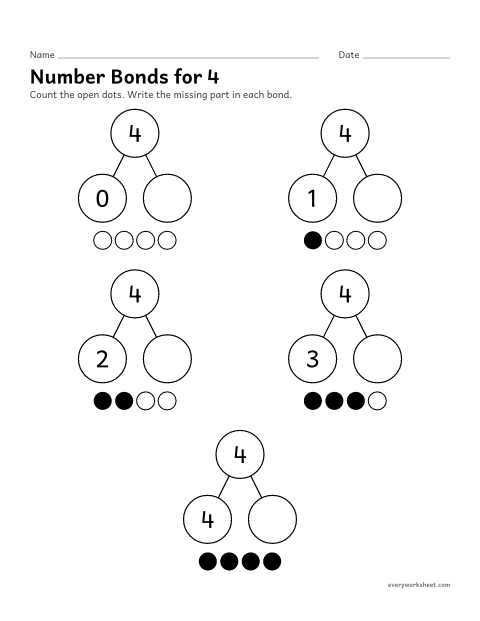
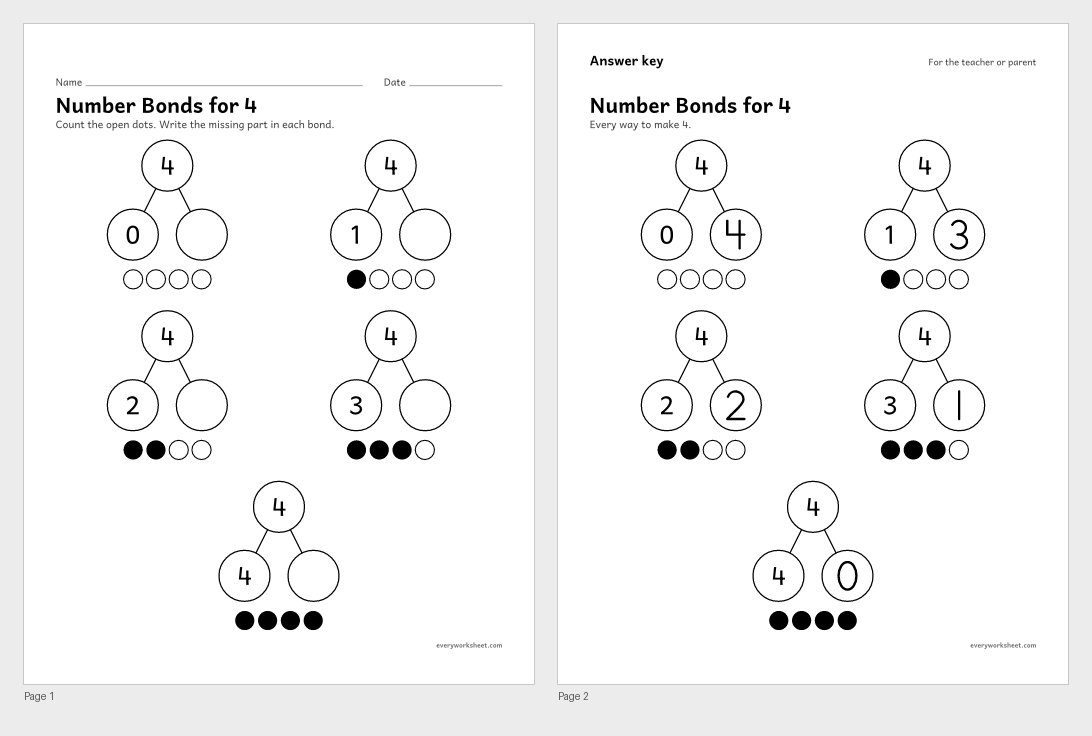
Number bonds for 4
Every way to split 4 into two parts
Answer key on page 2
2 pages29 KB
 View all 2 pages
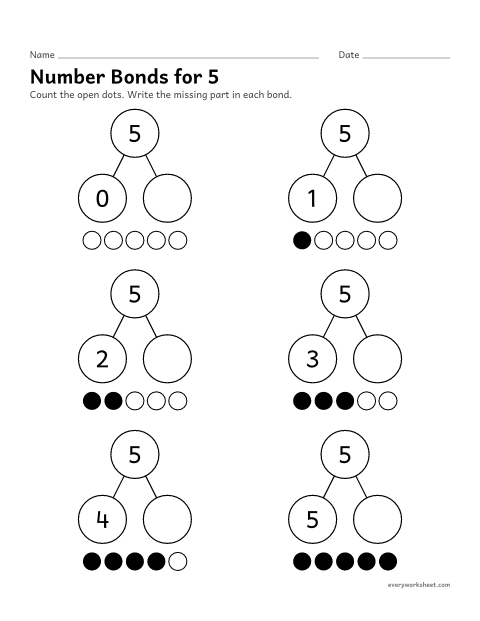
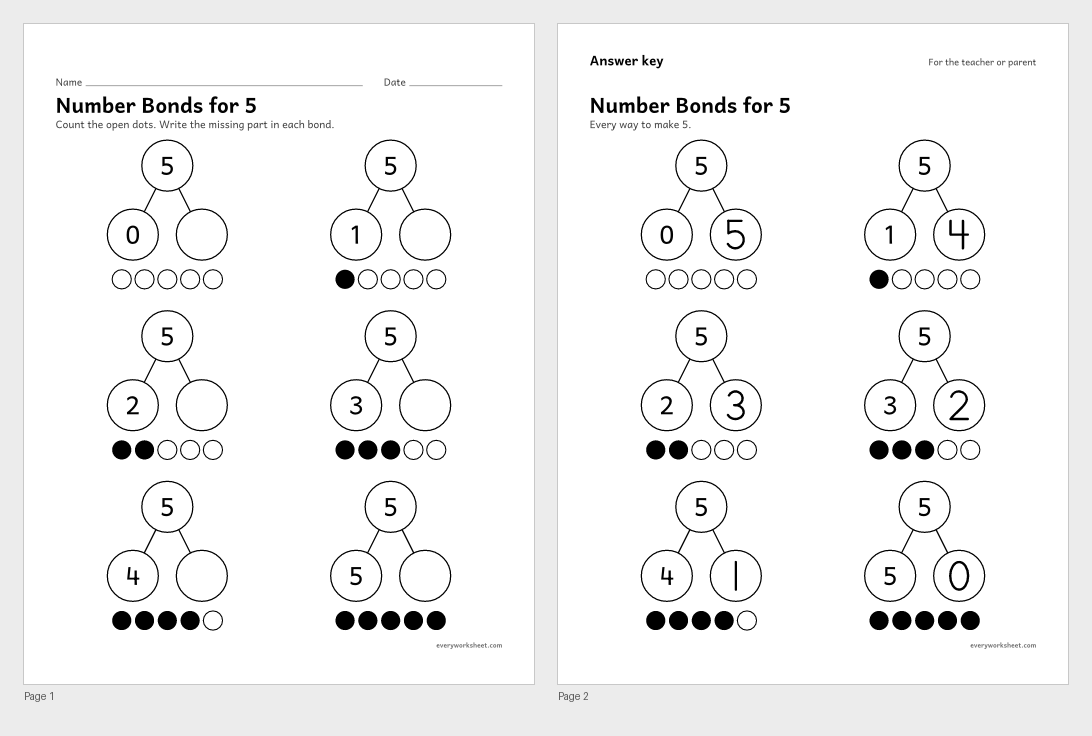
Number bonds for 5
Every way to split 5 into two parts
Answer key on page 2
2 pages29 KB
 View all 2 pages
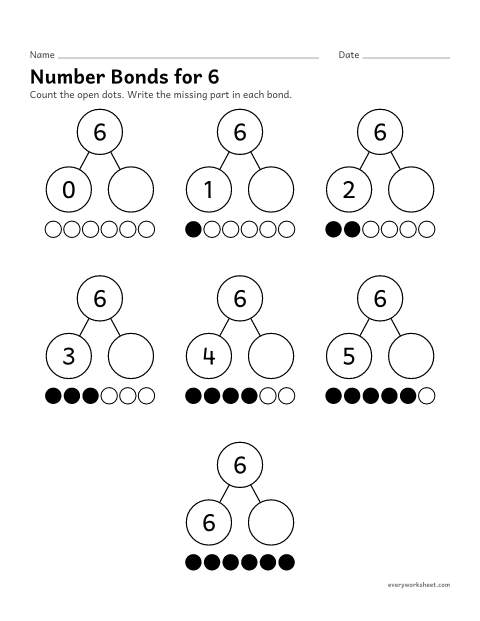
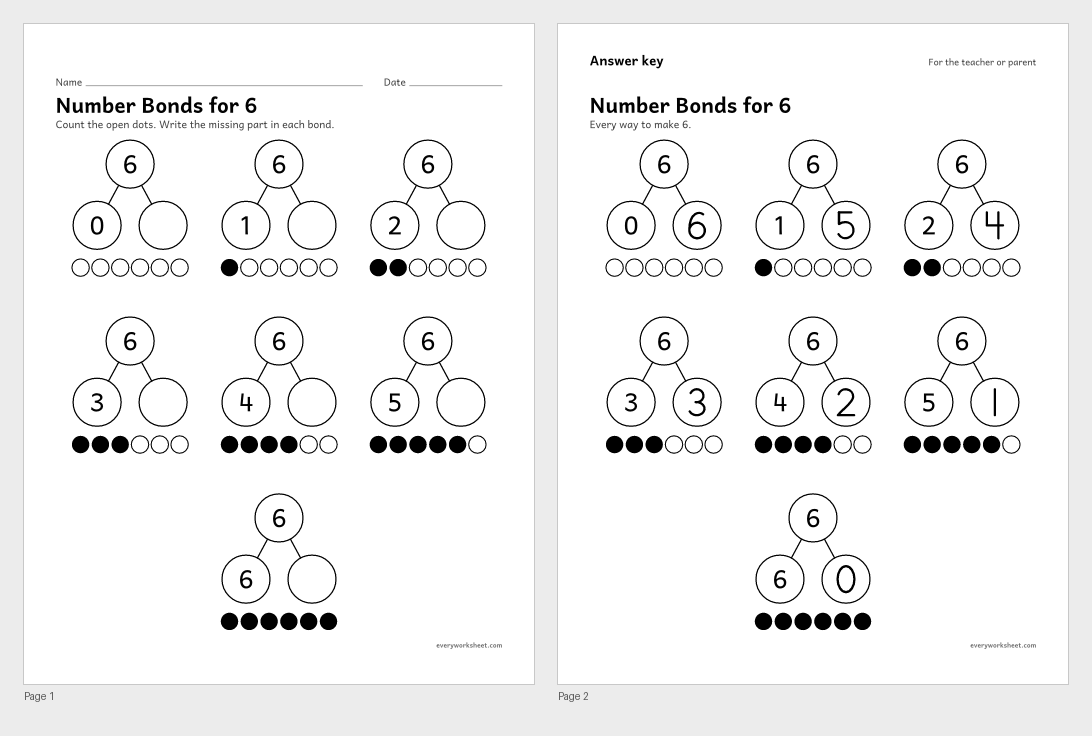
Number bonds for 6
Every way to split 6 into two parts
Answer key on page 2
2 pages30 KB
 View all 2 pages
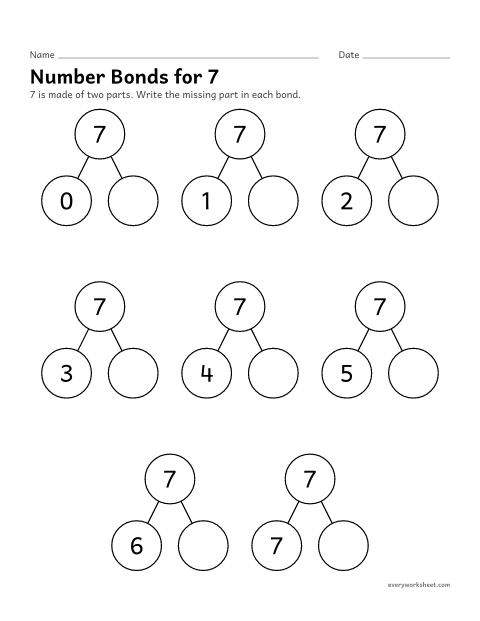
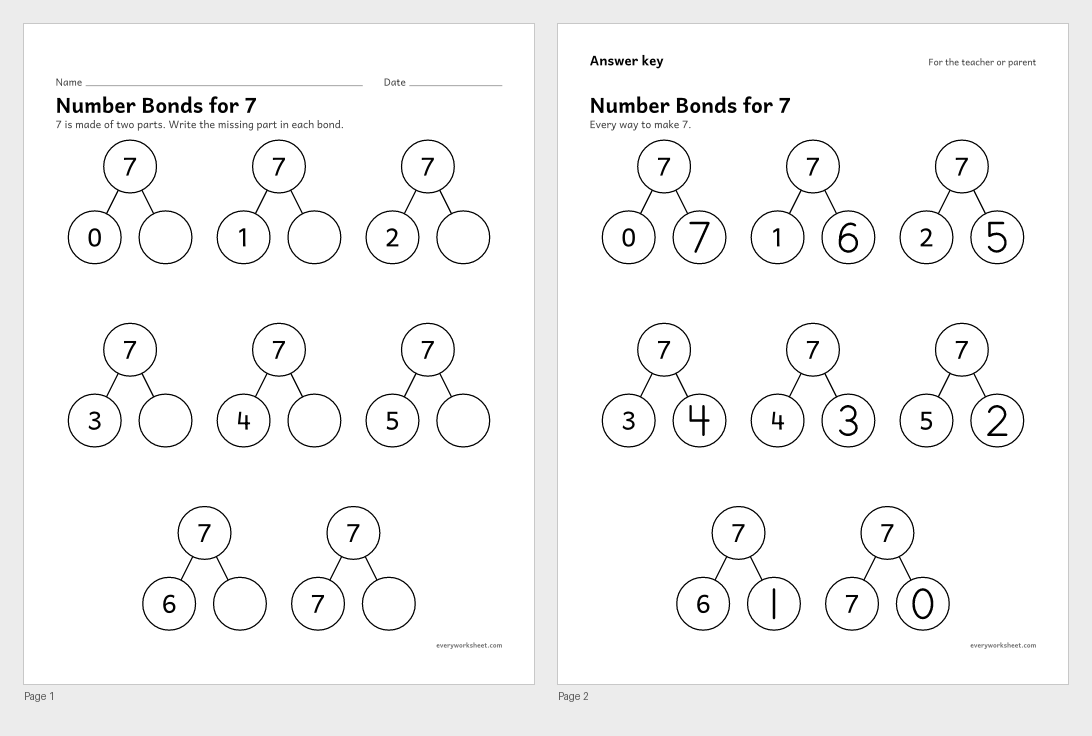
Number bonds for 7
Every way to split 7 into two parts
Answer key on page 2
2 pages29 KB
 View all 2 pages
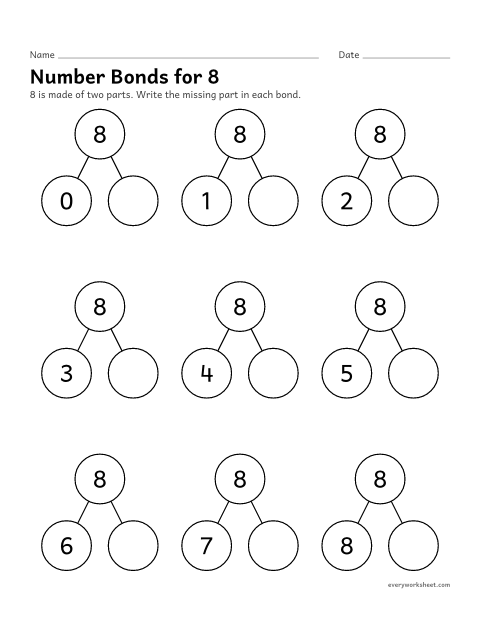
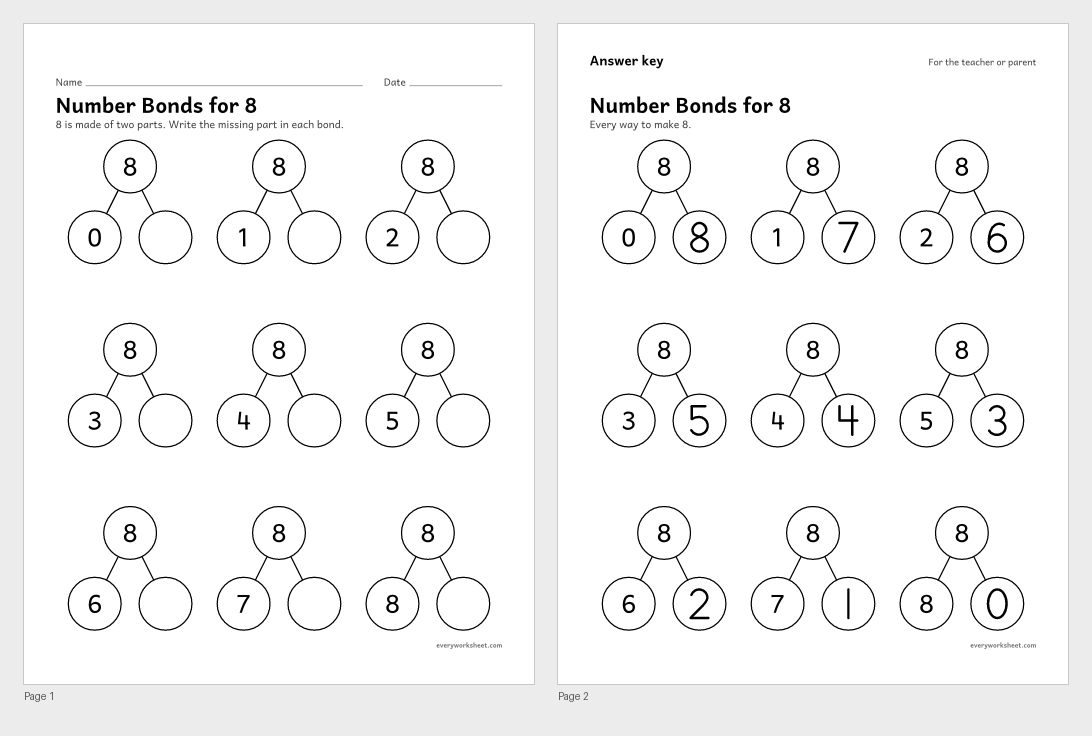
Number bonds for 8
Every way to split 8 into two parts
Answer key on page 2
2 pages30 KB
 View all 2 pages
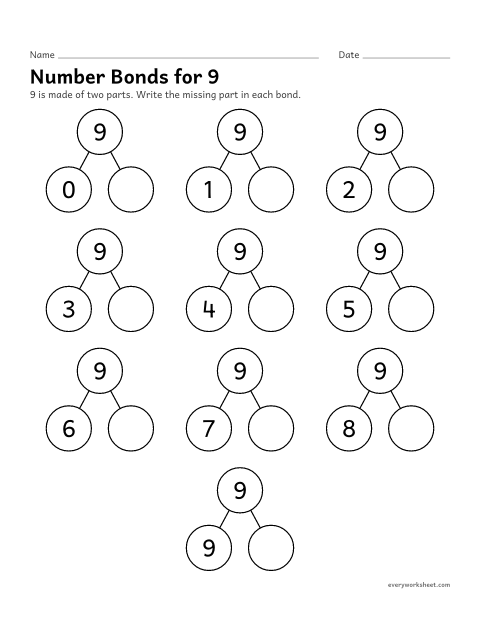
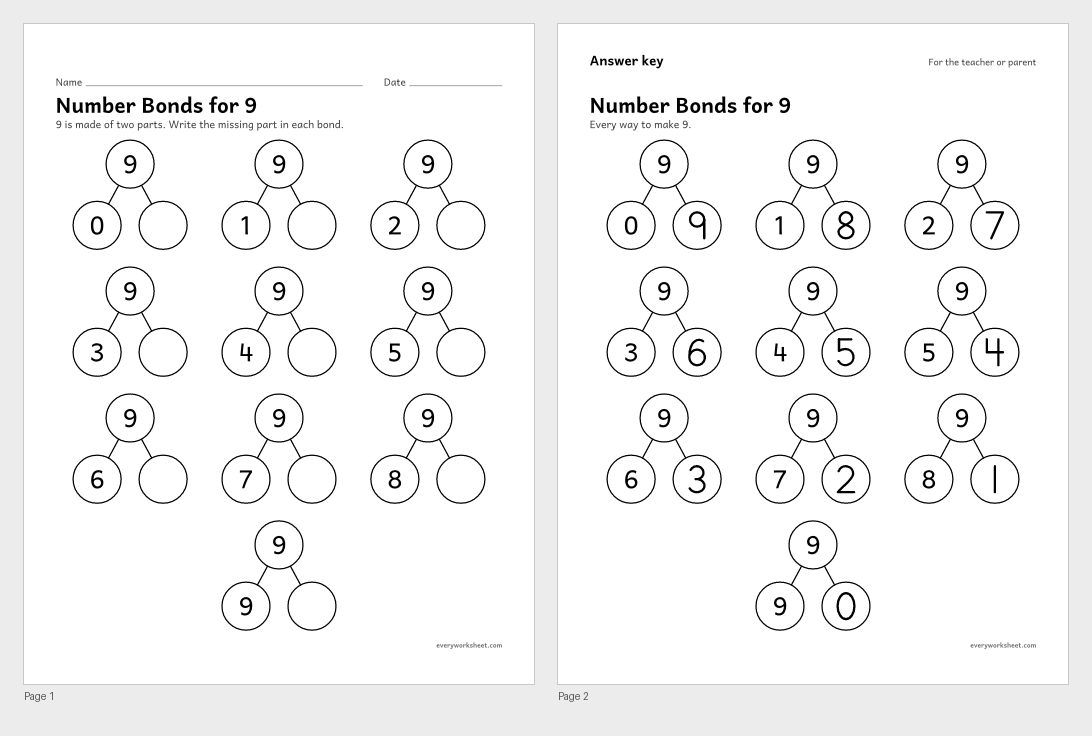
Number bonds for 9
Every way to split 9 into two parts
Answer key on page 2
2 pages30 KB
 View all 2 pages
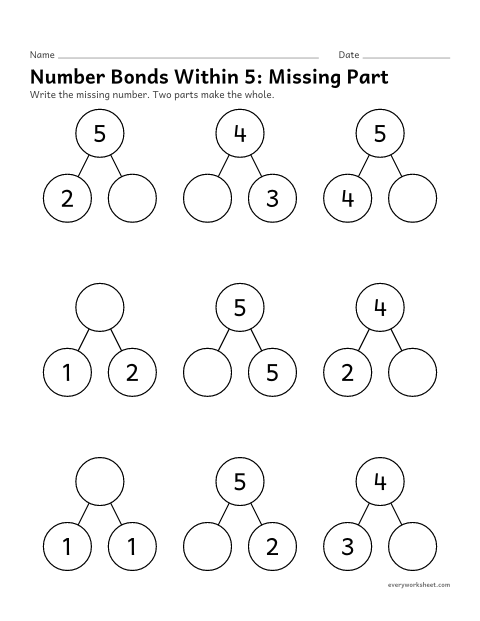
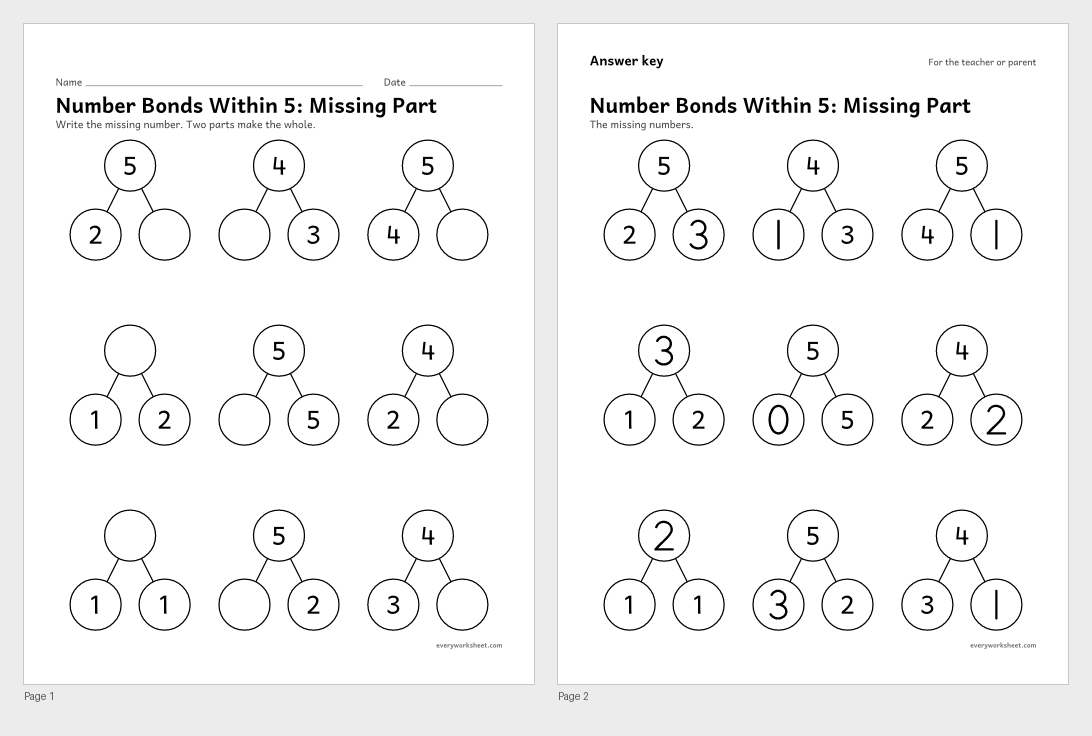
Number bonds within 5: missing part
Finding a missing part or whole within 5
Answer key on page 2
2 pages29 KB
 View all 2 pages
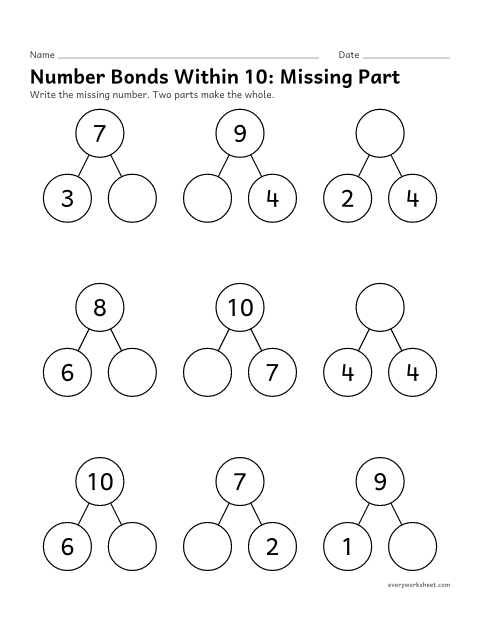
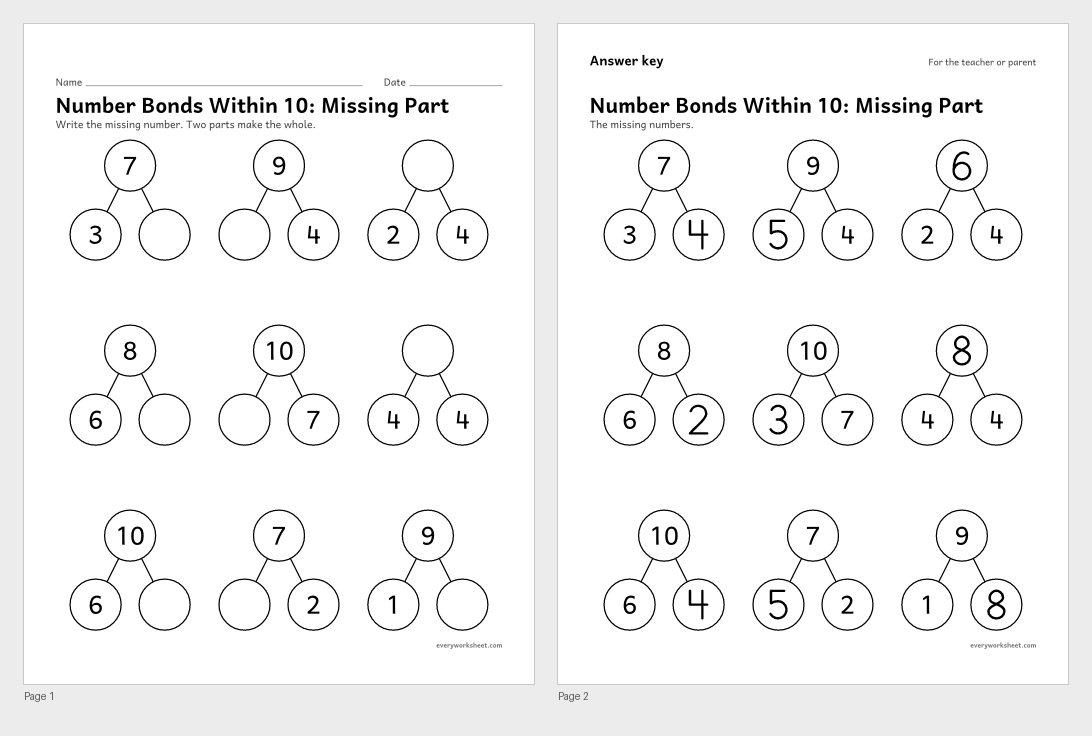
Number bonds within 10: missing part
Finding a missing part or whole within 10
Answer key on page 2
2 pages30 KB
 View all 2 pages
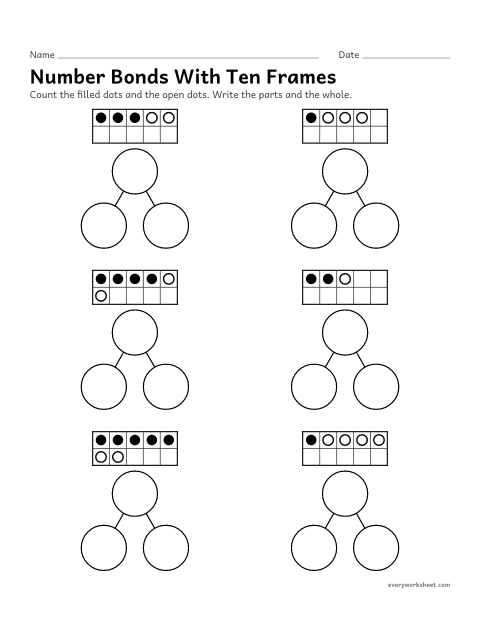
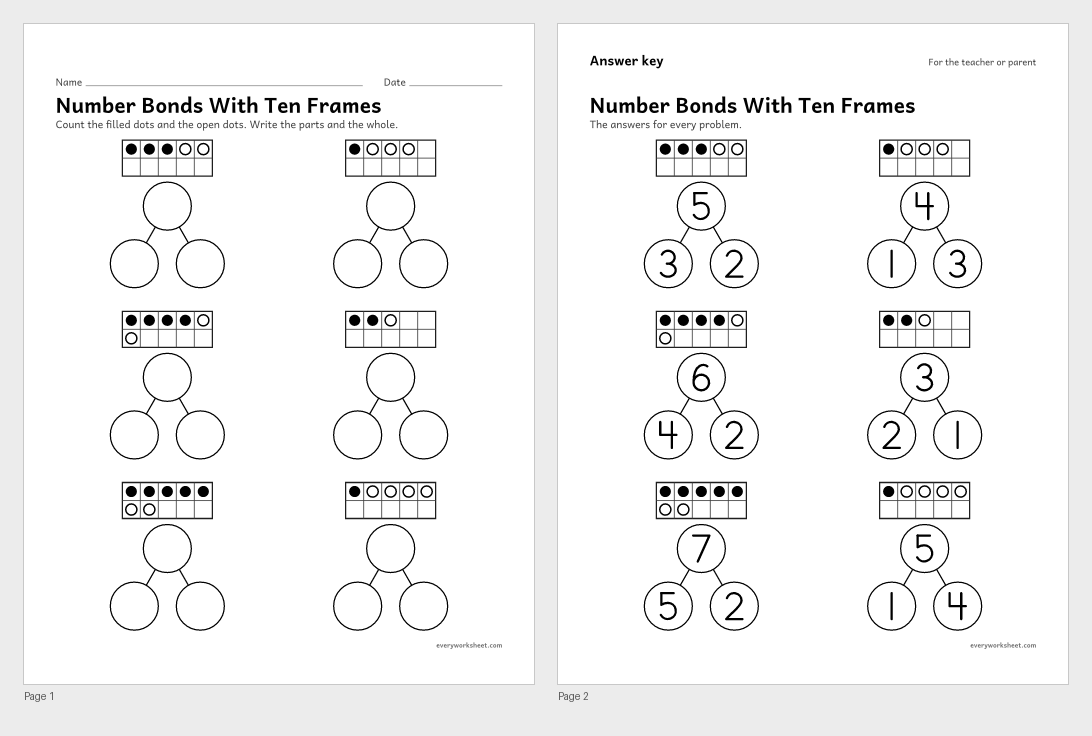
Number bonds with ten frames
Writing the parts and whole shown in a ten frame
Answer key on page 2
2 pages29 KB
 View all 2 pages
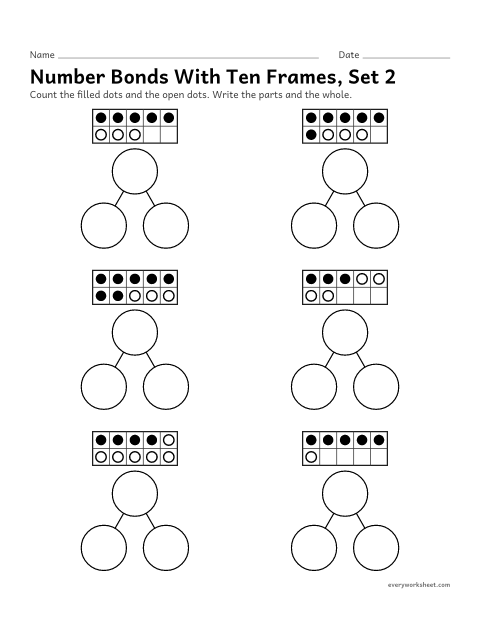
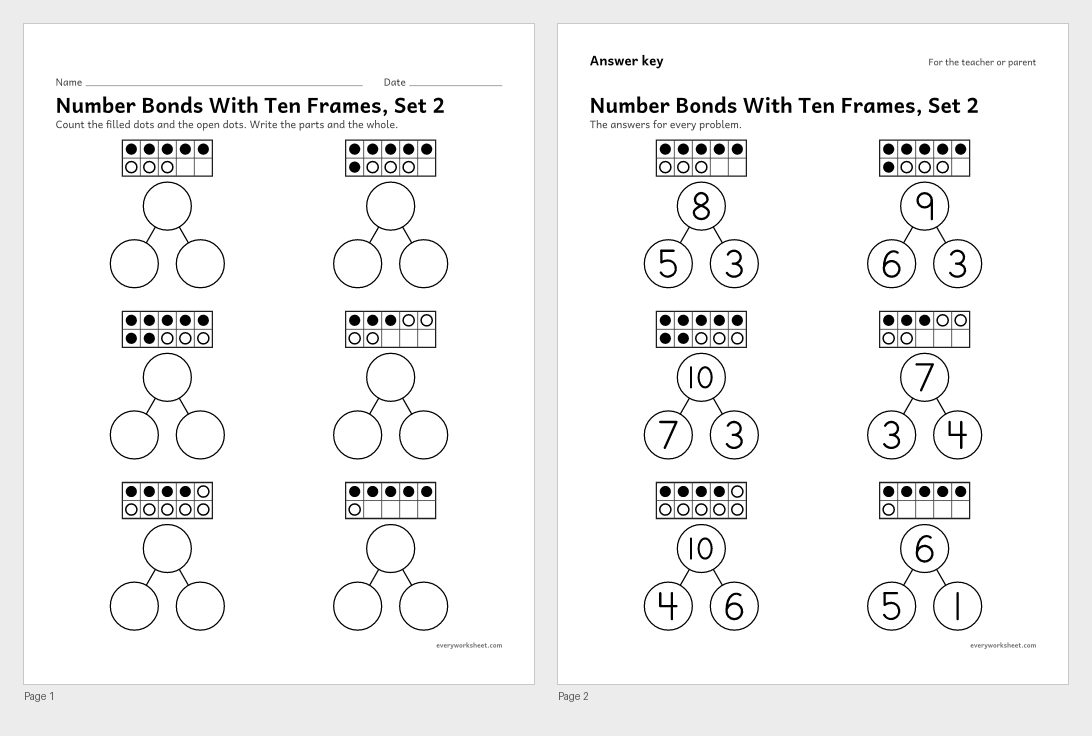
Number bonds with ten Frames, set 2
Writing the parts and whole shown in a ten frame
Answer key on page 2
2 pages30 KB
Making 10 worksheets
 View all 2 pages
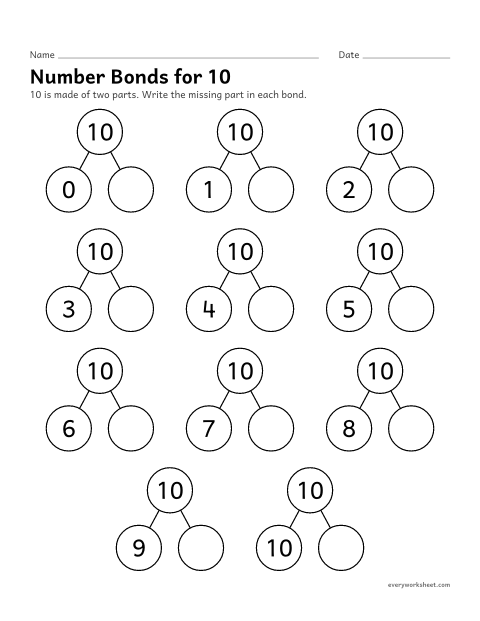
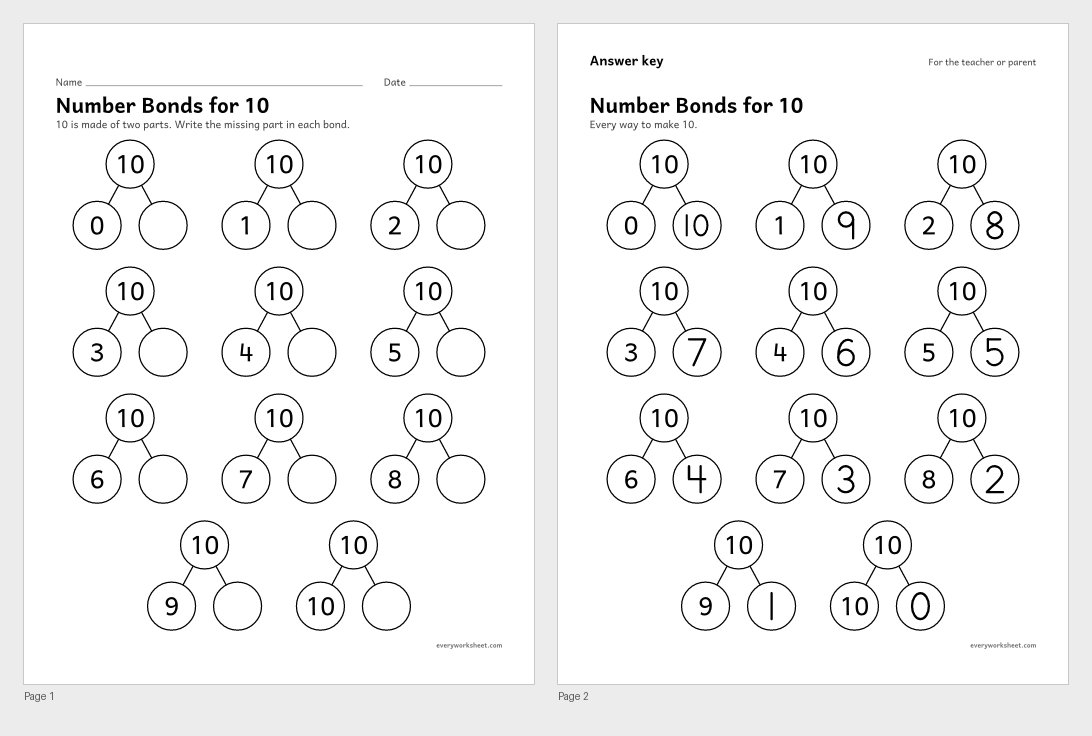
Number bonds for 10
Every way to split 10 into two parts
Answer key on page 2
2 pages31 KB
 View all 2 pages
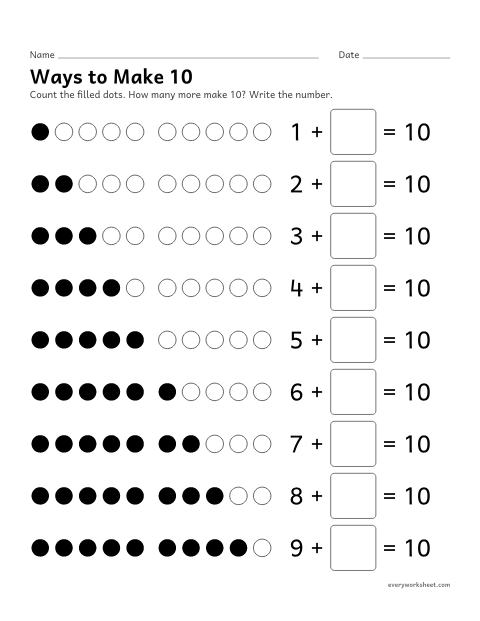
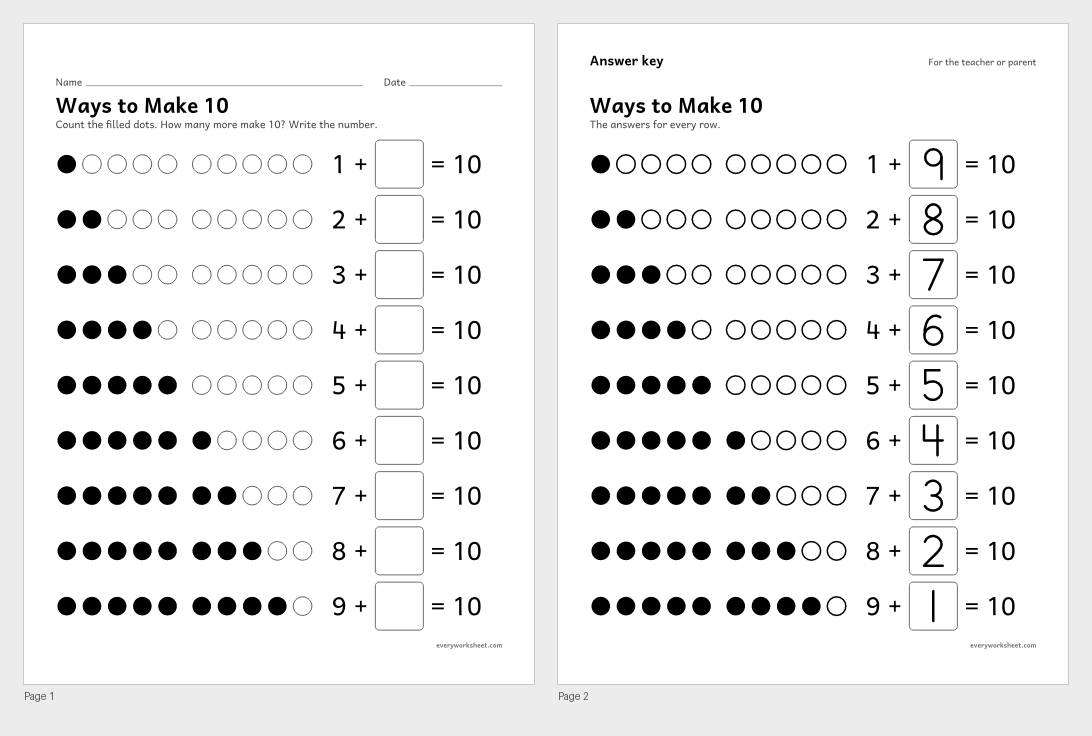
Ways to make 10
Finding how many more make 10 on a ten-dot strip
Answer key on page 2
2 pages54 KB
 View all 2 pages
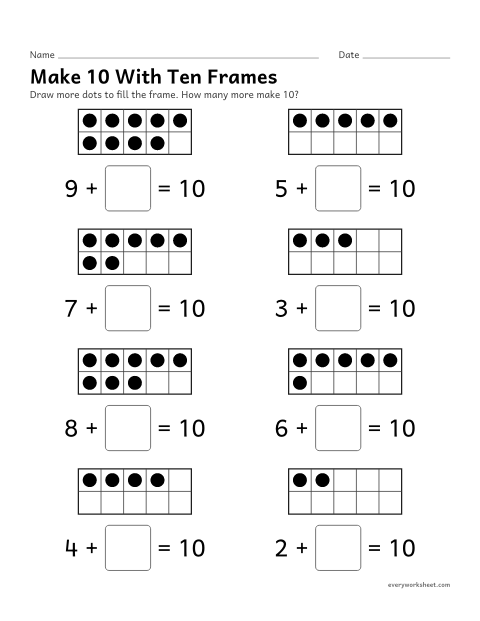
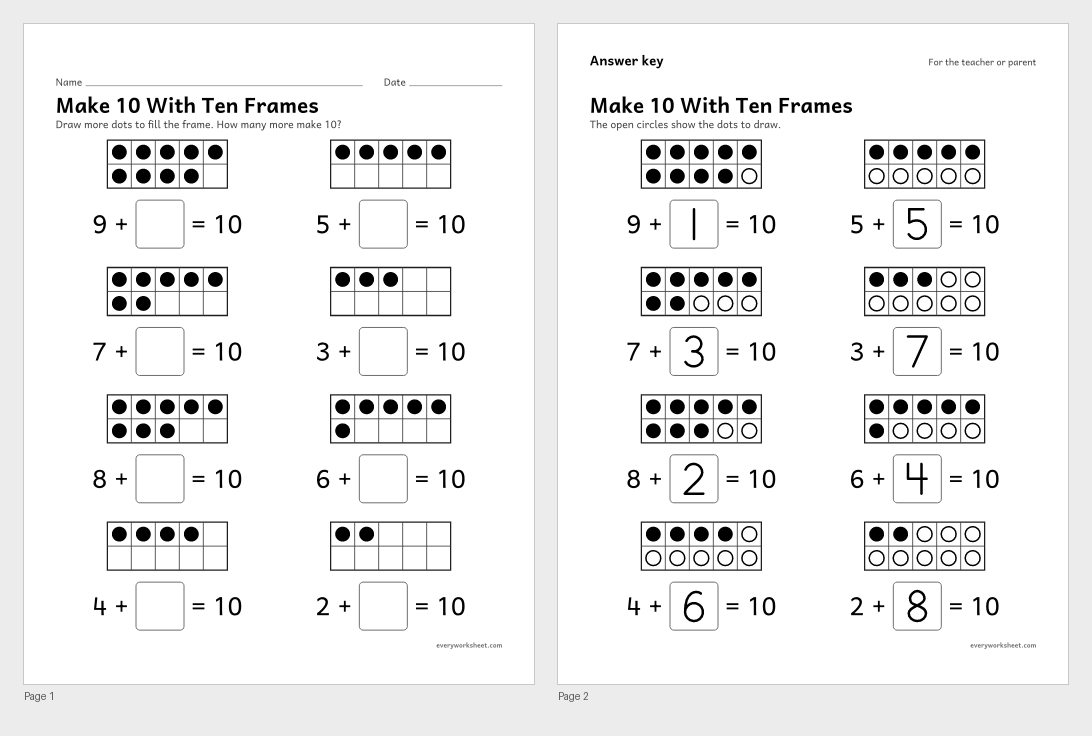
Make 10 with ten frames
Filling a ten frame to find the number that makes 10
Answer key on page 2
2 pages47 KB
 View all 2 pages
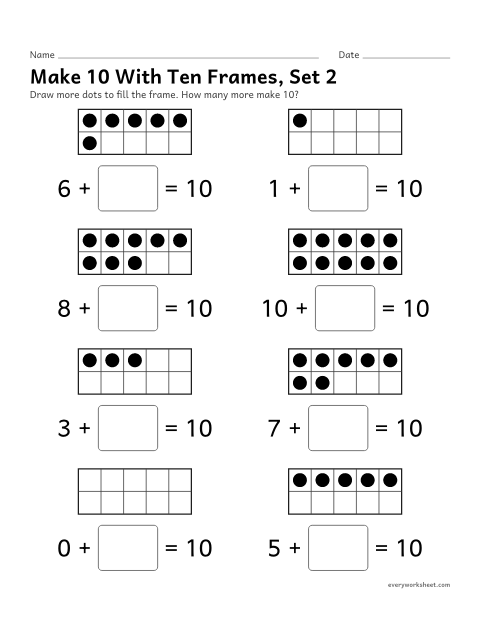
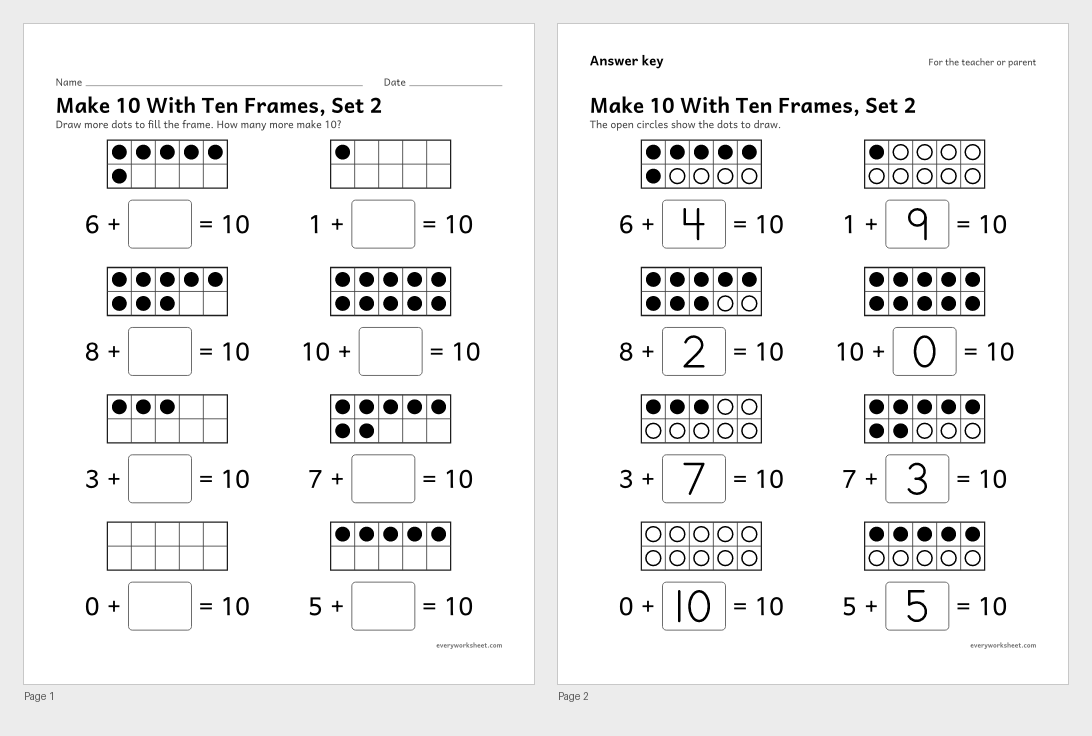
Make 10 with ten Frames, set 2
Filling a ten frame to find the number that makes 10
Answer key on page 2
2 pages47 KB
 View all 2 pages
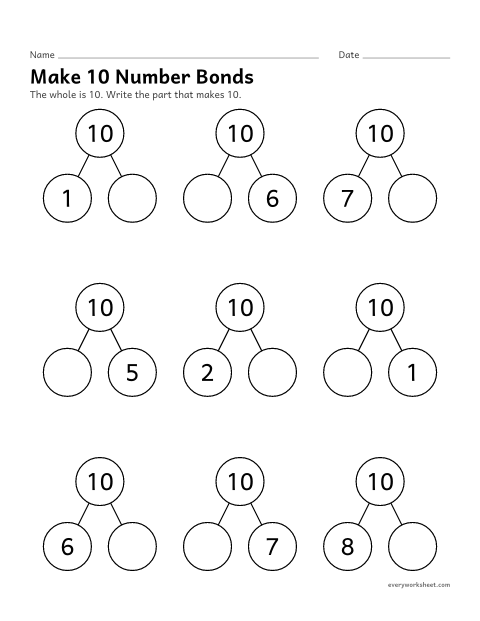
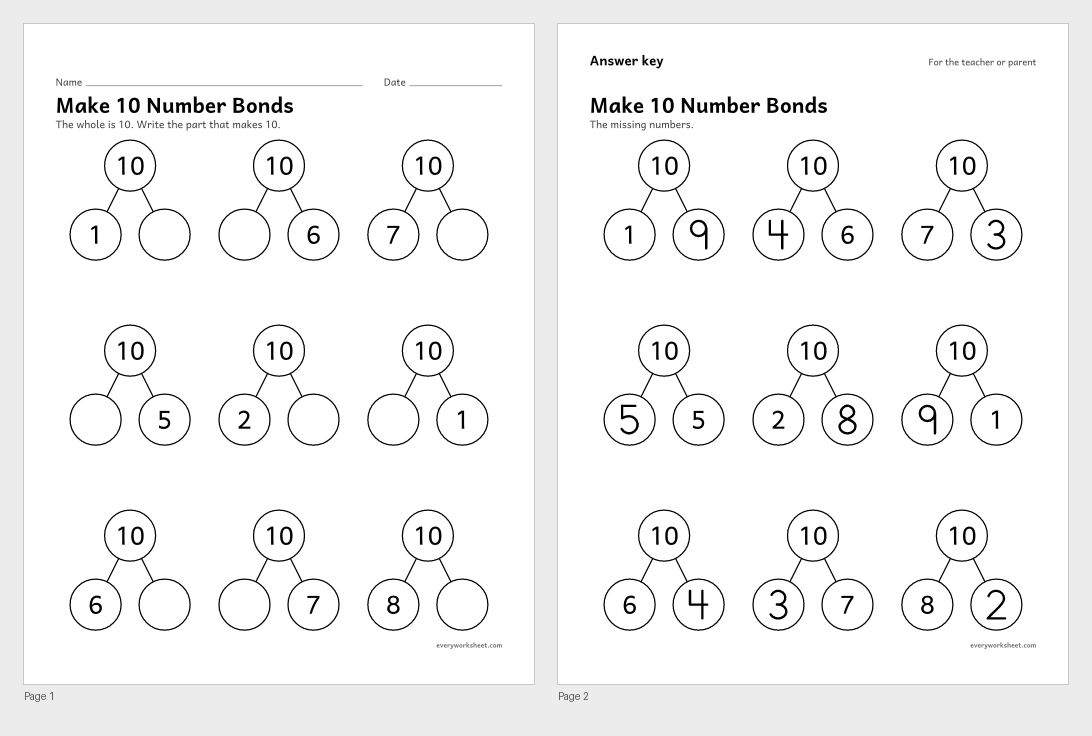
Make 10 number bonds
Finding the part that makes 10 in a number bond
Answer key on page 2
2 pages29 KB
 View all 2 pages
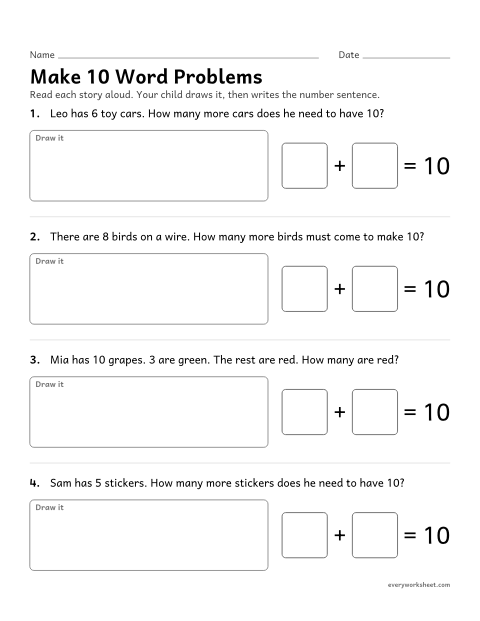
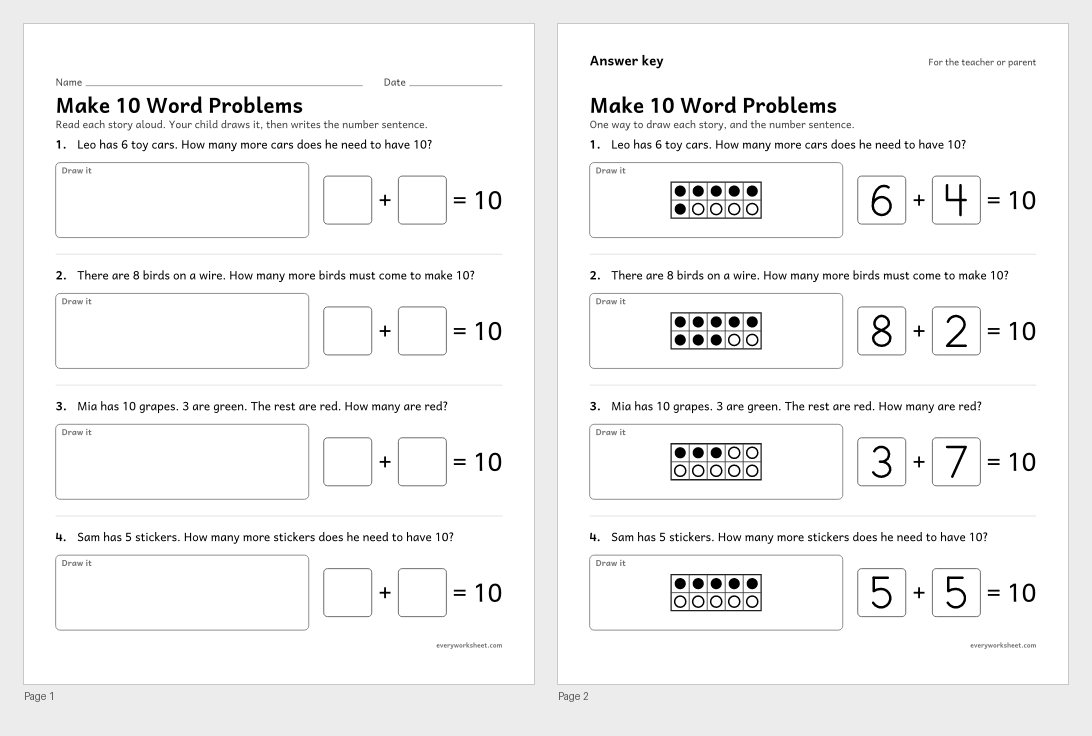
Make 10 word problems
Solving make-10 word problems by drawing
Answer key on page 2
2 pages47 KB
Print at 100% (actual size) for the cleanest tracing lines.
About these number bonds worksheets
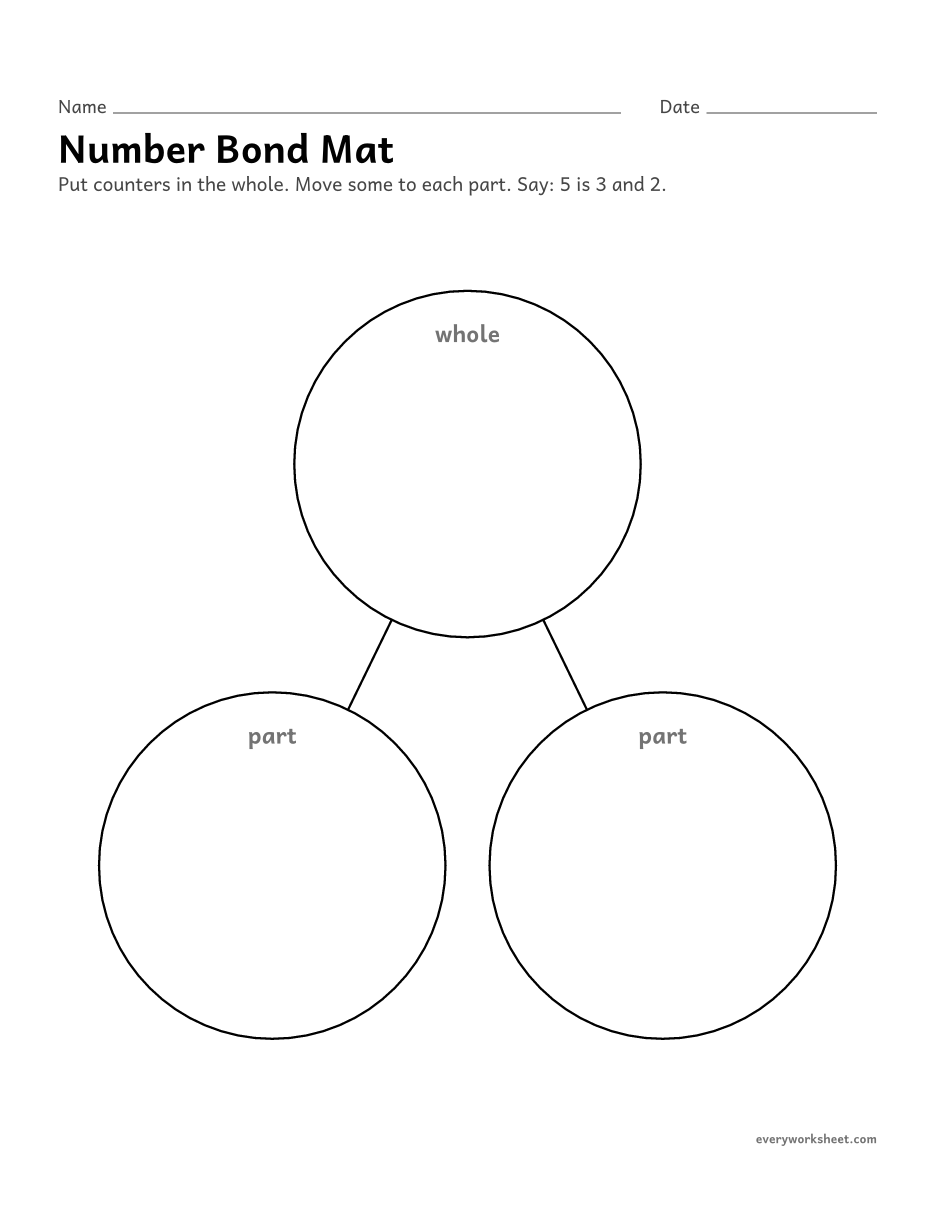
A number bond shows how a number splits into two parts. The whole goes in the top circle and the two parts go in the circles below: 5 is 3 and 2. Number bonds help children see that numbers are made of smaller numbers, which is the base for adding, subtracting and later mental math.
Start with the number bond mat and real counters, then use the blank number bond templates to record what your child finds. The number bonds for 3 to 10 sheets list every way to split each number, in order, so the pattern is easy to spot. The smaller numbers have a row of dots under each bond to count. The missing part pages mix it up, and the ten frame pages connect the bond to a picture.
Making 10 gets its own set of making 10 worksheets: every number bond for 10, a ten-dot strip for each way to make 10, make 10 with ten frames, make 10 number bonds and make 10 word problems. Knowing the pairs that make 10 is one of the most useful facts a child can carry into first grade. Every page with answers has an answer key on page 2.
Standards
CCSS.MATH.CONTENT.K.OA.A.3Decompose numbers less than or equal to 10 into pairs in more than one way, e.g., by using objects or drawings, and record each decomposition by a drawing or equation (e.g., 5 = 2 + 3 and 5 = 4 + 1).CCSS.MATH.CONTENT.K.OA.A.4For any number from 1 to 9, find the number that makes 10 when added to the given number, e.g., by using objects or drawings, and record the answer with a drawing or equation.CCSS.MATH.CONTENT.K.OA.A.1Represent addition and subtraction with objects, fingers, mental images, drawings, sounds, acting out situations, verbal explanations, expressions, or equations.
How to use them
- Put 5 counters in the whole circle of the number bond mat. Ask your child to move some into each part, then say the bond out loud: "5 is 4 and 1."
- Find another way and record it on the blank number bonds. Keep going until you have found them all.
- Work through the number bonds for 3 to 10 in order. Talk about the pattern: as one part goes up by 1, the other goes down by 1.
- On the missing part pages, cover the empty circle and ask, "The whole is 7. One part is 3. What is the other part?" Counting up from 3 to 7 is a good strategy.
- For making 10, use the ten frames first: count the dots, then the empty boxes. The empty boxes are the number that makes 10.
- Read the make 10 word problems aloud and let your child draw the story before writing the numbers.
Teaching tips
- Include 0. A bond like 6 is 6 and 0 is correct, and it helps children see the full set of pairs.
- If your child mixes up parts and whole, point to the top circle and say, "This is the whole. It is the biggest number."
- Finger pairs are a quick way to practice making 10: hold up 7 fingers and ask how many are down.
- Turnarounds count as their own bonds on these sheets (3 and 7, 7 and 3), which helps children see both orders.
- For children who are ready, ask them to write two addition sentences and two subtraction sentences for one bond.
Questions teachers and parents ask
What is a number bond?
A number bond is a picture of a number and two parts that make it. The whole sits in one circle, joined by lines to two smaller circles for the parts, like 8 is 5 and 3.
Why are number bonds useful?
They show how numbers break apart and go back together. That makes addition and subtraction facts easier to learn, because 5 + 3 = 8 and 8 − 3 = 5 come from the same bond.
What are the ways to make 10?
0 and 10, 1 and 9, 2 and 8, 3 and 7, 4 and 6, 5 and 5, and the same pairs turned around. The making 10 worksheets practice every one of them.
When do children learn number bonds?
Kindergartners split numbers up to 10 into pairs and find the number that makes 10. First graders build on this for addition and subtraction within 20.
Do the number bond worksheets have answer keys?
Every page with right answers has an answer key on page 2. The number bond mat and the blank number bonds are templates, so they have no key.