 View larger
Magnets Worksheets for Kindergarten
Magnet worksheets for kindergarten: a line-art poster, a magnetic or not sort, a predict-and-test record sheet and a count-the-paper-clips page.
Download the magnets worksheets
What magnets pull
 View larger
 View all 2 pages
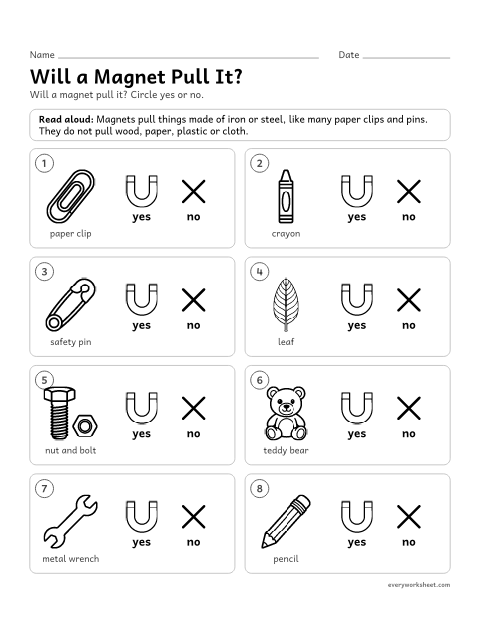
Magnetic or not picture sort
Predicting what a magnet will pull
Answer key on page 2
2 pages364 KB
Test with a magnet
 View all 2 pages
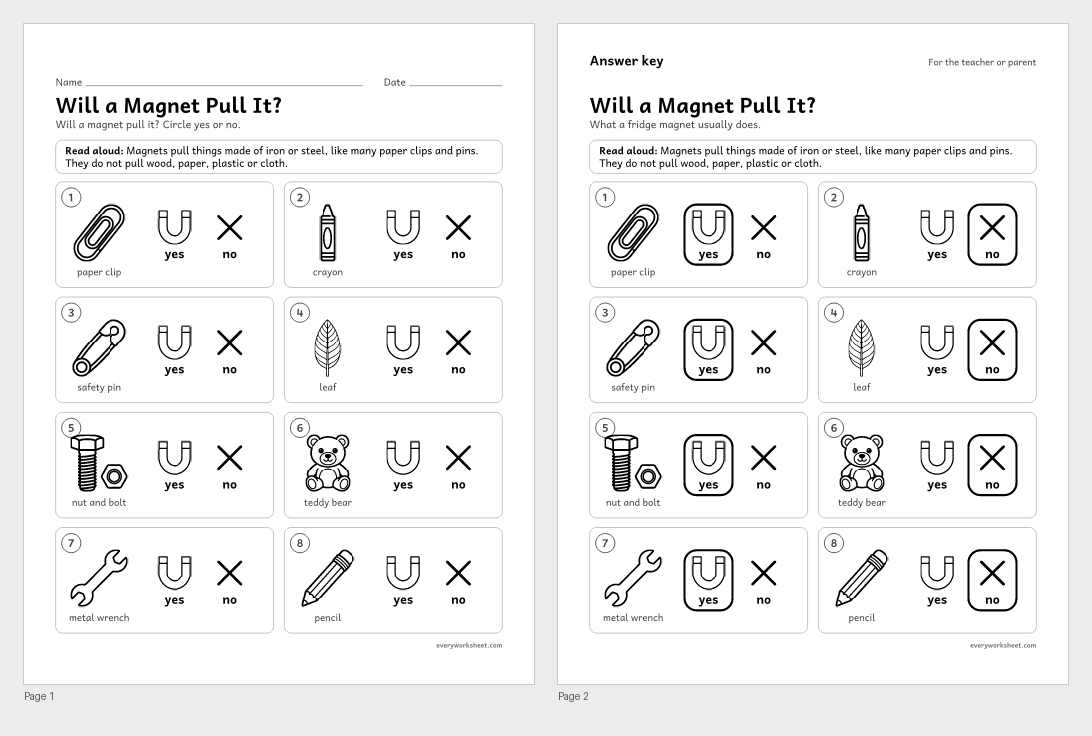
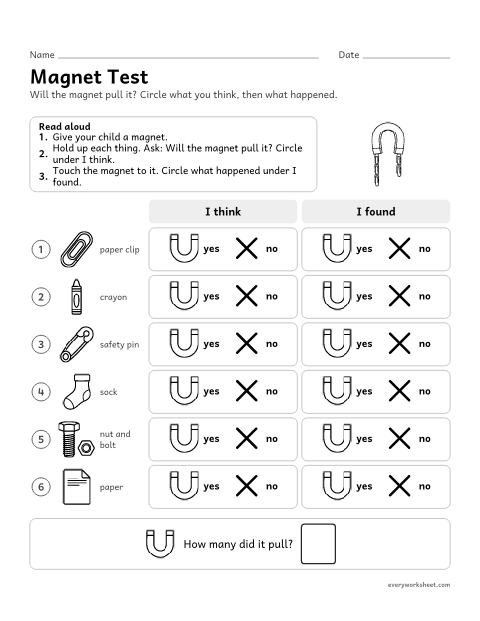
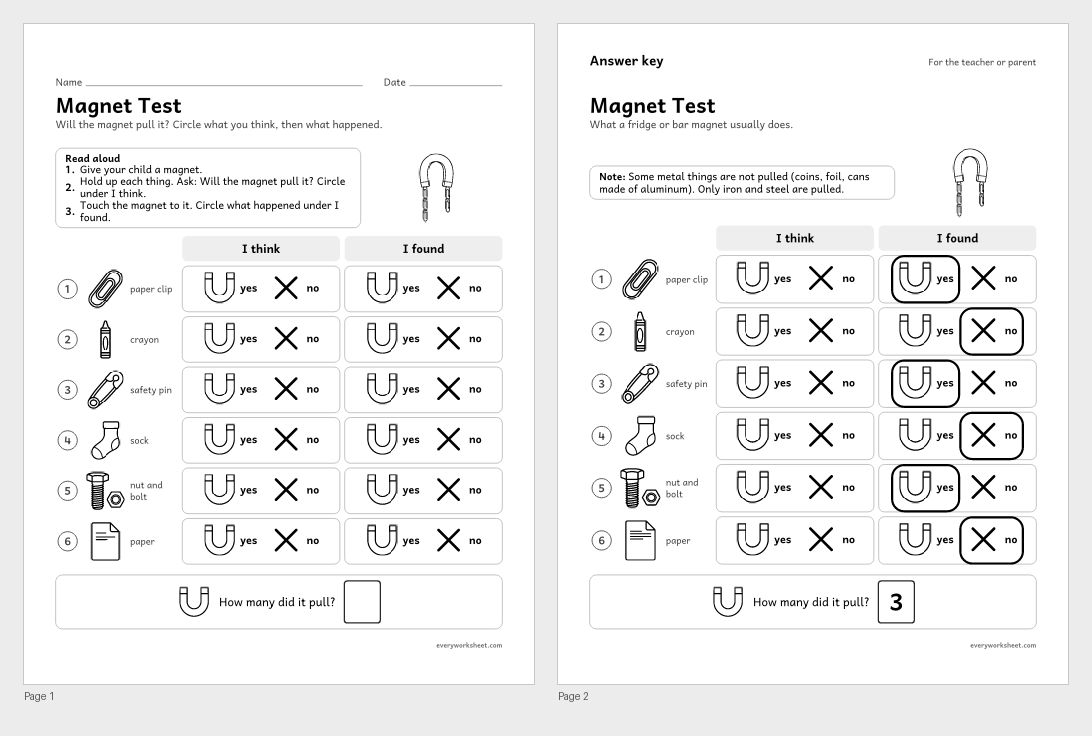
Magnetic or Not: predict and test record sheet
Predicting and testing what a magnet pulls
Answer key on page 2
2 pages311 KB
 View all 2 pages
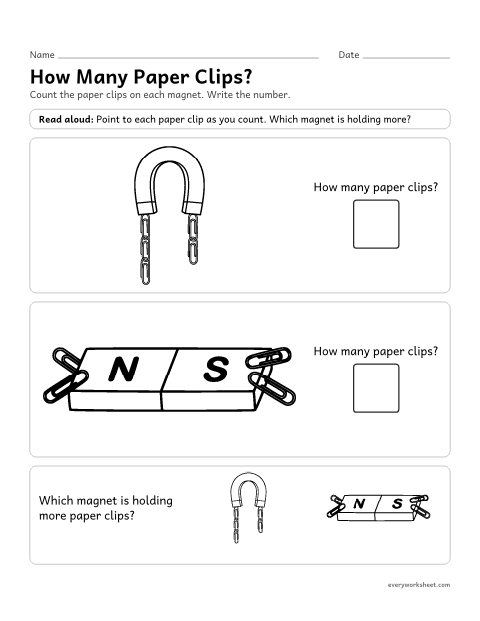
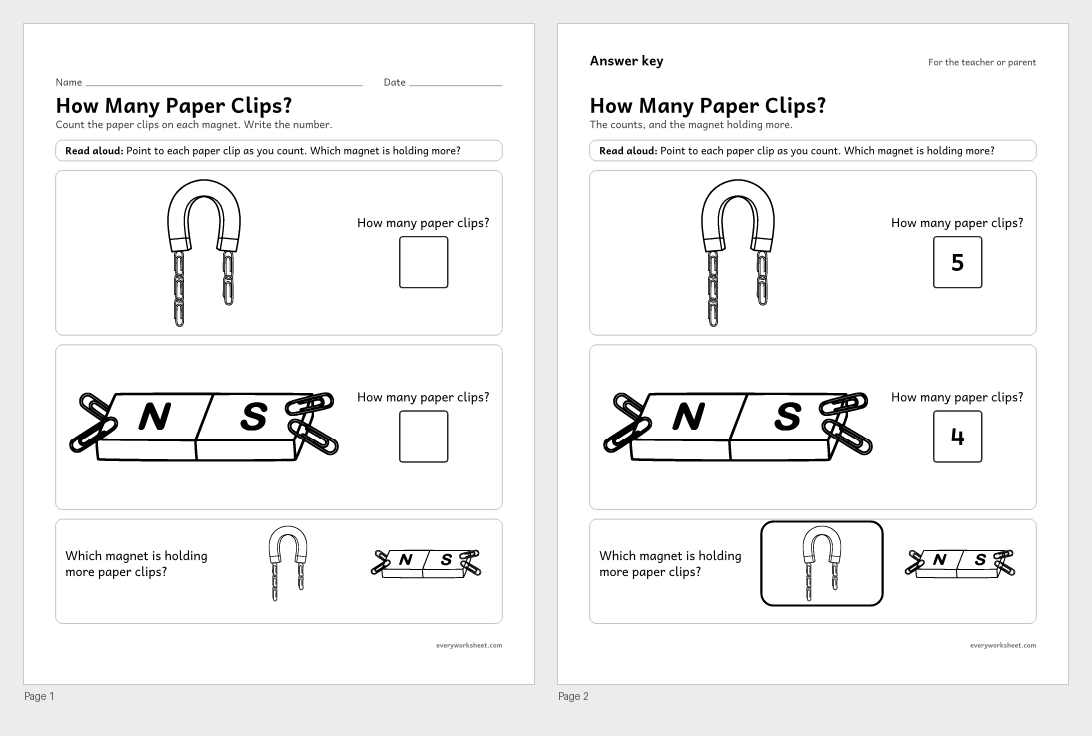
Magnet paper clip count
Counting what a magnet holds
Answer key on page 2
2 pages57 KB
Print at 100% (actual size) for the cleanest tracing lines.
About these magnets worksheets
Magnets feel like magic to young children: they pull some things without touching them. Kindergartners can find out which things a magnet pulls by testing them, which makes magnets a great topic for predicting and recording.
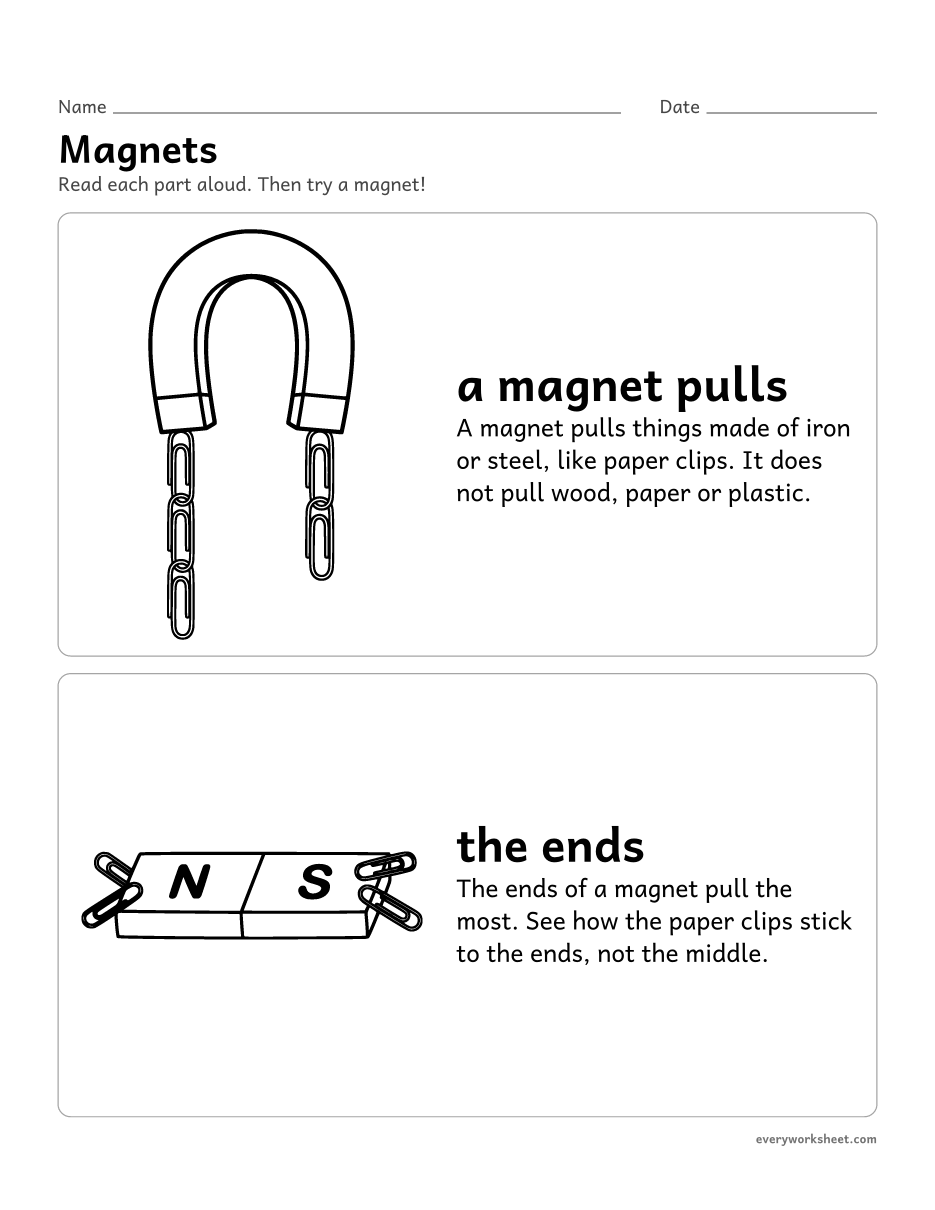
A magnet pulls things made of iron or steel, such as most paper clips, safety pins, nuts and bolts. It does not pull wood, paper, plastic, cloth or glass. Many metal things are not pulled either: most coins, foil and aluminum cans. The ends of a magnet pull the most, which is why paper clips gather at the ends.
Start with the poster of a horseshoe magnet and a bar magnet holding paper clips. Use the predict-and-test sheet with a fridge magnet or a bar magnet, then the sort to practice without the real objects. The paper clip page asks children to count the clips on each magnet and say which one holds more. Magnetic pulls are part of 3rd grade science, but young children love to explore them early as one more kind of pull.
Standards
NGSS K-PS2-1Plan and conduct an investigation to compare the effects of different strengths or different directions of pushes and pulls on the motion of an object.NGSS 3-PS2-3Ask questions to determine cause and effect relationships of electric or magnetic interactions between two objects not in contact with each other (grade 3).NGSS 2-PS1-1Plan and conduct an investigation to describe and classify different kinds of materials by their observable properties (grade 2).CCSS.MATH.CONTENT.K.MD.B.3Classify objects into given categories; count the numbers of objects in each category and sort the categories by count.CCSS.MATH.CONTENT.K.CC.B.5Count to answer "how many?" questions about as many as 20 things arranged in a line, a rectangular array, or a circle, or as many as 10 things in a scattered configuration.CCSS.ELA-LITERACY.W.K.8With guidance and support from adults, recall information from experiences or gather information from provided sources to answer a question.CCSS.ELA-LITERACY.W.K.2Use a combination of drawing, dictating, and writing to compose informative/explanatory texts in which they name what they are writing about and supply some information about the topic.CCSS.MATH.CONTENT.K.CC.C.6Identify whether the number of objects in one group is greater than, less than, or equal to the number of objects in another group, e.g., by using matching and counting strategies.
How to use them
- Show a magnet picking up a paper clip. Ask, "What else do you think it will pull?"
- On the predict-and-test sheet, circle yes or no under I think, then touch the magnet to each object and circle what happened.
- Count how many things the magnet pulled and write the number in the box.
- Keep magnets away from phones, tablets, screens and cards.
- Use the picture sort as a review, and the paper clip page to practice counting and comparing.
Teaching tips
- Children often think all metal is magnetic. Test a coin or foil to show that only some metals are pulled.
- Small magnets are a swallowing hazard. Use large magnets and supervise young children.
- A weak fridge magnet may not lift heavier steel objects. If it slides along but does not lift, it still counts as pulled.
- Let two magnets meet end to end, then turn one around. Feeling them push apart is a great extra for curious children.
Questions teachers and parents ask
What does a magnet attract?
Things made of iron or steel, like paper clips, safety pins, nails, bolts and steel scissor blades. Magnets do not pull wood, paper, plastic, cloth, glass, most coins or aluminum foil.
Are magnets taught in kindergarten?
Kindergarten science covers pushes and pulls. Magnets are formally taught in 3rd grade, but testing what a magnet pulls is a simple, hands-on way to explore a pull that works without touching.
What kind of magnet should we use?
A large bar magnet, horseshoe magnet or wand works best. Avoid tiny magnets with young children, as they are a swallowing hazard.
Are these magnets worksheets free?
Yes. Every page is a free PDF with no sign-up, in US Letter and A4. The sort, the predict-and-test sheet and the paper clip page include an answer key.