 View larger
Sink or Float Worksheets for Kindergarten
Sink or float pages for kindergarten: a line-art tub poster, a look-and-circle page, a picture sort, a predict-and-test record sheet and a boat challenge.
Download the sink or float worksheets
Look and learn
 View larger
 View all 2 pages
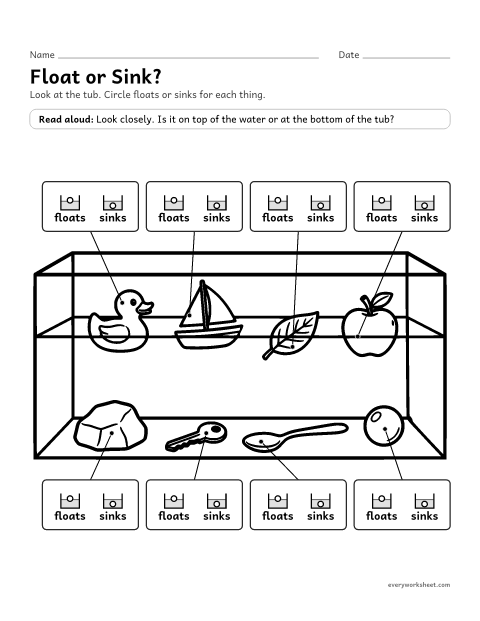
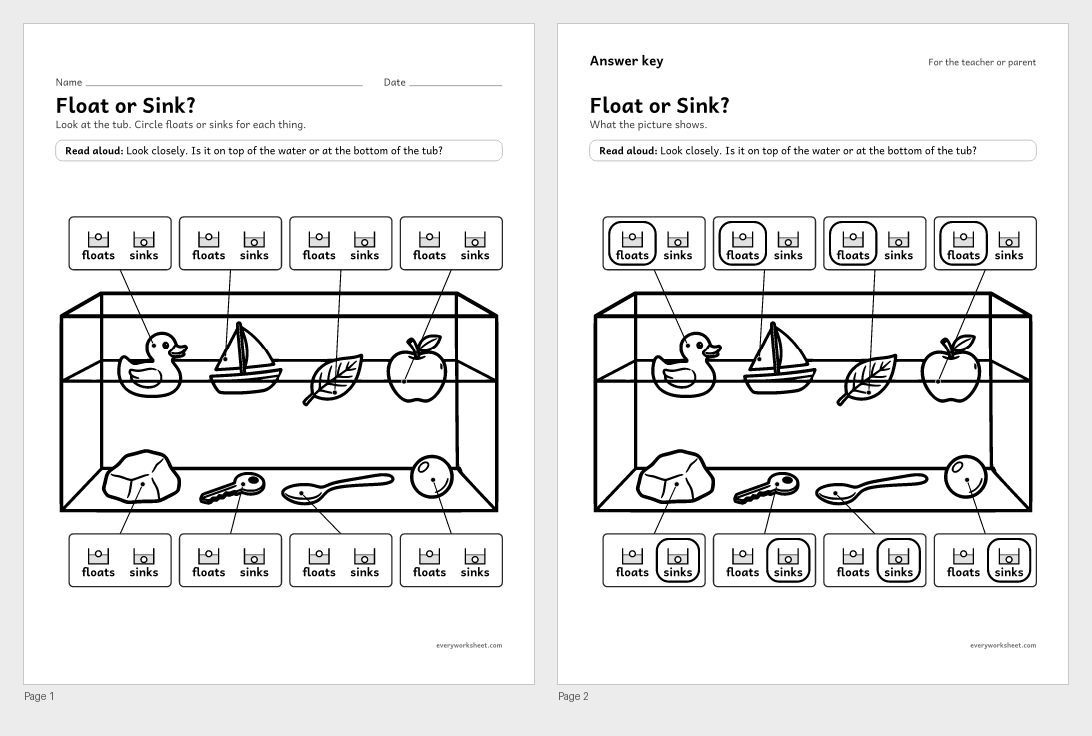
Sink or Float: look at the tub
Telling floating from sinking in a picture
Answer key on page 2
2 pages53 KB
 View all 2 pages
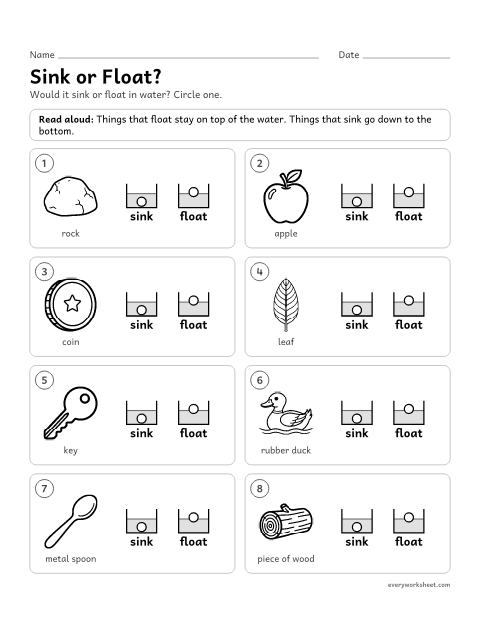
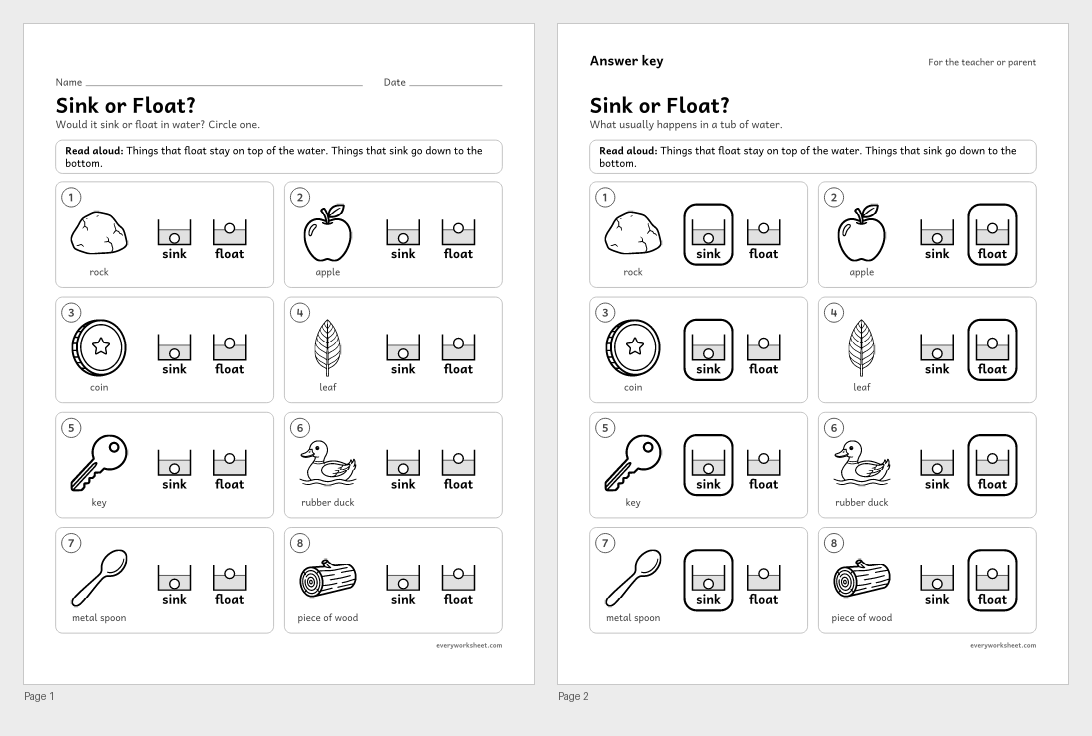
Sink or float picture sort
Predicting what sinks and what floats
Answer key on page 2
2 pages251 KB
Predict and test
 View all 2 pages
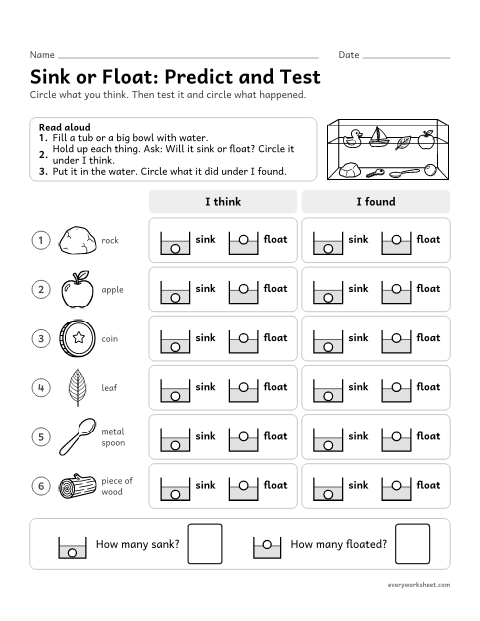
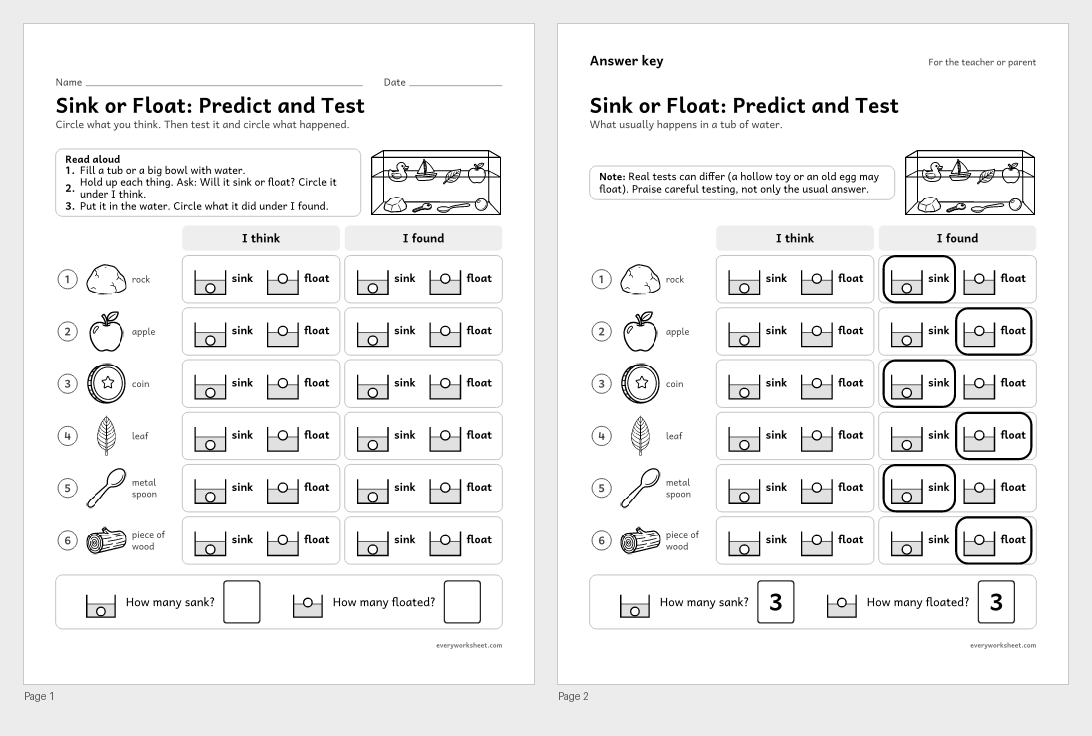
Sink or float predict and test record sheet
Predicting and testing what sinks and floats
Answer key on page 2
2 pages249 KB
Design challenge
 View larger
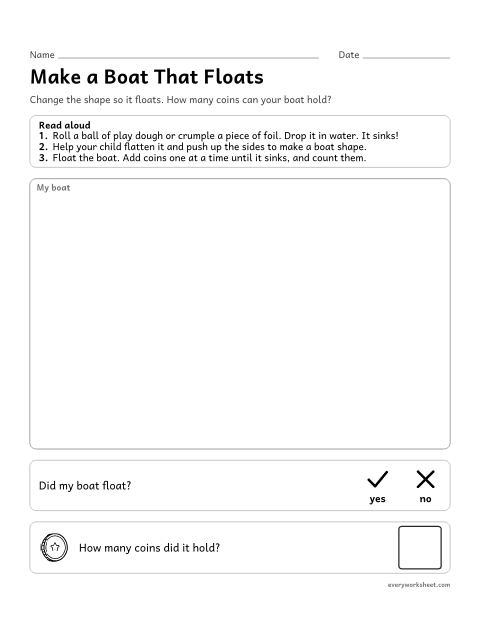
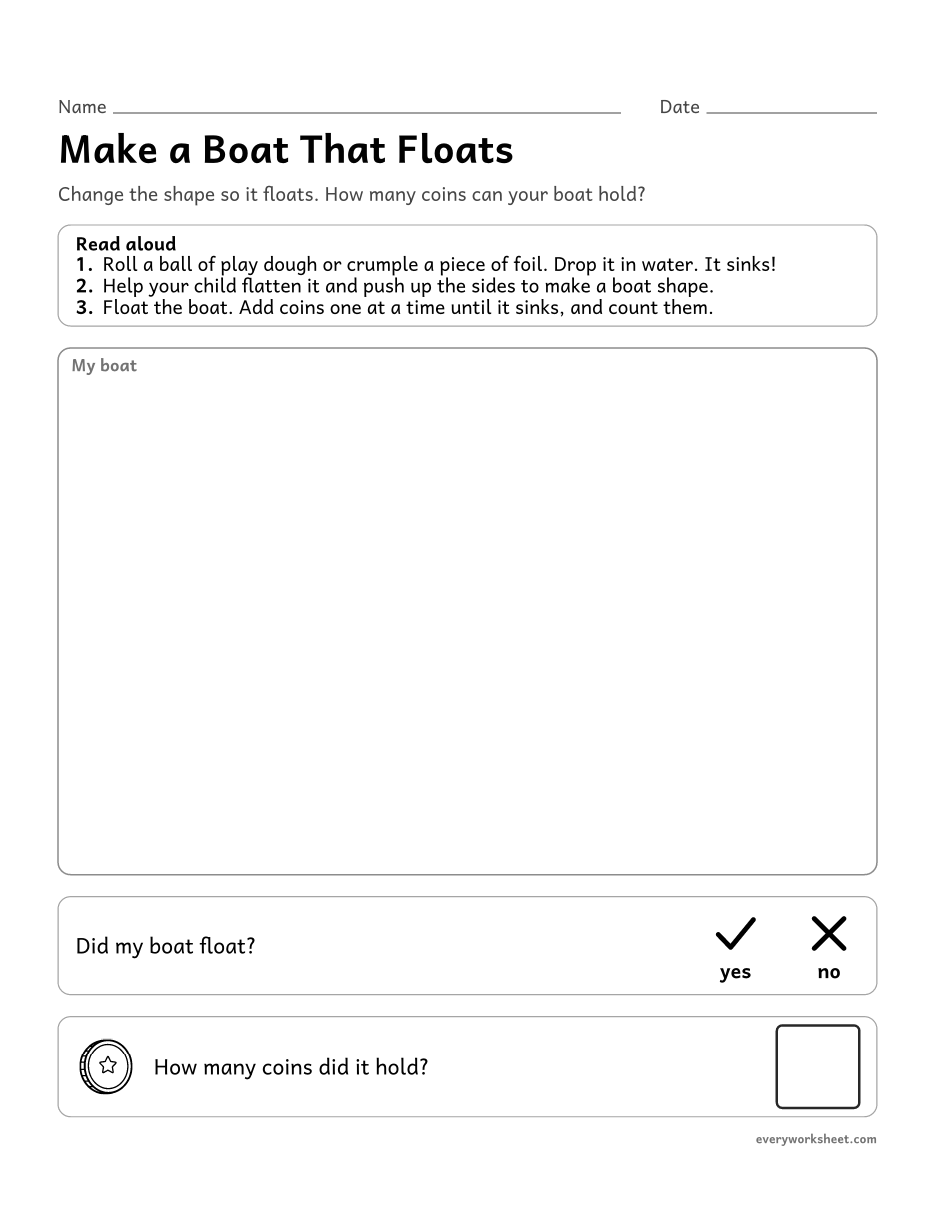
Design Challenge: make a clay or foil boat float
Changing a shape so it floats
1 page56 KB
Print at 100% (actual size) for the cleanest tracing lines.
About these sink or float worksheets
Sink or float is one of the best first experiments for young children. All you need is a tub of water and a few things from around the house or classroom. Children guess, test, and see the answer right away.
Things that float stay on top of the water. Things that sink go down to the bottom. Rocks, coins, keys and most metal things sink. Wood, leaves, apples and things with air inside, like a rubber duck or a ball, usually float.
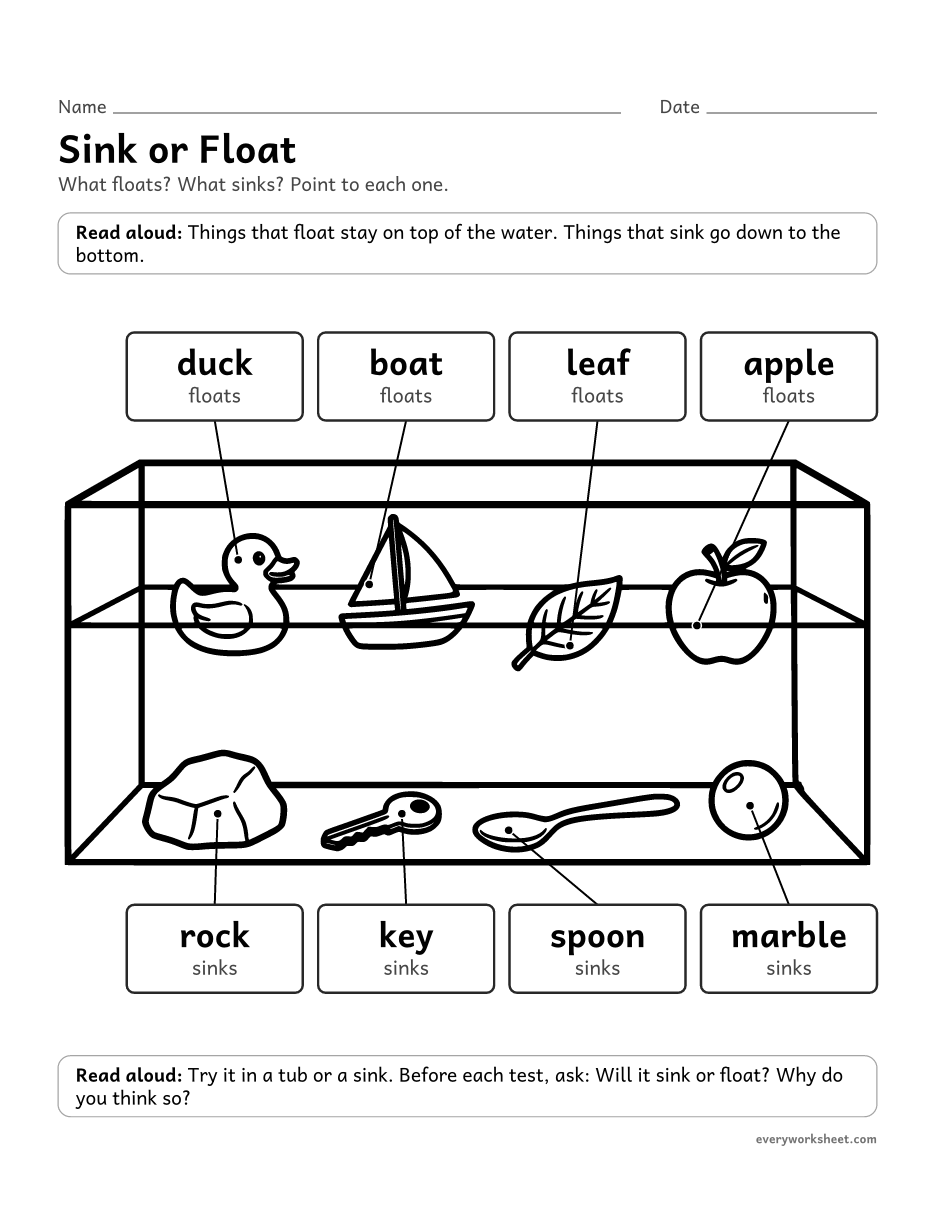
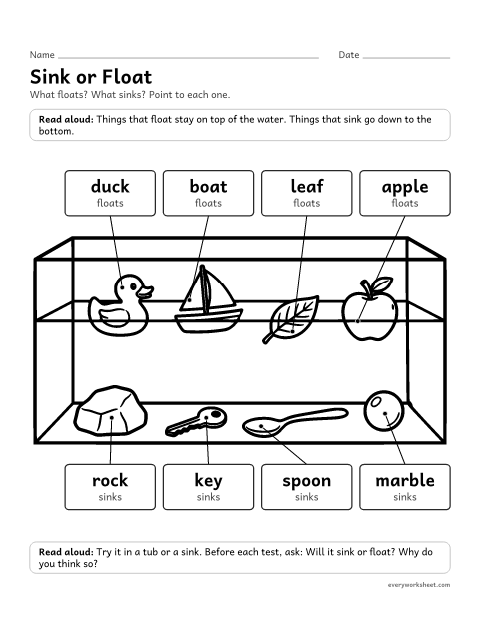
Start with the poster: a tub of water where a duck, a boat, a leaf and an apple float and a rock, a key, a spoon and a marble rest on the bottom. On the look-and-circle page, children read the same picture and circle floats or sinks for each thing. Then test for real with the predict-and-test record sheet: circle a guess under I think, test, and circle what happened under I found. The make-a-boat challenge shows that changing the shape of play dough or foil can turn a sinker into a floater. Sorting materials by what they do is a skill children build on in 2nd grade science.
Standards
NGSS K-PS2-1Plan and conduct an investigation to compare the effects of different strengths or different directions of pushes and pulls on the motion of an object.NGSS 2-PS1-1Plan and conduct an investigation to describe and classify different kinds of materials by their observable properties (grade 2).NGSS 2-PS1-2Analyze data obtained from testing different materials to determine which materials have the properties that are best suited for an intended purpose (grade 2).NGSS K-2-ETS1-2Develop a simple sketch, drawing, or physical model to illustrate how the shape of an object helps it function as needed to solve a given problem.CCSS.MATH.CONTENT.K.MD.B.3Classify objects into given categories; count the numbers of objects in each category and sort the categories by count.CCSS.MATH.CONTENT.K.CC.B.5Count to answer "how many?" questions about as many as 20 things arranged in a line, a rectangular array, or a circle, or as many as 10 things in a scattered configuration.CCSS.ELA-LITERACY.W.K.8With guidance and support from adults, recall information from experiences or gather information from provided sources to answer a question.CCSS.ELA-LITERACY.W.K.2Use a combination of drawing, dictating, and writing to compose informative/explanatory texts in which they name what they are writing about and supply some information about the topic.CCSS.ELA-LITERACY.L.K.6Use words and phrases acquired through conversations, reading and being read to, and responding to texts.
How to use them
- Fill a clear tub or bowl with water so everyone can see the bottom. Lay a towel underneath.
- Hold up each object and ask, "Will it sink or float?" Let your child circle a guess before testing. Guesses are never wrong.
- Drop it in gently and watch. Circle what happened, then count how many sank and how many floated.
- Use the picture sort as a review away from the water. Ask, "Why do you think so?" for each one.
- Finish with the make-a-boat challenge, and count how many coins the boat holds before it sinks.
Teaching tips
- Results can differ: an apple floats, but some old eggs float and fresh ones sink. Praise careful testing more than the usual answer.
- Children often think big things sink and small things float. Test a big piece of wood and a small coin to challenge that idea.
- A coin or paper clip resting on the water's skin may seem to float. Push it gently under and see whether it comes back up.
- Use the answer keys for the sorts, and the 'what usually happens' key for the record sheet, but trust what your child saw.
- Always supervise water play.
Questions teachers and parents ask
What things sink and float for a kindergarten experiment?
Reliable sinkers are rocks, coins, keys, metal spoons, paper clips and bolts. Reliable floaters are apples, leaves, pieces of wood, corks, rubber ducks, plastic balls and ice cubes.
Why do some things float?
For kindergarten, keep it simple: things that are light for their size, or have air inside, tend to float. Things that are heavy for their size tend to sink.
What is a sink or float record sheet?
A table where children circle what they think will happen before testing each object, then circle what really happened. It teaches the habit of predicting, testing and recording.
Is sink or float a kindergarten standard?
It is a classic kindergarten investigation that builds the skills of observing and recording. Sorting materials by their properties is formally taught in 2nd grade.
Are these worksheets free?
Yes. Every page is a free PDF with no sign-up, in US Letter and A4. The look-and-circle page, the sort and the predict-and-test sheet include an answer key.