 14 pagesView all 14 pages
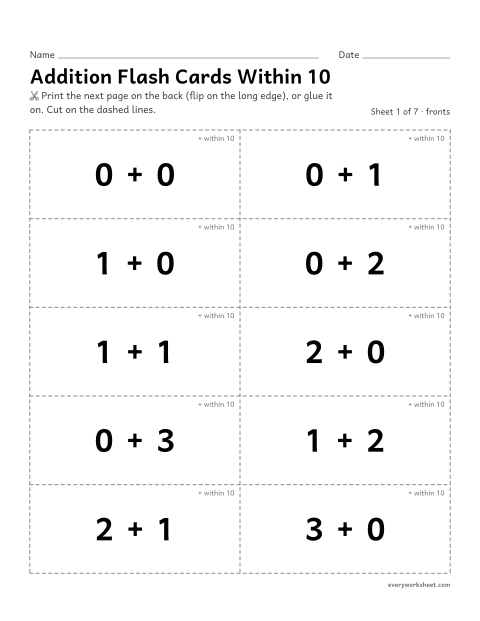
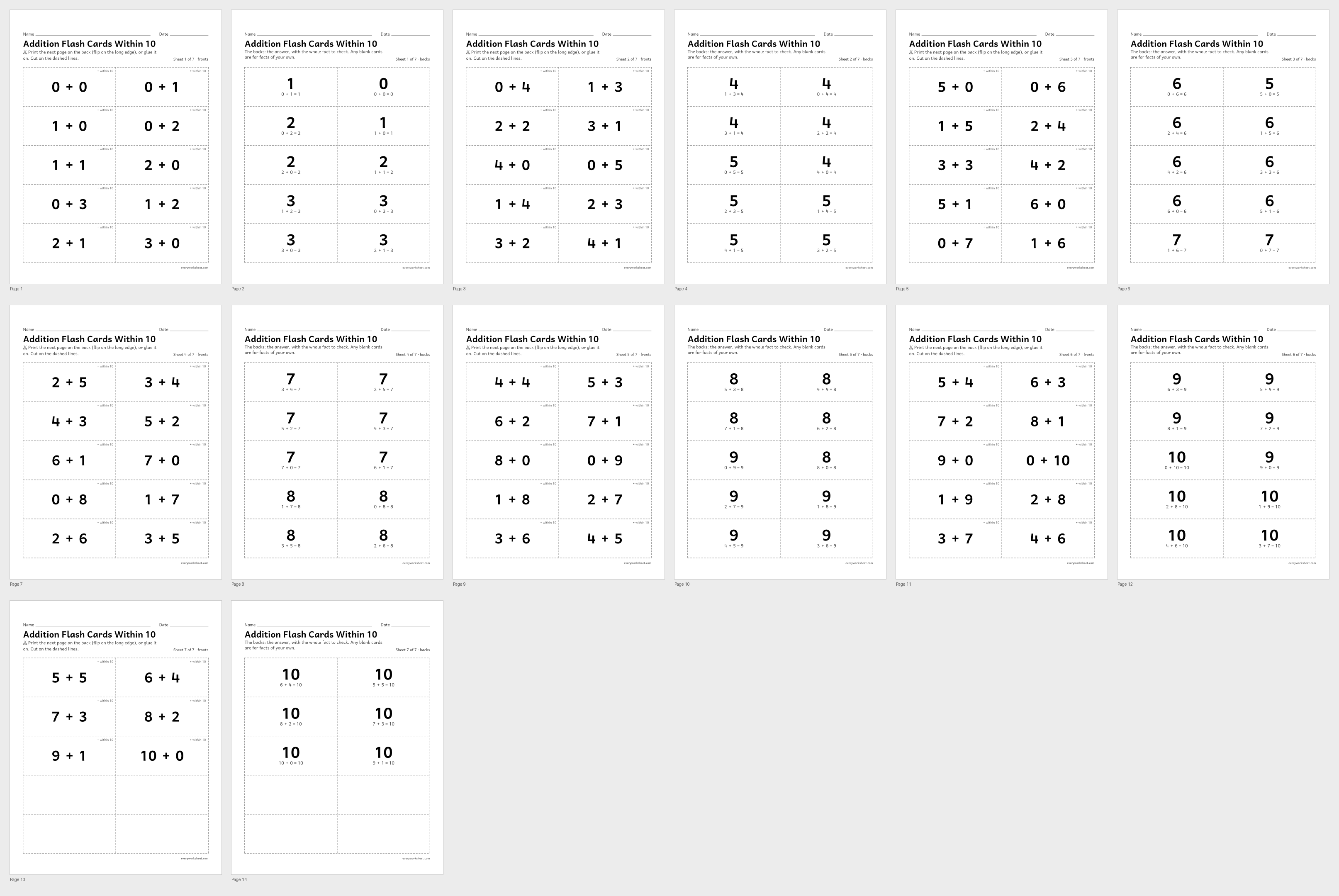
Addition flash cards within 10
Practicing addition facts within 10 with flash cards
14 pages301 KB
Printable fact cards for addition and subtraction within 10 and 20, and multiplication and division to 12, with each answer printed on the back.
14 pagesView all 14 pagesPracticing addition facts within 10 with flash cards
14 pages301 KB
 14 pagesView all 14 pages
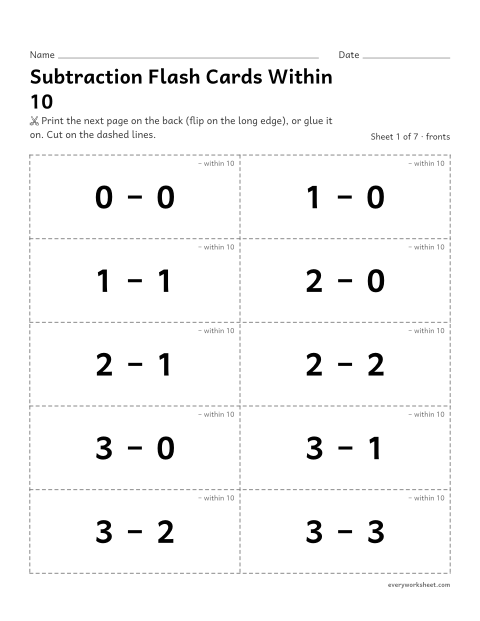
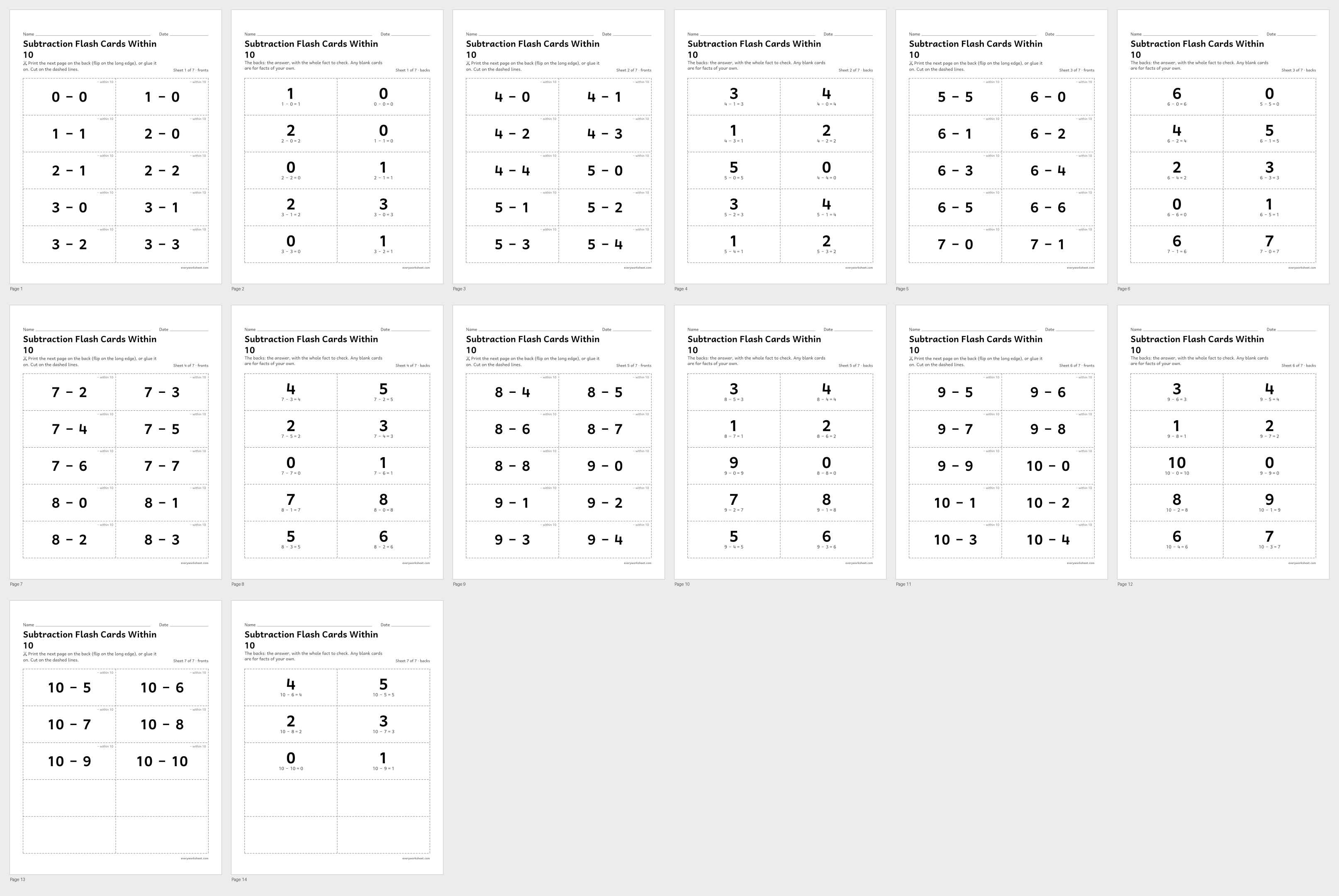
Practicing subtraction facts within 10 with flash cards
14 pages302 KB
 12 pagesView all 12 pages
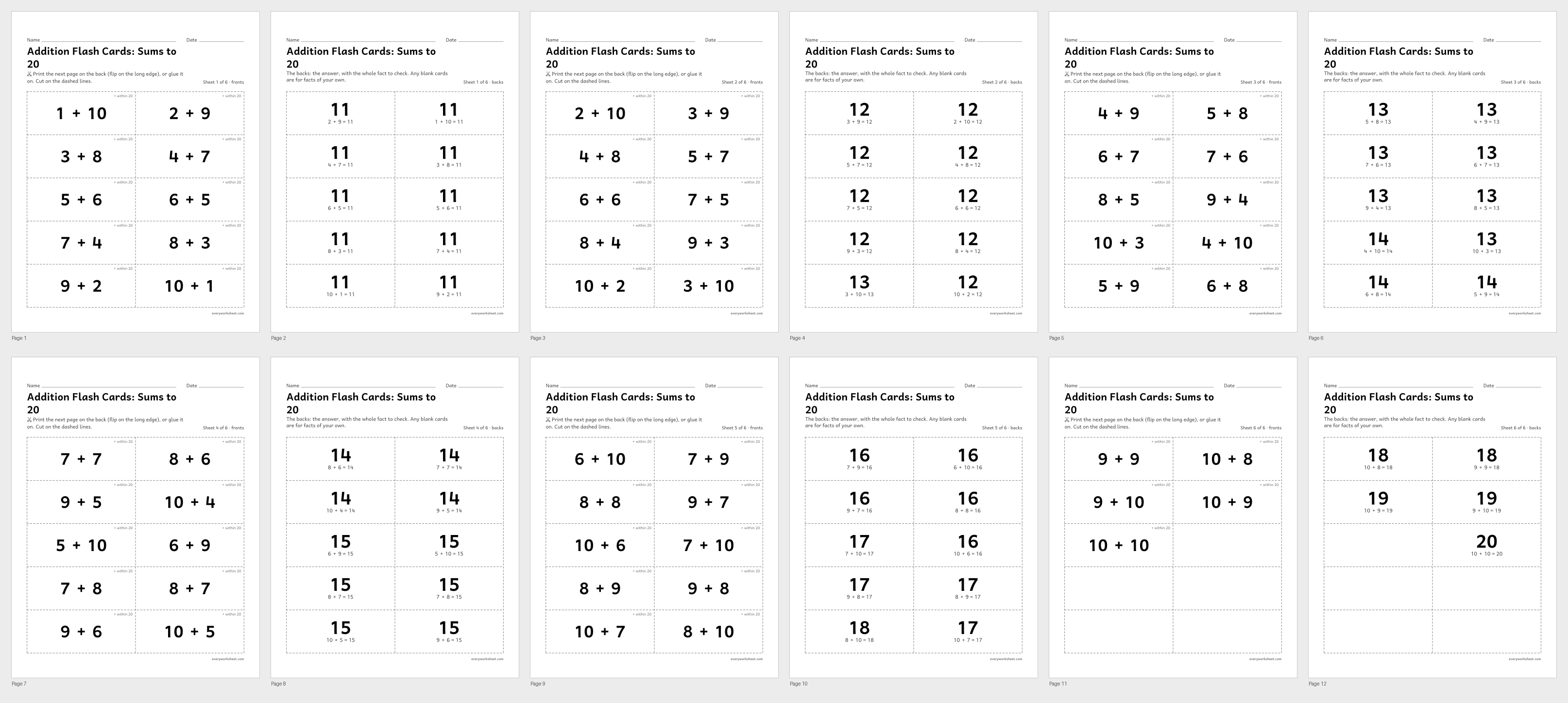
Practicing addition facts with sums from 11 to 20 with flash cards
12 pages262 KB
 12 pagesView all 12 pages
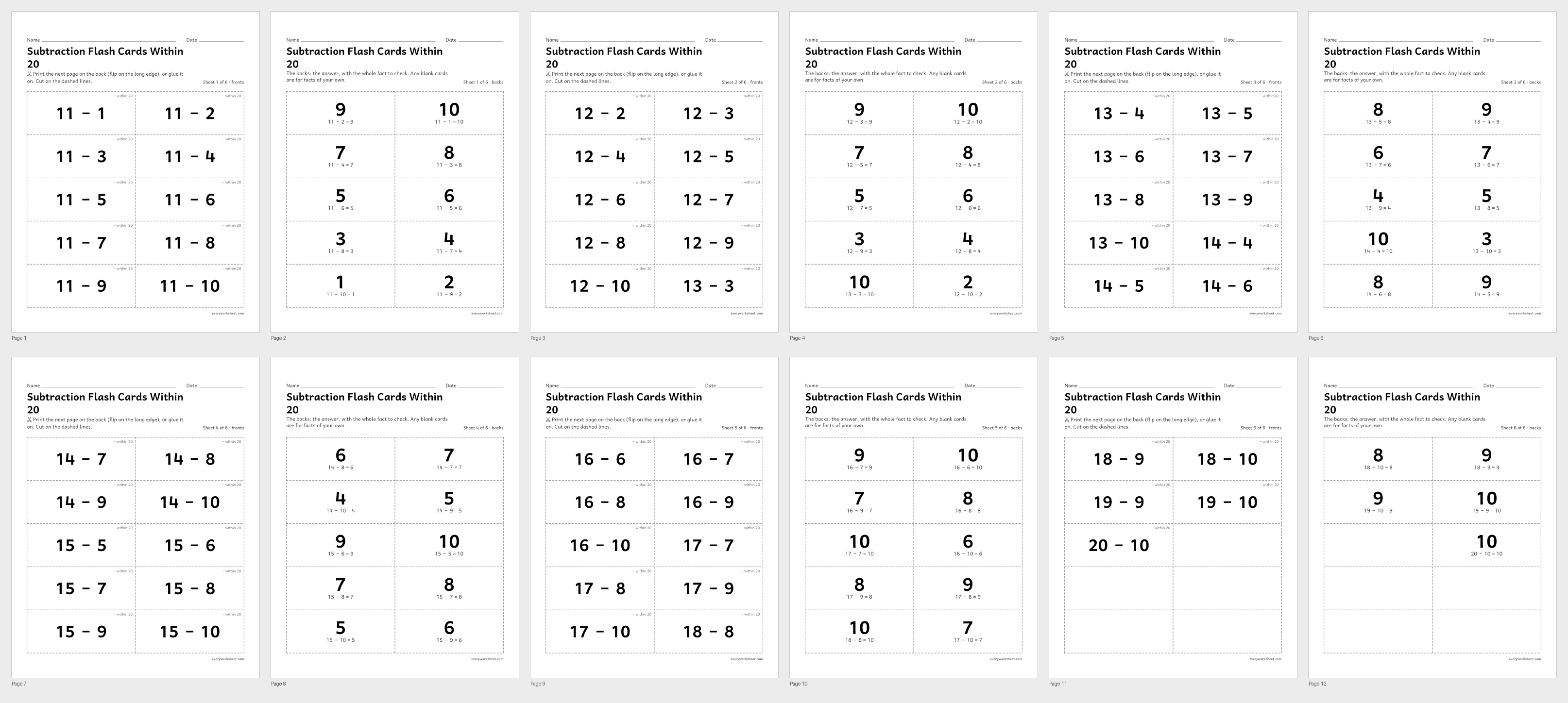
Practicing subtraction facts from 11 to 20 with flash cards
12 pages262 KB
 16 pagesView all 16 pages
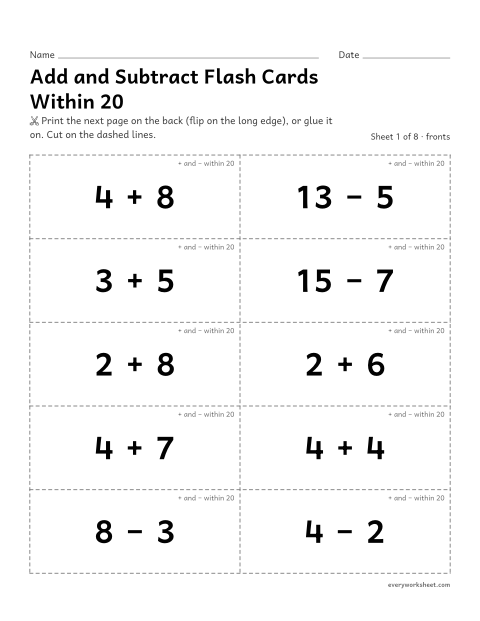
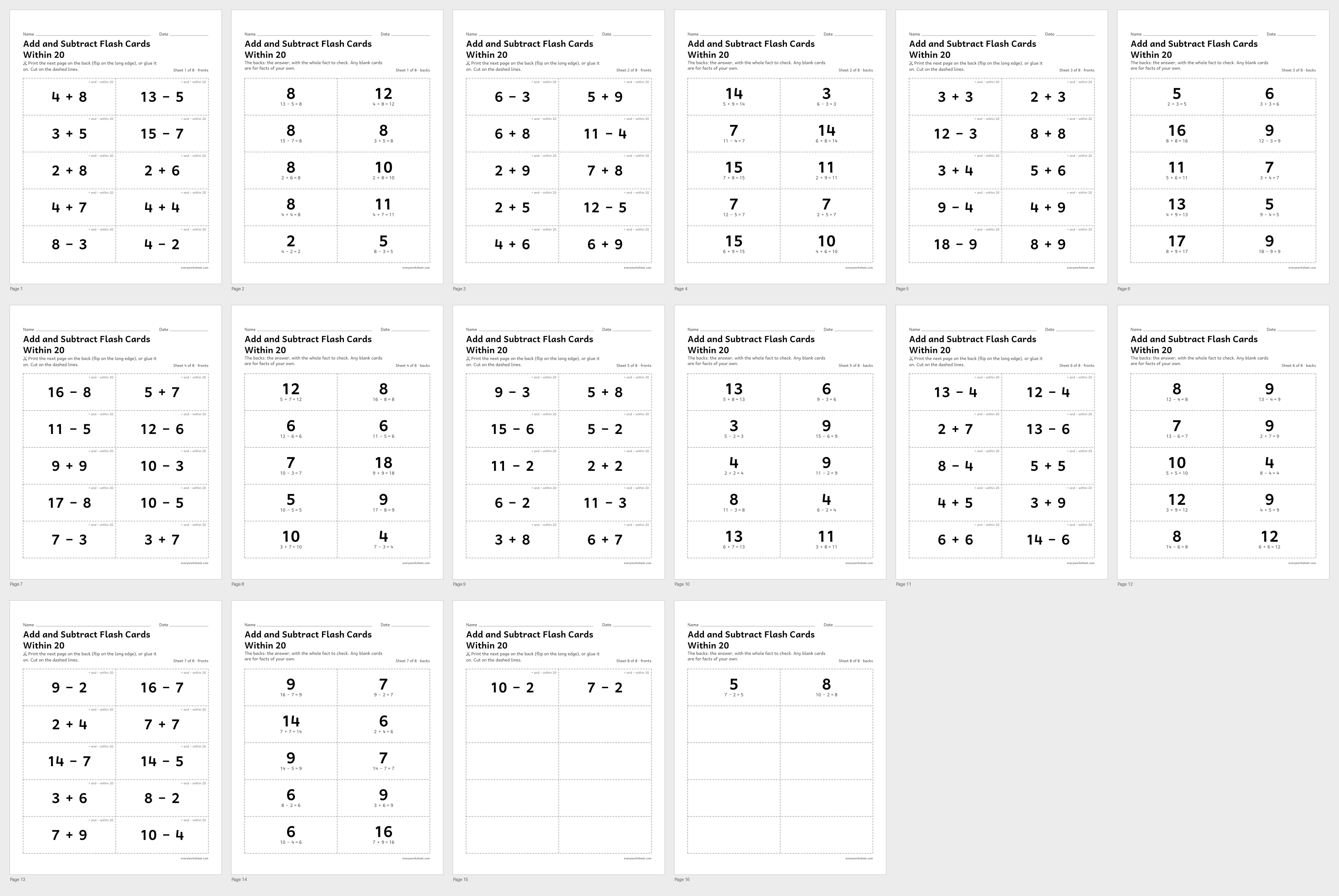
Practicing addition and subtraction facts within 20 with mixed flash cards
16 pages341 KB
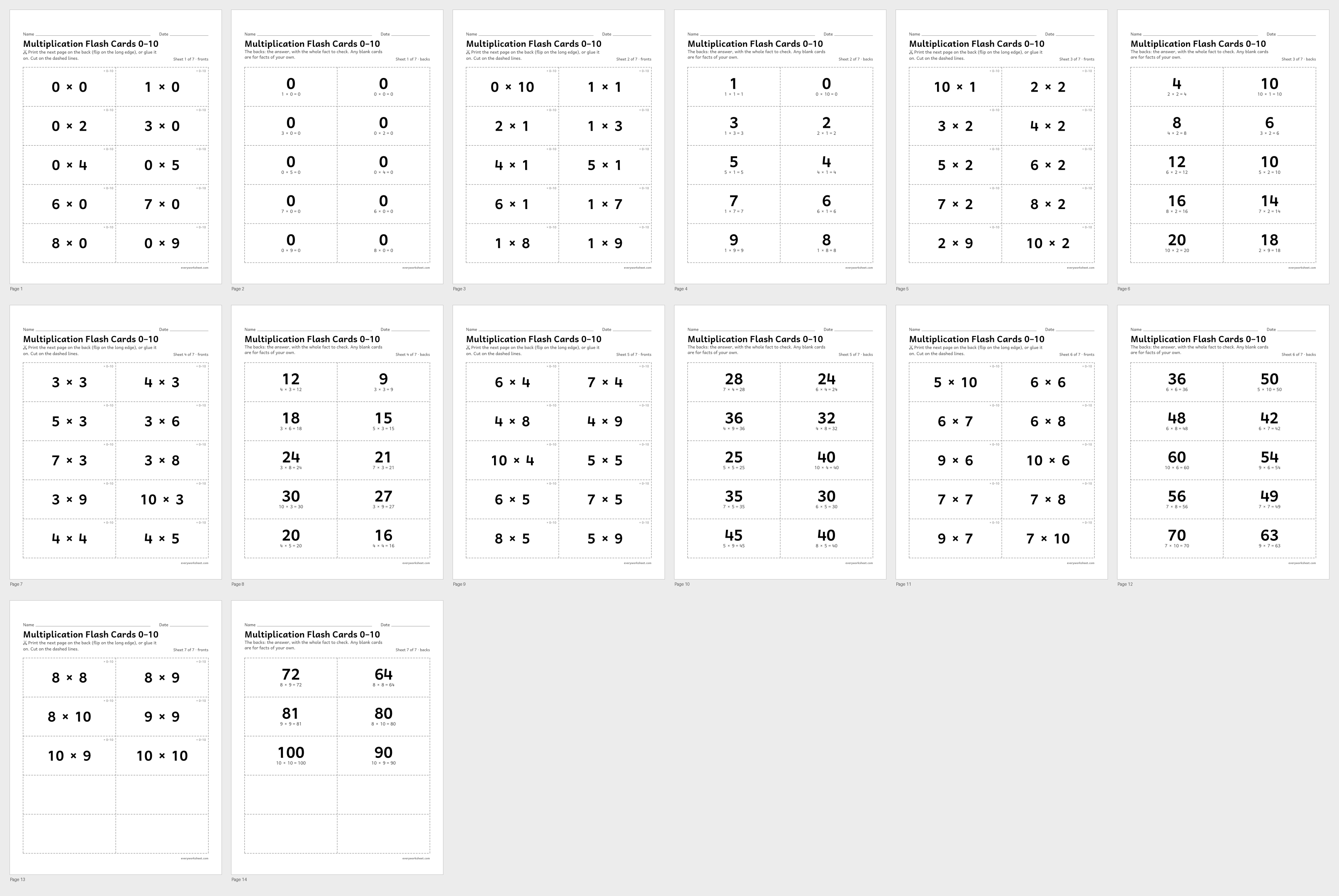 14 pagesView all 14 pages
Practicing multiplication facts from 0 × 0 to 10 × 10 with flash cards
14 pages302 KB
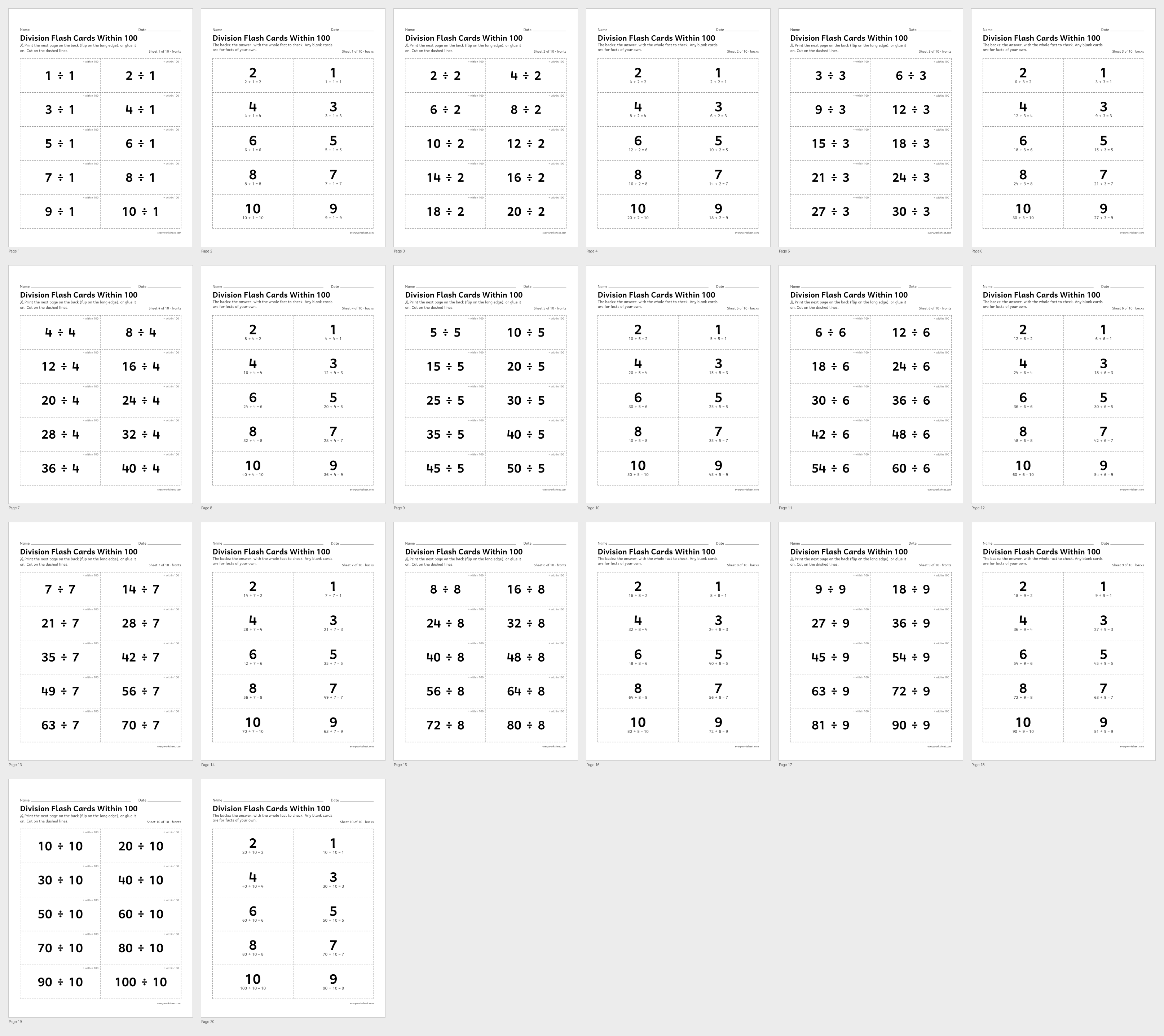 20 pagesView all 20 pages
Practicing division facts within 100 with flash cards
20 pages423 KB
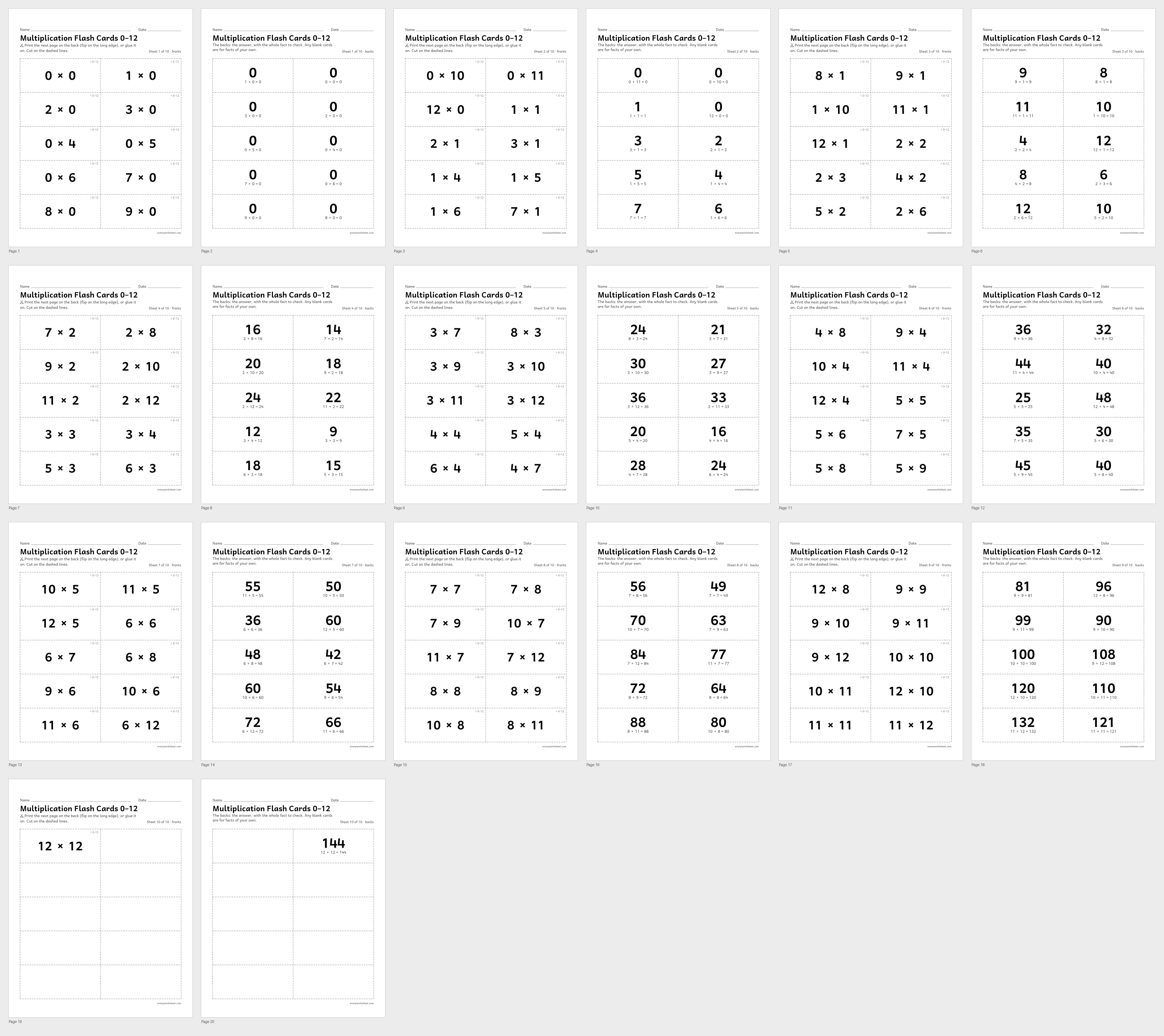 20 pagesView all 20 pages
Practicing multiplication facts to 12 × 12 with flash cards
20 pages418 KB
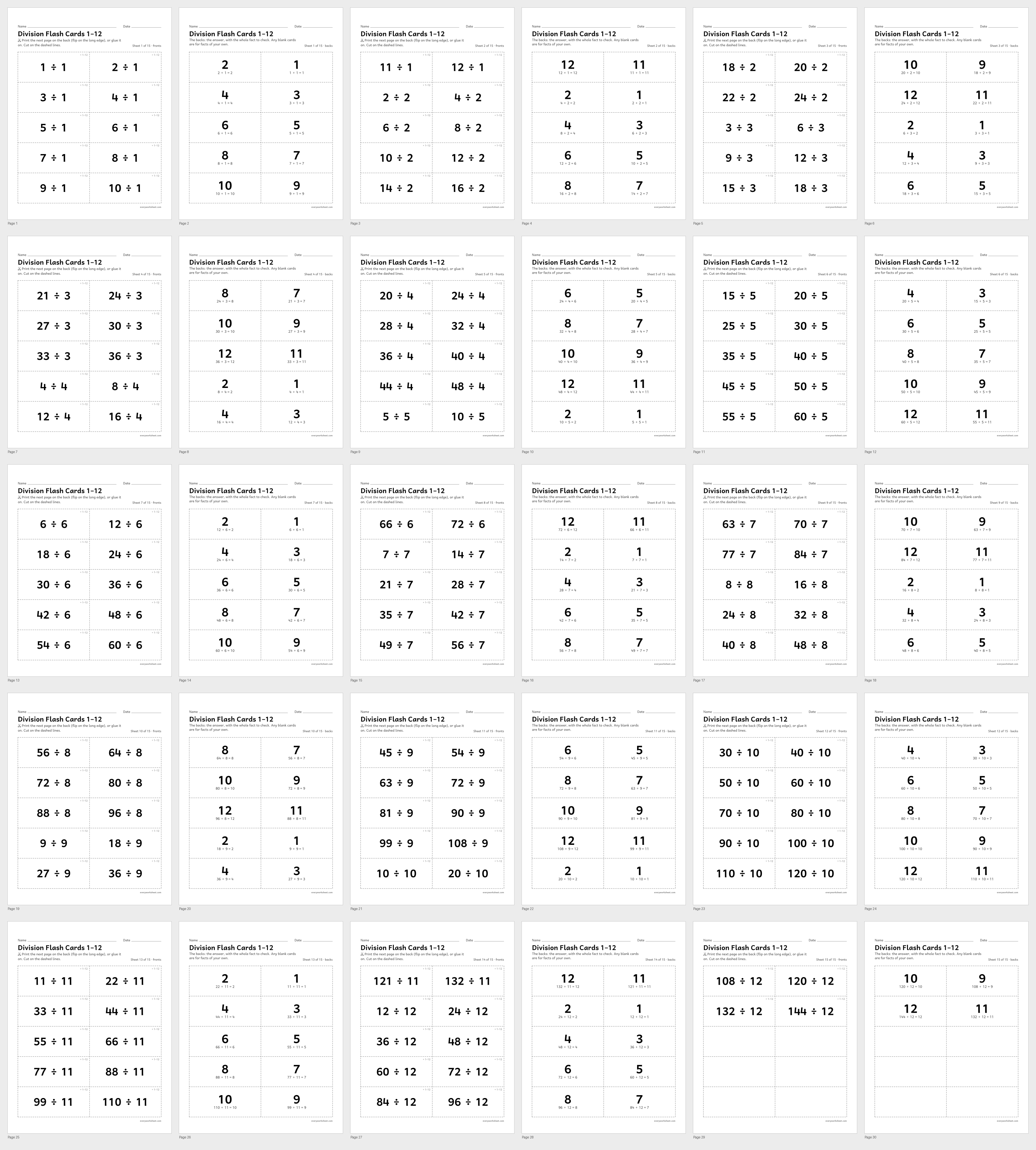 30 pagesView all 30 pages
Practicing division facts with divisors and quotients from 1 to 12 with flash cards
30 pages619 KB
Print at 100% (actual size) for the cleanest tracing lines.
These math fact flash cards print ten to a page. The fact is on the front and the answer is on the back, so a child can quiz alone and check every card.
Each set covers every fact in its range, not a sample: all the addition facts within 10, all the sums to 20, every multiplication fact to 10 × 10 or 12 × 12 and every division fact that goes with them.
Print the front page, then the back page on the other side of the same sheet. The backs are laid out in mirror order, so each answer lands behind its own fact when you flip on the long edge.
CCSS.MATH.CONTENT.K.OA.A.5Fluently add and subtract within 5.CCSS.MATH.CONTENT.1.OA.C.6Add and subtract within 20, demonstrating fluency for addition and subtraction within 10. Use strategies such as counting on; making ten (e.g., 8 + 6 = 8 + 2 + 4 = 10 + 4 = 14); decomposing a number leading to a ten (e.g., 13 - 4 = 13 - 3 - 1 = 10 - 1 = 9); using the relationship between addition and subtraction (e.g., knowing that 8 + 4 = 12, one knows 12 - 8 = 4); and creating equivalent but easier or known sums (e.g., adding 6 + 7 by creating the known equivalent 6 + 6 + 1 = 12 + 1 = 13).CCSS.MATH.CONTENT.2.OA.B.2Fluently add and subtract within 20 using mental strategies. By end of Grade 2, know from memory all sums of two one-digit numbers.CCSS.MATH.CONTENT.3.OA.C.7Fluently multiply and divide within 100, using strategies such as the relationship between multiplication and division (e.g., knowing that 8 × 5 = 40, one knows 40 ÷ 5 = 8) or properties of operations. By the end of Grade 3, know from memory all products of two one-digit numbers.Print the front page and the back page on the two sides of one sheet and choose flip on the long edge. The backs are in mirror order, so each answer lines up behind its fact. If your printer cannot print both sides, print both pages and glue them back to back before cutting.
Kindergarten children start with addition and subtraction within 10, 1st graders move on to sums up to 20, 2nd graders practice all of them mixed, 3rd graders learn multiplication and division to 10 × 10, and 4th graders review the full 12 × 12 tables.
A set that does not fill its last page leaves the extra cards blank. Children can write a fact they find hard on the front and its answer on the back.