 3 pagesView all 3 pages
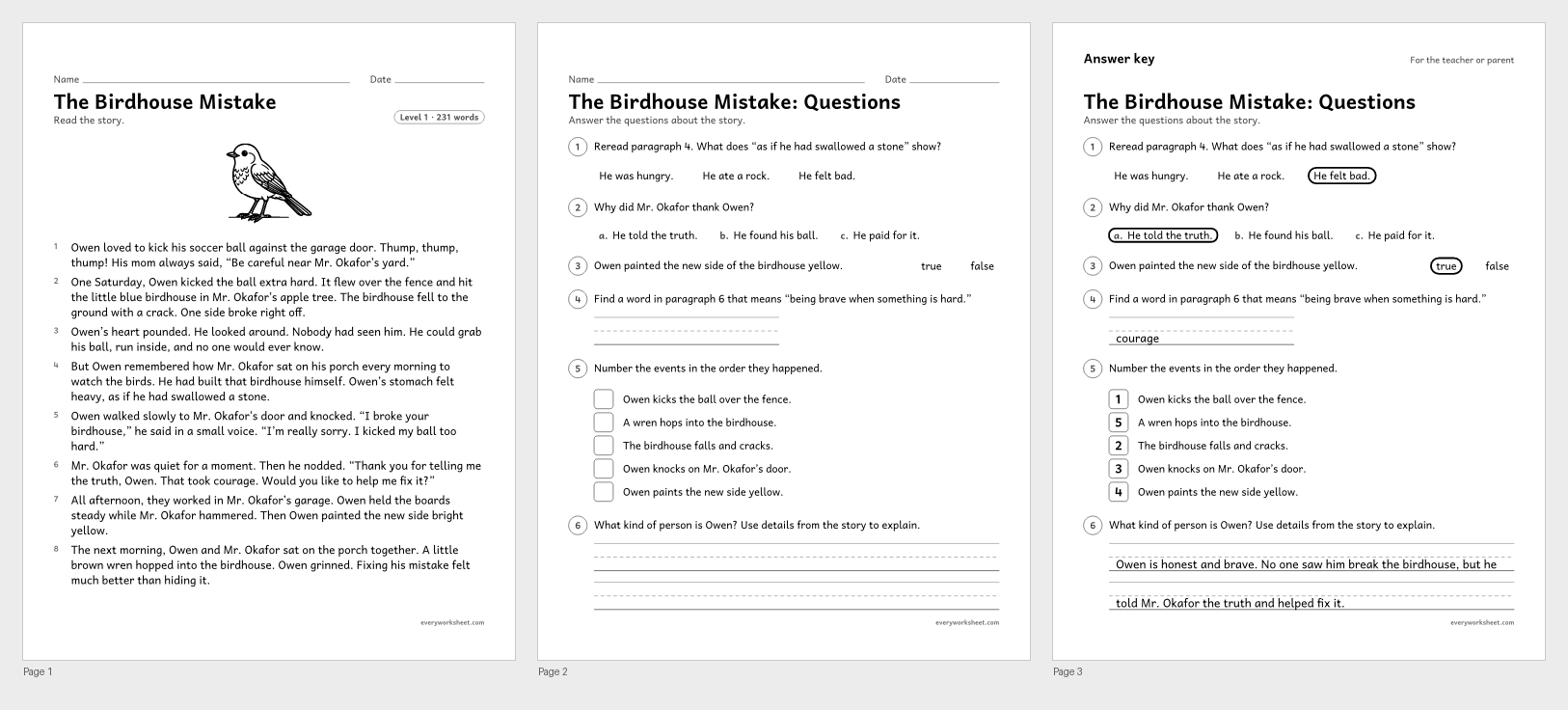
The birdhouse mistake
Describing how a character's actions and feelings move the story along
Answer key on page 3
3 pages69 KB
Original stories, nonfiction, and poems at three reading levels, each with text-based questions and an answer key, plus organizers for any book.
3 pagesView all 3 pagesDescribing how a character's actions and feelings move the story along
Answer key on page 3
3 pages69 KB
 3 pagesView all 3 pages
Asking and answering questions about a story, using details from the text
Answer key on page 3
3 pages79 KB
 3 pagesView all 3 pages
Asking and answering questions about a science text, using details from the text
Answer key on page 3
3 pages64 KB
 3 pagesView all 3 pages
Explaining causes and effects and the order of steps in a science text
Answer key on page 3
3 pages128 KB
 3 pagesView all 3 pages
Describing how a character changes and how his actions affect the story
Answer key on page 3
3 pages67 KB
 3 pagesView all 3 pages
Finding the lesson of an animal tale and how the details show it
Answer key on page 3
3 pages55 KB
 3 pagesView all 3 pages
Finding the main idea of a science text and the key details that support it
Answer key on page 3
3 pages66 KB
 3 pagesView all 3 pages
Comparing ideas across paragraphs in a text about three kinds of bridges
Answer key on page 3
3 pages82 KB
 3 pagesView all 3 pages
Finding the central message of a fable and how key details show it
Answer key on page 3
3 pages56 KB
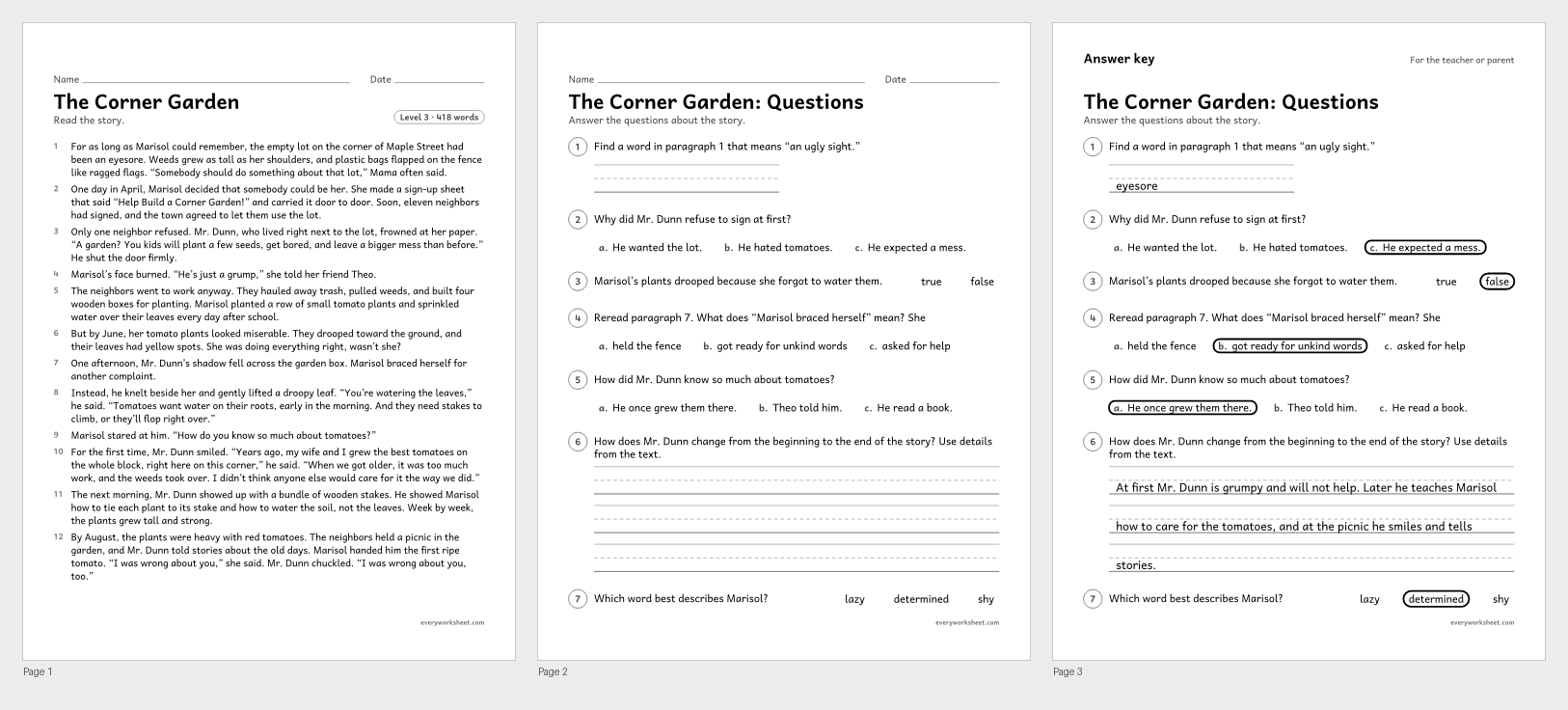 3 pagesView all 3 pages
Describing characters' traits, motivations, and feelings and how they change
Answer key on page 3
3 pages56 KB
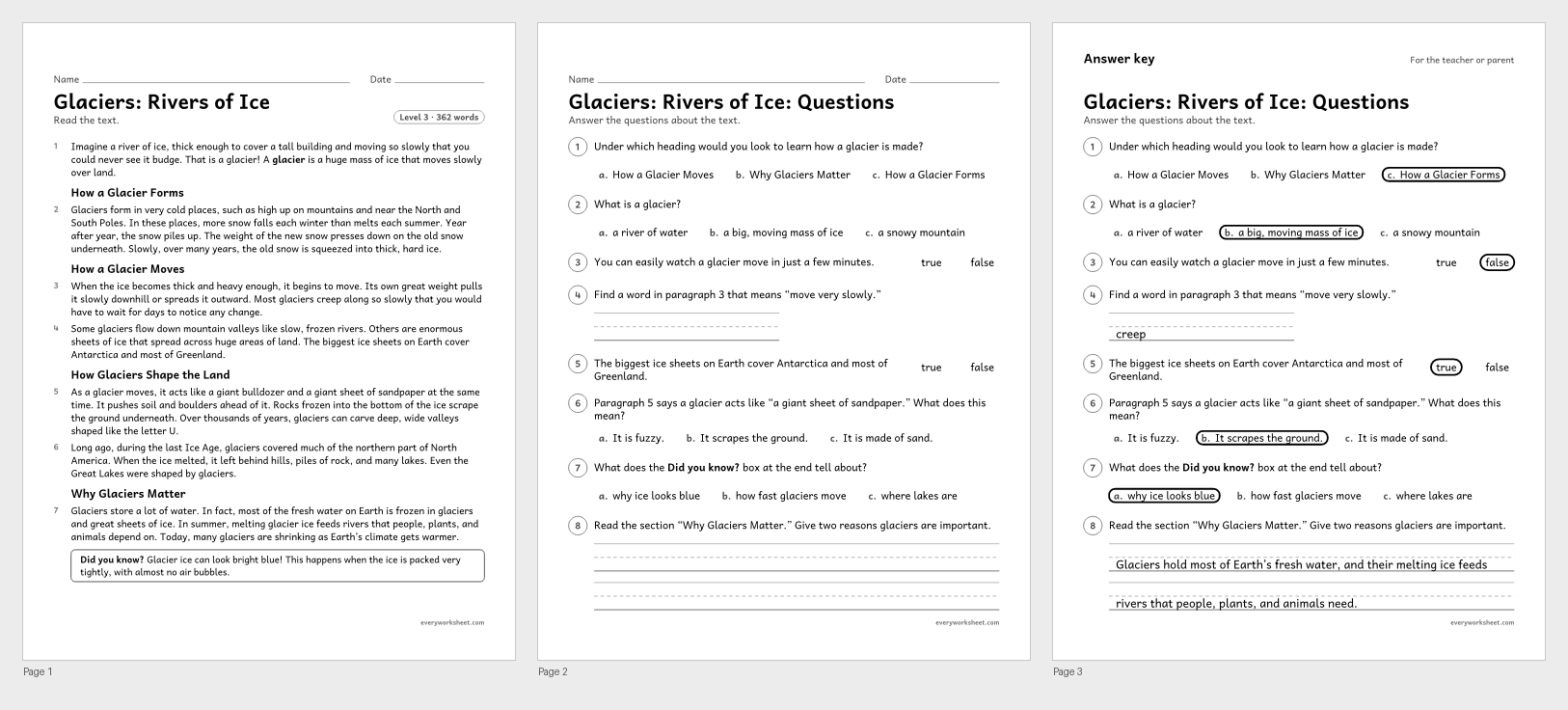 3 pagesView all 3 pages
Using headings and a fact box to find information in a science text
Answer key on page 3
3 pages57 KB
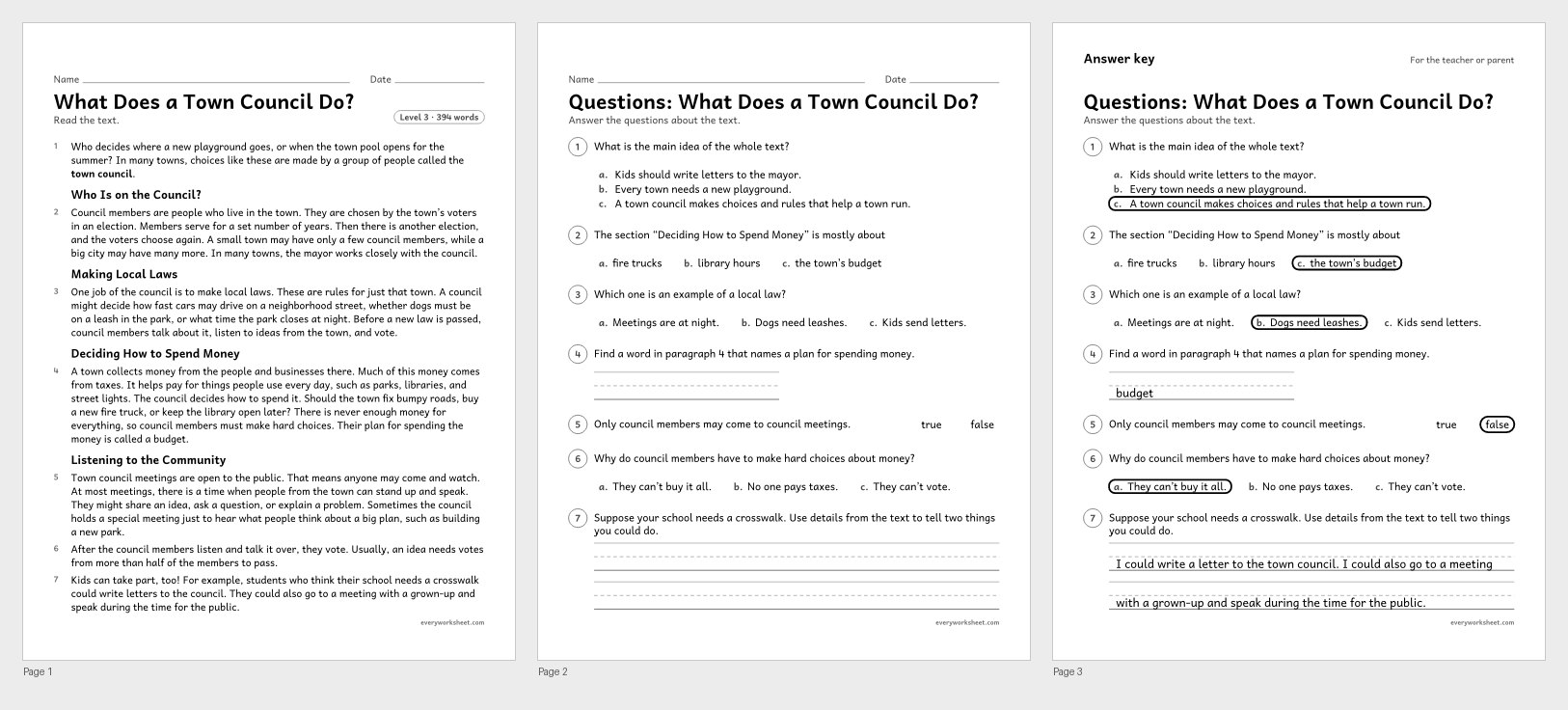 3 pagesView all 3 pages
Finding the main idea of a social studies text and of each section
Answer key on page 3
3 pages56 KB
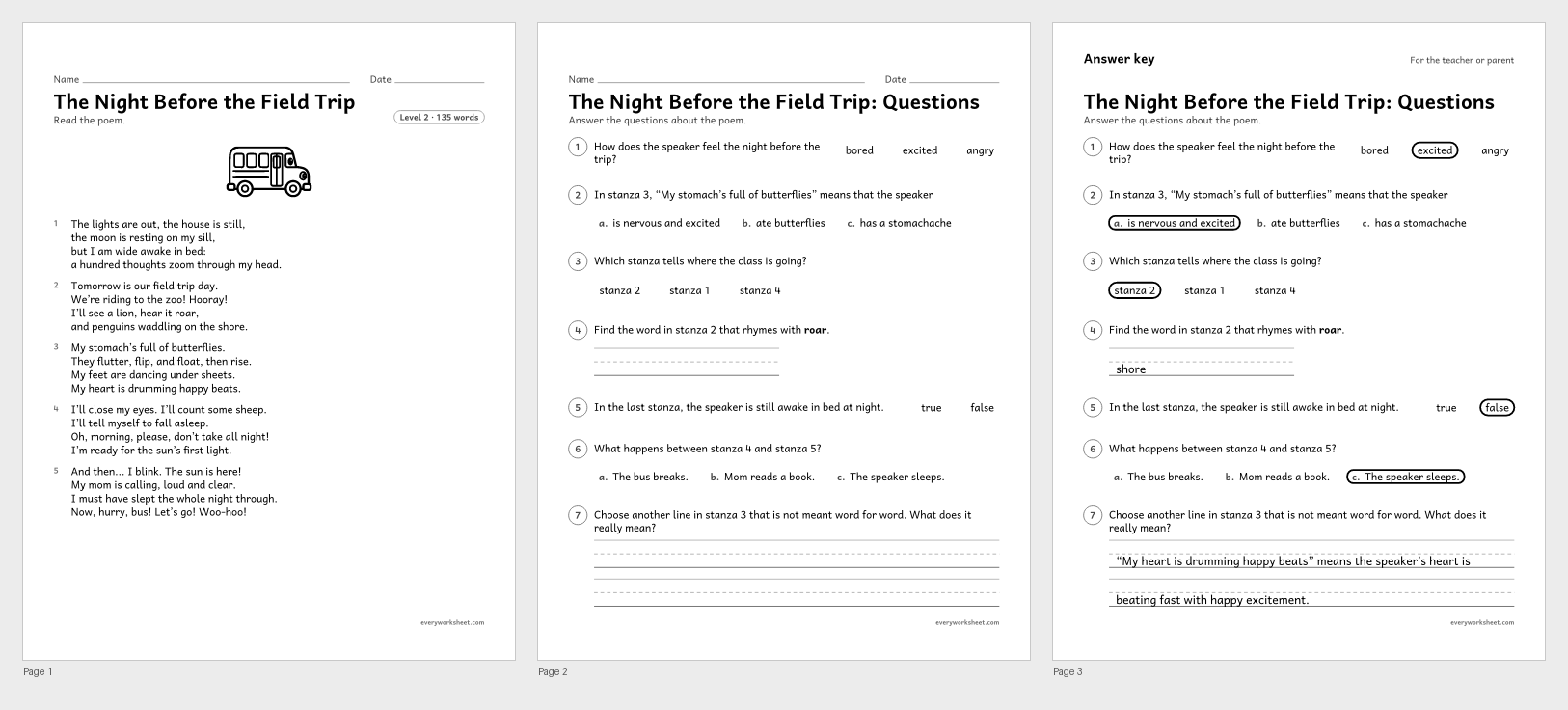 3 pagesView all 3 pages
Telling literal from nonliteral language in a rhyming poem
Answer key on page 3
3 pages63 KB
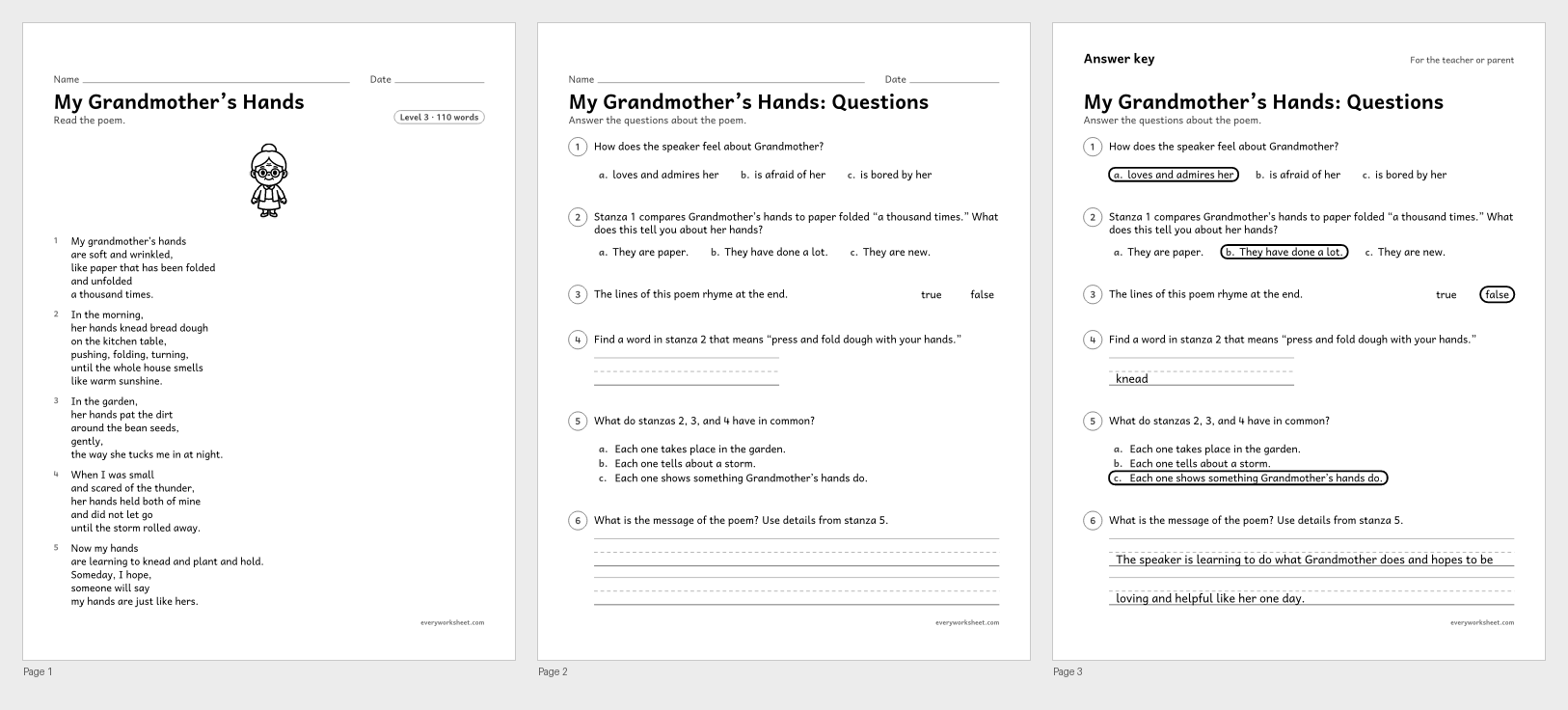 3 pagesView all 3 pages
Finding the message of a free verse poem and the speaker's feelings
Answer key on page 3
3 pages73 KB
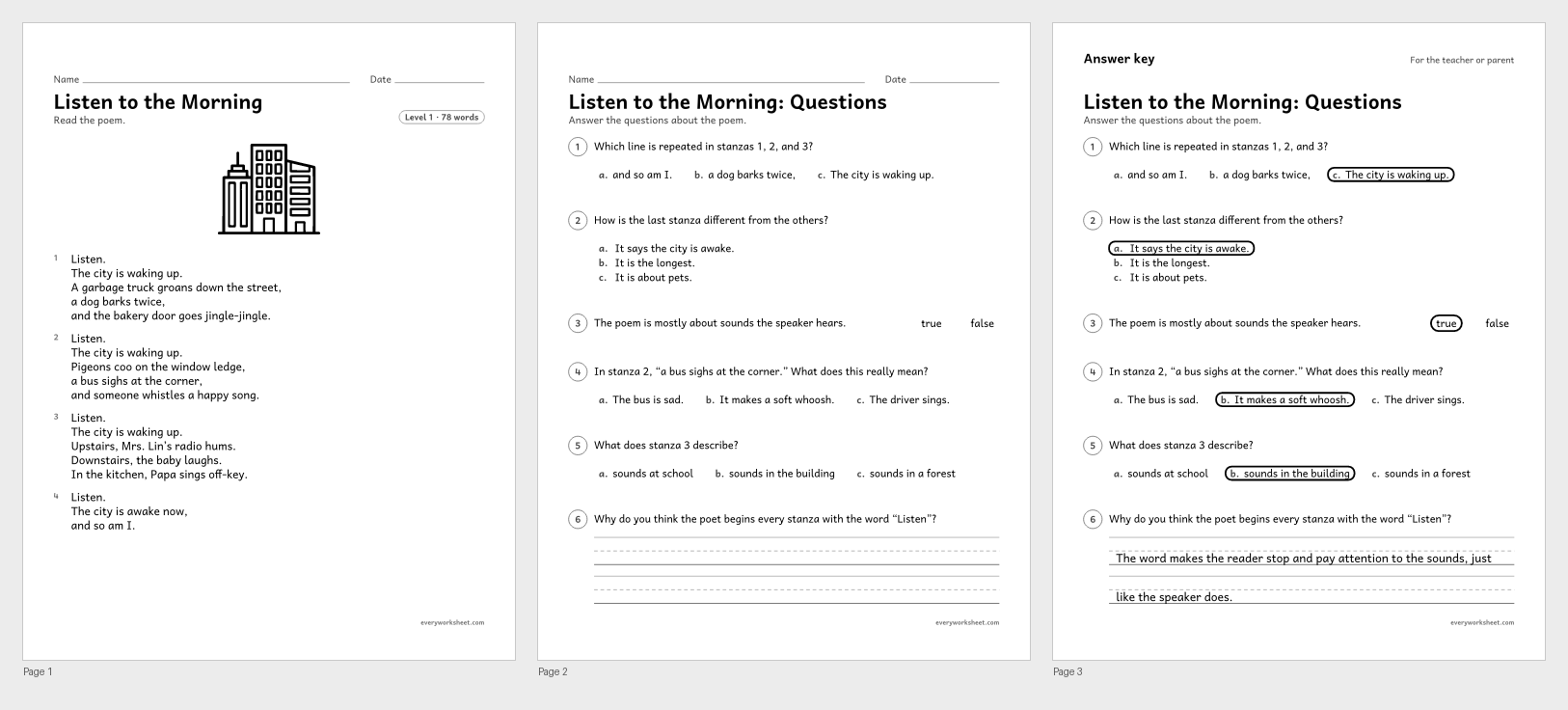 3 pagesView all 3 pages
Describing how stanzas and a repeated line build a poem
Answer key on page 3
3 pages57 KB
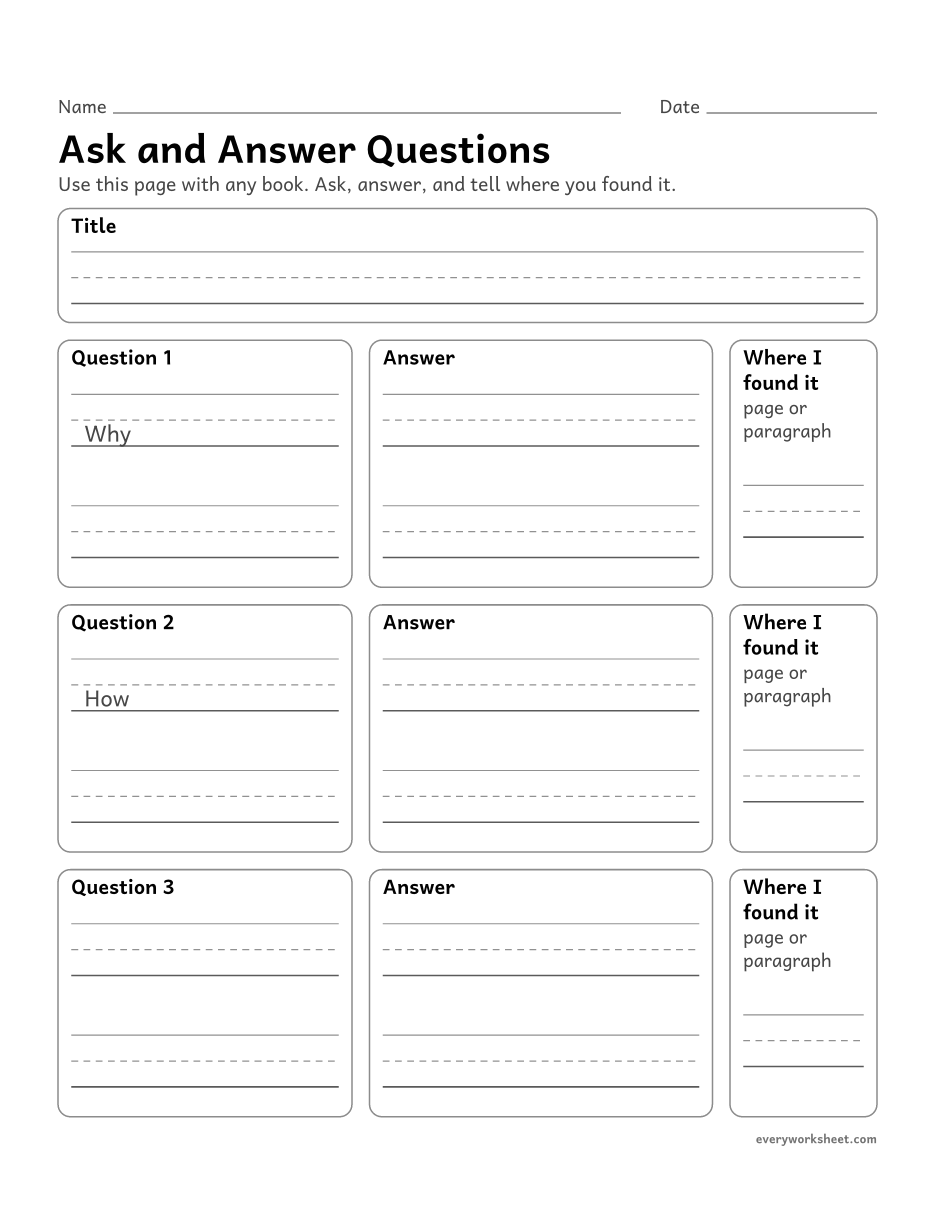 View larger
Asking and answering questions about any book and showing where the answer is in the text
1 page29 KB
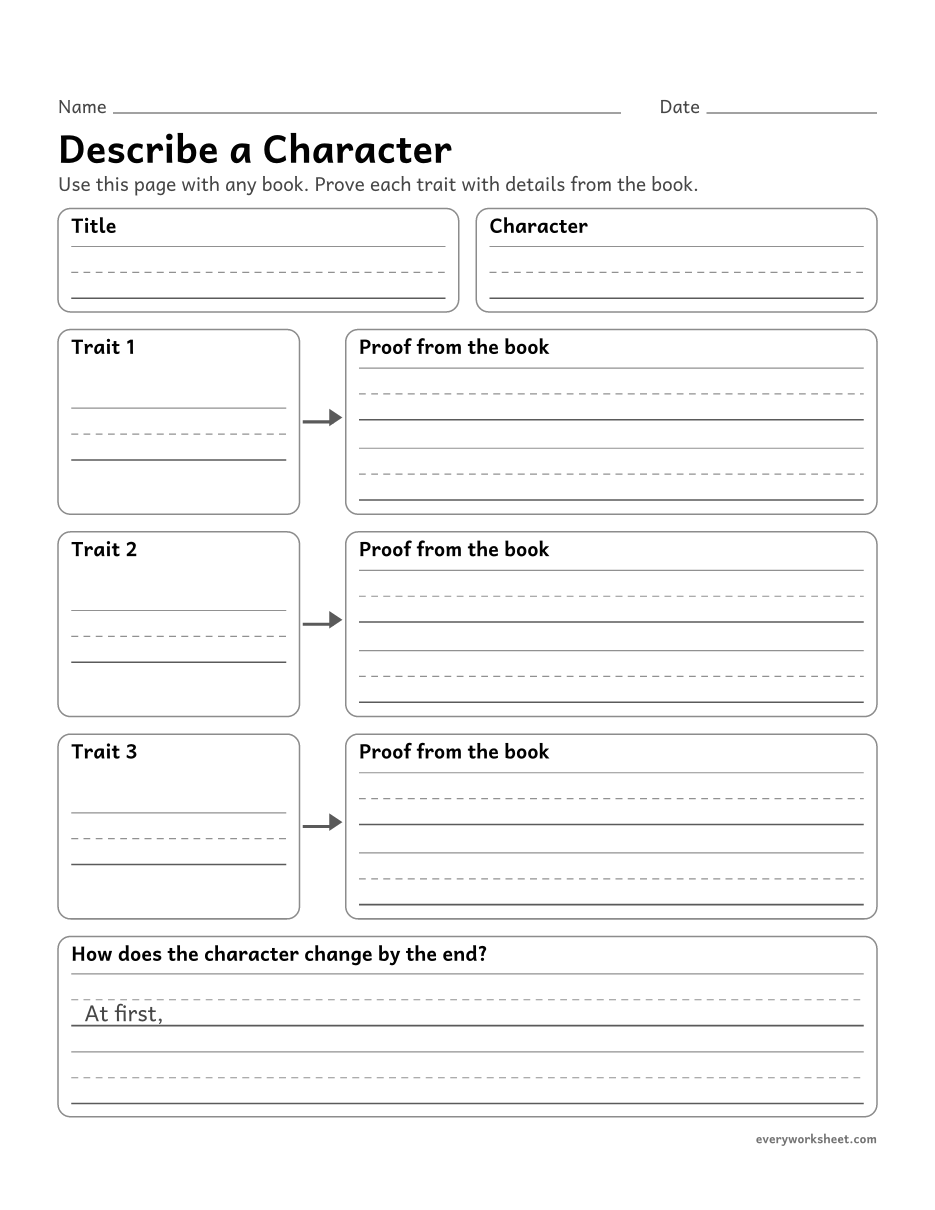 View larger
Describing a character in any book with traits and evidence from the text
1 page29 KB
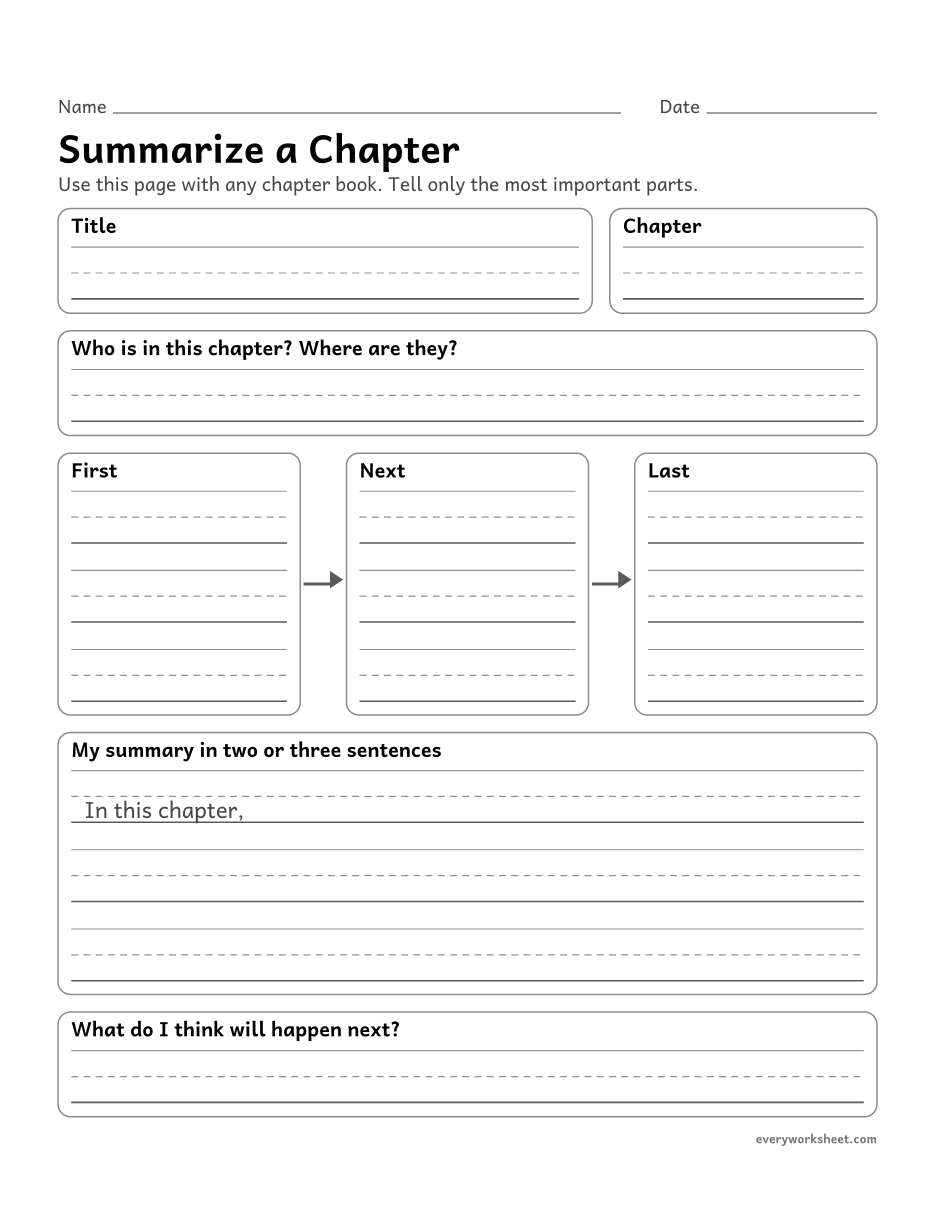 View larger
Summarizing a chapter of any book with its most important events
1 page28 KB
Print at 100% (actual size) for the cleanest tracing lines.
Third grade is the year children read longer texts on their own: stories with several paragraphs and real problems, nonfiction with headings and fact boxes, and poems with stanzas. Comprehension now means going back to the text to prove an answer, finding the main idea and the details that support it, describing why characters act as they do, and telling what a story teaches.
These reading comprehension passages for 3rd graders are all original and come in three levels. Level 1 passages are about 230 to 250 words, Level 2 passages are 300 to 400 words, and Level 3 passages are 360 to 420 words with richer vocabulary and nonfiction headings. Every passage has numbered paragraphs, so questions can say "Reread paragraph 4" and children practice finding the evidence.
Each passage has six to eight questions that mix multiple choice, true or false, putting events in order, word meaning in context, and written answers that ask children to explain using details from the text. Three original poems add questions about stanzas and nonliteral language. Every page with right answers has an answer key.
CCSS.ELA-LITERACY.RL.3.1Ask and answer questions to demonstrate understanding of a text, referring explicitly to the text as the basis for the answers.CCSS.ELA-LITERACY.RL.3.2Recount stories, including fables, folktales, and myths from diverse cultures; determine the central message, lesson, or moral and explain how it is conveyed through key details in the text.CCSS.ELA-LITERACY.RL.3.3Describe characters in a story (e.g., their traits, motivations, or feelings) and explain how their actions contribute to the sequence of events.CCSS.ELA-LITERACY.RL.3.4Determine the meaning of words and phrases as they are used in a text, distinguishing literal from nonliteral language.CCSS.ELA-LITERACY.RL.3.5Refer to parts of stories, dramas, and poems when writing or speaking about a text, using terms such as chapter, scene, and stanza; describe how each successive part builds on earlier sections.CCSS.ELA-LITERACY.RI.3.1Ask and answer questions to demonstrate understanding of a text, referring explicitly to the text as the basis for the answers.CCSS.ELA-LITERACY.RI.3.2Determine the main idea of a text; recount the key details and explain how they support the main idea.CCSS.ELA-LITERACY.RI.3.3Describe the relationship between a series of historical events, scientific ideas or concepts, or steps in technical procedures in a text, using language that pertains to time, sequence, and cause/effect.CCSS.ELA-LITERACY.RI.3.5Use text features and search tools (e.g., key words, sidebars, hyperlinks) to locate information relevant to a given topic efficiently.CCSS.ELA-LITERACY.RI.3.8Describe the logical connection between particular sentences and paragraphs in a text (e.g., comparison, cause/effect, first/second/third in a sequence).By the end of third grade, most children read chapter books and nonfiction articles of several pages on their own. These passages grow from about 230 words at Level 1 to about 400 words at Level 3.
Start with Level 1. If your child reads it smoothly and answers most questions, move up. If the reading is slow or the answers are guesses, stay at that level a little longer.
Yes. Every story, nonfiction text, and poem was written for this site, and all of them are free to print.
Yes. Every page with right answers has an answer key on page 2. Written answers show an example.