 View all 2 pages
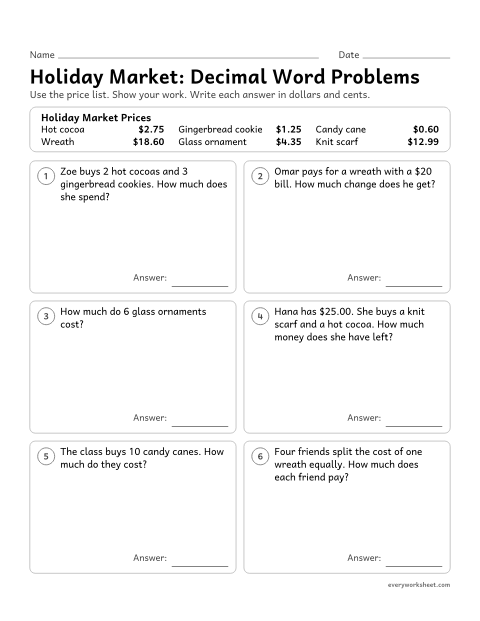
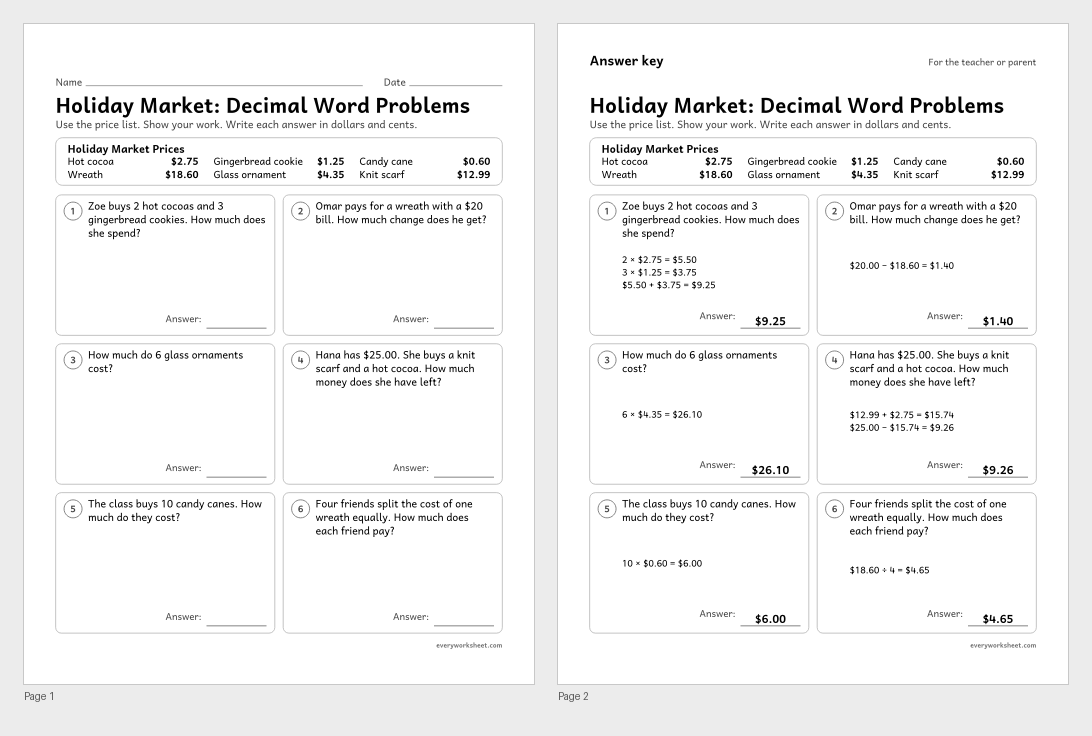
Holiday Market: decimal word problems
Adding, subtracting, multiplying and dividing decimals to hundredths in money problems
Answer key on page 2
2 pages52 KB
Christmas decimals, fractions, volume, coordinate graphing, expressions, long division, reading, writing and commas for 5th grade, with keys.
View all 2 pagesAdding, subtracting, multiplying and dividing decimals to hundredths in money problems
Answer key on page 2
2 pages52 KB
 View all 2 pages
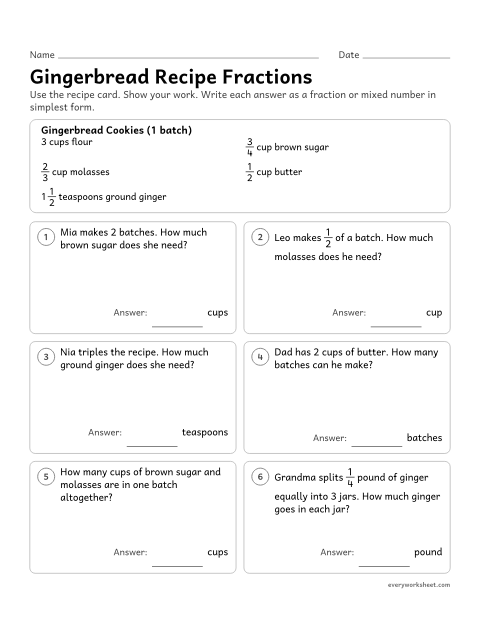
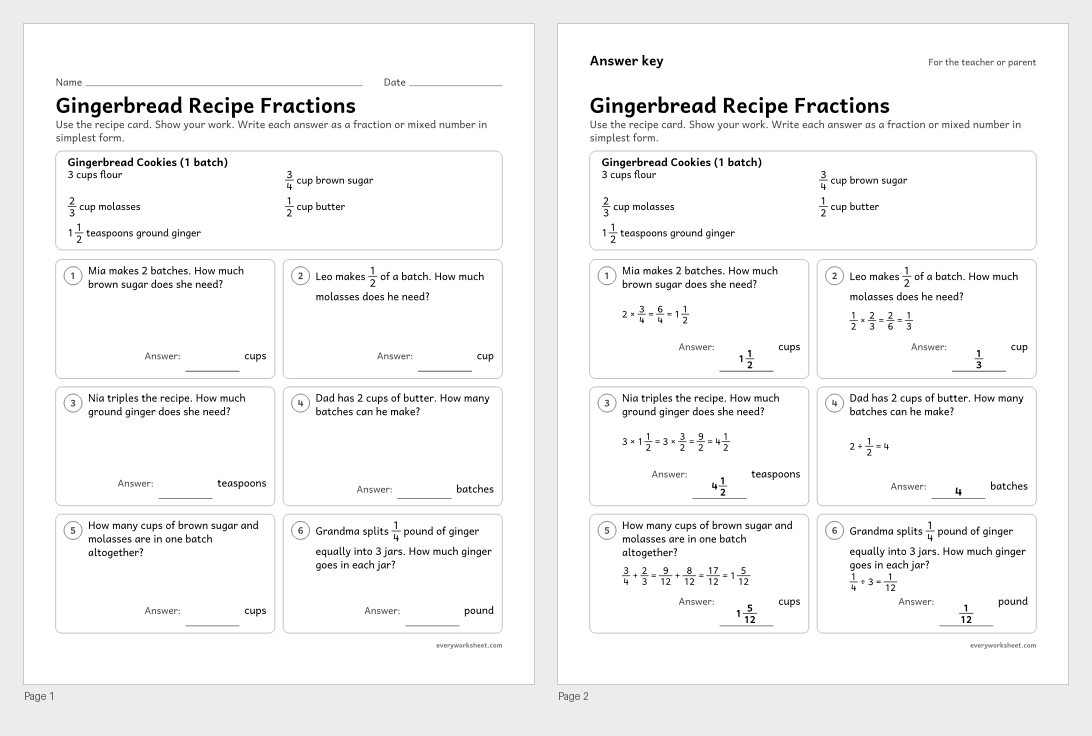
Multiplying and dividing fractions and adding fractions with unlike denominators in recipe problems
Answer key on page 2
2 pages48 KB
 View all 2 pages
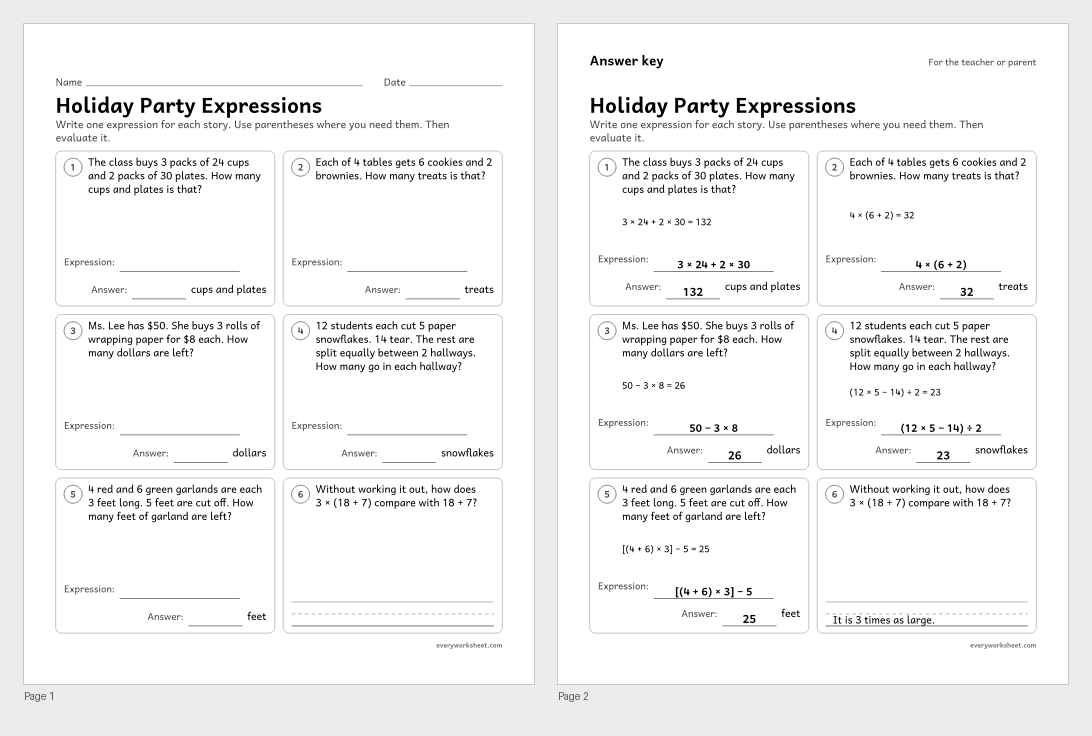
Writing and evaluating numerical expressions with parentheses and brackets
Answer key on page 2
2 pages46 KB
 View all 2 pages
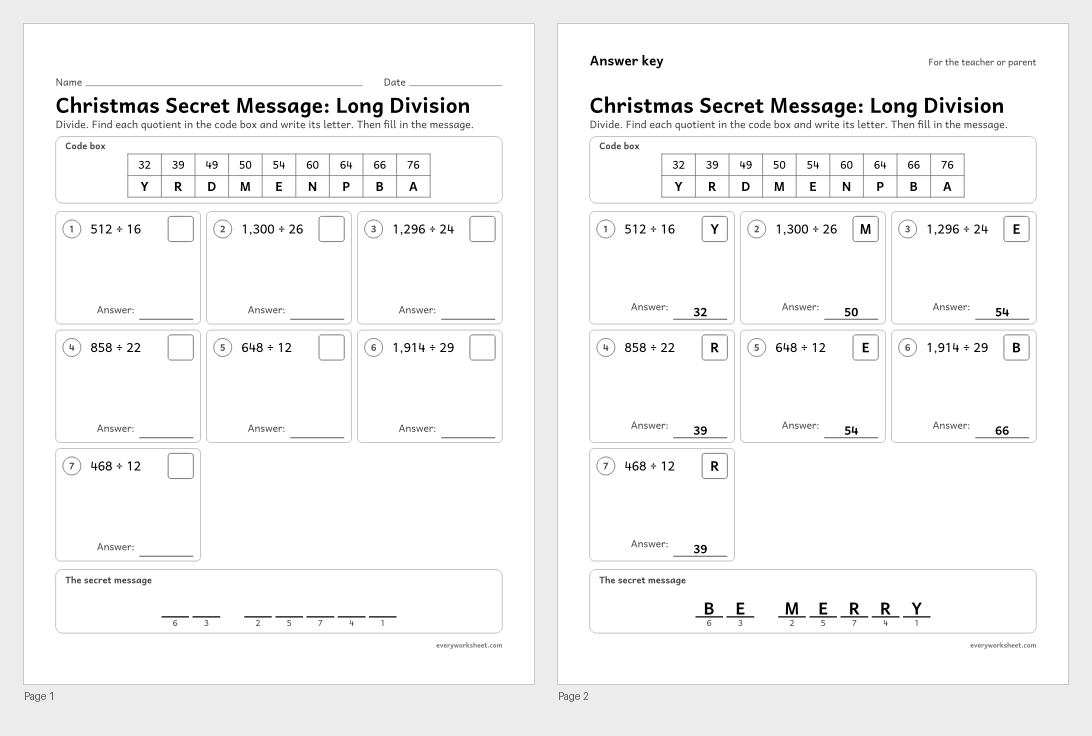
Dividing up to four-digit numbers by two-digit divisors (secret message puzzle)
Answer key on page 2
2 pages56 KB
 View all 2 pages
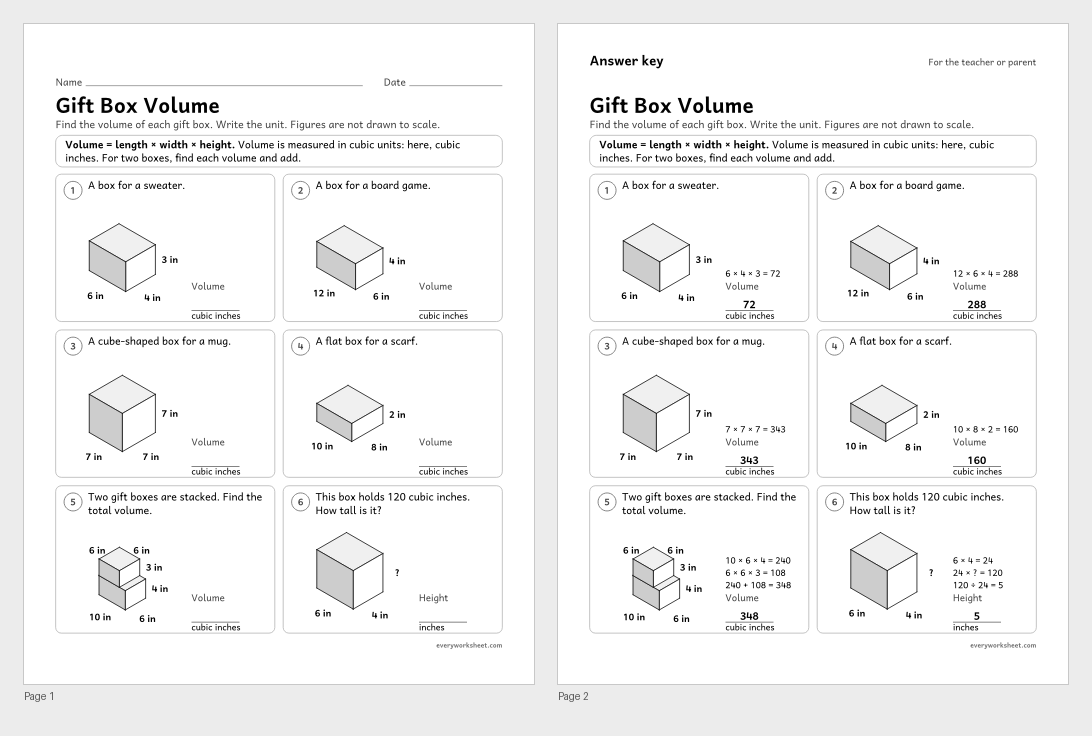
Finding the volume of rectangular prisms and of figures made of two prisms
Answer key on page 2
2 pages51 KB
 View all 2 pages
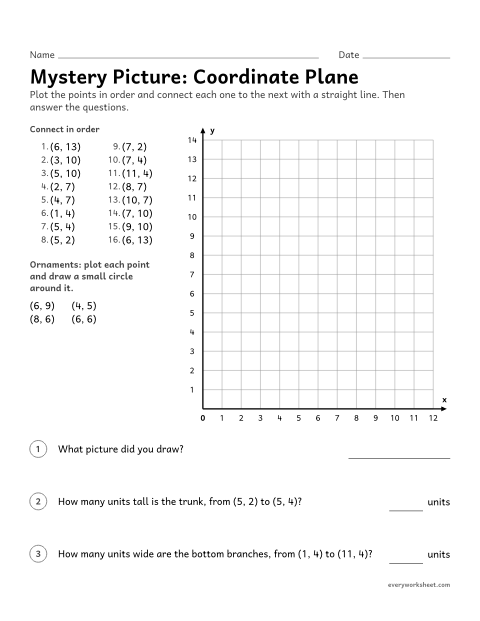
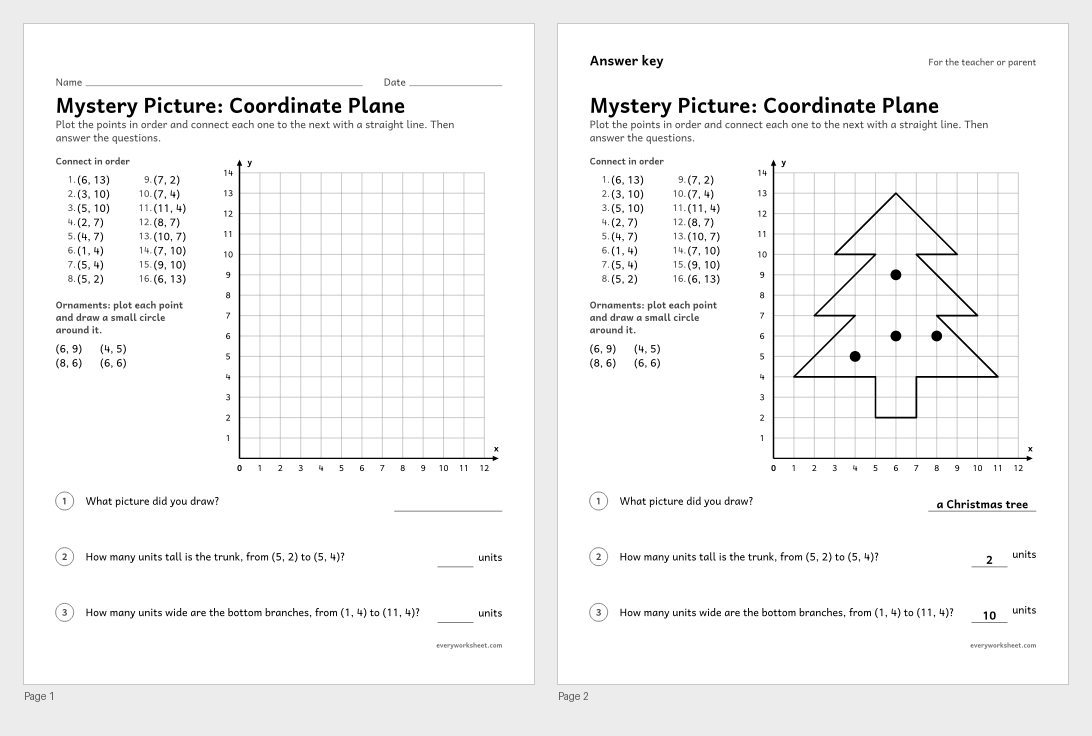
Plotting ordered pairs in the first quadrant to draw a picture
Answer key on page 2
2 pages57 KB
 3 pagesView all 3 pages
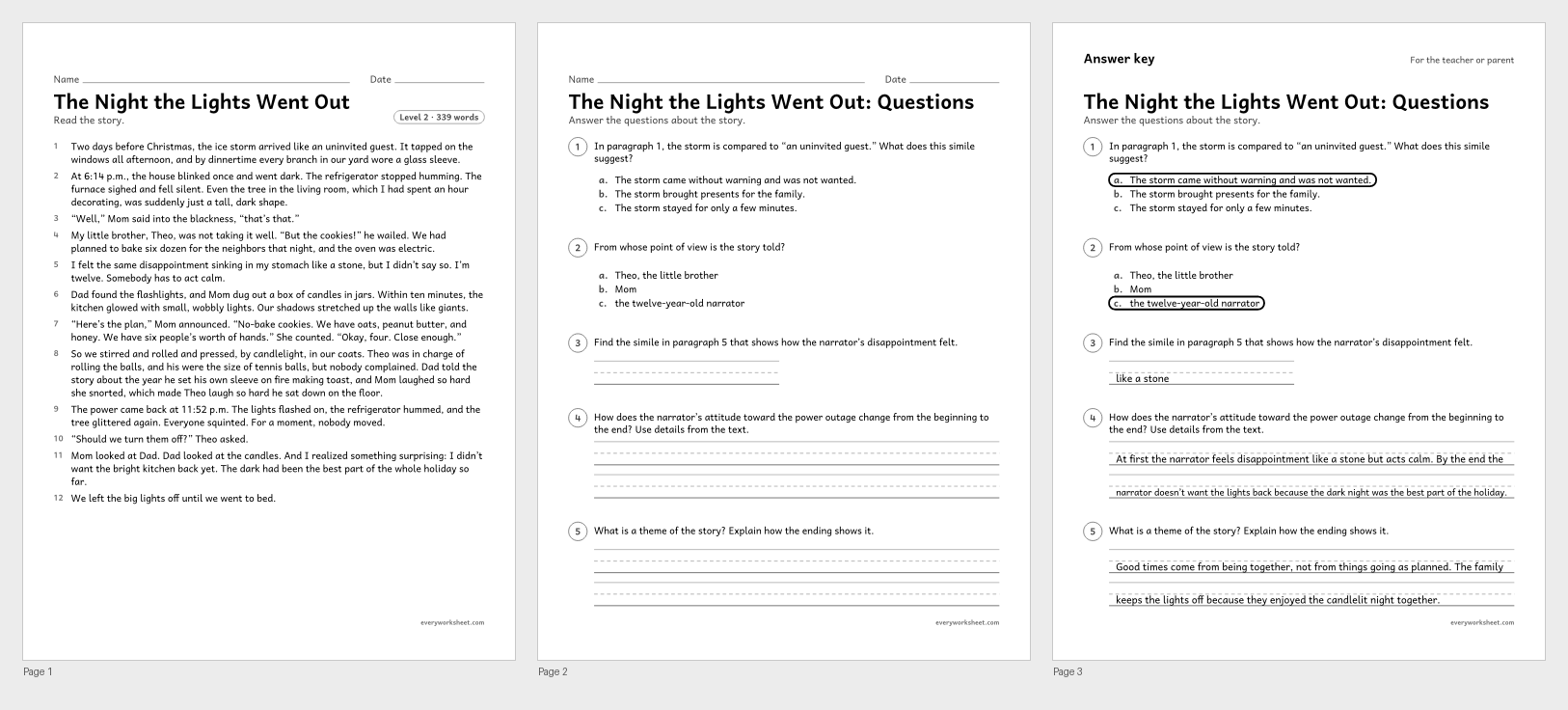
Determining the meaning of words and phrases in a story, including figurative language such as similes and metaphors
Answer key on page 3
3 pages57 KB
 3 pagesView all 3 pages
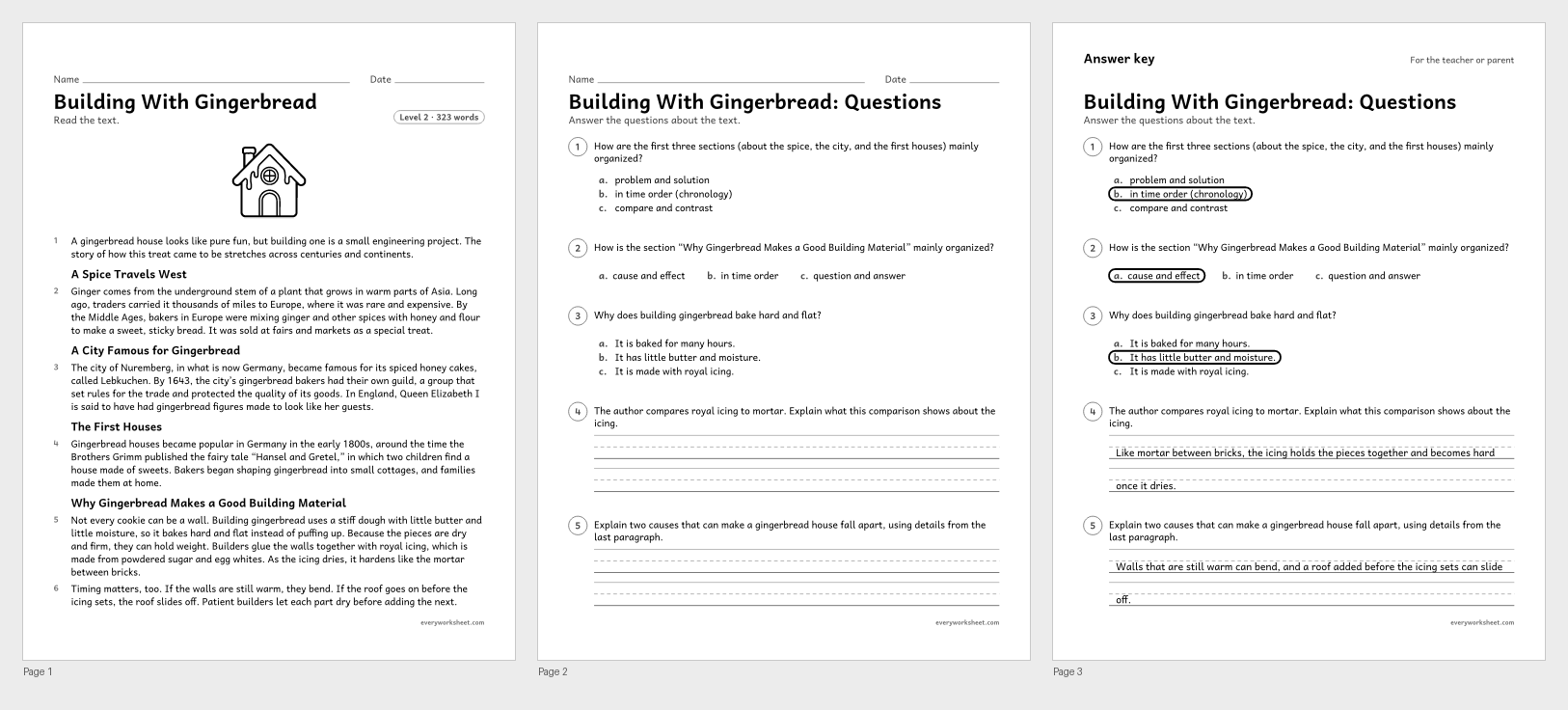
Comparing the overall structure of a text, such as chronology and cause and effect, across its sections
Answer key on page 3
3 pages71 KB
 View all 2 pages
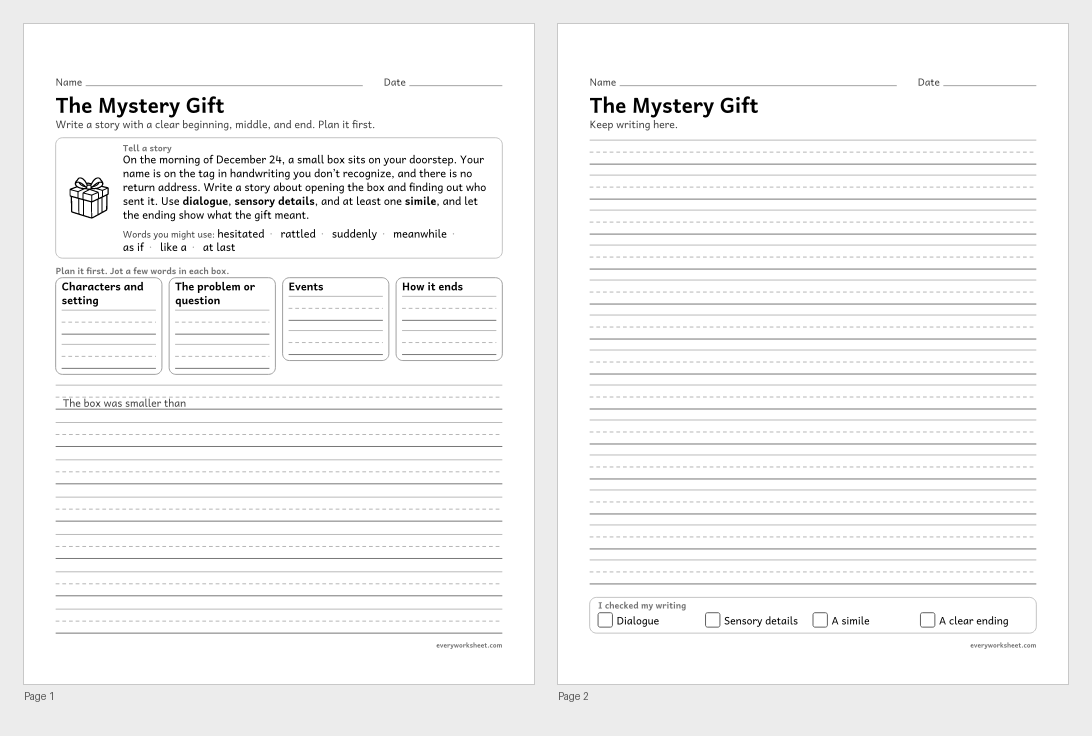
Writing a narrative with dialogue, description, transitions and a conclusion
2 pages62 KB
 View all 2 pages
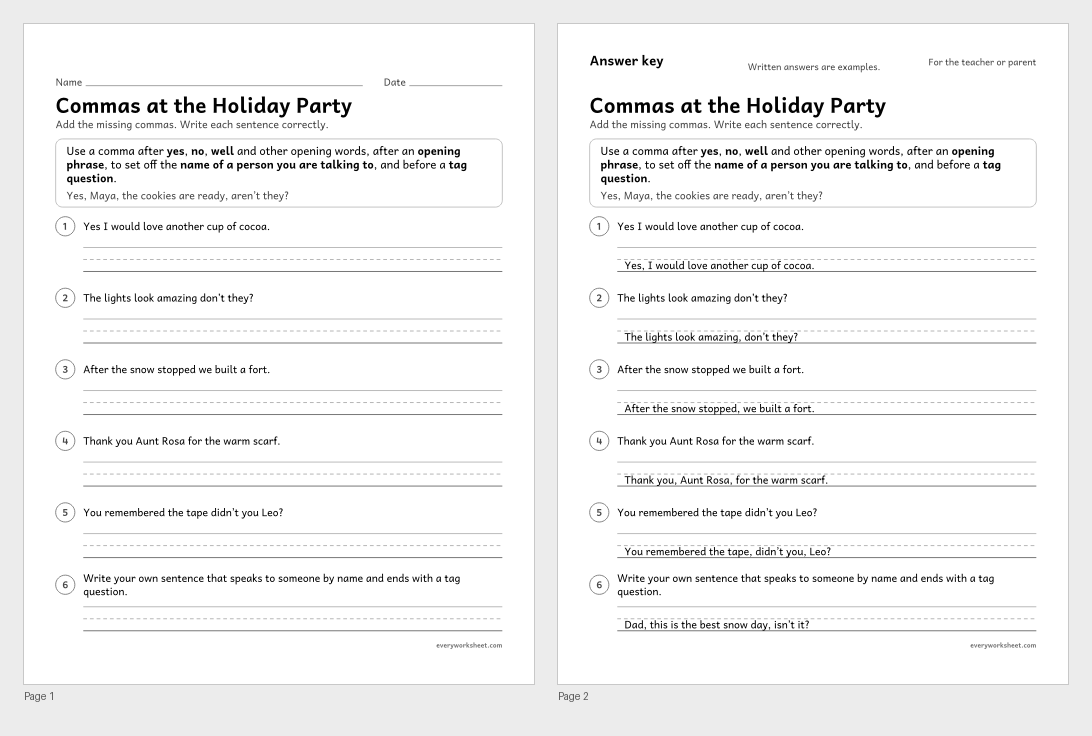
Using commas to set off yes and no, tag questions, direct address and introductory elements
Answer key on page 2
2 pages42 KB
Print at 100% (actual size) for the cleanest tracing lines.
These Christmas worksheets for 5th graders put the hardest skills of the year into holiday problems. Children shop a holiday market with decimals, scale a gingerbread recipe with fraction multiplication and division, find the volume of single and stacked gift boxes, plot a mystery Christmas tree on the coordinate plane, write expressions for party planning and crack a secret message with long division by 2-digit divisors.
For reading, there is an original story about a family's candlelit night in an ice storm, full of similes and metaphors, and a nonfiction history of gingerbread houses and why gingerbread works as a building material. Children also write a mystery-gift narrative and practice commas.
Every page with one right answer has a key on page 2. See the Christmas math worksheets page for every grade, and the Christmas around the world worksheets for an Australian summer Christmas and more.
CCSS.MATH.CONTENT.5.NBT.B.6Find whole-number quotients of whole numbers with up to four-digit dividends and two-digit divisors, using strategies based on place value, the properties of operations, and/or the relationship between multiplication and division. Illustrate and explain the calculation by using equations, rectangular arrays, and/or area models.CCSS.MATH.CONTENT.5.NBT.B.7Add, subtract, multiply, and divide decimals to hundredths, using concrete models or drawings and strategies based on place value, properties of operations, and/or the relationship between addition and subtraction; relate the strategy to a written method and explain the reasoning used.CCSS.MATH.CONTENT.5.NF.A.2Solve word problems involving addition and subtraction of fractions referring to the same whole, including cases of unlike denominators, e.g., by using visual fraction models or equations to represent the problem. Use benchmark fractions and number sense of fractions to estimate mentally and assess the reasonableness of answers. For example, recognize an incorrect result 2/5 + 1/2 = 3/7, by observing that 3/7 < 1/2.CCSS.MATH.CONTENT.5.NF.B.6Solve real world problems involving multiplication of fractions and mixed numbers, e.g., by using visual fraction models or equations to represent the problem.CCSS.MATH.CONTENT.5.NF.B.7.CSolve real world problems involving division of unit fractions by non-zero whole numbers and division of whole numbers by unit fractions, e.g., by using visual fraction models and equations to represent the problem. For example, how much chocolate will each person get if 3 people share 1/2 lb of chocolate equally? How many 1/3-cup servings are in 2 cups of raisins?CCSS.MATH.CONTENT.5.OA.A.2Write simple expressions that record calculations with numbers, and interpret numerical expressions without evaluating them. For example, express the calculation "add 8 and 7, then multiply by 2" as 2 × (8 + 7). Recognize that 3 × (18932 + 921) is three times as large as 18932 + 921, without having to calculate the indicated sum or product.CCSS.MATH.CONTENT.5.MD.C.5Relate volume to the operations of multiplication and addition and solve real world and mathematical problems involving volume.CCSS.MATH.CONTENT.5.G.A.1Use a pair of perpendicular number lines, called axes, to define a coordinate system, with the intersection of the lines (the origin) arranged to coincide with the 0 on each line and a given point in the plane located by using an ordered pair of numbers, called its coordinates. Understand that the first number indicates how far to travel from the origin in the direction of one axis, and the second number indicates how far to travel in the direction of the second axis, with the convention that the names of the two axes and the coordinates correspond (e.g., x-axis and x-coordinate, y-axis and y-coordinate).CCSS.ELA-LITERACY.RL.5.4Determine the meaning of words and phrases as they are used in a text, including figurative language such as metaphors and similes.CCSS.ELA-LITERACY.RI.5.5Compare and contrast the overall structure (e.g., chronology, comparison, cause/effect, problem/solution) of events, ideas, concepts, or information in two or more texts.CCSS.ELA-LITERACY.W.5.3Write narratives to develop real or imagined experiences or events using effective technique, descriptive details, and clear event sequences.CCSS.ELA-LITERACY.L.5.2.BUse a comma to separate an introductory element from the rest of the sentence.CCSS.ELA-LITERACY.L.5.2.CUse a comma to set off the words yes and no (e.g., Yes, thank you), to set off a tag question from the rest of the sentence (e.g., It's true, isn't it?), and to indicate direct address (e.g., Is that you, Steve?).Decimal money problems, fraction multiplication and division in a recipe, numerical expressions, long division with 2-digit divisors, volume of gift boxes and a coordinate plane mystery picture.
Yes. Every point has whole-number coordinates from 0 to 14, as in 5th grade.
Yes. Every page with one right answer has a key on page 2, with the work shown.