 View larger
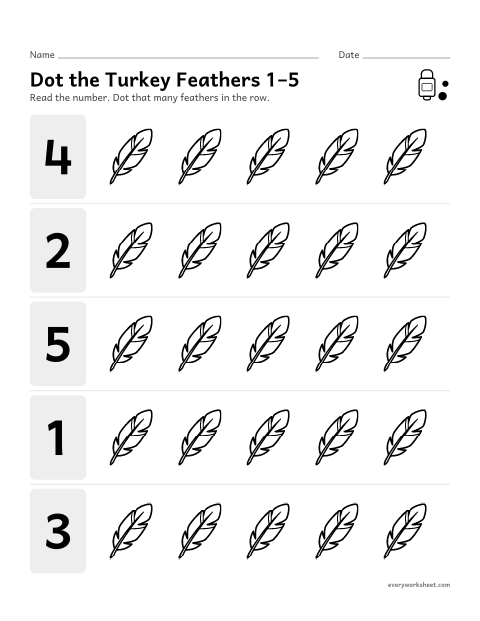
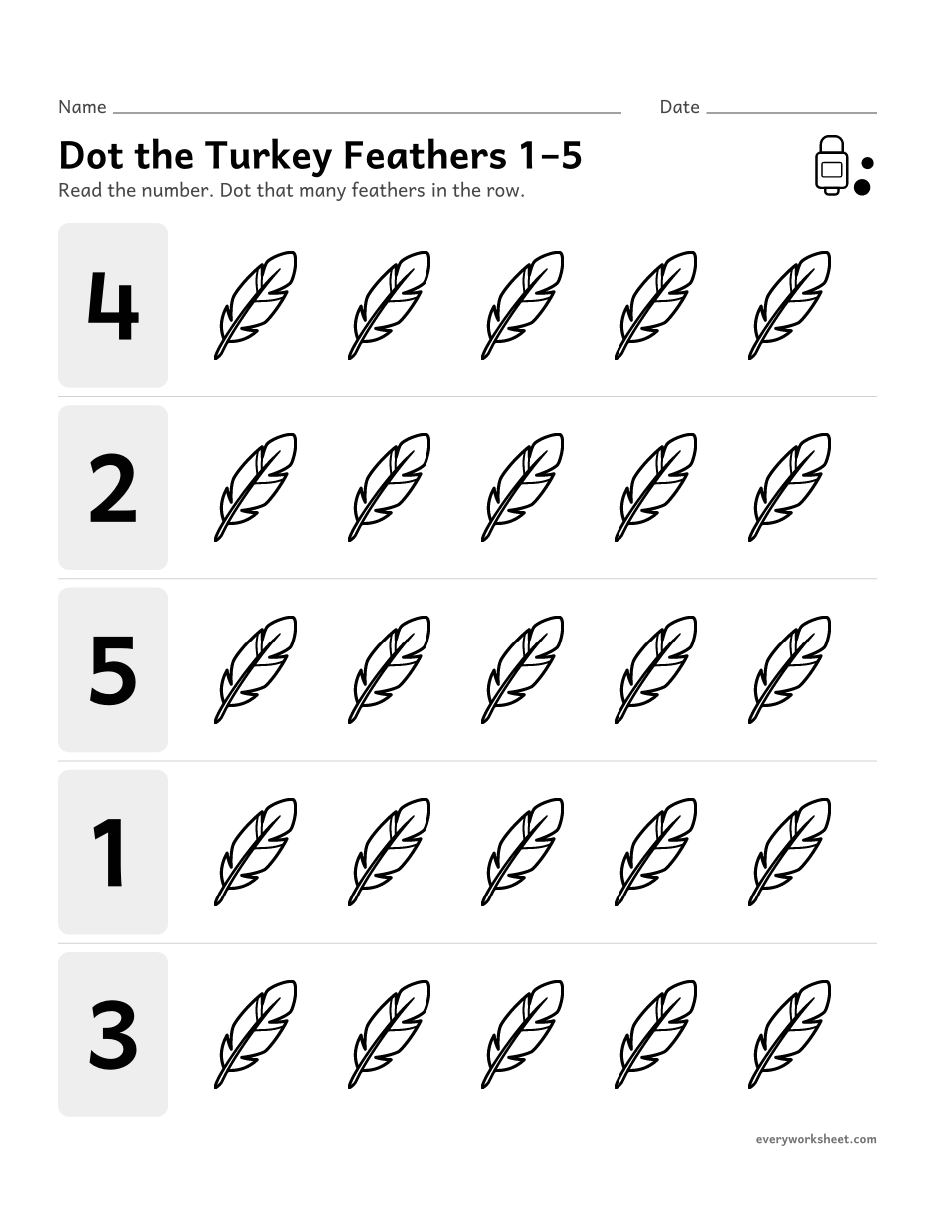
Dot the turkey feathers 1–5
Counting out 1 to 5 feathers with a dot marker
1 page46 KB
Every Thanksgiving math page in one place, from counting turkey feathers in preschool to recipe fractions and a coordinate turkey in 5th grade.
View largerCounting out 1 to 5 feathers with a dot marker
1 page46 KB
 View all 2 pages
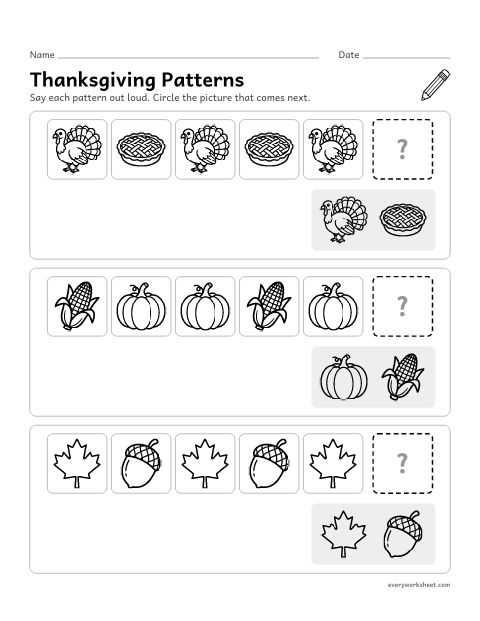
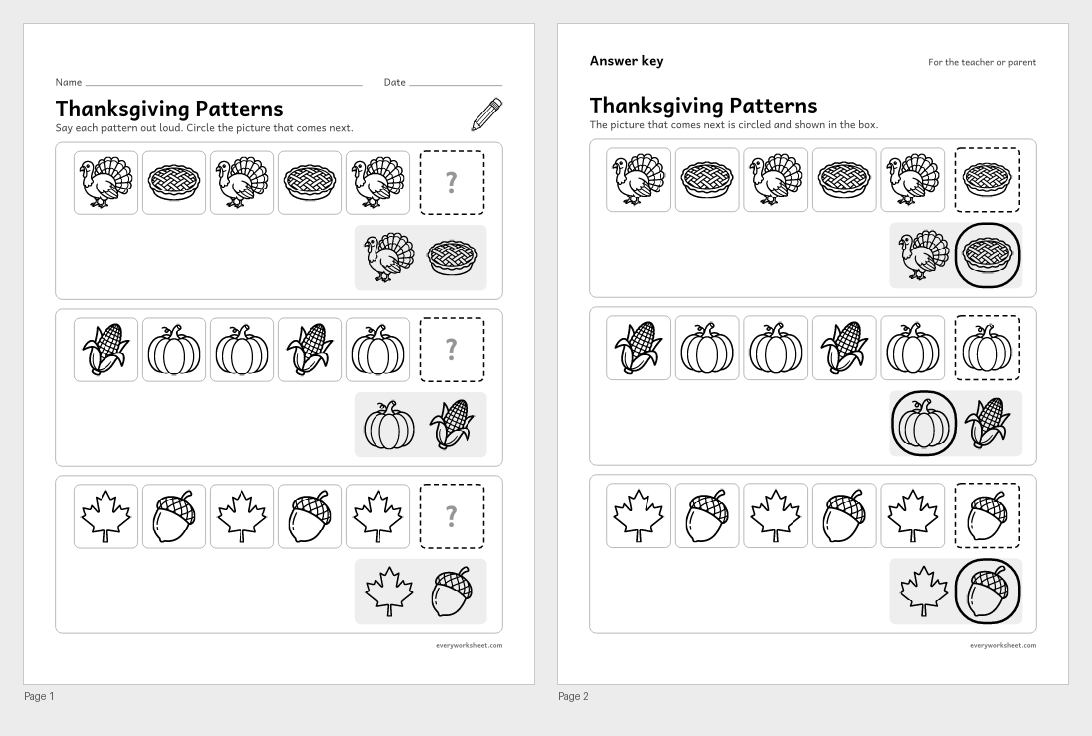
Finishing AB and ABB Thanksgiving picture patterns
Answer key on page 2
2 pages1.3 MB
 View all 2 pages
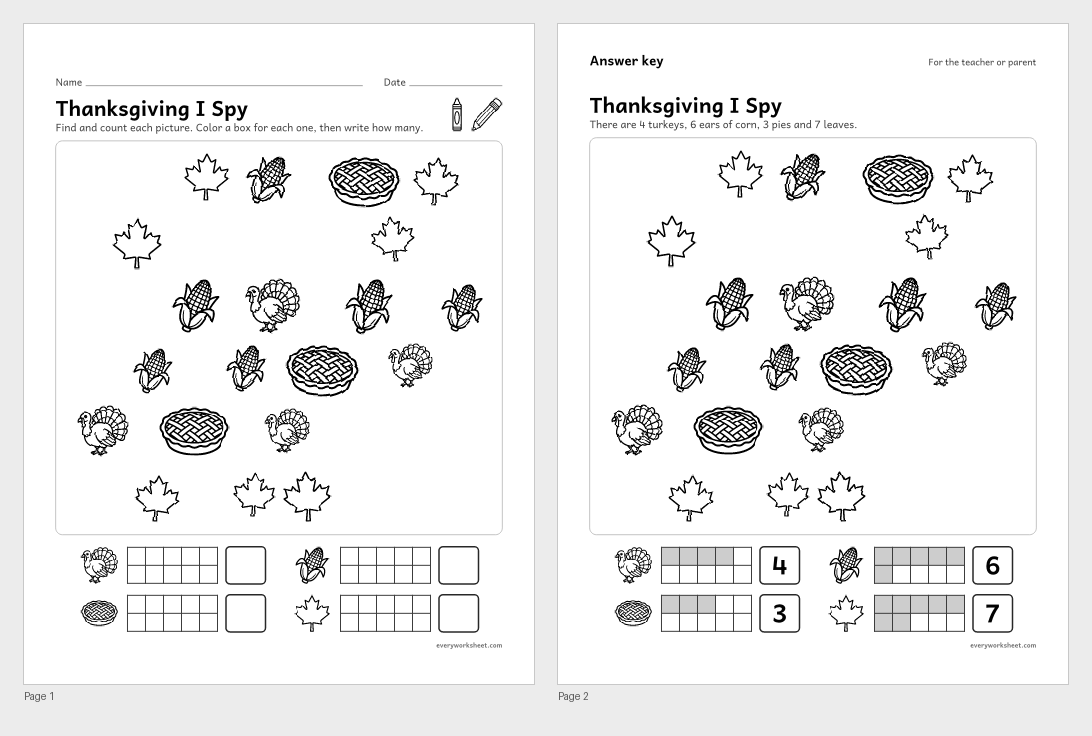
Finding and counting Thanksgiving pictures to 10
Answer key on page 2
2 pages1.3 MB
 View all 2 pages
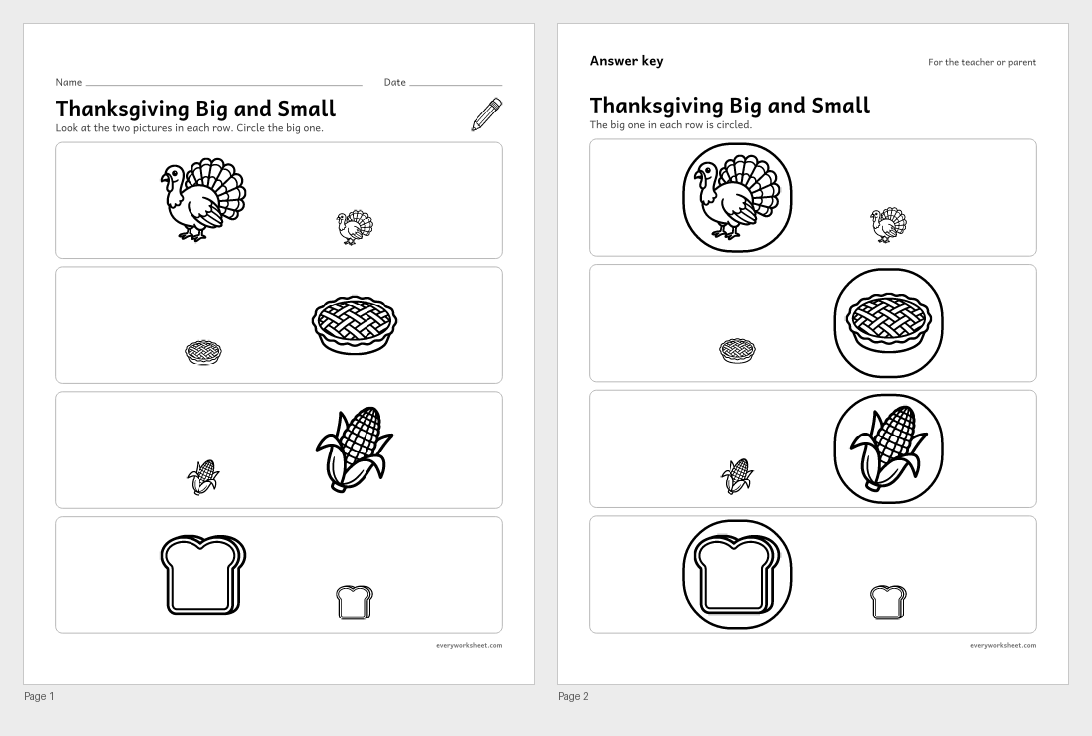
Comparing two Thanksgiving pictures by size
Answer key on page 2
2 pages539 KB
 View all 2 pages
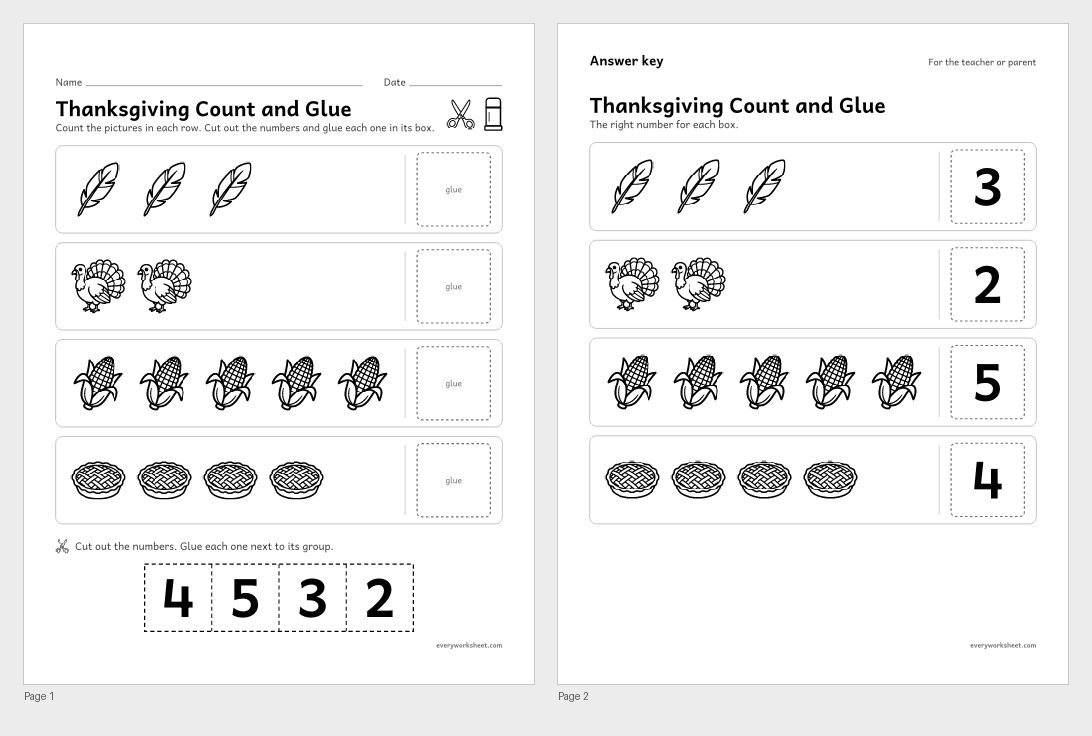
Counting Thanksgiving pictures to 5 and gluing the matching number
Answer key on page 2
2 pages924 KB
 View all 2 pages
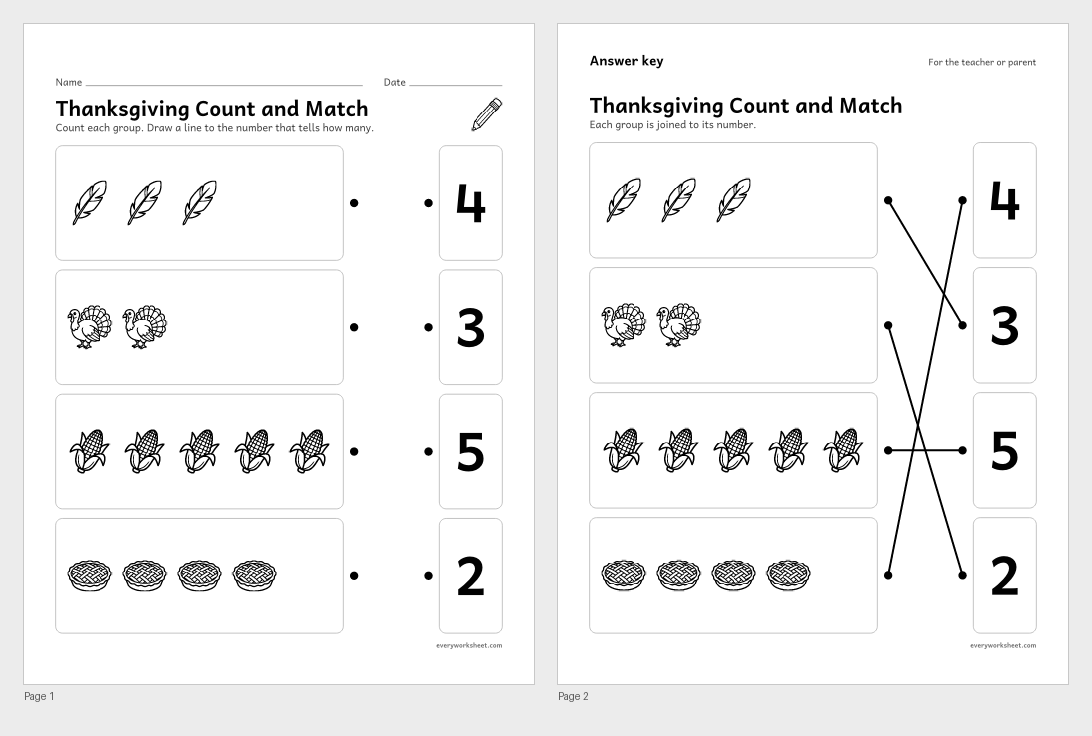
Matching groups of 1 to 5 Thanksgiving pictures to numbers
Answer key on page 2
2 pages877 KB
 View all 2 pages
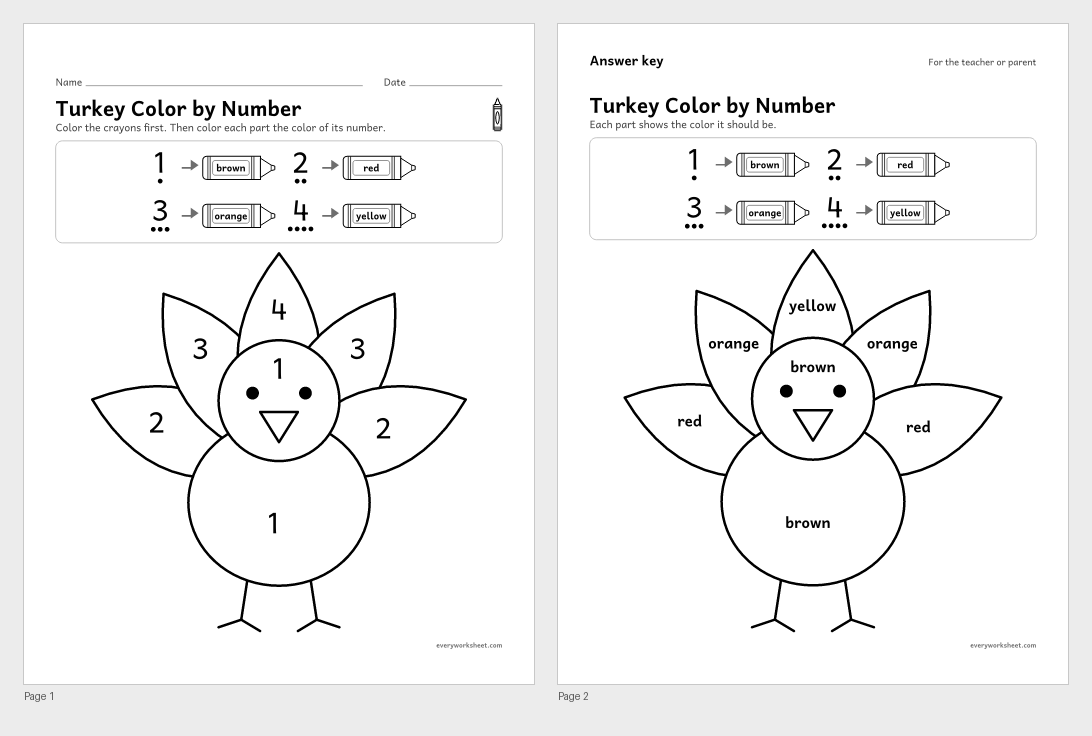
Reading the numerals 1 to 4 to color a turkey
Answer key on page 2
2 pages40 KB
 View all 2 pages
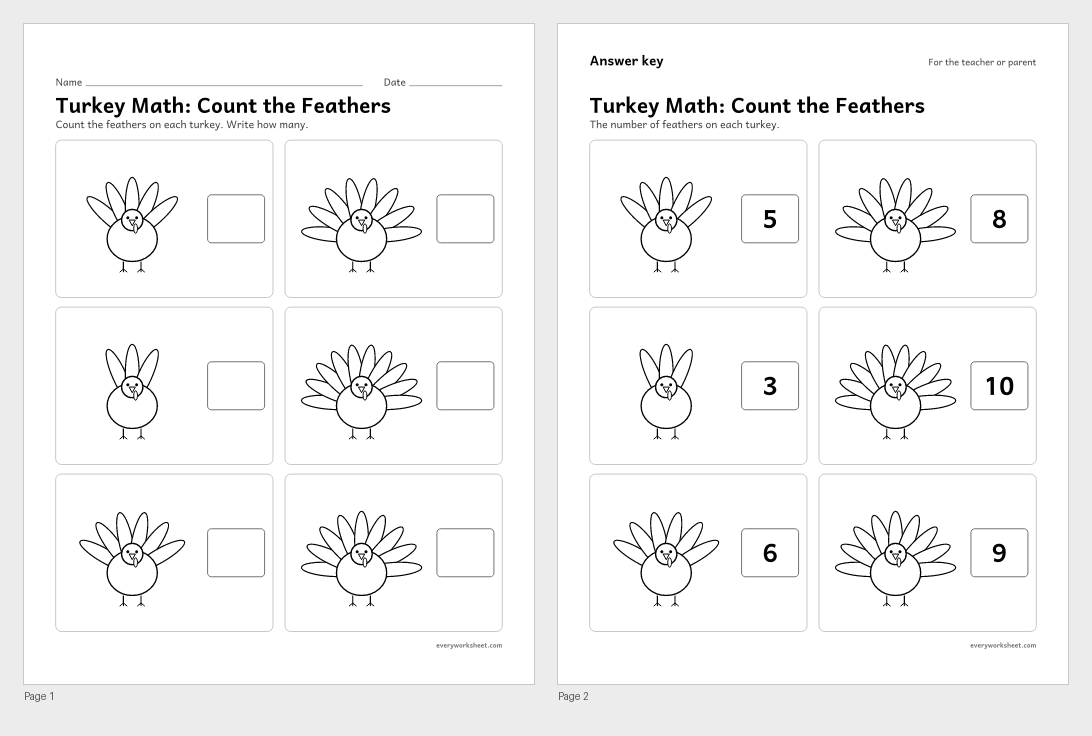
Counting up to 10 feathers in a fan and writing how many
Answer key on page 2
2 pages36 KB
 View all 2 pages
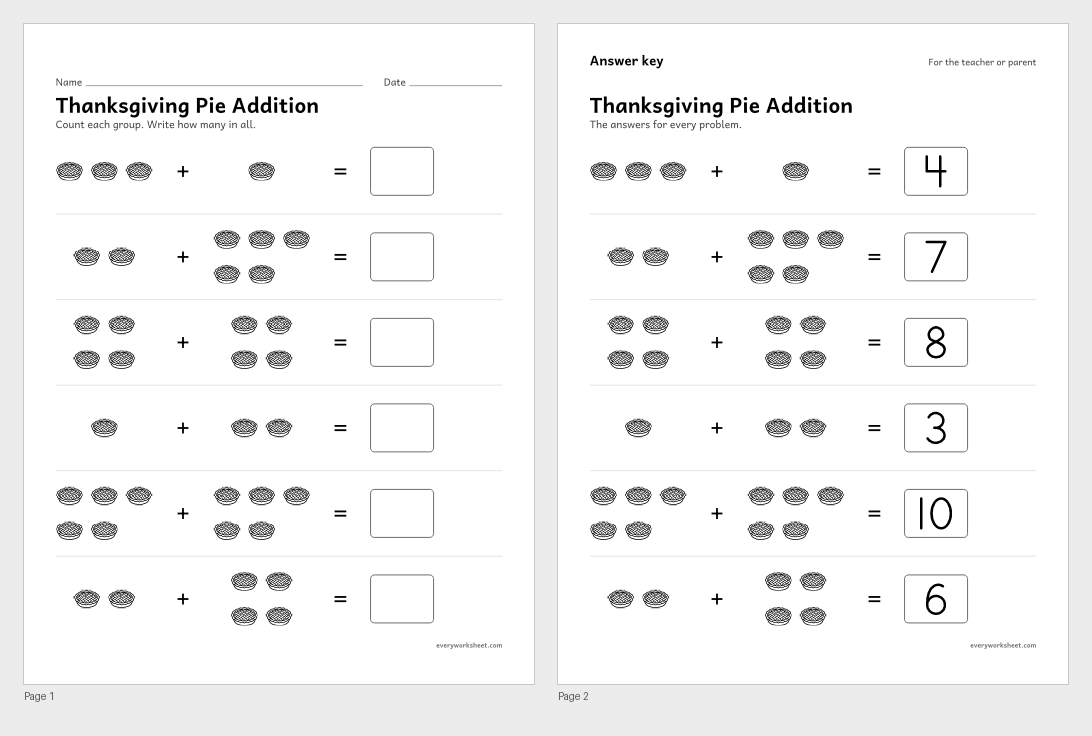
Adding two groups of pictures within 10
Answer key on page 2
2 pages3.1 MB
 View all 2 pages
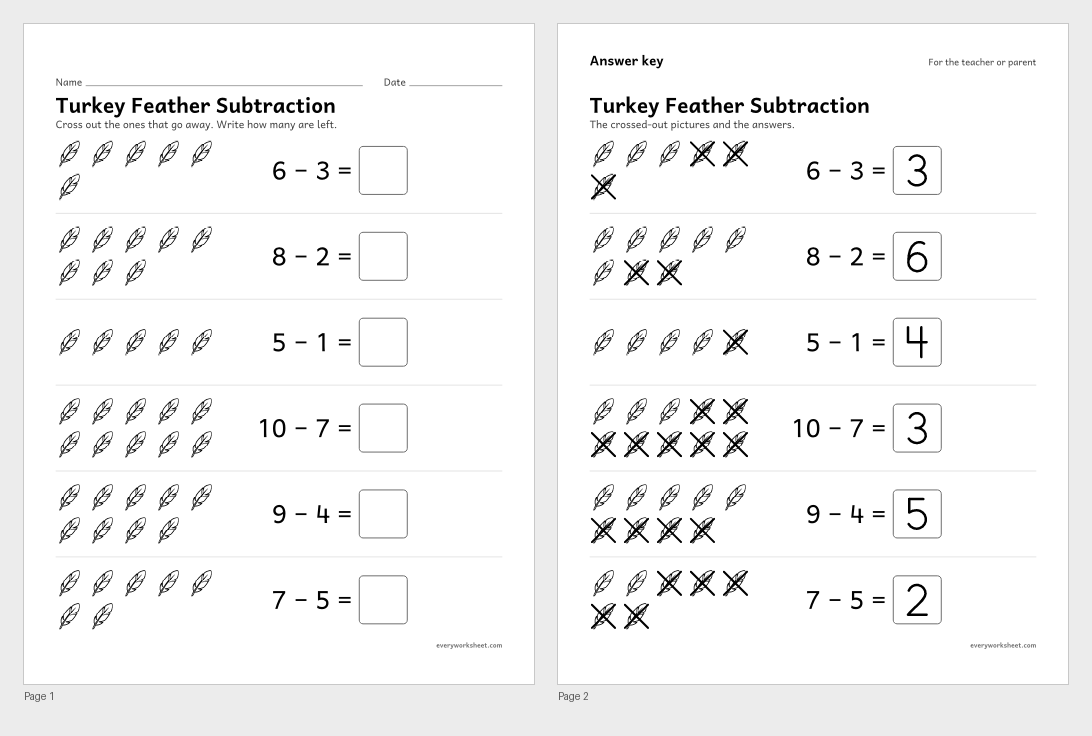
Taking away pictures to subtract within 10
Answer key on page 2
2 pages102 KB
 View all 2 pages
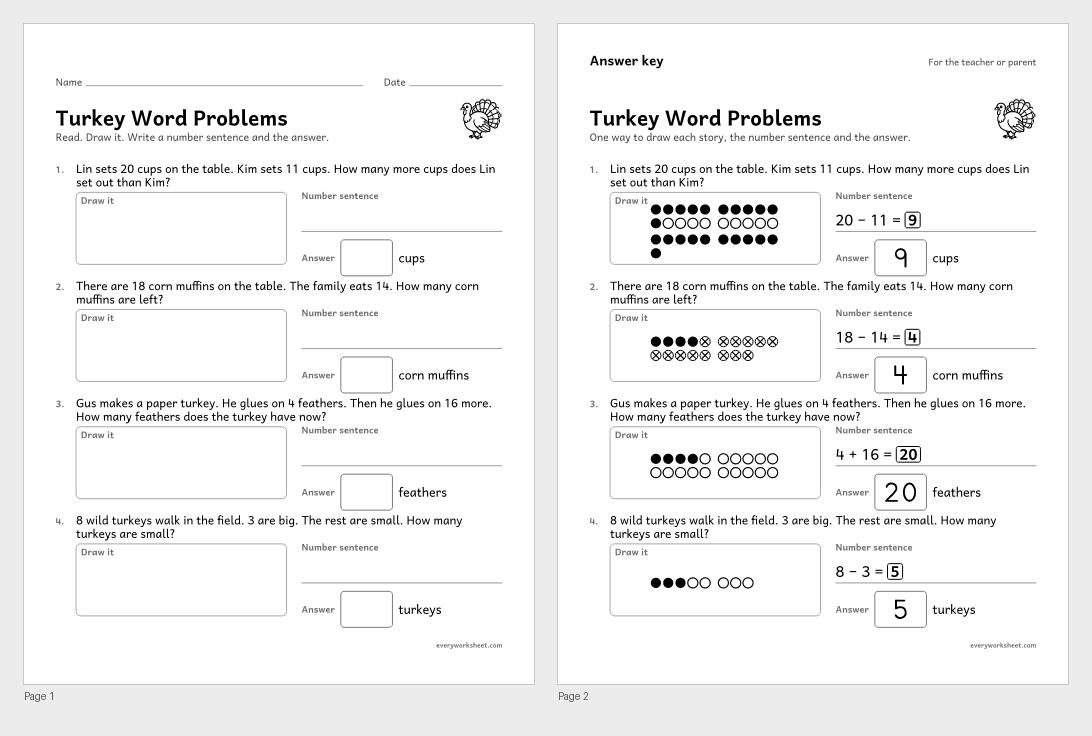
Solving Thanksgiving word problems within 20
Answer key on page 2
2 pages126 KB
 View all 2 pages
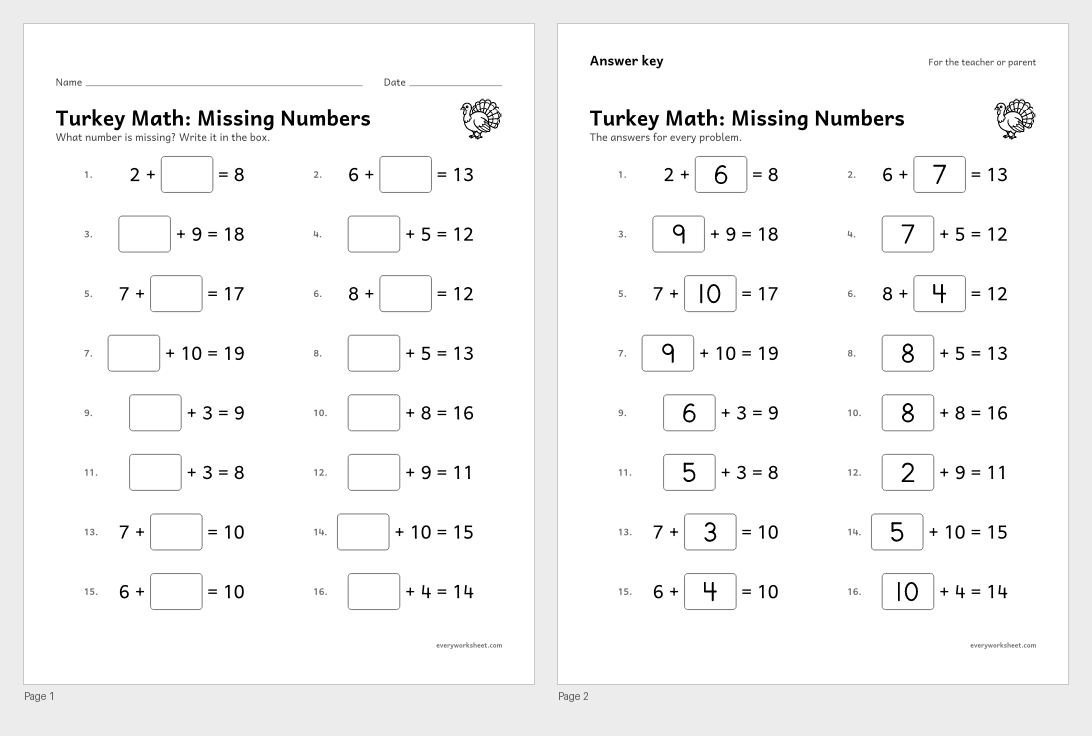
Finding a missing addend within 20
Answer key on page 2
2 pages158 KB
 View all 2 pages
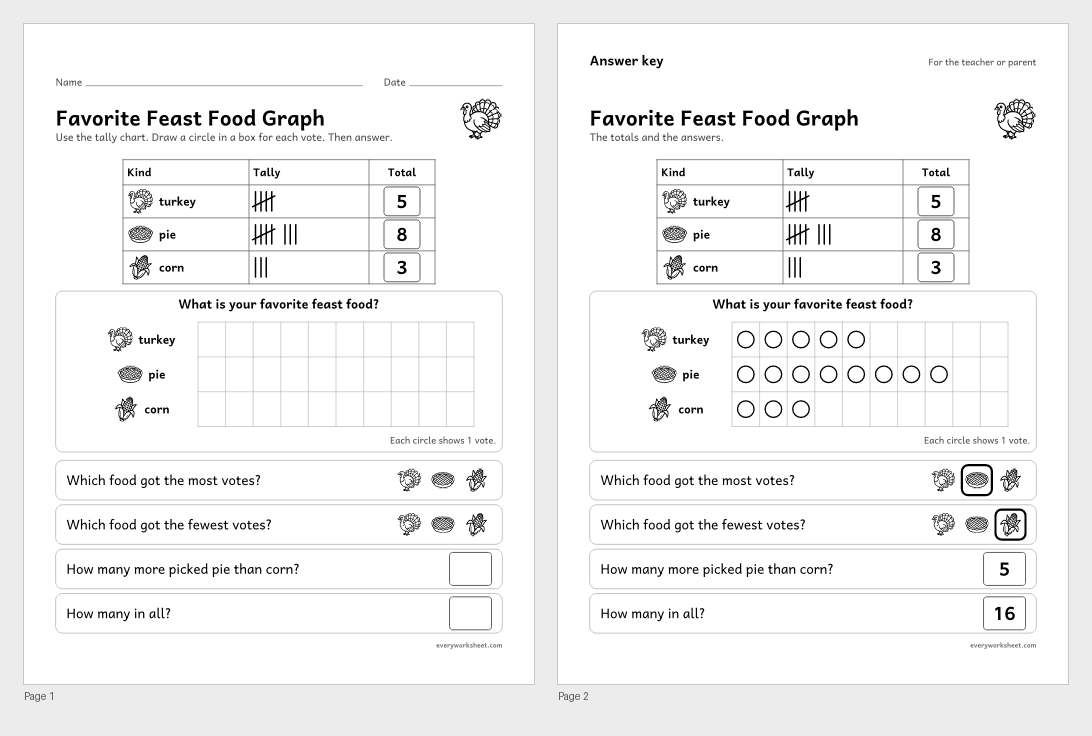
Turning a tally chart into a picture graph and comparing the totals
Answer key on page 2
2 pages1021 KB
 View all 2 pages
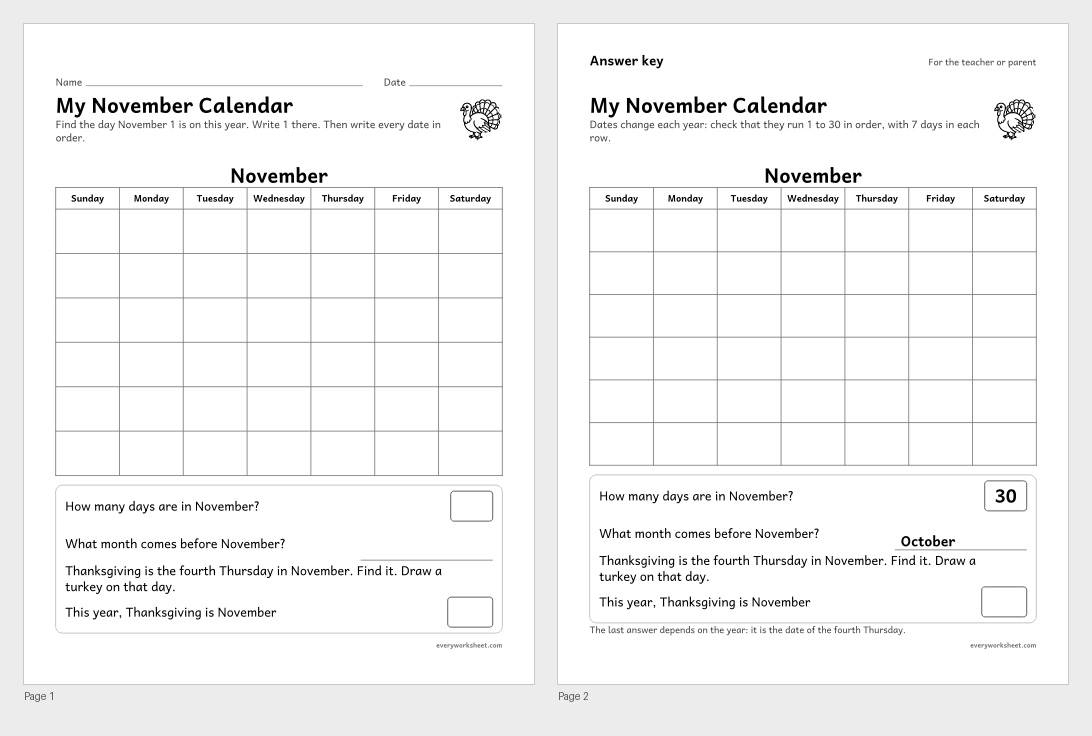
Writing the numbers 1 to 30 on a calendar and finding the fourth Thursday
Answer key on page 2
2 pages118 KB
 View all 2 pages
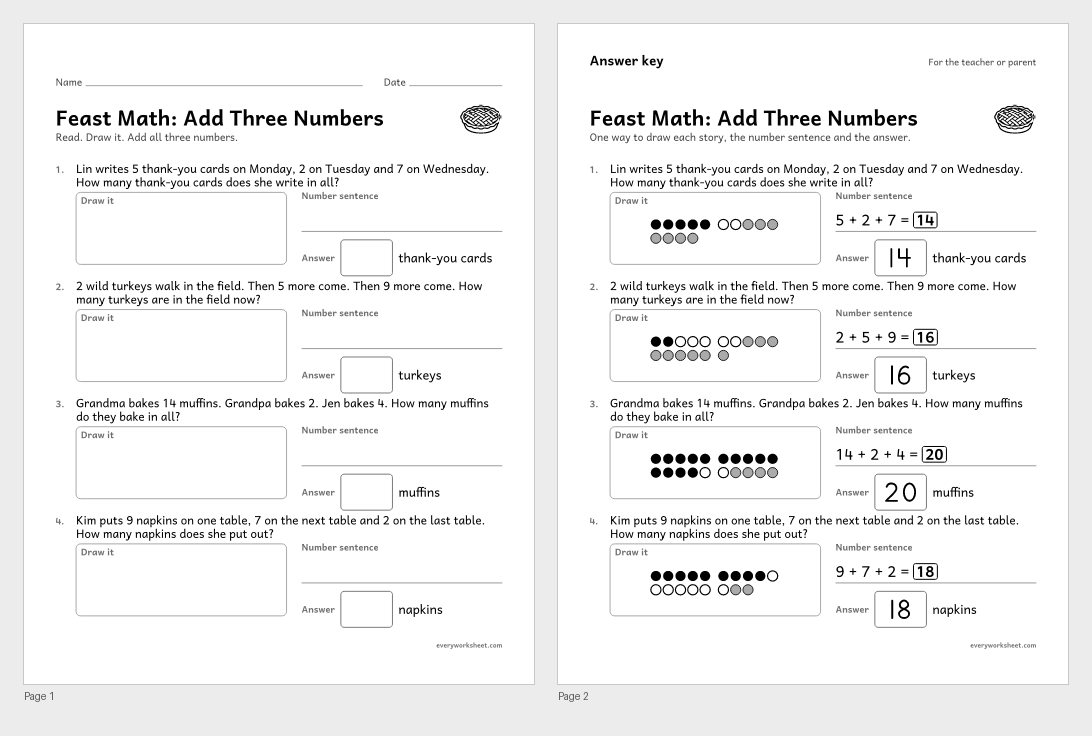
Solving word problems with three addends within 20
Answer key on page 2
2 pages137 KB
 View all 2 pages
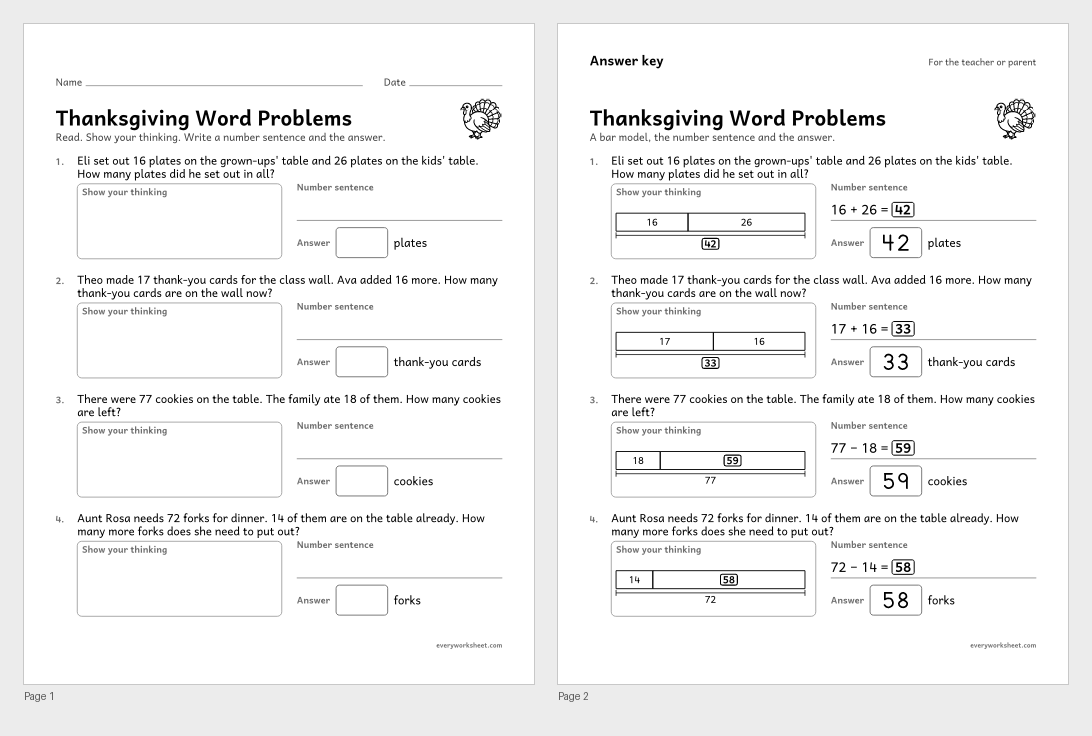
Solving Thanksgiving addition and subtraction word problems within 100 with regrouping
Answer key on page 2
2 pages126 KB
 View all 2 pages
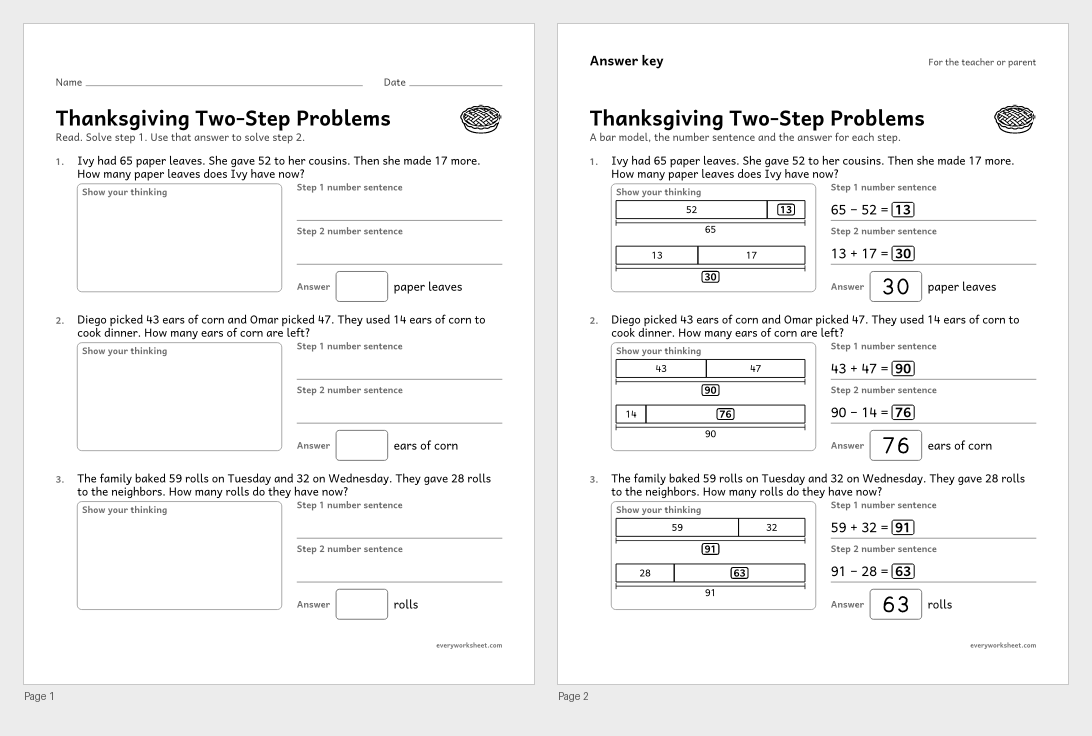
Solving two-step Thanksgiving word problems within 100
Answer key on page 2
2 pages136 KB
 View all 2 pages
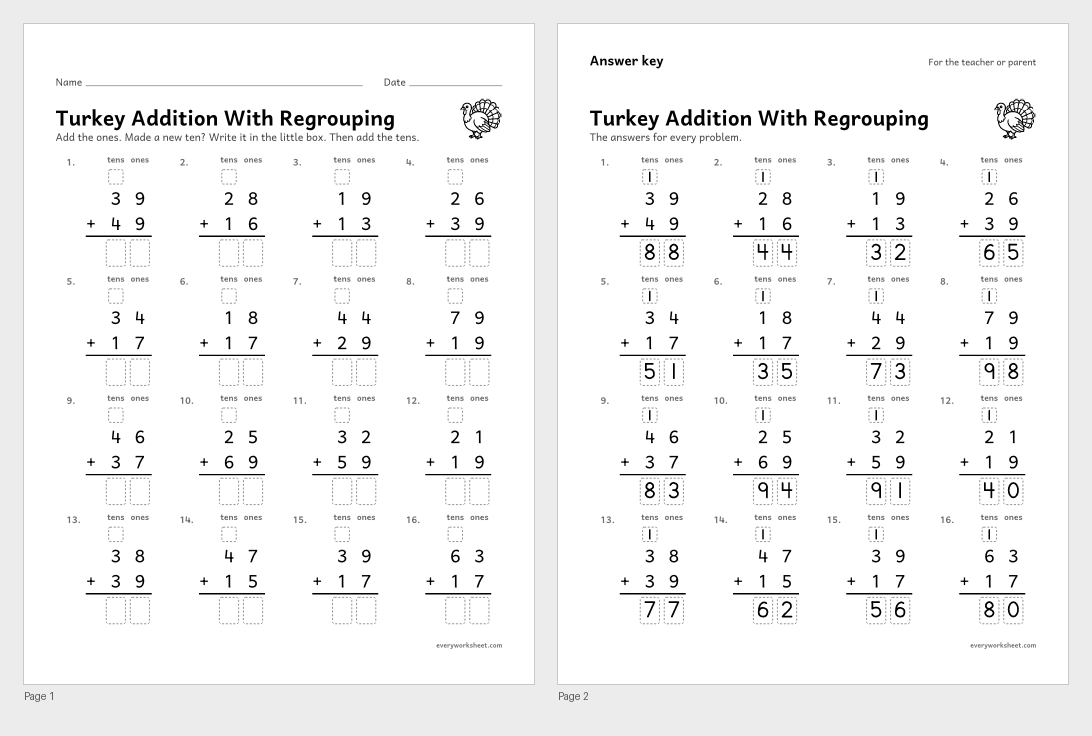
Adding two-digit numbers with regrouping
Answer key on page 2
2 pages132 KB
 View all 2 pages
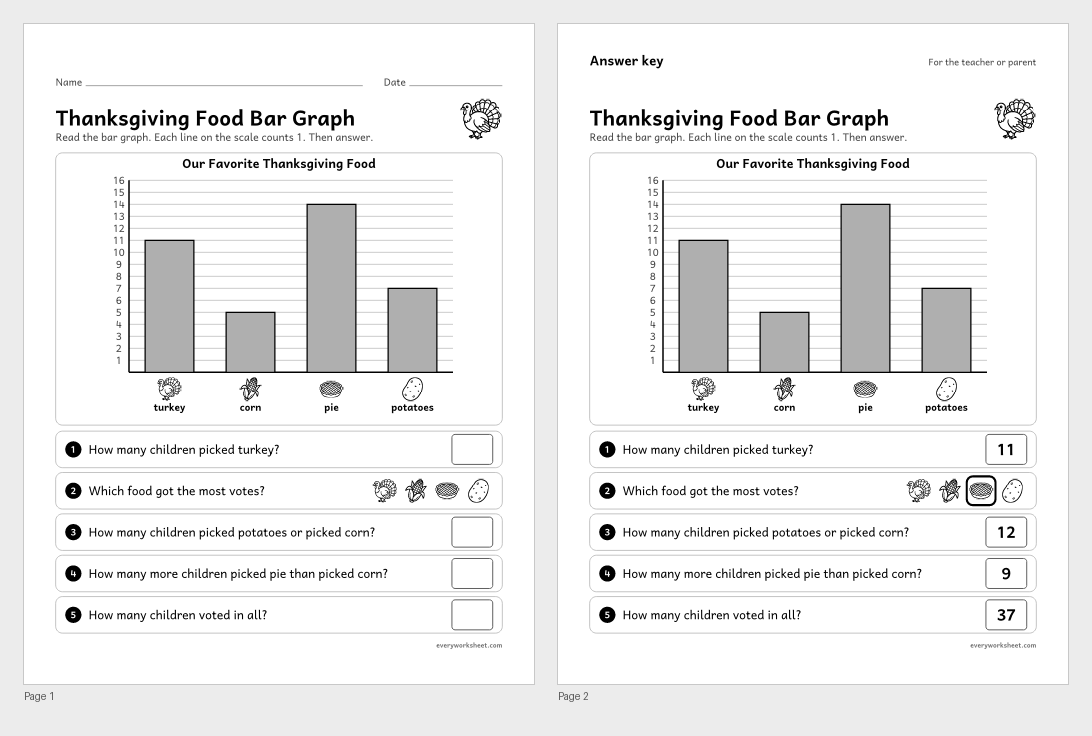
Reading a bar graph with a single-unit scale and solving put-together and compare problems
Answer key on page 2
2 pages618 KB
 View all 2 pages
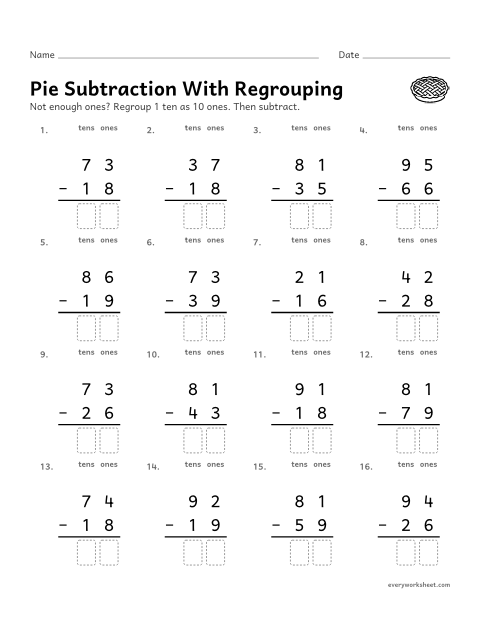
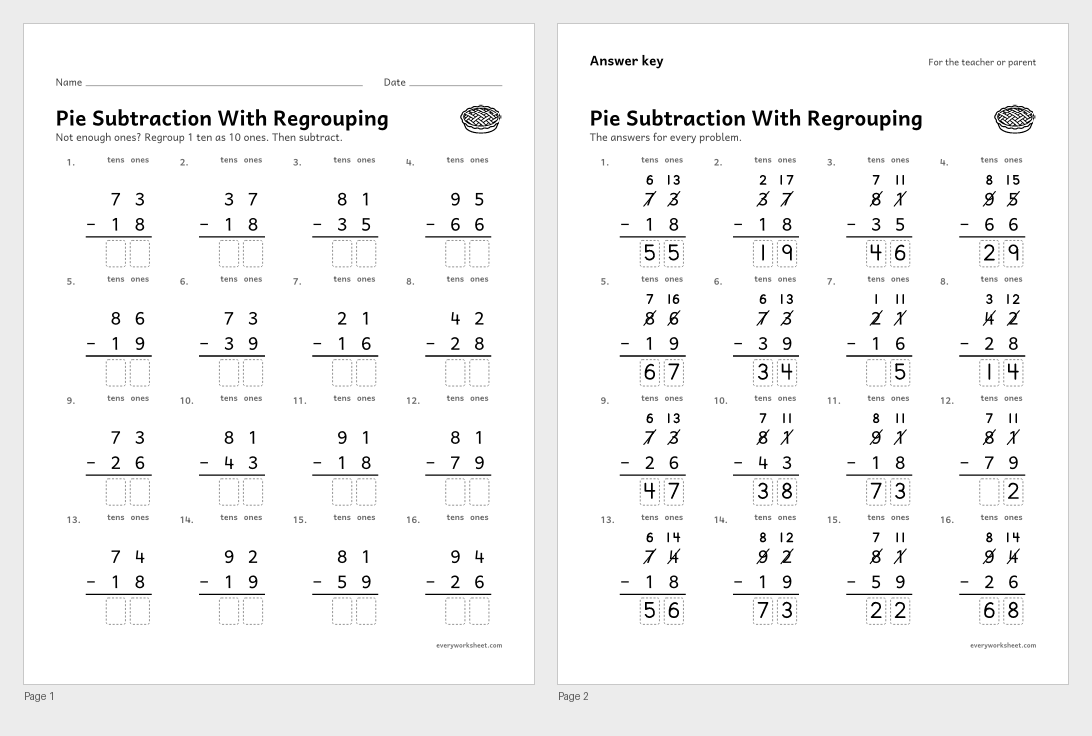
Subtracting two-digit numbers with regrouping
Answer key on page 2
2 pages143 KB
 View all 2 pages
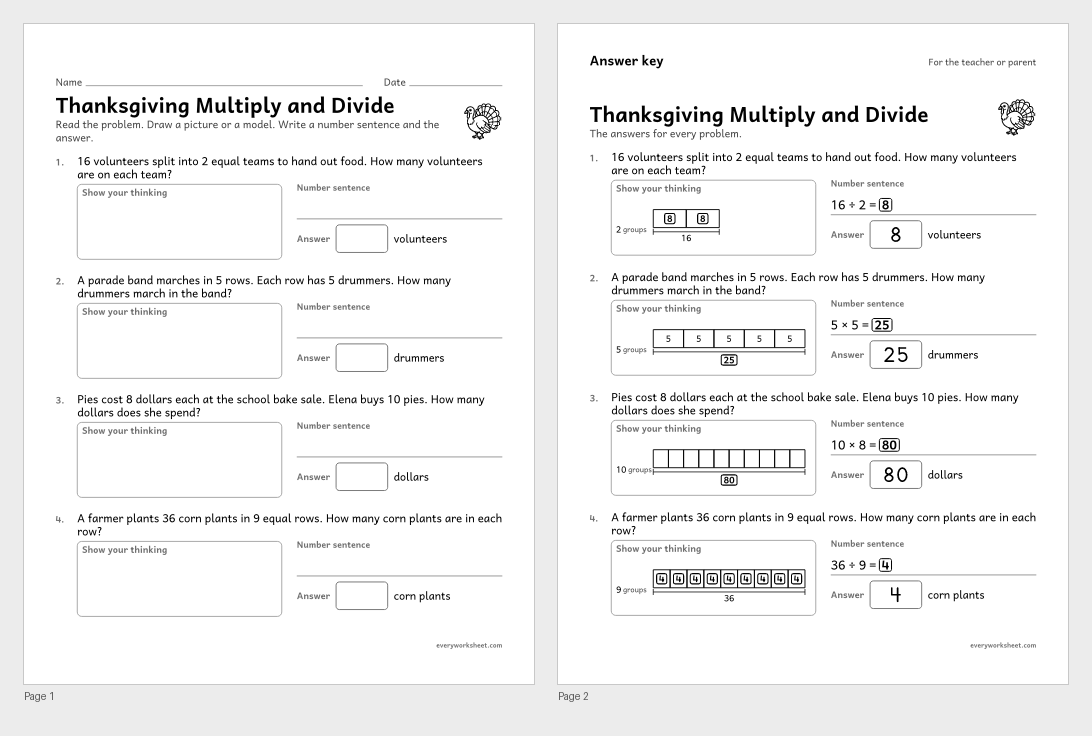
Solving multiplication and division word problems within 100
Answer key on page 2
2 pages129 KB
 View all 2 pages
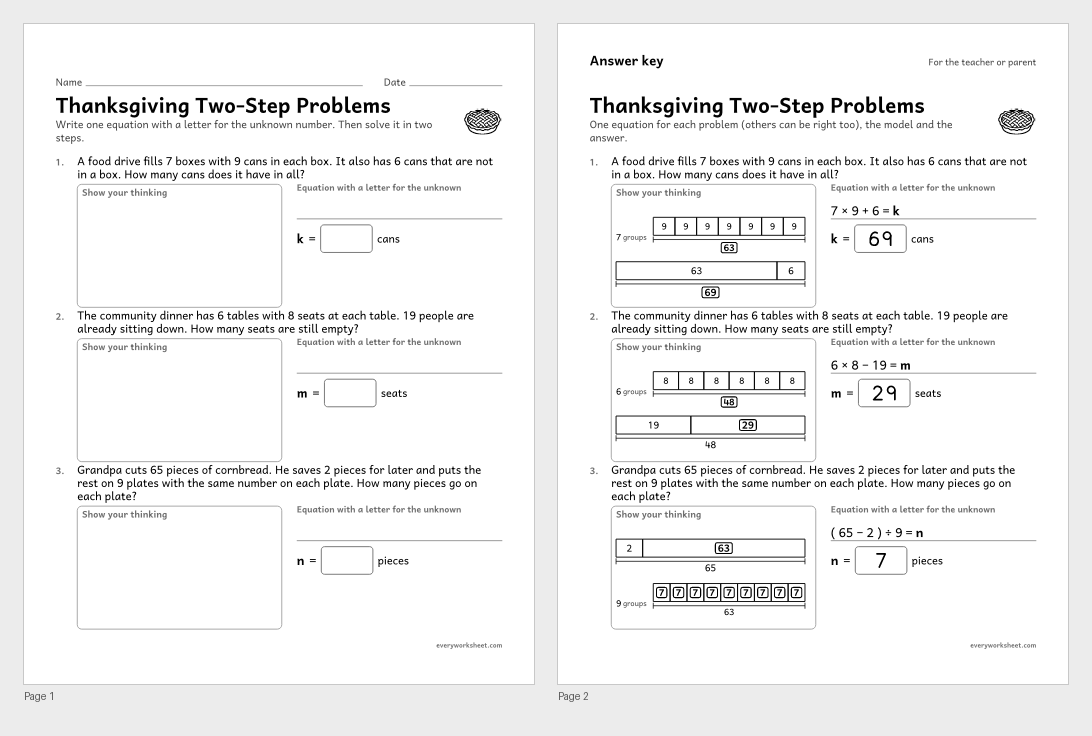
Solving two-step word problems and writing an equation with a letter for the unknown
Answer key on page 2
2 pages139 KB
 View all 2 pages
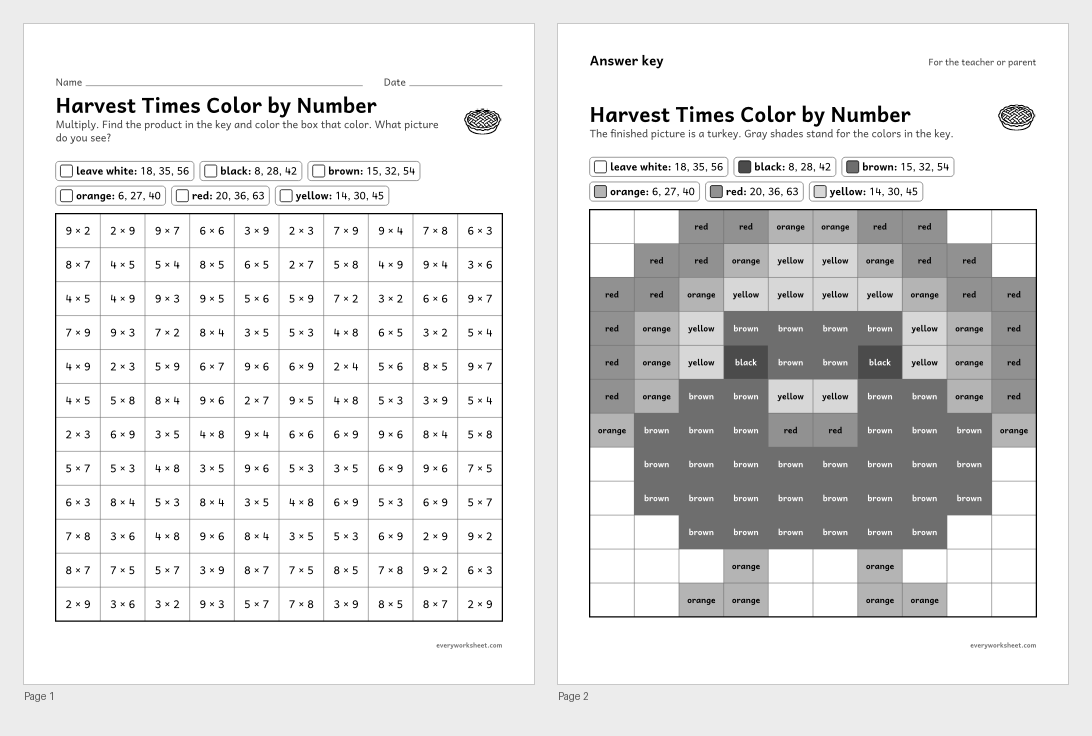
Multiplication facts within 100 (color by product)
Answer key on page 2
2 pages120 KB
 View all 2 pages
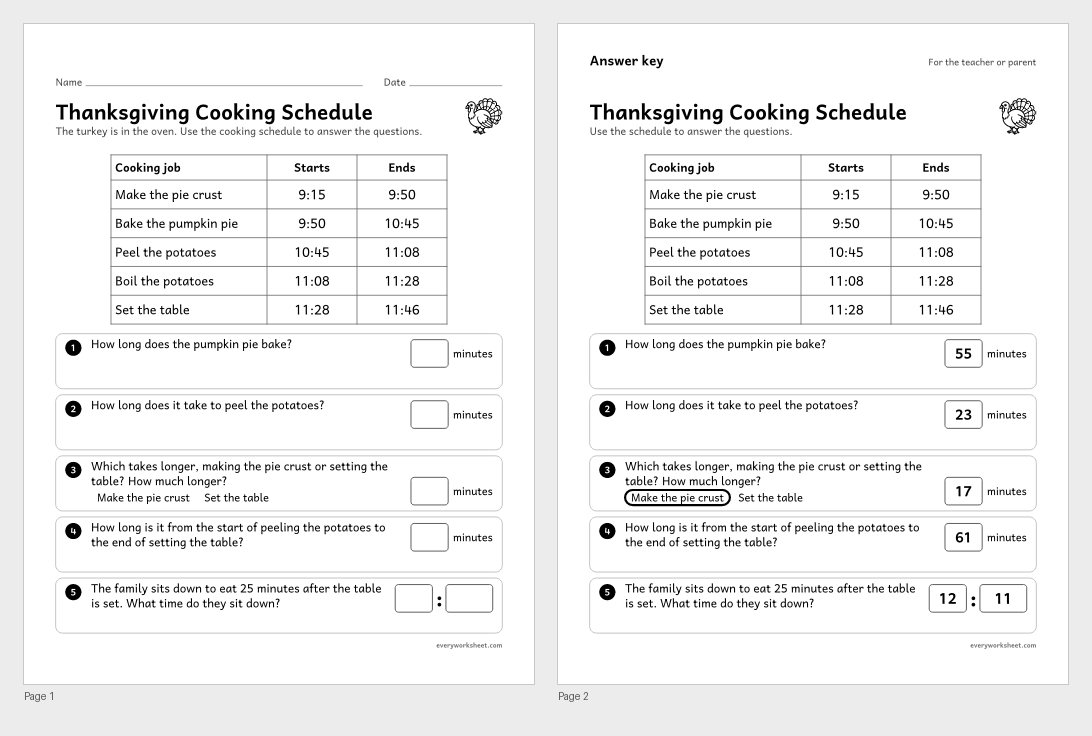
Solving elapsed time problems in minutes with a cooking schedule
Answer key on page 2
2 pages122 KB
 View all 2 pages
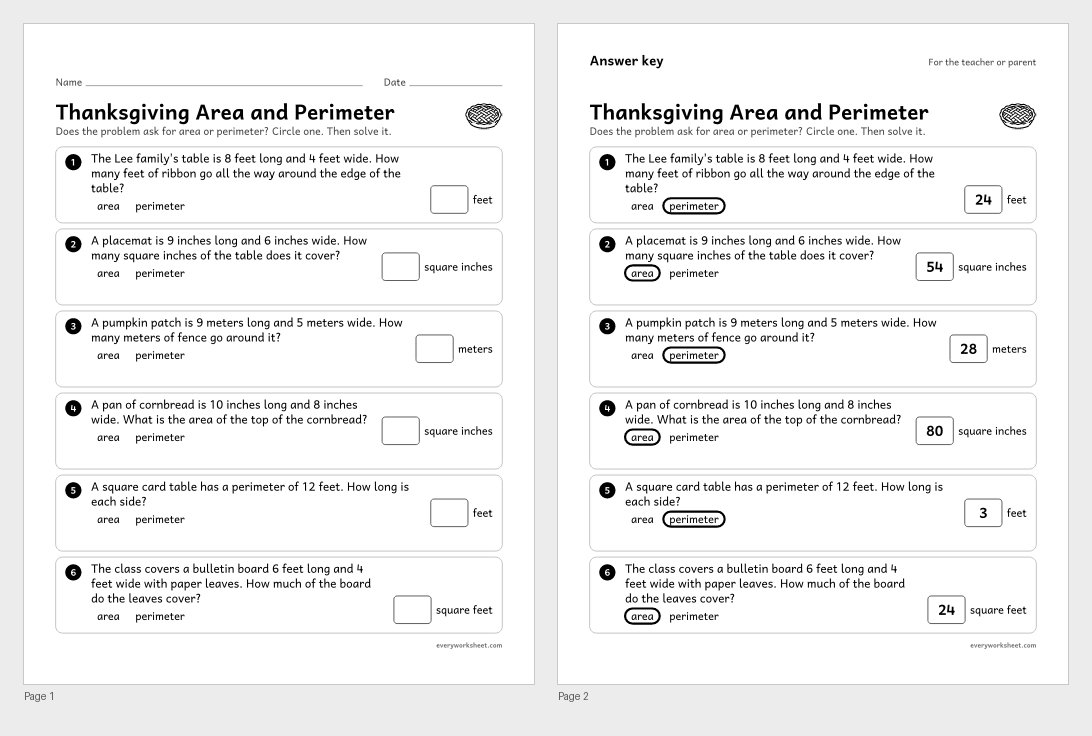
Telling area from perimeter and solving real-world area and perimeter problems
Answer key on page 2
2 pages125 KB
 View all 2 pages
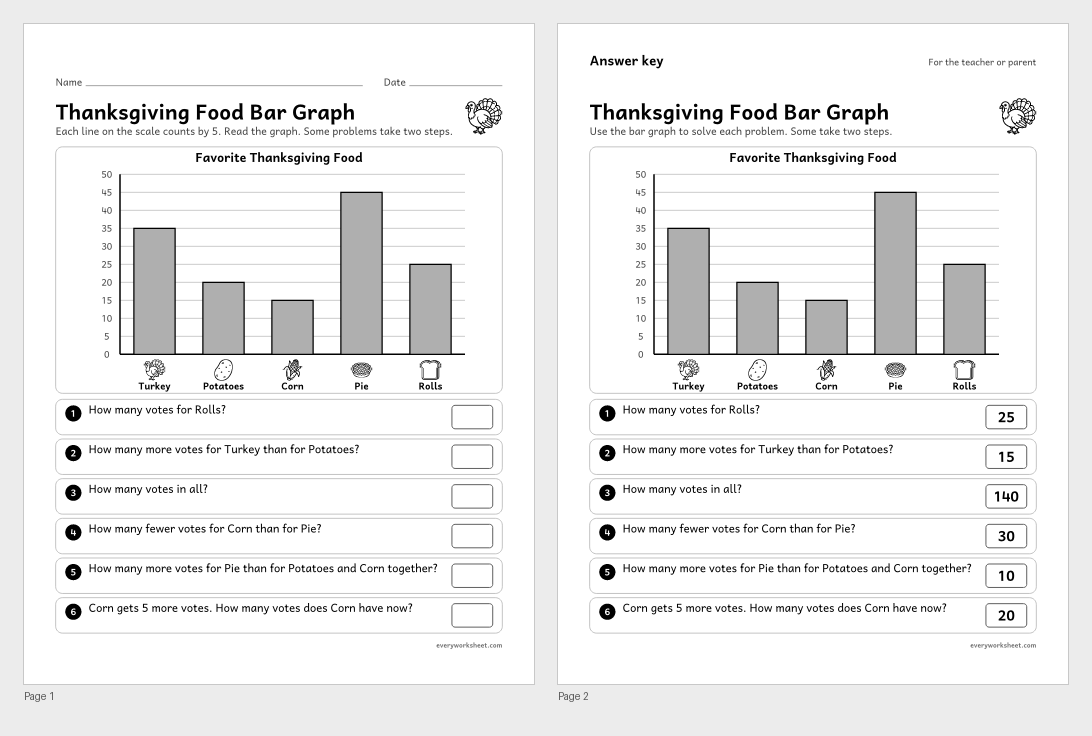
Solving one- and two-step how many more and how many less problems with a scaled bar graph
Answer key on page 2
2 pages396 KB
 View all 2 pages
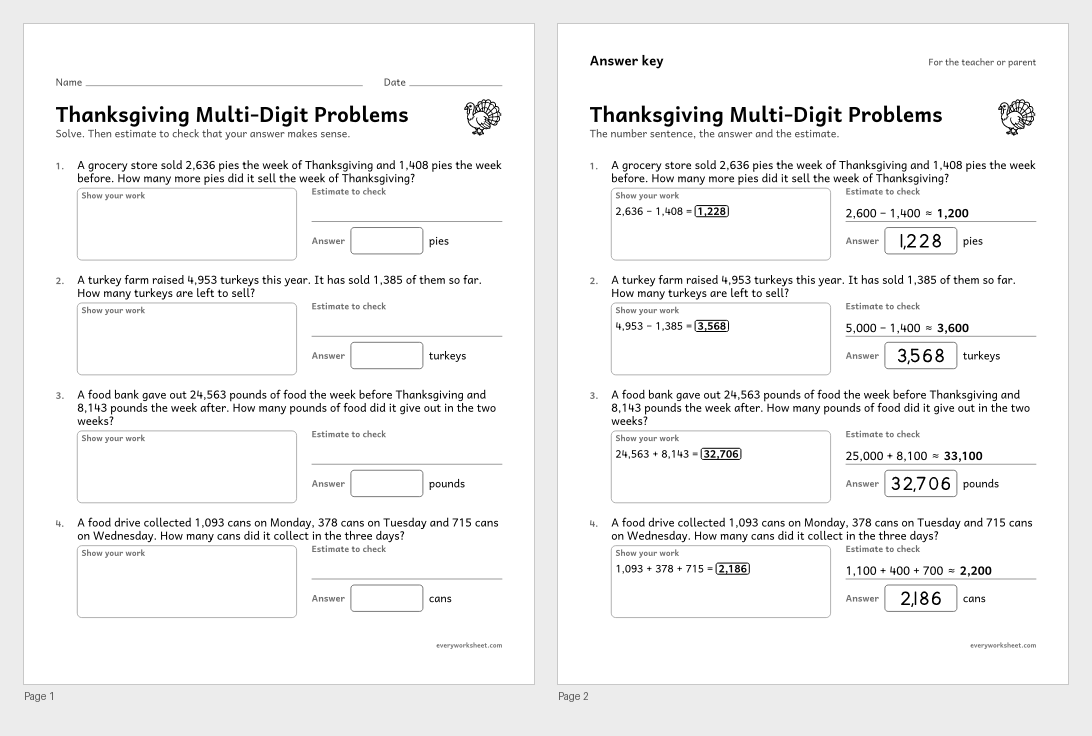
Adding and subtracting multi-digit numbers in stories, with an estimate
Answer key on page 2
2 pages134 KB
 View all 2 pages
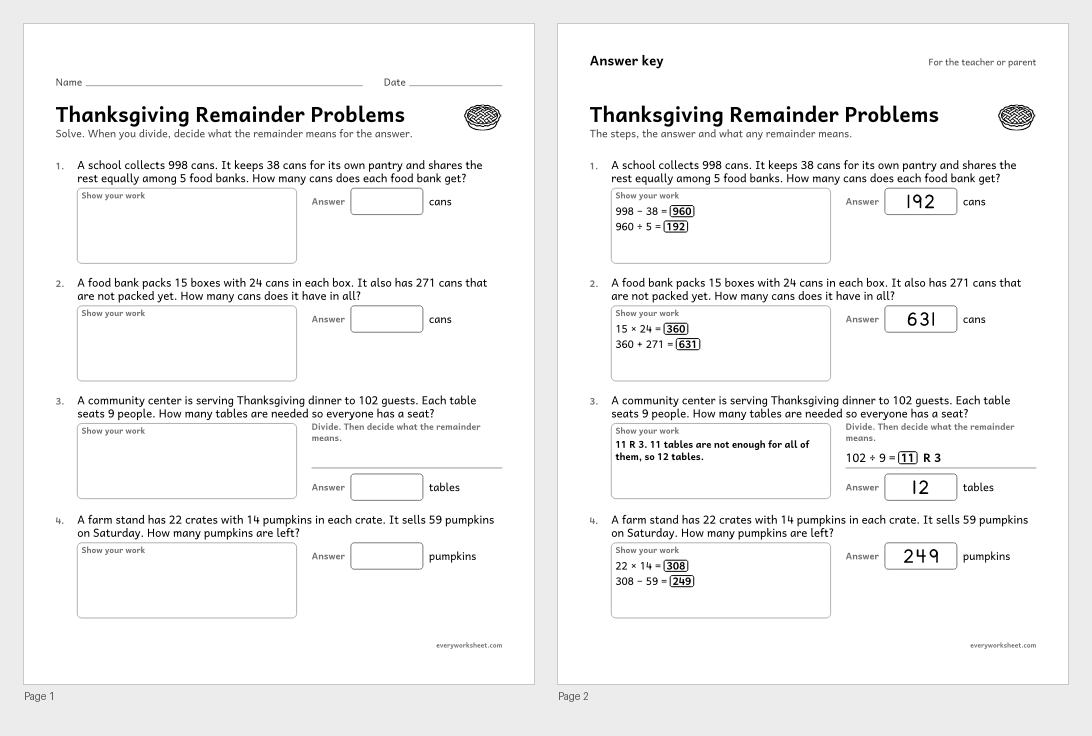
Solving multi-step word problems and interpreting remainders
Answer key on page 2
2 pages140 KB
 View all 2 pages
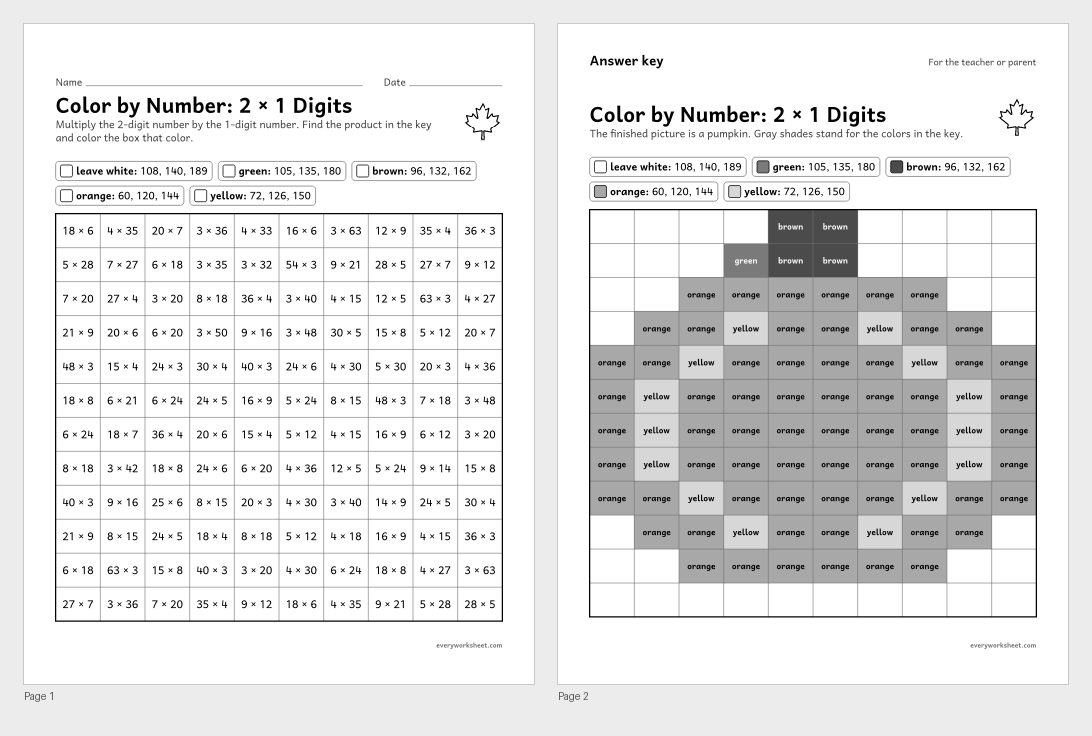
Multiplying 2-digit numbers by 1-digit numbers (color by product)
Answer key on page 2
2 pages62 KB
 View all 2 pages
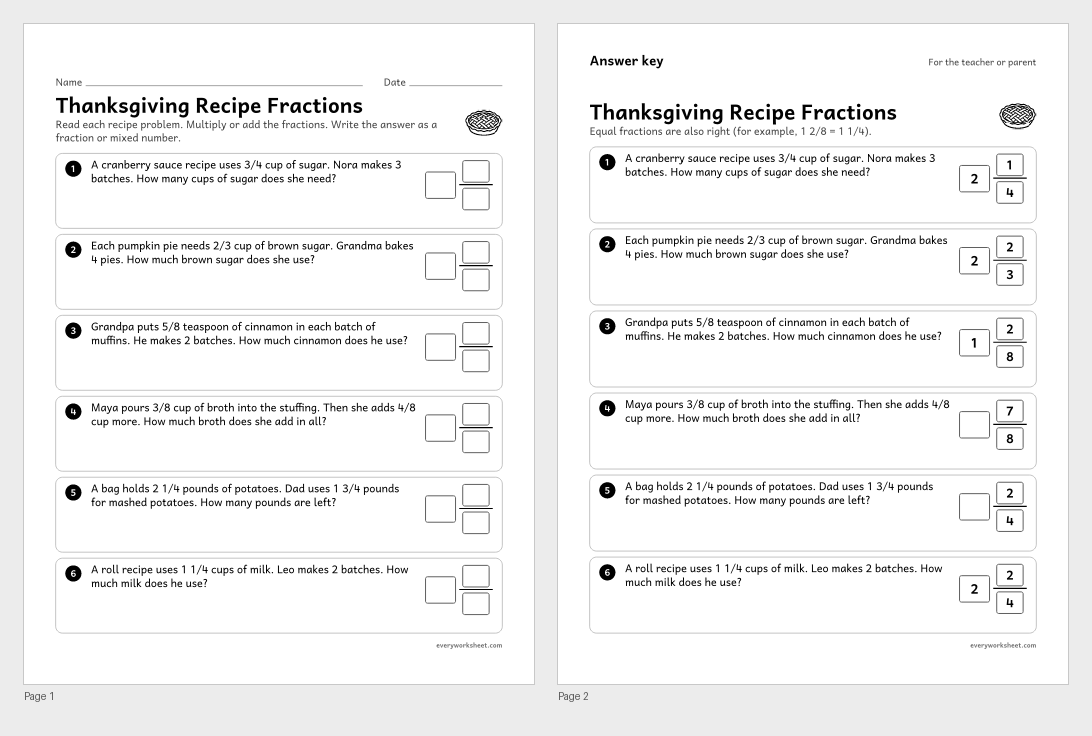
Multiplying a fraction by a whole number and adding and subtracting like fractions in recipe problems
Answer key on page 2
2 pages125 KB
 View all 2 pages
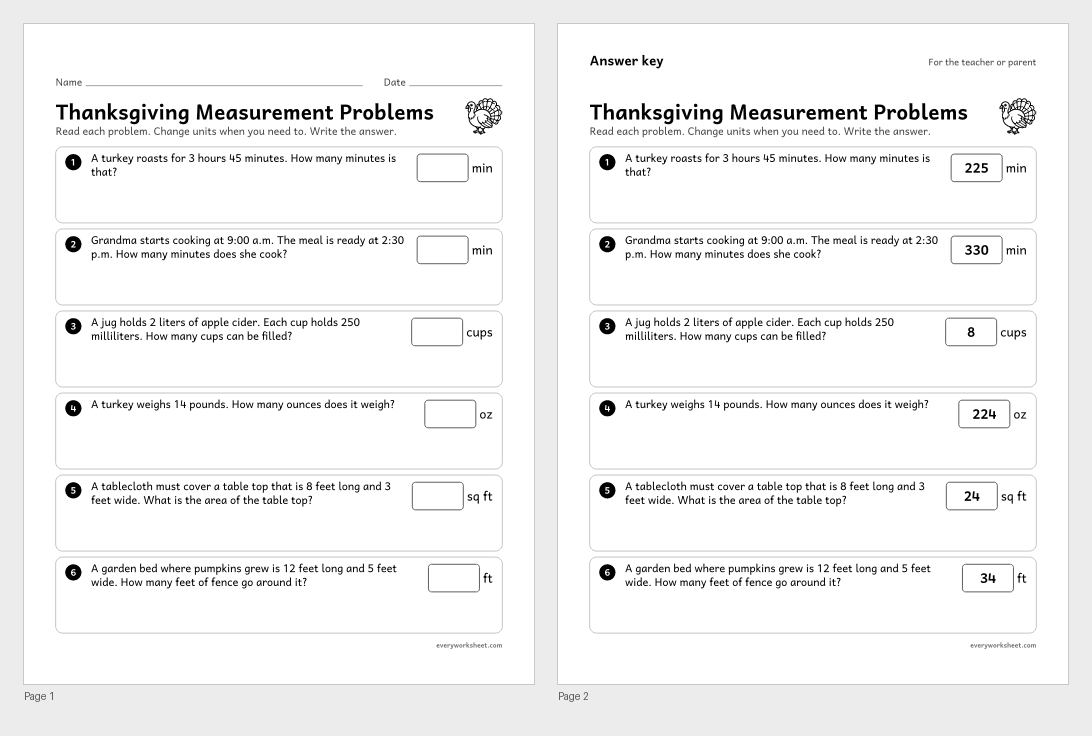
Solving word problems with time, liquid volume, weight and area and perimeter, changing units when needed
Answer key on page 2
2 pages116 KB
 View all 2 pages
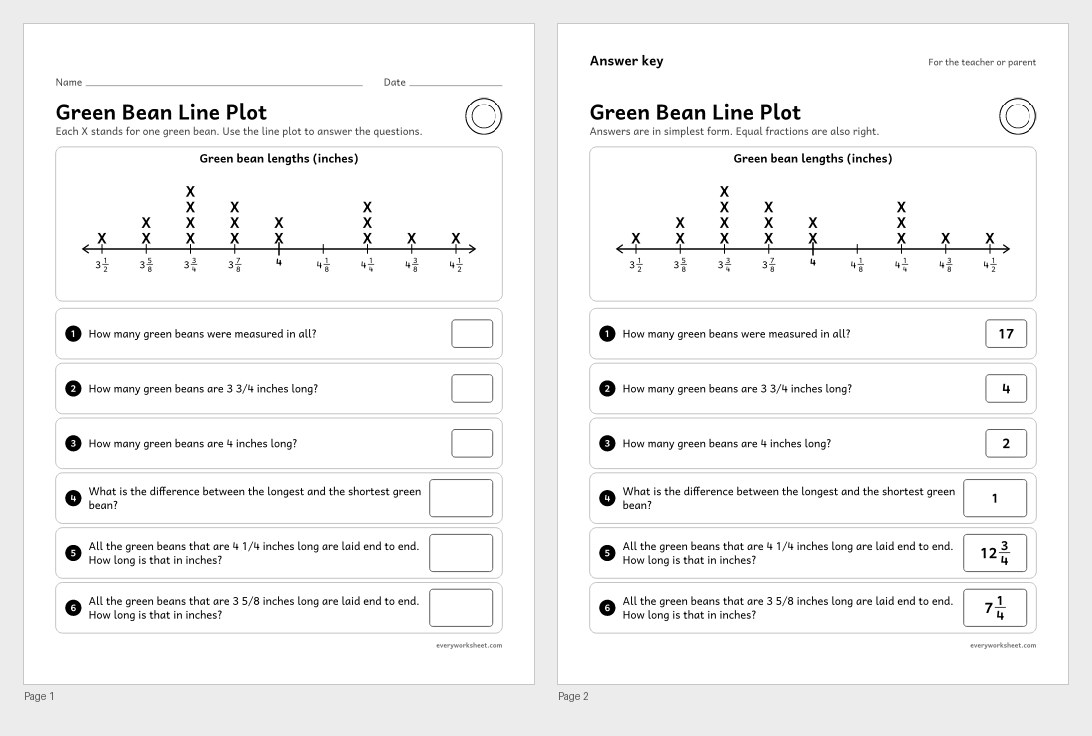
Reading a line plot in eighths of an inch and adding and subtracting fractions to answer questions
Answer key on page 2
2 pages80 KB
 View all 2 pages
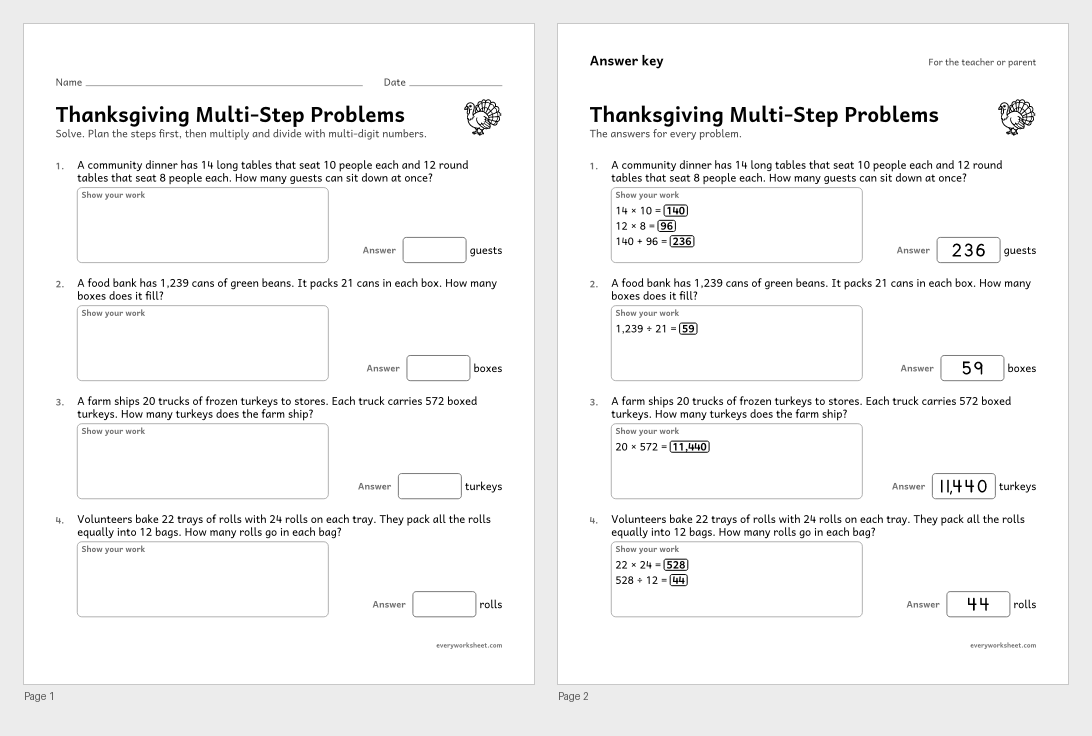
Solving multi-step word problems with multi-digit multiplication and 2-digit divisors
Answer key on page 2
2 pages131 KB
 View all 2 pages
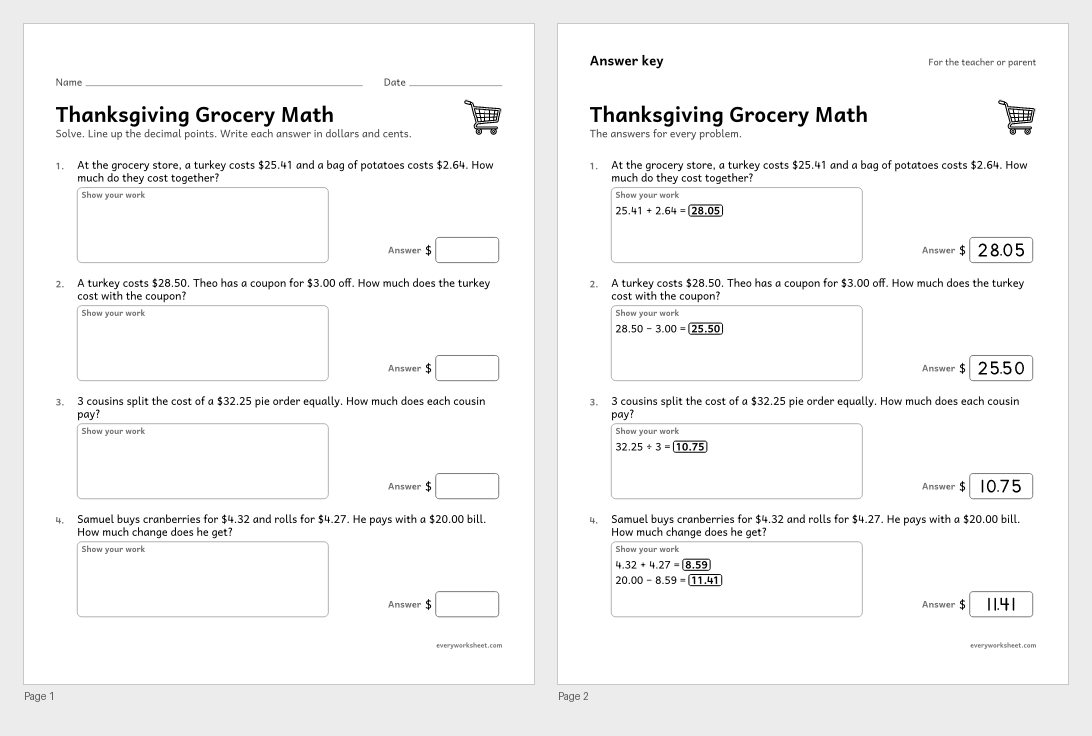
Adding, subtracting, multiplying and dividing money amounts in decimal word problems
Answer key on page 2
2 pages87 KB
 View all 2 pages
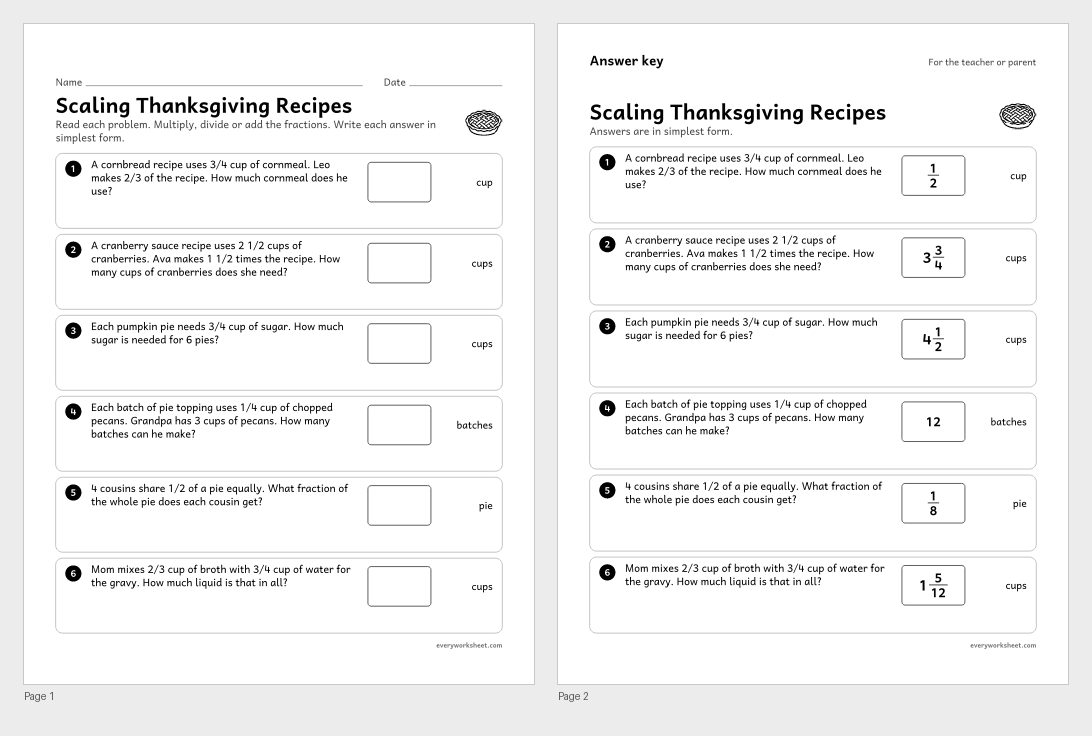
Scaling recipes by multiplying fractions and mixed numbers, and dividing with unit fractions
Answer key on page 2
2 pages126 KB
 View all 2 pages
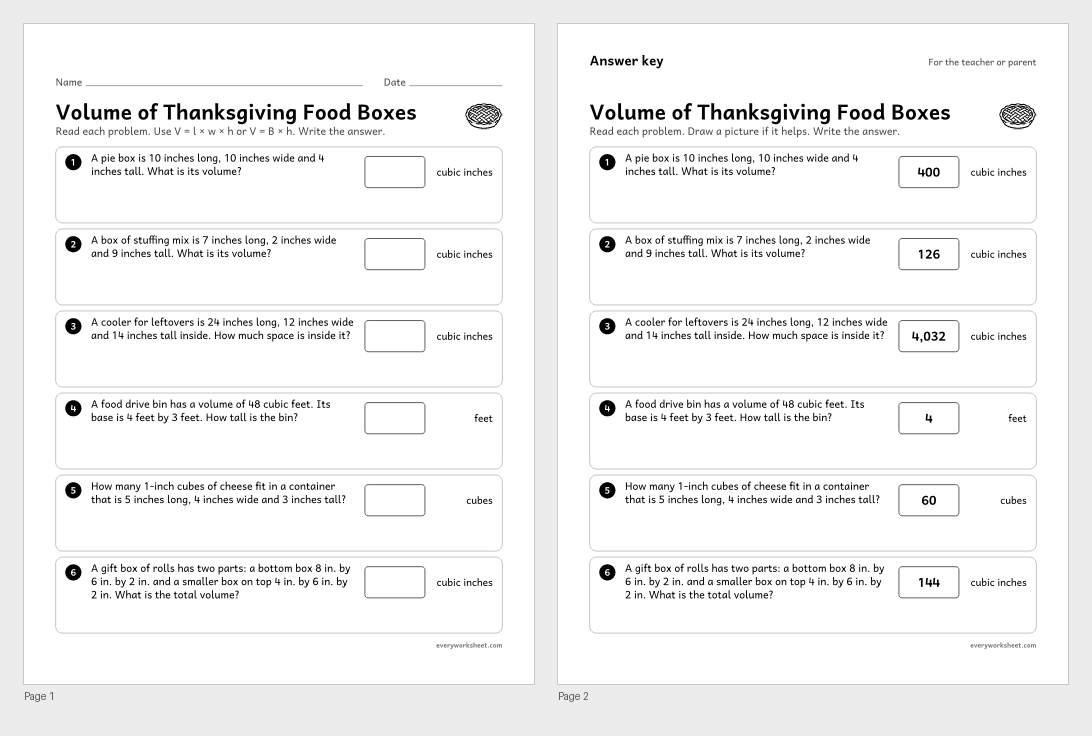
Solving real-world volume problems with V = l × w × h and V = B × h, including a figure made of two boxes
Answer key on page 2
2 pages127 KB
 View all 2 pages
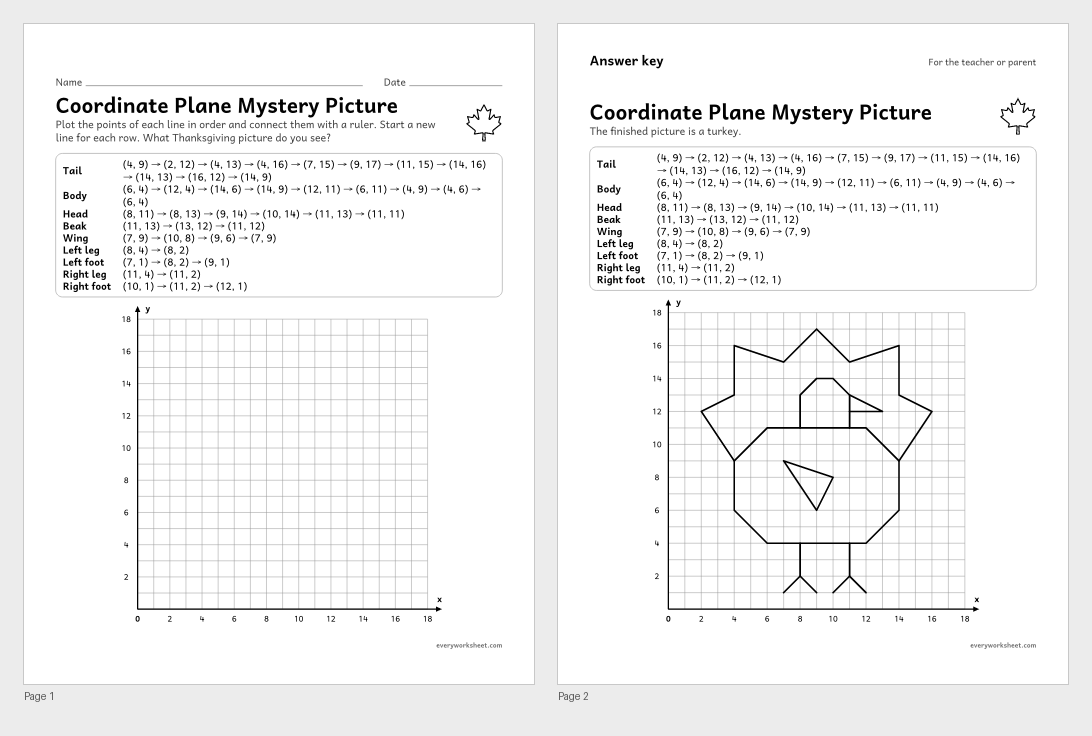
Plotting ordered pairs in the first quadrant to draw a picture
Answer key on page 2
2 pages70 KB
 View all 2 pages
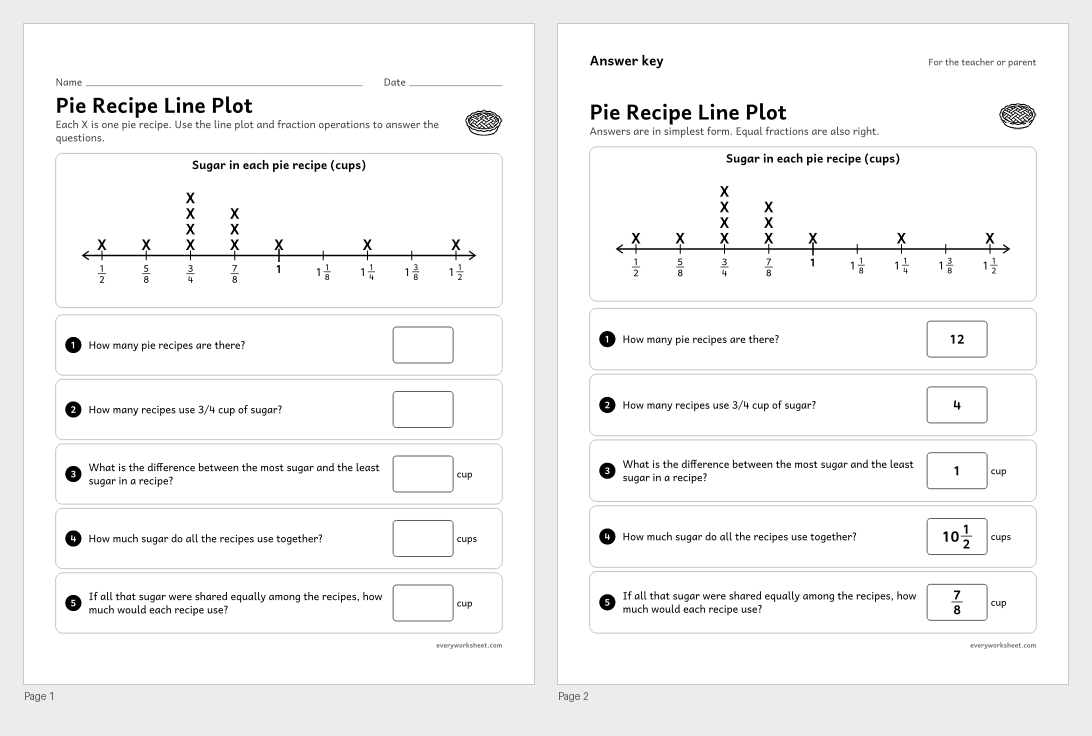
Making sense of a line plot in eighths and using fraction operations, including sharing equally
Answer key on page 2
2 pages125 KB
Print at 100% (actual size) for the cleanest tracing lines.
These Thanksgiving math worksheets put every holiday math page on the site in one place, grouped by grade. Preschoolers count turkey feathers, finish patterns and color by number. Kindergartners count, add and take away. 1st and 2nd graders solve turkey word problems, add and subtract with regrouping and read graphs of favorite foods.
From 3rd grade up the pages get harder: multiplication and division stories, a Thanksgiving color by number multiplication page (a turkey with facts to 9 × 9 in 3rd grade and a pumpkin with 2-digit by 1-digit products in 4th), elapsed time on a cooking schedule, area and perimeter, recipe fractions, line plots, multi-digit and decimal money problems, the volume of food boxes and a coordinate grid mystery turkey. Every page practices a real grade skill, prints in black and white on US Letter or A4, and has an answer key at the end of the PDF. For reading and writing pages too, see Thanksgiving Worksheets.
CCSS.MATH.CONTENT.1.MD.C.4Organize, represent, and interpret data with up to three categories; ask and answer questions about the total number of data points, how many in each category, and how many more or less are in one category than in another.CCSS.MATH.CONTENT.1.NBT.A.1Count to 120, starting at any number less than 120. In this range, read and write numerals and represent a number of objects with a written numeral.CCSS.MATH.CONTENT.1.OA.A.1Use addition and subtraction within 20 to solve word problems involving situations of adding to, taking from, putting together, taking apart, and comparing, with unknowns in all positions, e.g., by using objects, drawings, and equations with a symbol for the unknown number to represent the problem.CCSS.MATH.CONTENT.1.OA.A.2Solve word problems that call for addition of three whole numbers whose sum is less than or equal to 20, e.g., by using objects, drawings, and equations with a symbol for the unknown number to represent the problem.CCSS.MATH.CONTENT.1.OA.D.8Determine the unknown whole number in an addition or subtraction equation relating three whole numbers. For example, determine the unknown number that makes the equation true in each of the equations 8 + ? = 11, 5 = _ - 3, 6 + 6 = _.CCSS.MATH.CONTENT.2.MD.D.10Draw a picture graph and a bar graph (with single-unit scale) to represent a data set with up to four categories. Solve simple put-together, take-apart, and compare problems using information presented in a bar graph.CCSS.MATH.CONTENT.2.NBT.B.5Fluently add and subtract within 100 using strategies based on place value, properties of operations, and/or the relationship between addition and subtraction.CCSS.MATH.CONTENT.2.OA.A.1Use addition and subtraction within 100 to solve one- and two-step word problems involving situations of adding to, taking from, putting together, taking apart, and comparing, with unknowns in all positions, e.g., by using drawings and equations with a symbol for the unknown number to represent the problem.CCSS.MATH.CONTENT.3.MD.A.1Tell and write time to the nearest minute and measure time intervals in minutes. Solve word problems involving addition and subtraction of time intervals in minutes, e.g., by representing the problem on a number line diagram.CCSS.MATH.CONTENT.3.MD.B.3Draw a scaled picture graph and a scaled bar graph to represent a data set with several categories. Solve one- and two-step "how many more" and "how many less" problems using information presented in scaled bar graphs.CCSS.MATH.CONTENT.3.MD.D.8Solve real world and mathematical problems involving perimeters of polygons, including finding the perimeter given the side lengths, finding an unknown side length, and exhibiting rectangles with the same perimeter and different areas or with the same area and different perimeters.CCSS.MATH.CONTENT.3.OA.A.3Use multiplication and division within 100 to solve word problems in situations involving equal groups, arrays, and measurement quantities, e.g., by using drawings and equations with a symbol for the unknown number to represent the problem.CCSS.MATH.CONTENT.3.OA.C.7Fluently multiply and divide within 100, using strategies such as the relationship between multiplication and division (e.g., knowing that 8 × 5 = 40, one knows 40 ÷ 5 = 8) or properties of operations. By the end of Grade 3, know from memory all products of two one-digit numbers.CCSS.MATH.CONTENT.3.OA.D.8Solve two-step word problems using the four operations. Represent these problems using equations with a letter standing for the unknown quantity. Assess the reasonableness of answers using mental computation and estimation strategies including rounding.CCSS.MATH.CONTENT.4.MD.A.2Use the four operations to solve word problems involving distances, intervals of time, liquid volumes, masses of objects, and money, including problems involving simple fractions or decimals, and problems that require expressing measurements given in a larger unit in terms of a smaller unit. Represent measurement quantities using diagrams such as number line diagrams that feature a measurement scale.CCSS.MATH.CONTENT.4.MD.B.4Make a line plot to display a data set of measurements in fractions of a unit (1/2, 1/4, 1/8). Solve problems involving addition and subtraction of fractions by using information presented in line plots. For example, from a line plot find and interpret the difference in length between the longest and shortest specimens in an insect collection.CCSS.MATH.CONTENT.4.NBT.B.4Fluently add and subtract multi-digit whole numbers using the standard algorithm.CCSS.MATH.CONTENT.4.NBT.B.5Multiply a whole number of up to four digits by a one-digit whole number, and multiply two two-digit numbers, using strategies based on place value and the properties of operations. Illustrate and explain the calculation by using equations, rectangular arrays, and/or area models.CCSS.MATH.CONTENT.4.NF.B.4.CSolve word problems involving multiplication of a fraction by a whole number, e.g., by using visual fraction models and equations to represent the problem. For example, if each person at a party will eat 3/8 of a pound of roast beef, and there will be 5 people at the party, how many pounds of roast beef will be needed? Between what two whole numbers does your answer lie?CCSS.MATH.CONTENT.4.OA.A.3Solve multistep word problems posed with whole numbers and having whole-number answers using the four operations, including problems in which remainders must be interpreted. Represent these problems using equations with a letter standing for the unknown quantity. Assess the reasonableness of answers using mental computation and estimation strategies including rounding.CCSS.MATH.CONTENT.5.G.A.2Represent real world and mathematical problems by graphing points in the first quadrant of the coordinate plane, and interpret coordinate values of points in the context of the situation.CCSS.MATH.CONTENT.5.MD.B.2Make a line plot to display a data set of measurements in fractions of a unit (1/2, 1/4, 1/8). Use operations on fractions for this grade to solve problems involving information presented in line plots. For example, given different measurements of liquid in identical beakers, find the amount of liquid each beaker would contain if the total amount in all the beakers were redistributed equally.CCSS.MATH.CONTENT.5.MD.C.5.BApply the formulas V = l × w × h and V = b × h for rectangular prisms to find volumes of right rectangular prisms with whole-number edge lengths in the context of solving real world and mathematical problems.CCSS.MATH.CONTENT.5.NBT.B.6Find whole-number quotients of whole numbers with up to four-digit dividends and two-digit divisors, using strategies based on place value, the properties of operations, and/or the relationship between multiplication and division. Illustrate and explain the calculation by using equations, rectangular arrays, and/or area models.CCSS.MATH.CONTENT.5.NBT.B.7Add, subtract, multiply, and divide decimals to hundredths, using concrete models or drawings and strategies based on place value, properties of operations, and/or the relationship between addition and subtraction; relate the strategy to a written method and explain the reasoning used.CCSS.MATH.CONTENT.5.NF.B.6Solve real world problems involving multiplication of fractions and mixed numbers, e.g., by using visual fraction models or equations to represent the problem.CCSS.MATH.CONTENT.K.CC.B.5Count to answer "how many?" questions about as many as 20 things arranged in a line, a rectangular array, or a circle, or as many as 10 things in a scattered configuration; given a number from 1-20, count out that many objects.CCSS.MATH.CONTENT.K.OA.A.1Represent addition and subtraction with objects, fingers, mental images, drawings, sounds (e.g., claps), acting out situations, verbal explanations, expressions, or equations.ELOF P-MATH 2Child recognizes the number of objects in a small set.ELOF P-MATH 3Child understands the relationship between numbers and quantities.ELOF P-MATH 5Child associates a quantity with written numerals up to 5 and begins to write numbers.ELOF P-MATH 7Child understands simple patterns.ELOF P-MATH 8Child measures objects by their various attributes using standard and non-standard measurement. Uses differences in attributes to make comparisons.Preschool through 5th grade. Each grade has its own group, and every page practices a skill from that grade.
Yes. 3rd grade colors a turkey by solving multiplication facts to 9 × 9, and 4th grade colors a pumpkin by multiplying 2-digit numbers by 1-digit numbers, such as 24 × 6. The answer key shows the finished picture.
Yes. Every math page has an answer key at the end of the same PDF.
Yes. The stories use sensible numbers for the setting, such as a few pies at a bake sale, thousands of cans at a food bank and a family's grocery bill in dollars and cents.