 View larger
Homographs List: 14 pairs with meanings
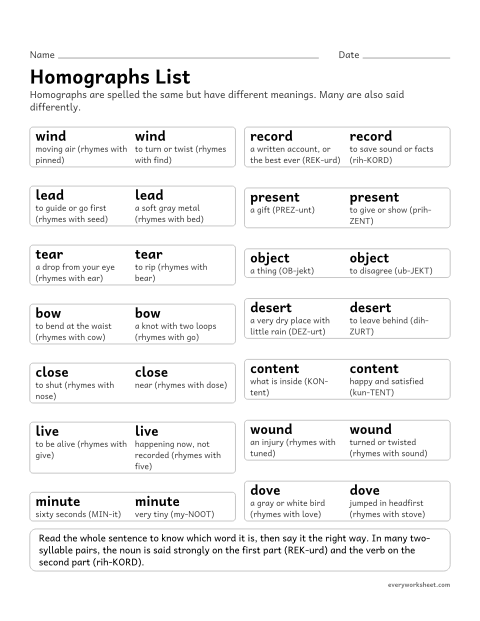
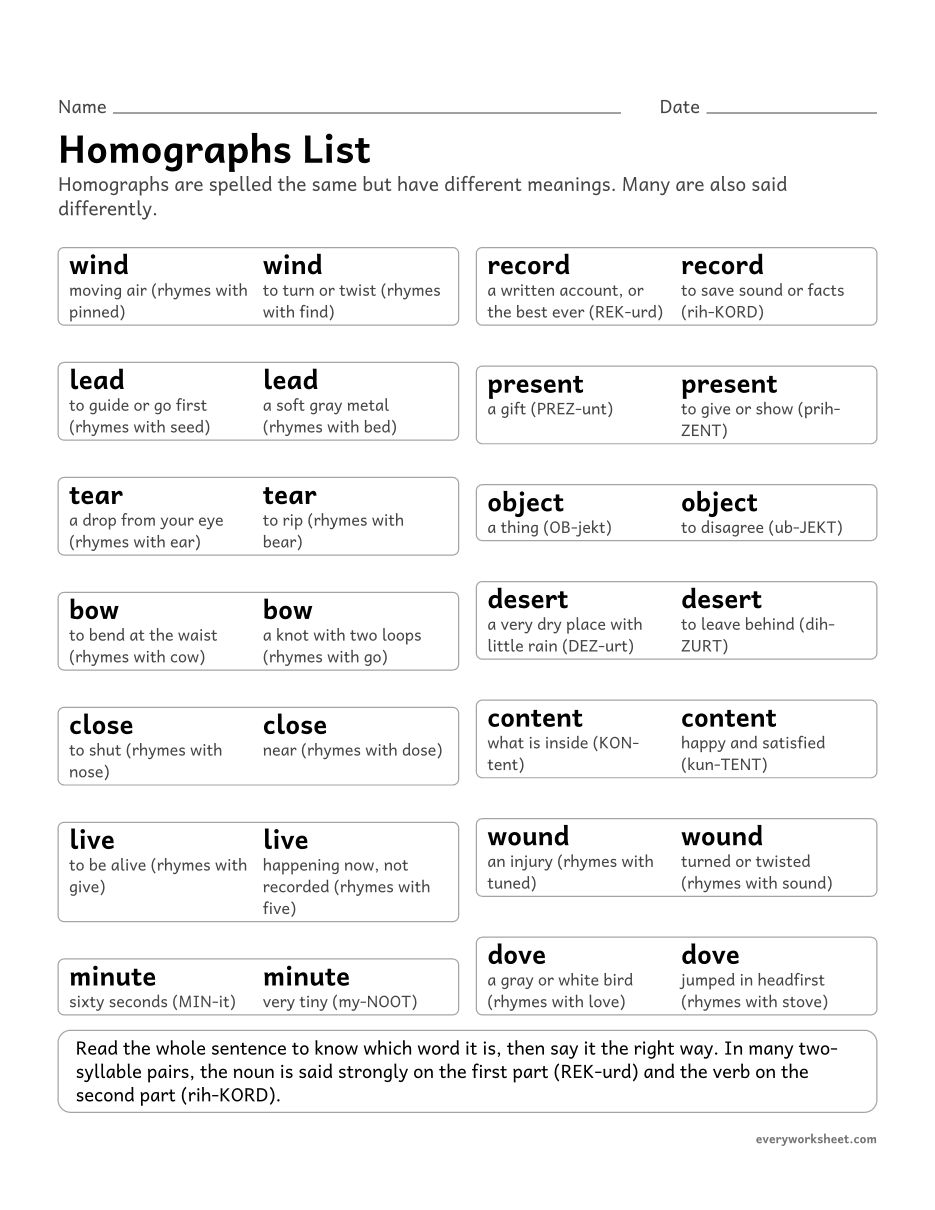
Reading 14 homographs, with each meaning and how to say it
1 page37 KB
A list of 14 homographs with both meanings and how to say each one, plus pages for choosing the meaning, choosing the pronunciation, reading dictionary entries and writing sentences.
View largerReading 14 homographs, with each meaning and how to say it
1 page37 KB
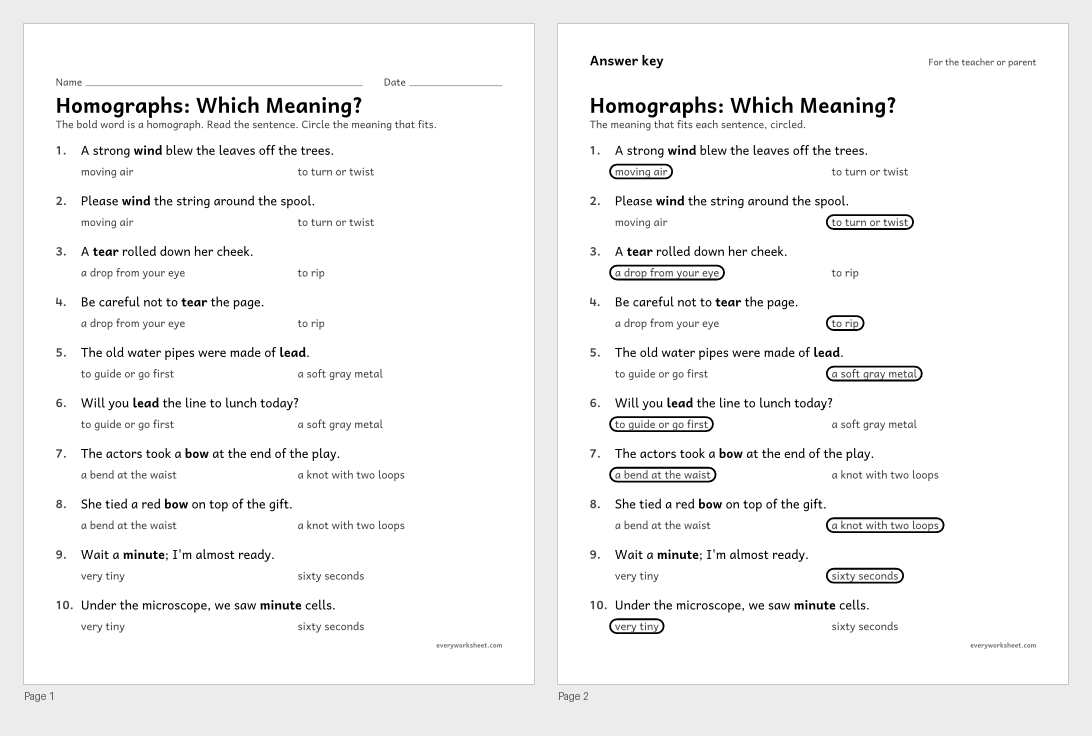 View all 2 pages
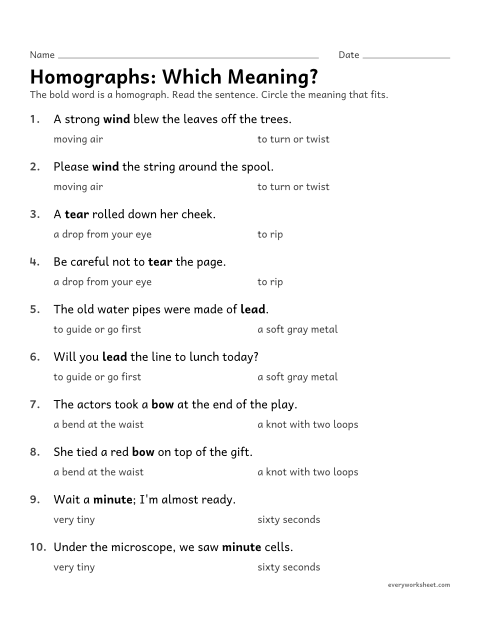
Using the sentence to choose the meaning of a homograph
Answer key on page 2
2 pages54 KB
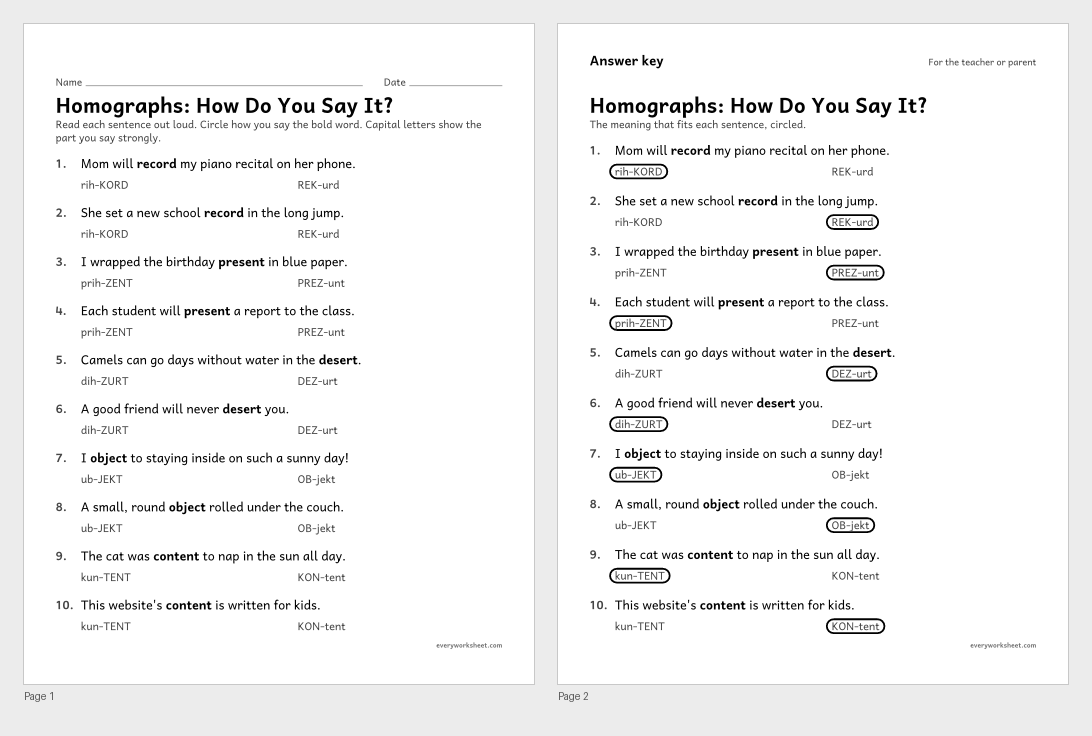 View all 2 pages
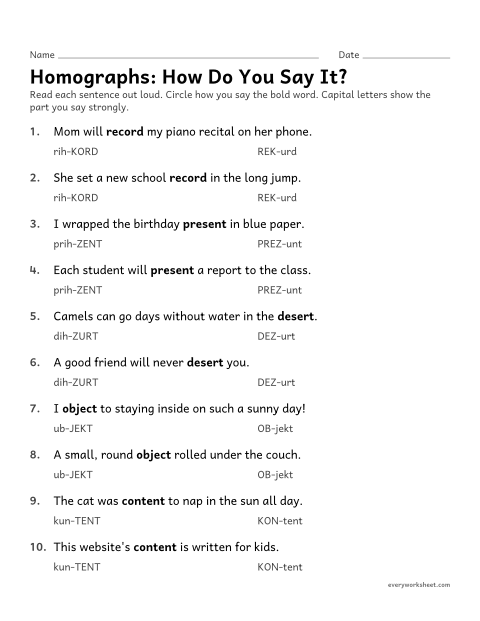
Choosing how to say a homograph from its meaning in a sentence
Answer key on page 2
2 pages55 KB
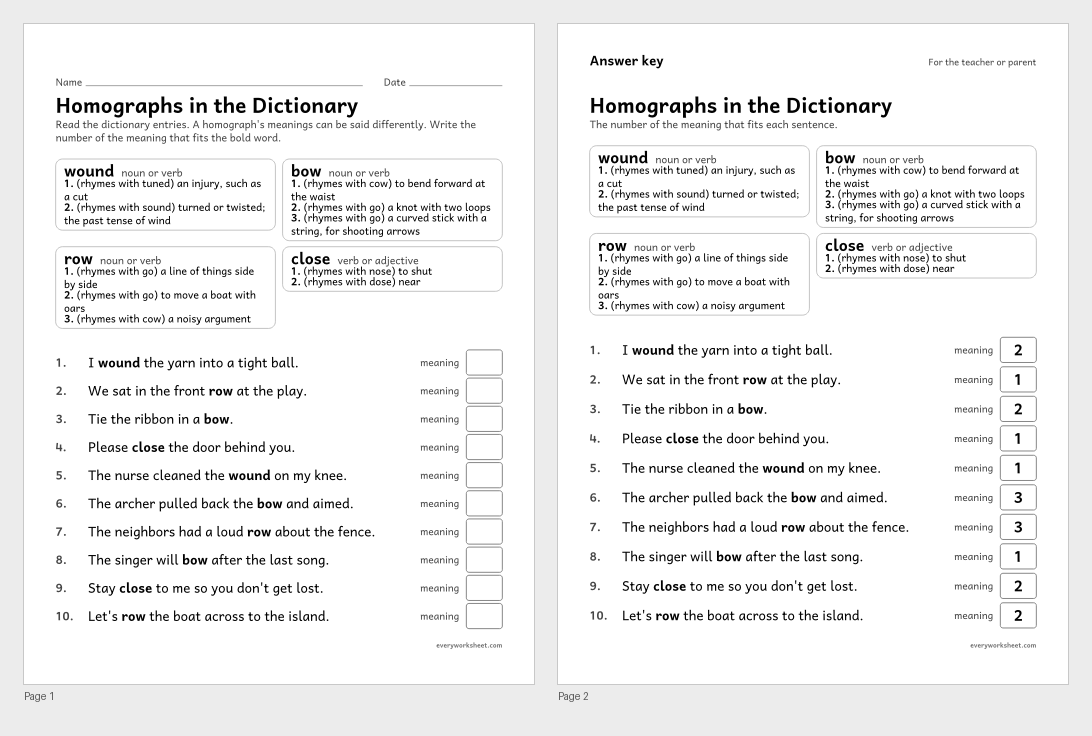 View all 2 pages
Using dictionary entries to choose the meaning and pronunciation of a homograph
Answer key on page 2
2 pages57 KB
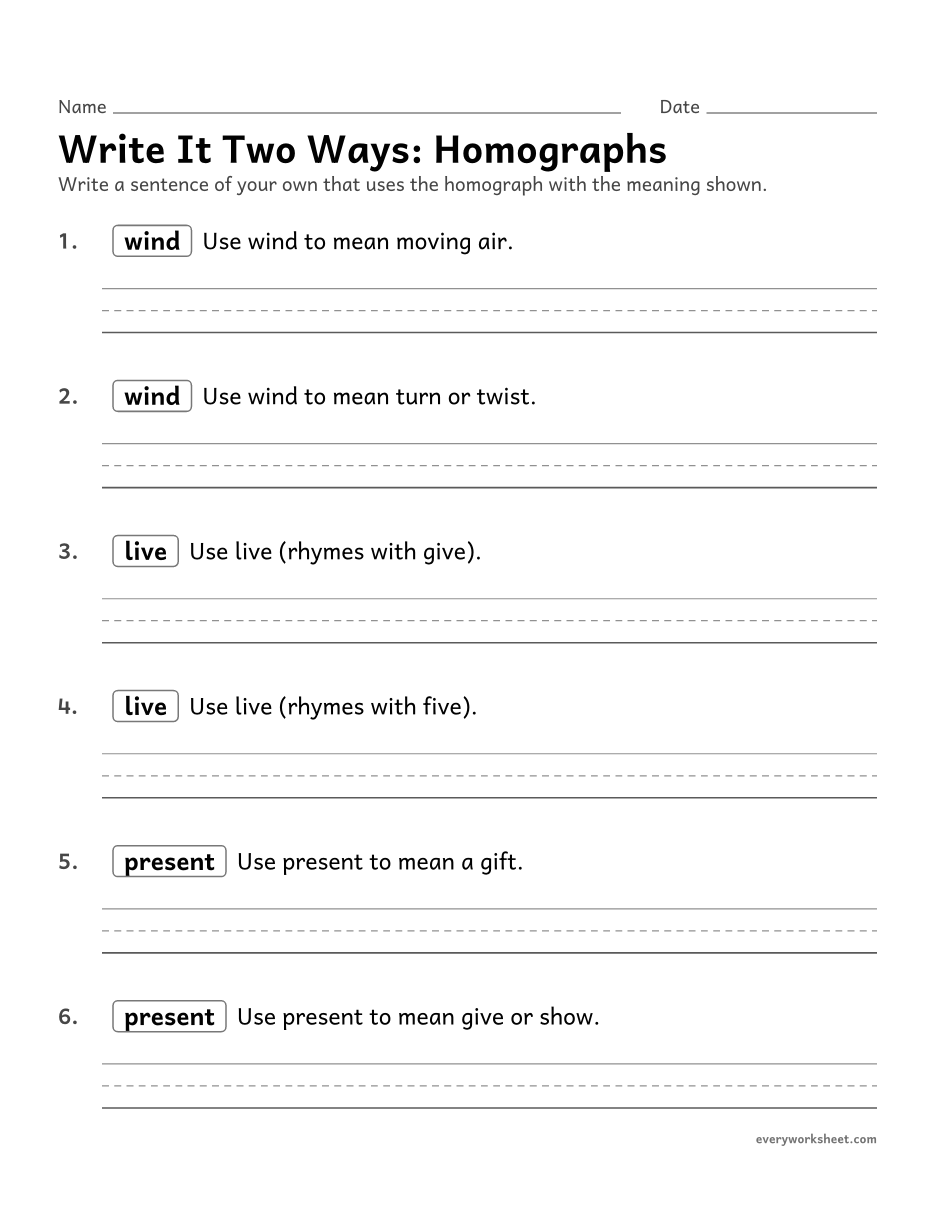 View larger
Writing sentences that use each meaning of a homograph
1 page30 KB
Print at 100% (actual size) for the cleanest tracing lines.
Homographs are words that are spelled the same but have different meanings. Many are also said differently. The wind blows (wind rhymes with pinned), but you wind a clock (rhymes with find). A tear rolls down your cheek, but you tear paper. The only way to know which word you are reading is to read the whole sentence.
Some homographs change which part of the word you say strongly. As a noun, record is said REK-urd (a school record); as a verb, it is rih-KORD (record a song). Present, object, desert and content work the same way. Homographs are different from homophones, which sound the same but are spelled differently (principal and principle).
These homographs worksheets start with a list of 14 homographs, each with both meanings and a pronunciation clue. Children then choose the meaning that fits a sentence, choose how to say a word from its meaning, read dictionary entries for wound, bow, row and close, and write their own sentences for each meaning. Pages with right answers have an answer key on page 2.
CCSS.ELA-LITERACY.L.5.5.CUse the relationship between particular words (e.g., synonyms, antonyms, homographs) to better understand each of the words.CCSS.ELA-LITERACY.L.5.4.AUse context (e.g., cause/effect relationships and comparisons in text) as a clue to the meaning of a word or phrase.CCSS.ELA-LITERACY.L.5.4.CConsult reference materials (e.g., dictionaries, glossaries, thesauruses), both print and digital, to find the pronunciation and determine or clarify the precise meaning of key words and phrases.A word that is spelled the same as another word but has a different meaning, and often a different pronunciation, such as wind (moving air) and wind (to turn).
Homographs are spelled the same (lead, lead). Homophones sound the same but are spelled differently (steal, steel).
Wind, lead, tear, bow, close, live, minute, record, present, object, desert, content, wound and dove.