 View larger
Volume of rectangular prisms
Volume as unit cubes, counting by layers, V = l × w × h, V = B × h and adding the volumes of two prisms
1 page38 KB
A volume chart, unit cubes, layers, the volume formulas, missing edges, converting units, composite figures and word problems. With answer keys.
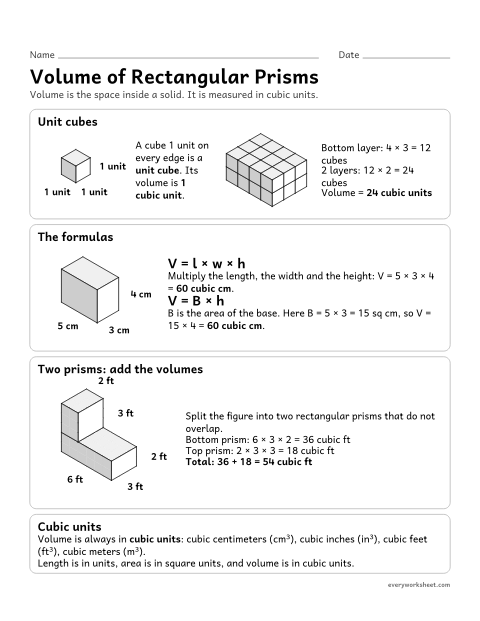
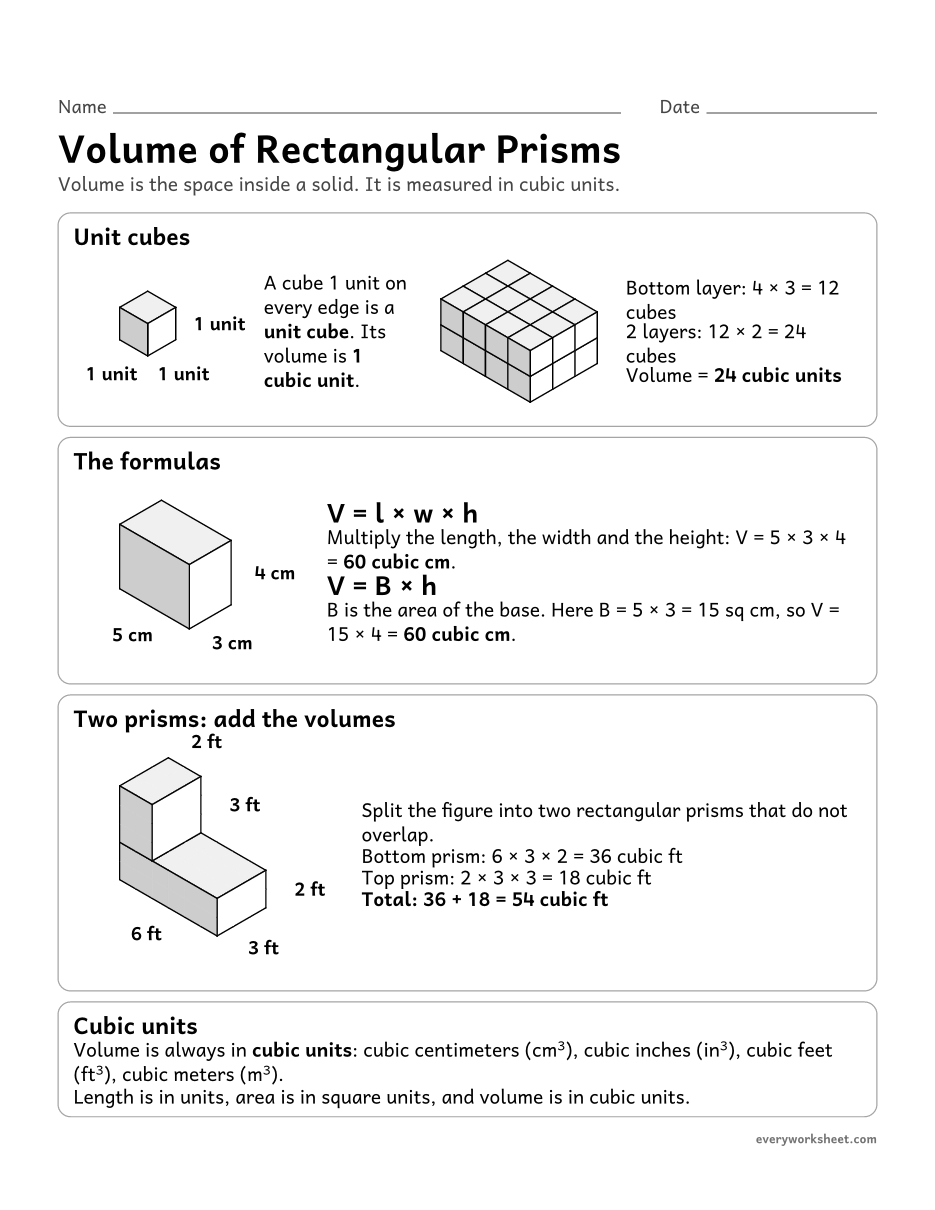
View largerVolume as unit cubes, counting by layers, V = l × w × h, V = B × h and adding the volumes of two prisms
1 page38 KB
 View all 2 pages
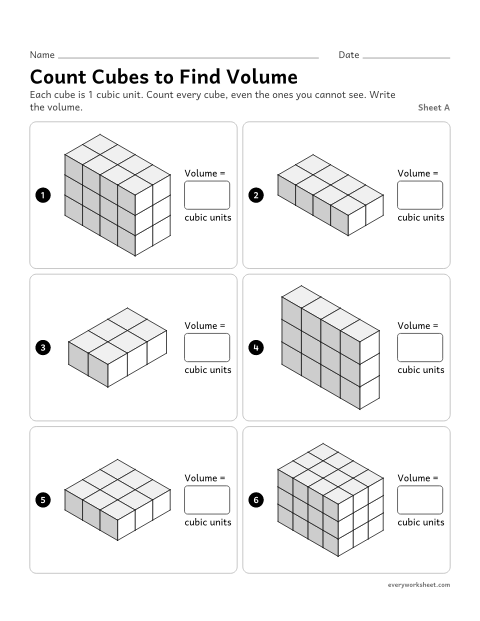
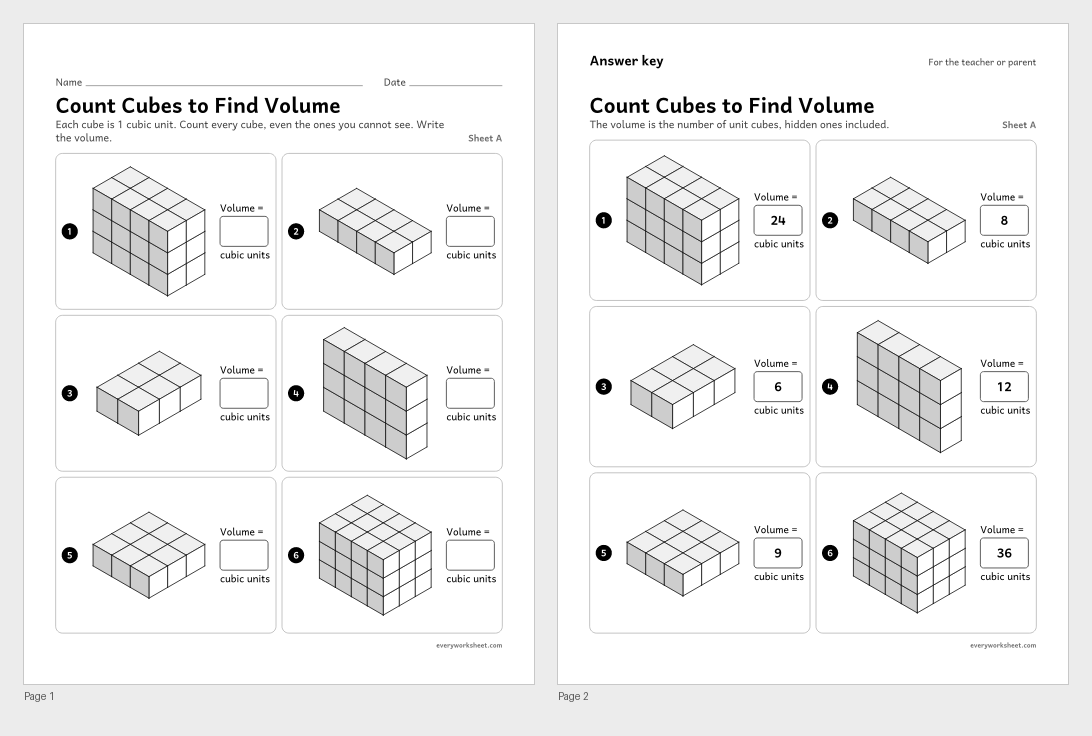
Finding the volume of small prisms by counting unit cubes, including the hidden ones
Answer key on page 2
2 pages48 KB
 View all 2 pages
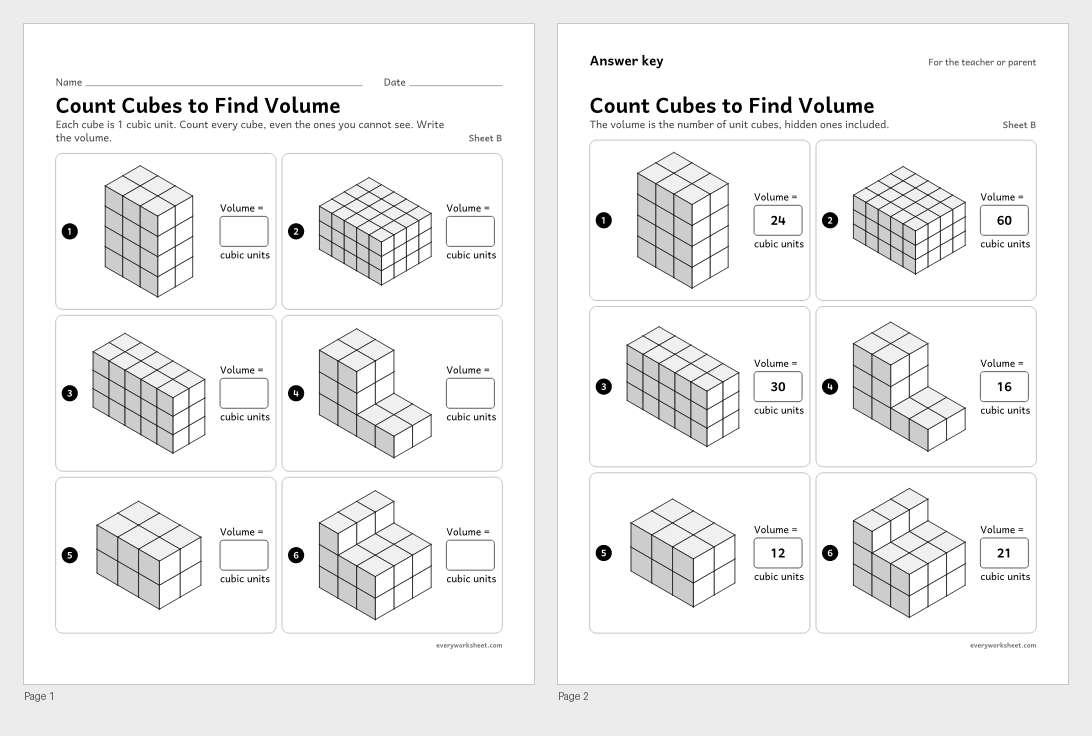
Counting unit cubes in larger prisms and in figures made of two prisms, including the cubes you cannot see
Answer key on page 2
2 pages53 KB
 View all 2 pages
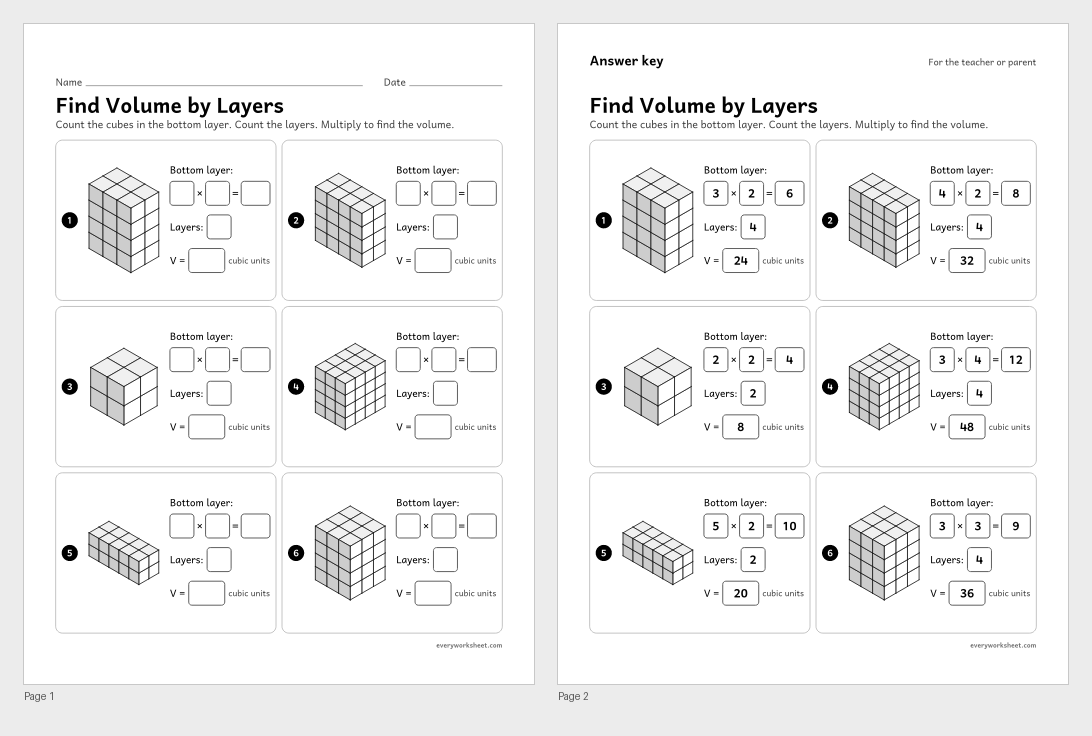
Counting the cubes in one layer, then multiplying by the number of layers: volume = base × height
Answer key on page 2
2 pages55 KB
 View all 2 pages
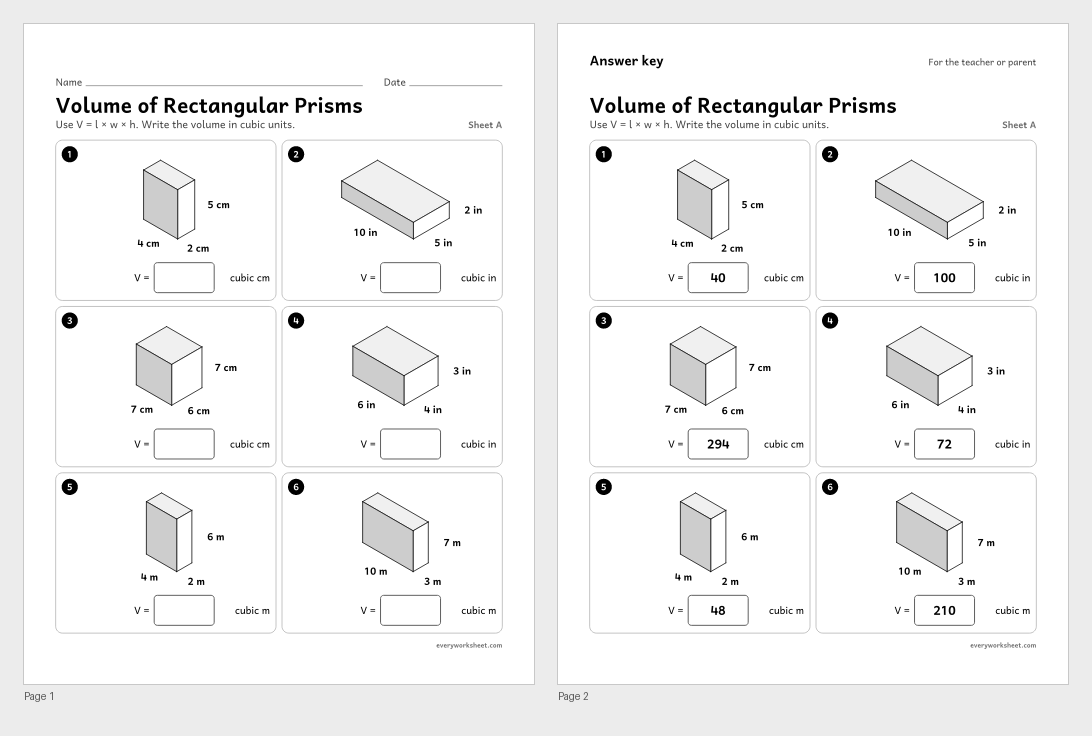
Using V = l × w × h to find the volume of rectangular prisms with whole-number edges
Answer key on page 2
2 pages41 KB
 View all 2 pages
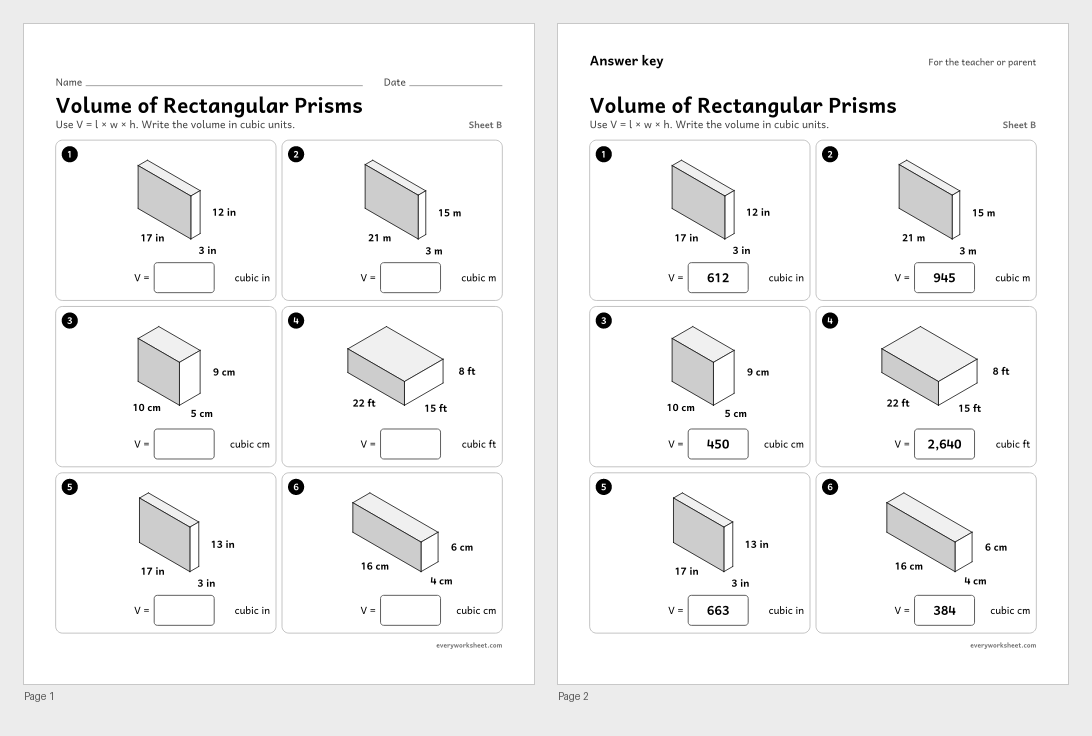
Using V = l × w × h for prisms with two-digit edge lengths
Answer key on page 2
2 pages42 KB
 View all 2 pages
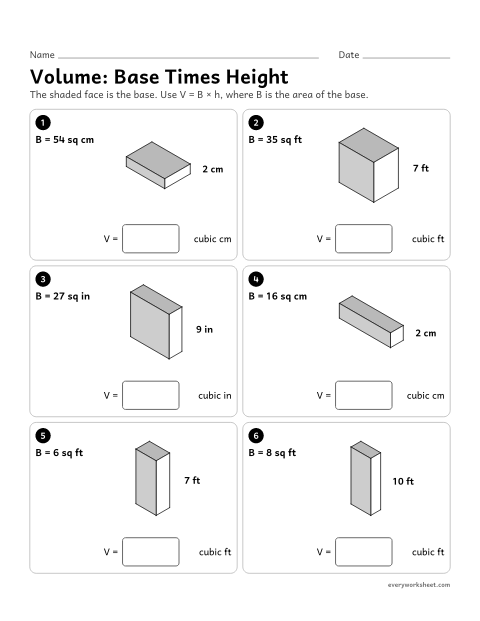
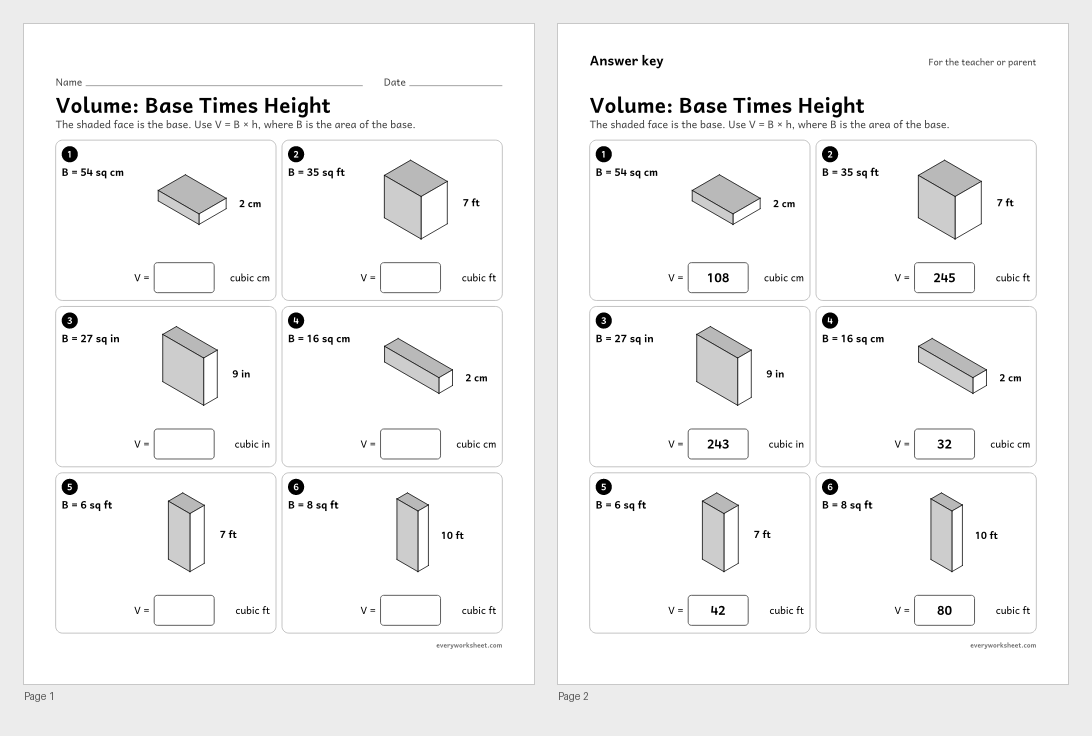
Using V = B × h when the area of the base is given
Answer key on page 2
2 pages41 KB
 View all 2 pages
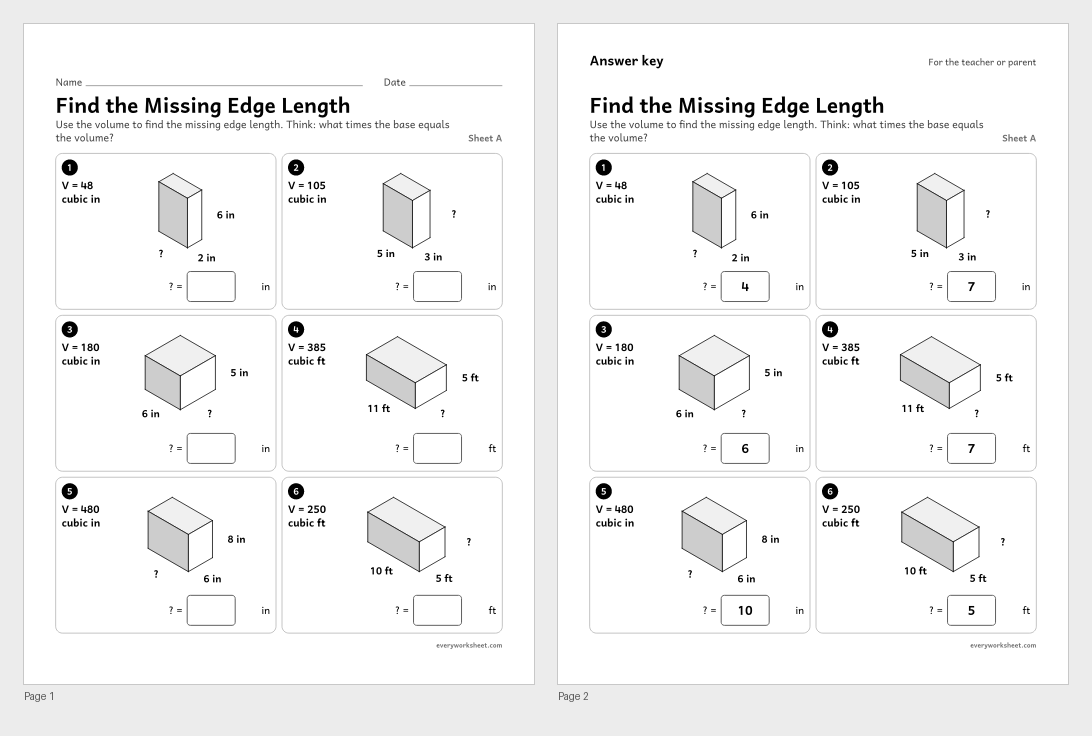
Finding an unknown edge of a rectangular prism from its volume and the other two edges
Answer key on page 2
2 pages43 KB
 View all 2 pages
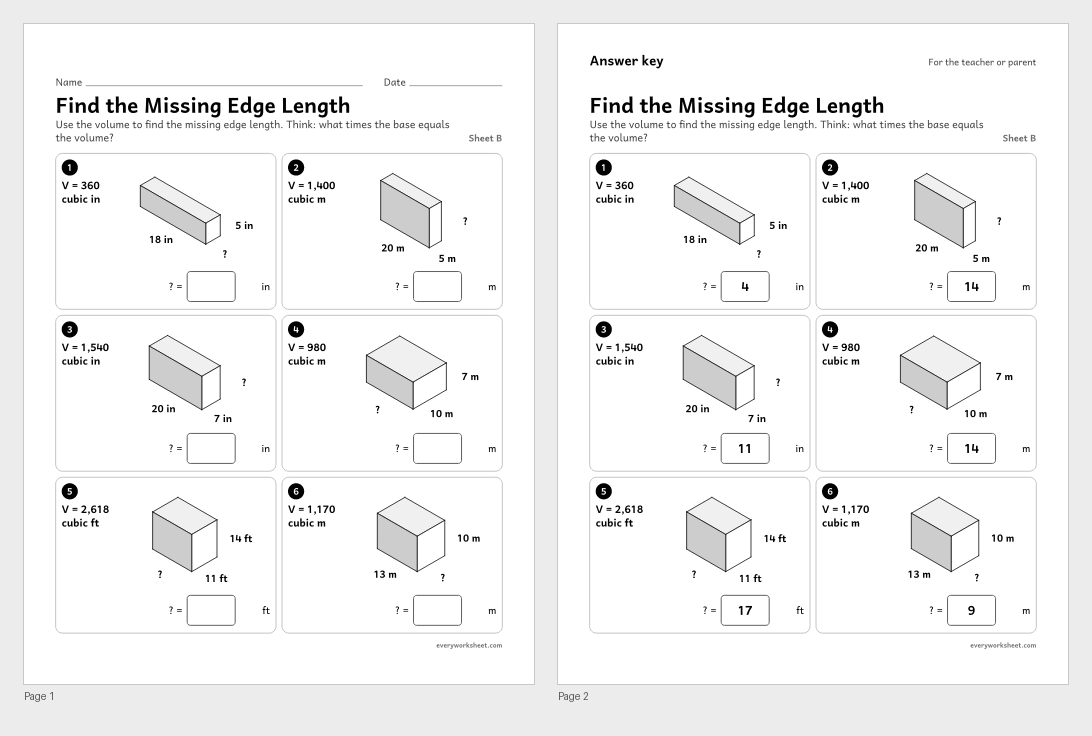
Finding an unknown edge of a larger rectangular prism by dividing the volume by the area of a face
Answer key on page 2
2 pages44 KB
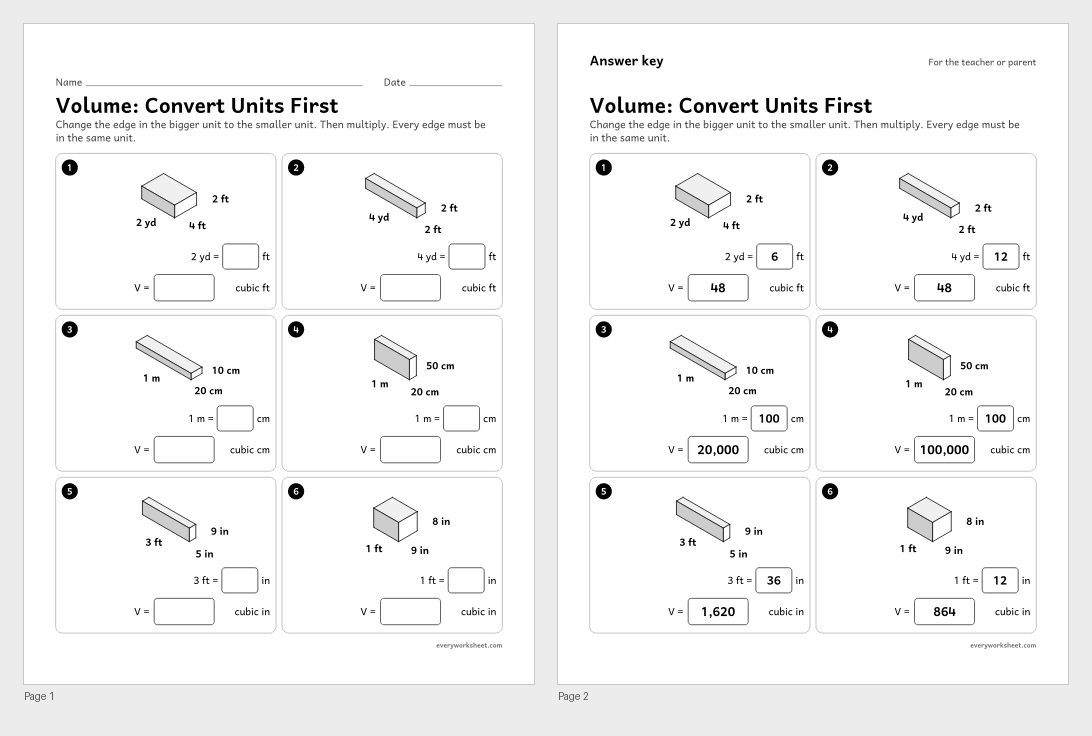 View all 2 pages
Changing every edge to the same unit before multiplying, like 2 ft by 6 in by 4 in = 24 in by 6 in by 4 in
Answer key on page 2
2 pages43 KB
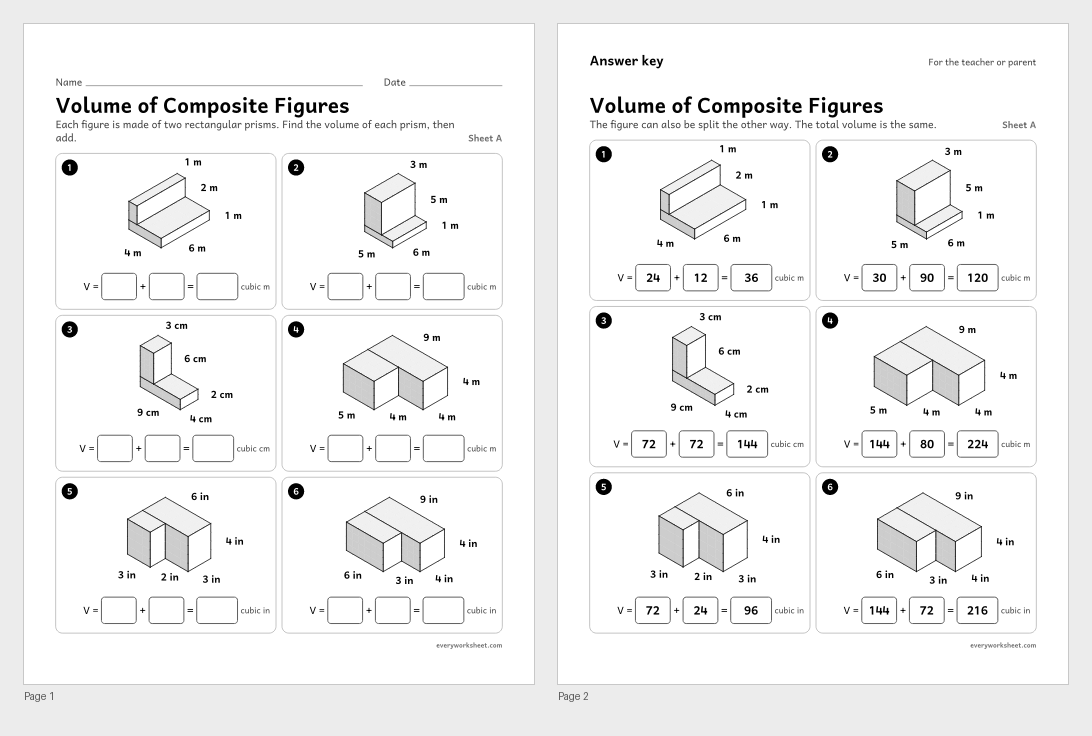 View all 2 pages
Finding the volume of a figure made of two rectangular prisms by adding the two volumes
Answer key on page 2
2 pages73 KB
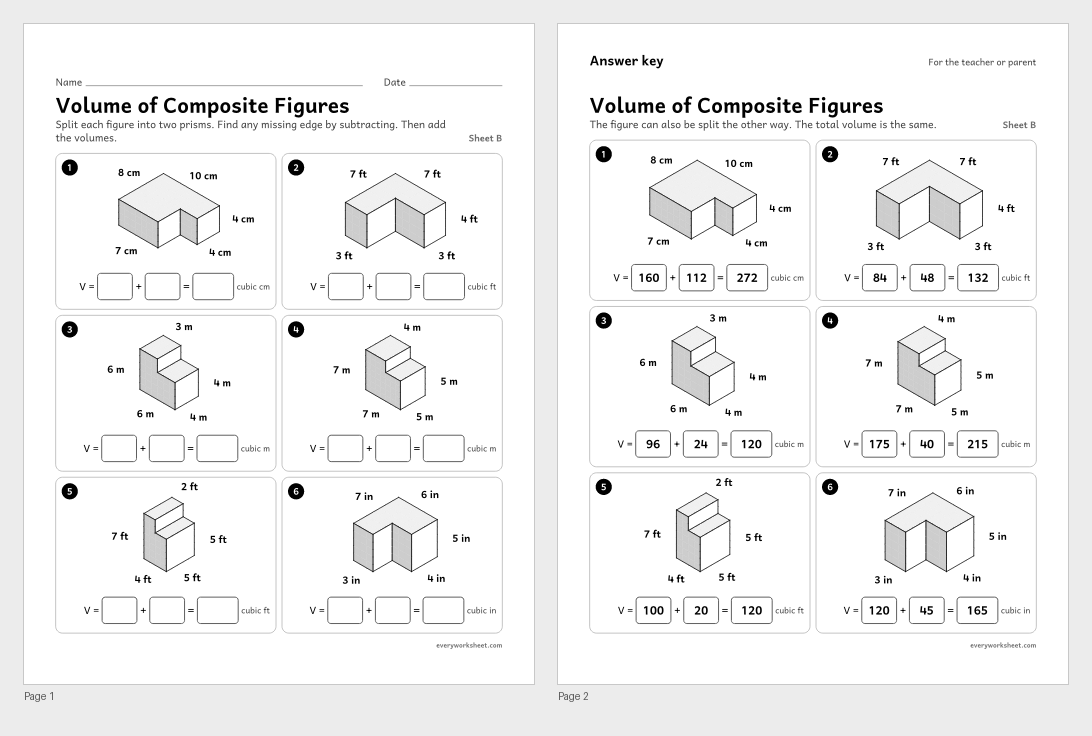 View all 2 pages
Finding the volume of figures made of two prisms when one edge must be found by subtracting
Answer key on page 2
2 pages76 KB
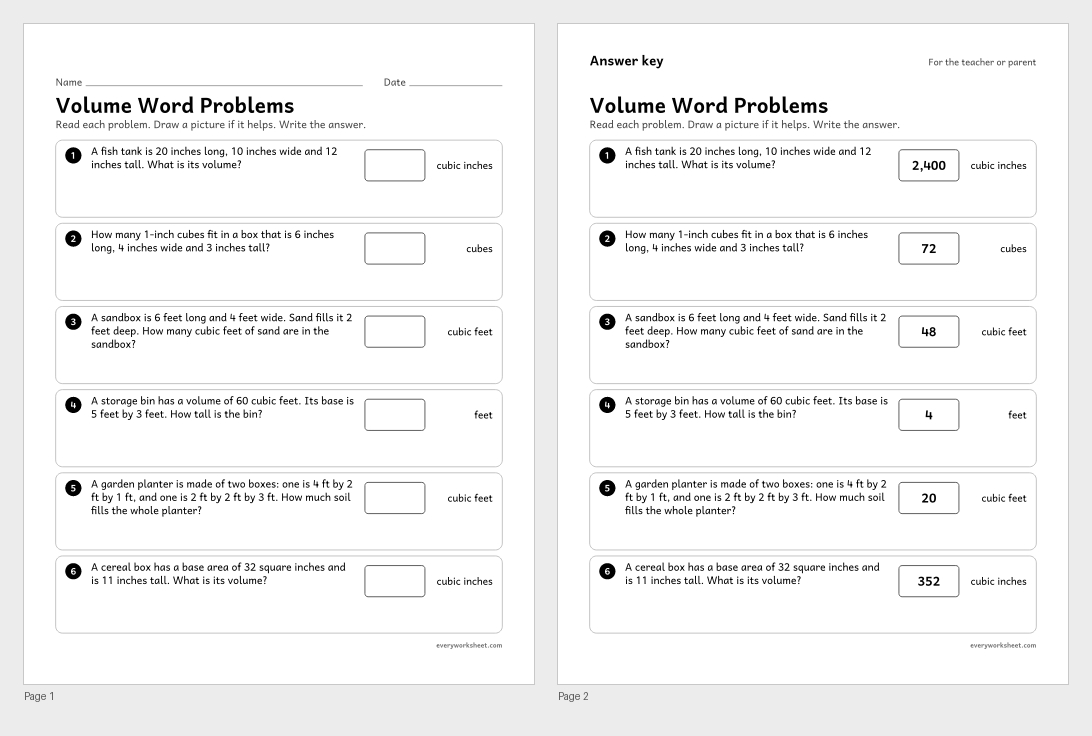 View all 2 pages
Solving real-world volume problems with V = l × w × h, V = B × h and figures made of two prisms
Answer key on page 2
2 pages41 KB
Print at 100% (actual size) for the cleanest tracing lines.
Volume is the space inside a solid, measured in cubic units. A unit cube is 1 unit long, 1 unit wide and 1 unit tall, and has a volume of 1 cubic unit. To find the volume of a rectangular prism, count the cubes in the bottom layer and multiply by the number of layers. A prism 4 cubes long and 3 cubes wide has 12 cubes in a layer, so 2 layers make 24 cubic units.
That gives the formulas V = l × w × h and V = B × h, where B is the area of the base. A box 5 cm long, 3 cm wide and 4 cm tall has a volume of 5 × 3 × 4 = 60 cubic cm. For a figure made of two rectangular prisms, find the volume of each prism and add them. When the edges use different units, change them to the same unit first.
These worksheets start with a volume chart and counting unit cubes, then move to layers, both formulas, finding a missing edge, converting units, composite figures and word problems. Every prism is drawn to scale from its real edge lengths, and every practice page has an answer key.
CCSS.MATH.CONTENT.5.MD.A.1Convert among different-sized standard measurement units within a given measurement system (e.g., convert 5 cm to 0.05 m), and use these conversions in solving multi-step, real world problems.CCSS.MATH.CONTENT.5.MD.C.3.BA solid figure which can be packed without gaps or overlaps using n unit cubes is said to have a volume of n cubic units.CCSS.MATH.CONTENT.5.MD.C.4Measure volumes by counting unit cubes, using cubic cm, cubic in, cubic ft, and improvised units.CCSS.MATH.CONTENT.5.MD.C.5.AFind the volume of a right rectangular prism with whole-number side lengths by packing it with unit cubes, and show that the volume is the same as would be found by multiplying the edge lengths, equivalently by multiplying the height by the area of the base. Represent threefold whole-number products as volumes, e.g., to represent the associative property of multiplication.CCSS.MATH.CONTENT.5.MD.C.5.BApply the formulas V = l × w × h and V = b × h for rectangular prisms to find volumes of right rectangular prisms with whole-number edge lengths in the context of solving real world and mathematical problems.CCSS.MATH.CONTENT.5.MD.C.5.CRecognize volume as additive. Find volumes of solid figures composed of two non-overlapping right rectangular prisms by adding the volumes of the non-overlapping parts, applying this technique to solve real world problems.Multiply the length, the width and the height: V = l × w × h. A box 6 in by 4 in by 3 in has a volume of 72 cubic inches.
They are the same. B is the area of the base, which is l × w, so B × h = l × w × h.
Split it into rectangular prisms that do not overlap, find the volume of each, and add them.