 View larger
What is a Limerick?
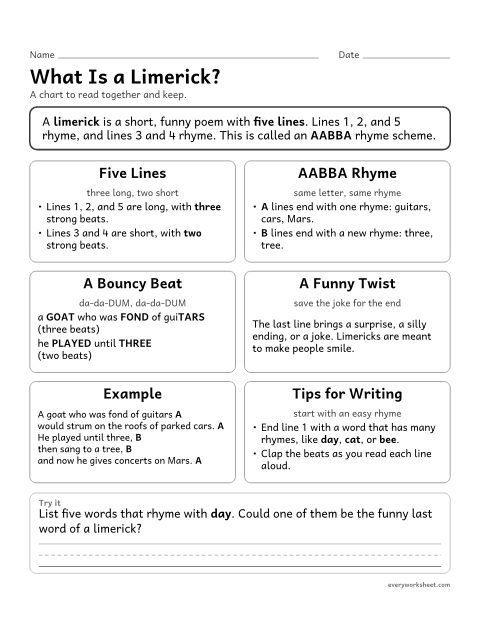
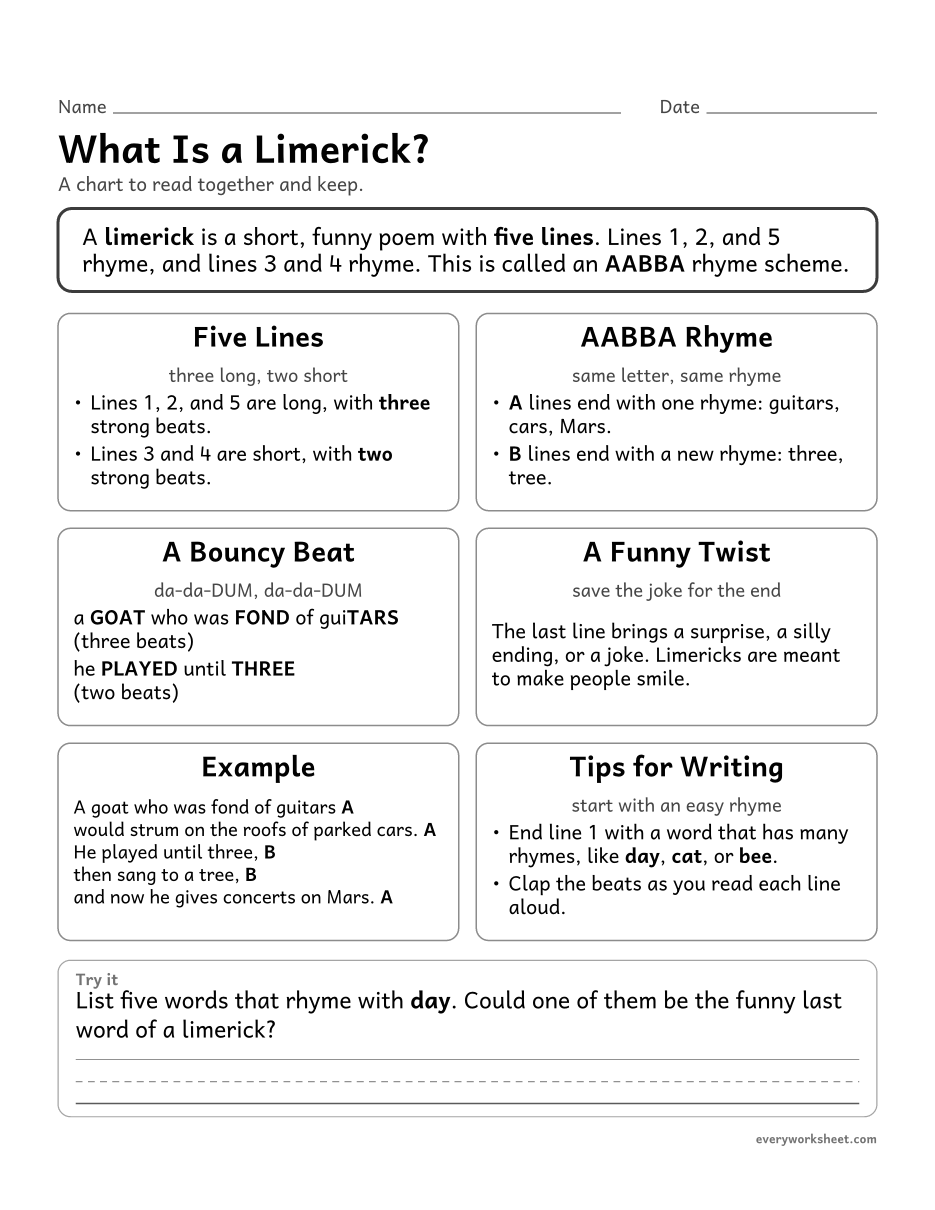
Knowing the limerick form: five lines, an AABBA rhyme scheme, a bouncy three- and two-beat rhythm, and a funny twist
1 page40 KB
Learn the funny five-line limerick: AABBA rhyme, a bouncy beat, original examples, and write your own.
View largerKnowing the limerick form: five lines, an AABBA rhyme scheme, a bouncy three- and two-beat rhythm, and a funny twist
1 page40 KB
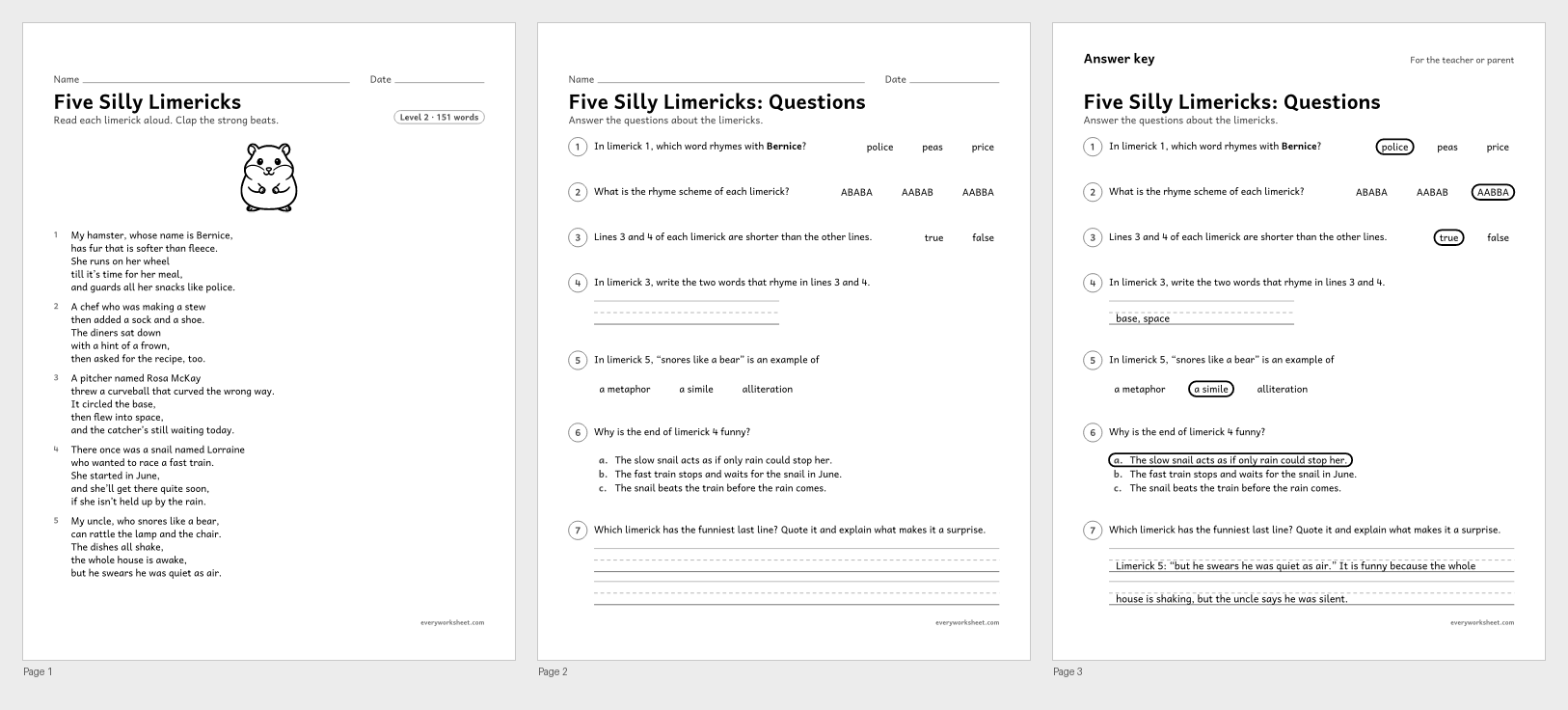 3 pagesView all 3 pages
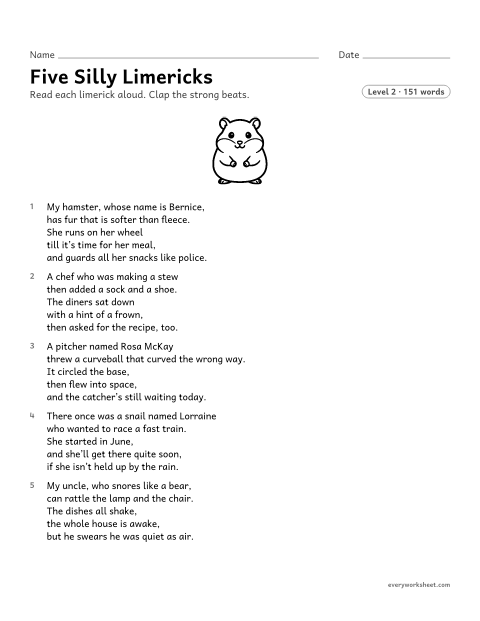
Finding the AABBA rhyme scheme, the beat, figurative language, and the funny twist in five limericks
Answer key on page 3
3 pages76 KB
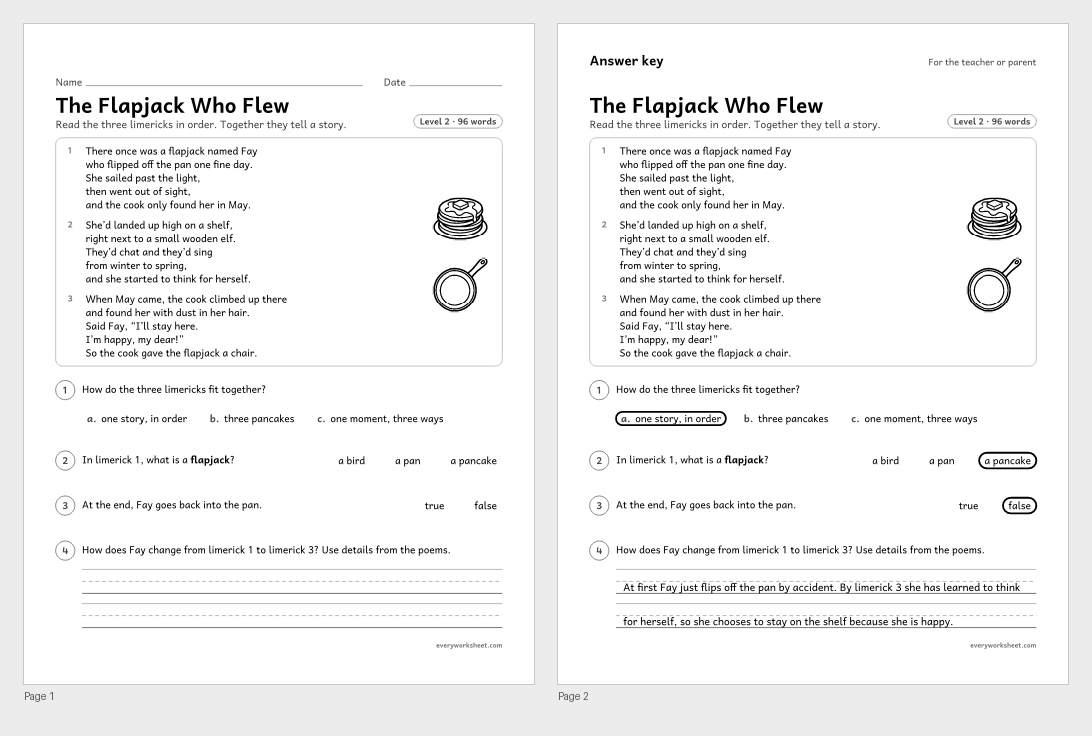 View all 2 pages
Explaining how three linked limericks fit together to tell one story
Answer key on page 2
2 pages168 KB
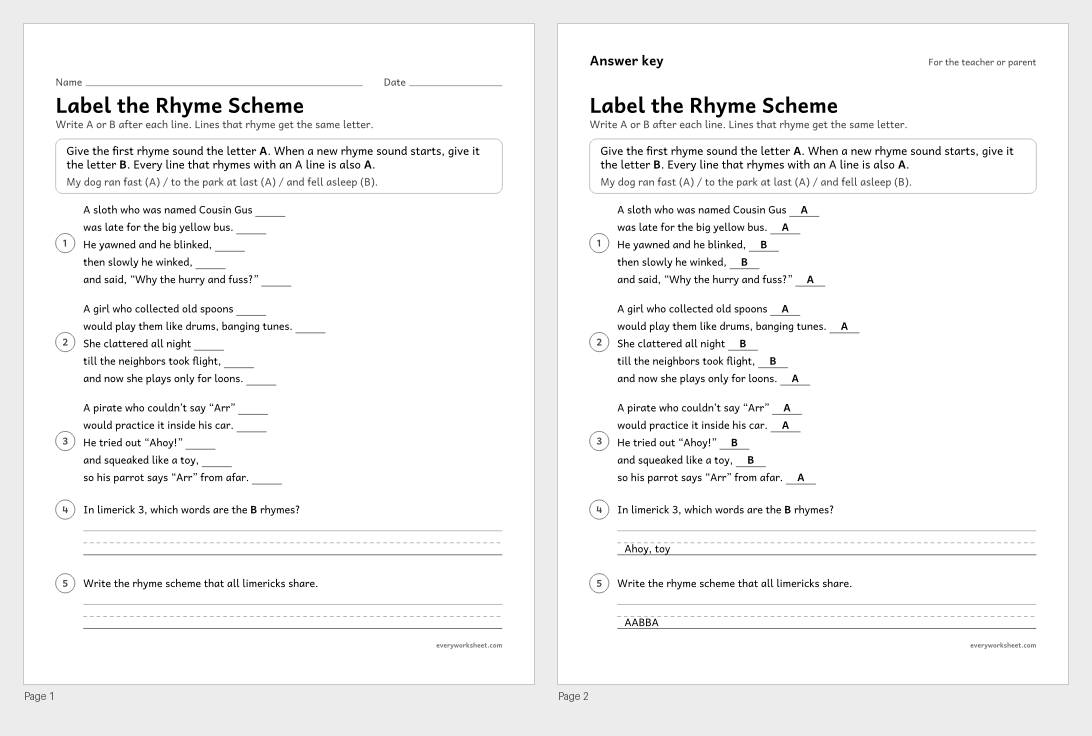 View all 2 pages
Labeling the AABBA rhyme scheme of limericks by matching rhyming line endings
Answer key on page 2
2 pages42 KB
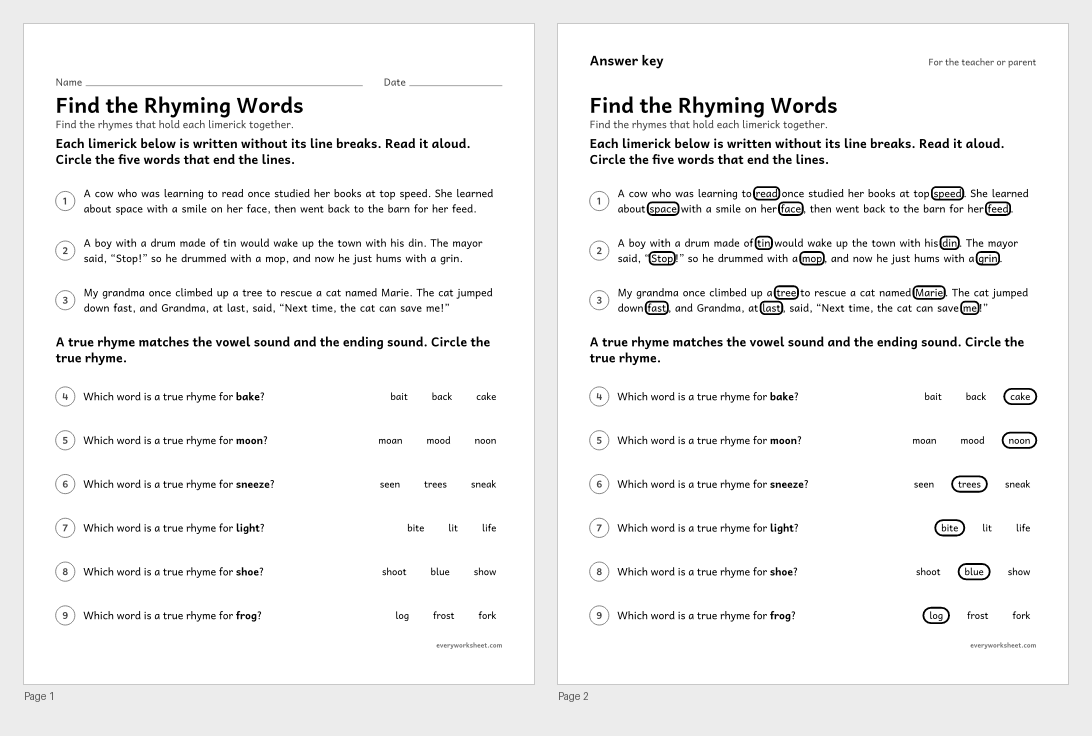 View all 2 pages
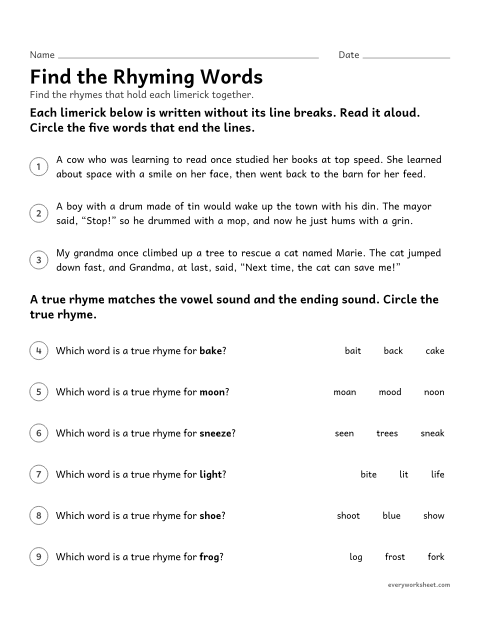
Hearing the rhymes in limericks written without line breaks, and telling true rhymes from near rhymes
Answer key on page 2
2 pages57 KB
 View all 2 pages
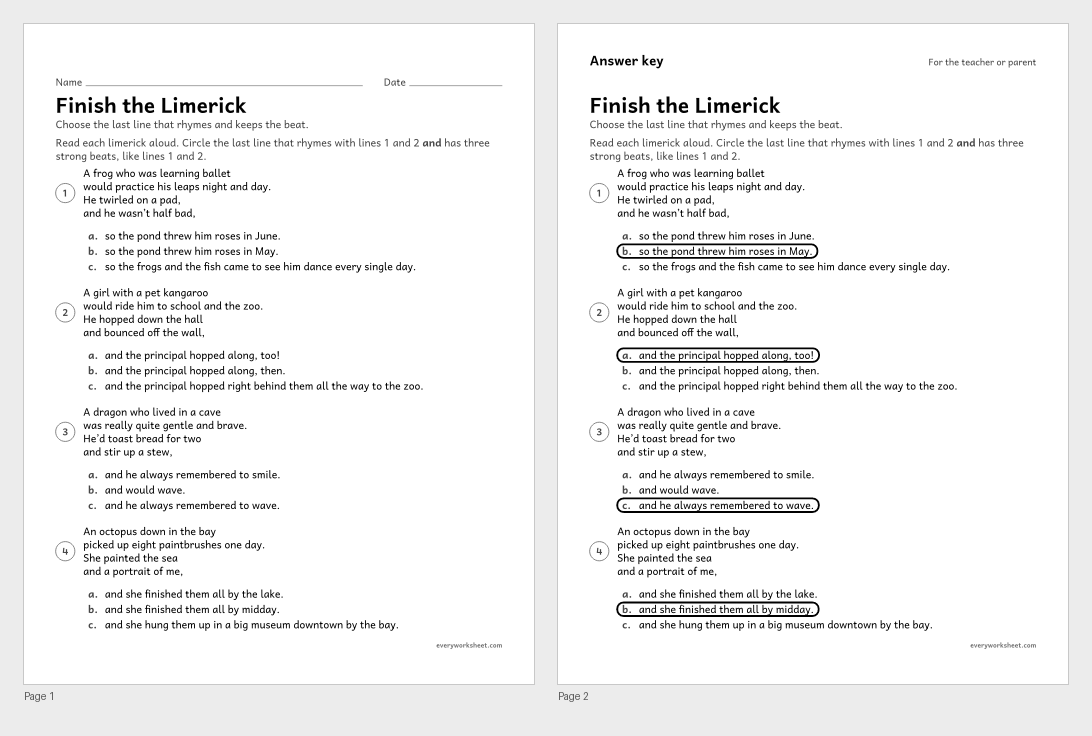
Choosing and writing a last line for a limerick that keeps the AABBA rhyme and the three-beat rhythm
Answer key on page 2
2 pages49 KB
 View larger
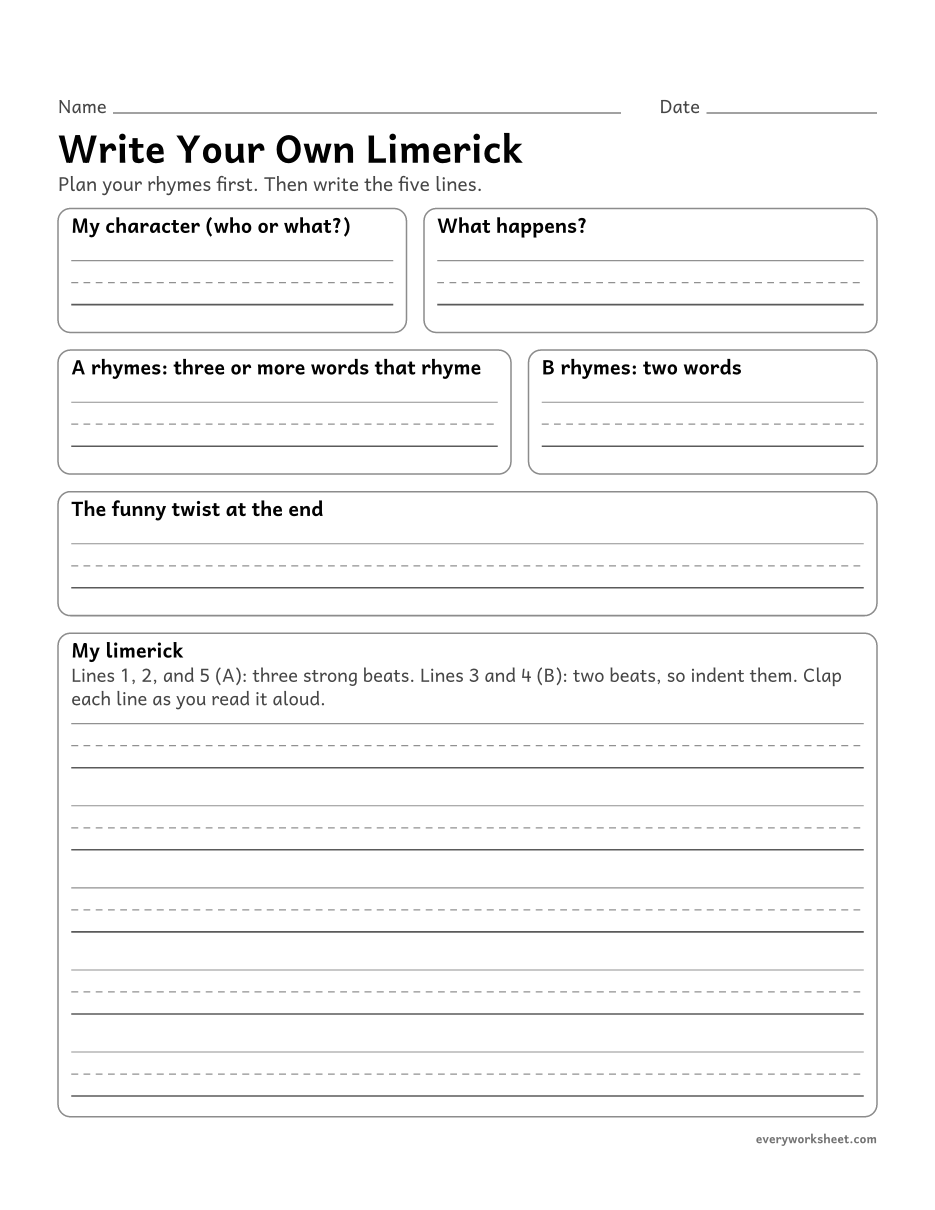
Planning a limerick (a character, two rhyme families, and a funny twist), then writing it in five lines
1 page30 KB
 View larger
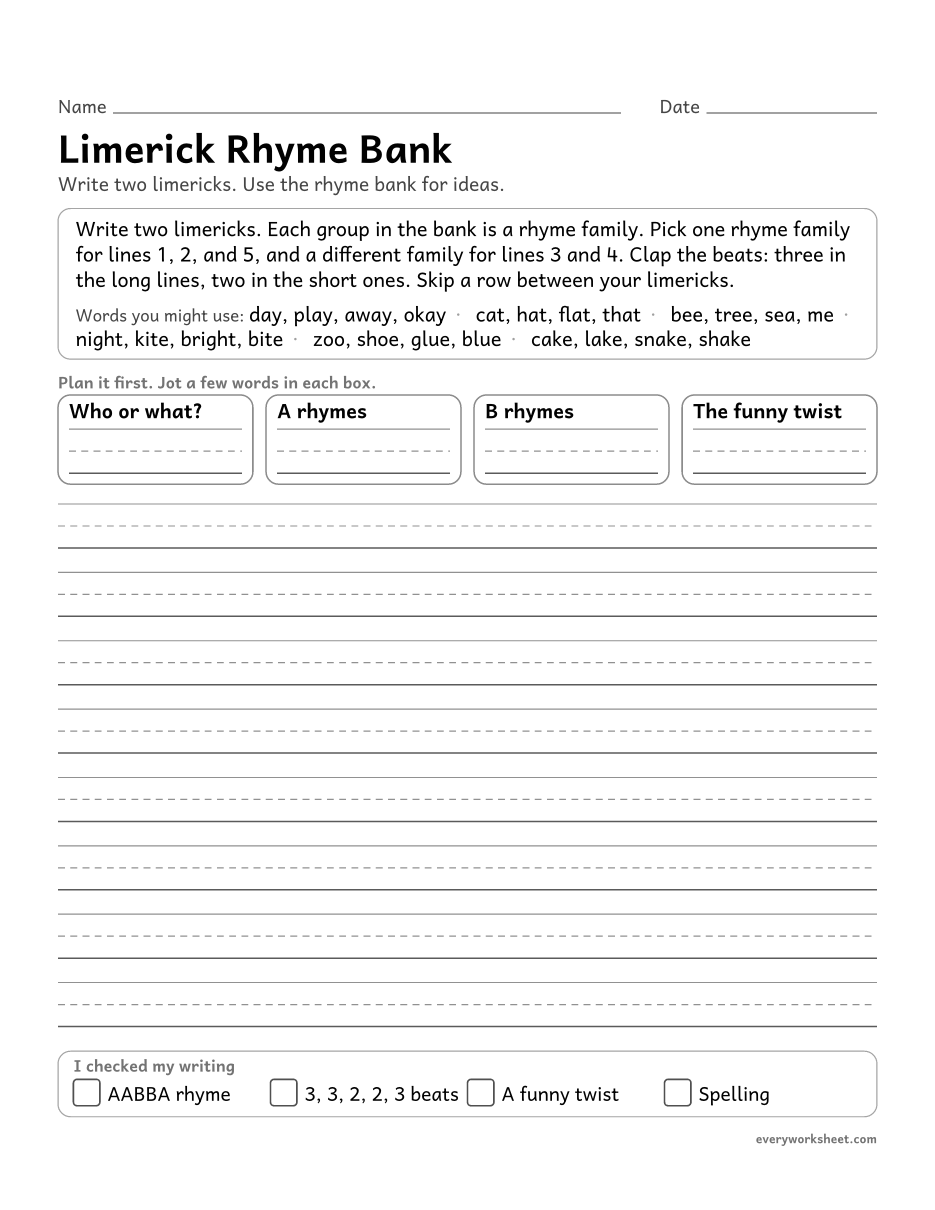
Writing two limericks using rhyme families from a rhyme bank
1 page32 KB
Print at 100% (actual size) for the cleanest tracing lines.
A limerick is a short, funny poem with five lines. Lines 1, 2, and 5 rhyme with each other, and lines 3 and 4 rhyme with each other, so the rhyme scheme is AABBA. Lines 1, 2, and 5 are long, with three strong beats. Lines 3 and 4 are short, with two strong beats. The rhythm bounces: da-da-DUM, da-da-DUM, as in "a GOAT who was FOND of guiTARS." The last line brings a surprise or a joke.
Here is an original example: "A goat who was fond of guitars / would strum on the roofs of parked cars. / He played until three, / then sang to a tree, / and now he gives concerts on Mars." Guitars, cars, and Mars are the A rhymes; three and tree are the B rhymes.
These limerick worksheets are written for 5th graders. A chart explains the form. Children label rhyme schemes with A and B, find the rhymes in limericks written without line breaks, tell true rhymes from near rhymes, and choose the last line that rhymes and keeps the beat. Two reading pages, five silly limericks and a three-part limerick story, come with questions and answer keys. Every limerick is original.
Planning pages help children pick a character, build A and B rhyme lists, and save the joke for the last line.
CCSS.ELA-LITERACY.RL.5.5Explain how a series of chapters, scenes, or stanzas fits together to provide the overall structure of a particular story, drama, or poem.CCSS.ELA-LITERACY.W.5.3.DUse concrete words and phrases and sensory details to convey experiences and events precisely.CCSS.ELA-LITERACY.W.5.10Write routinely over extended time frames (time for research, reflection, and revision) and shorter time frames (a single sitting or a day or two) for a range of discipline-specific tasks, purposes, and audiences.AABBA. Lines 1, 2, and 5 rhyme with each other, and lines 3 and 4 rhyme with each other.
Limericks have a bouncy beat, often da-da-DUM. Lines 1, 2, and 5 have three strong beats, and lines 3 and 4 have two.
Limericks tell a silly story in a few lines and usually end with a surprise, a twist, or a joke in the last line.
A true rhyme matches the vowel sound and the ending sound, like cake and bake. A near rhyme only comes close, like bake and bait.
Yes. Every limerick on these worksheets was written for this site.