 View larger
Multiply fractions by whole numbers
How to multiply a fraction by a whole number with groups, a number line and n × (a/b) = (n × a)/b
1 page34 KB
Multiply a fraction by a whole number: a chart, unit fractions, fraction bar groups, number line jumps, practice and word problems. With keys.
View largerHow to multiply a fraction by a whole number with groups, a number line and n × (a/b) = (n × a)/b
1 page34 KB
 View all 2 pages
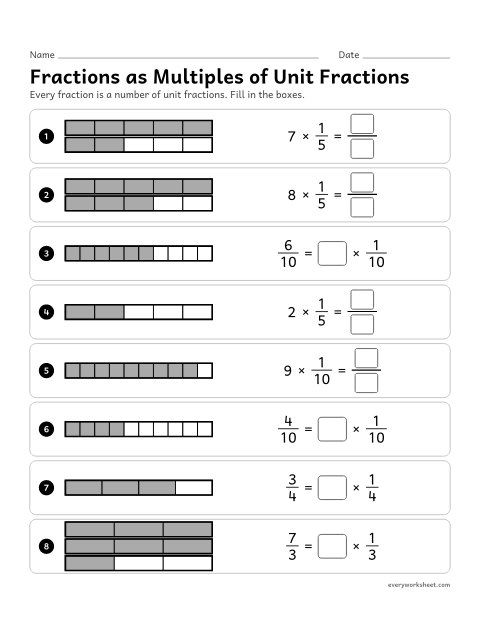
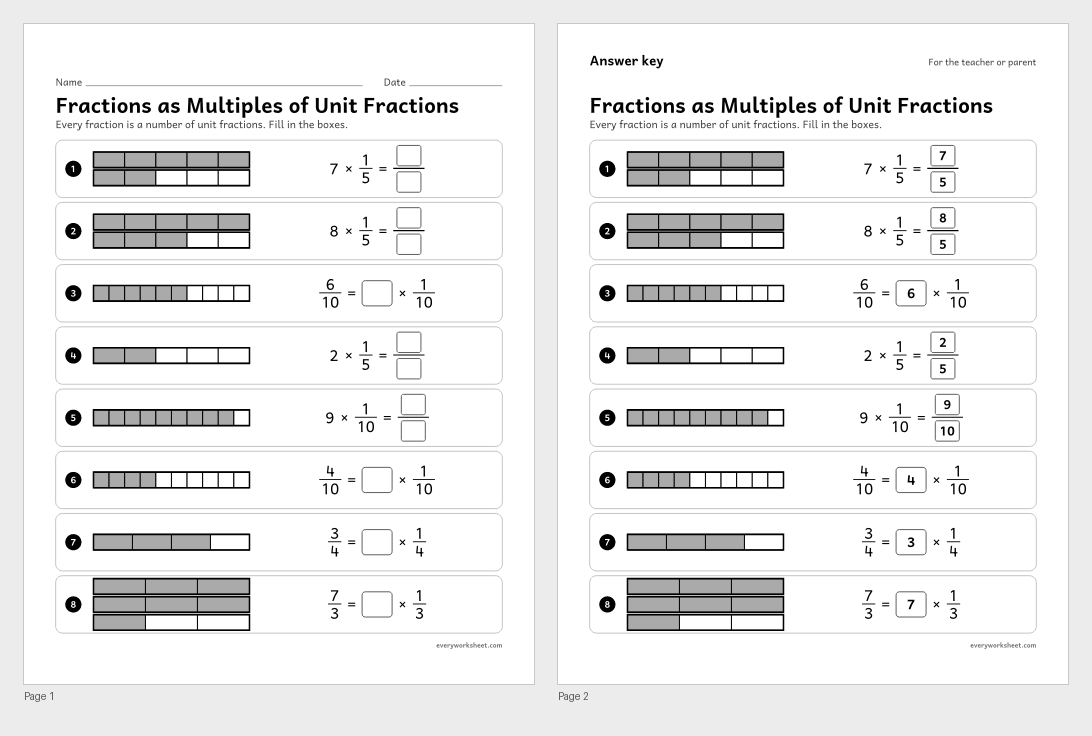
Writing a fraction a/b as a × (1/b), for example 5/4 = 5 × (1/4), with fraction bars
Answer key on page 2
2 pages43 KB
 View all 2 pages
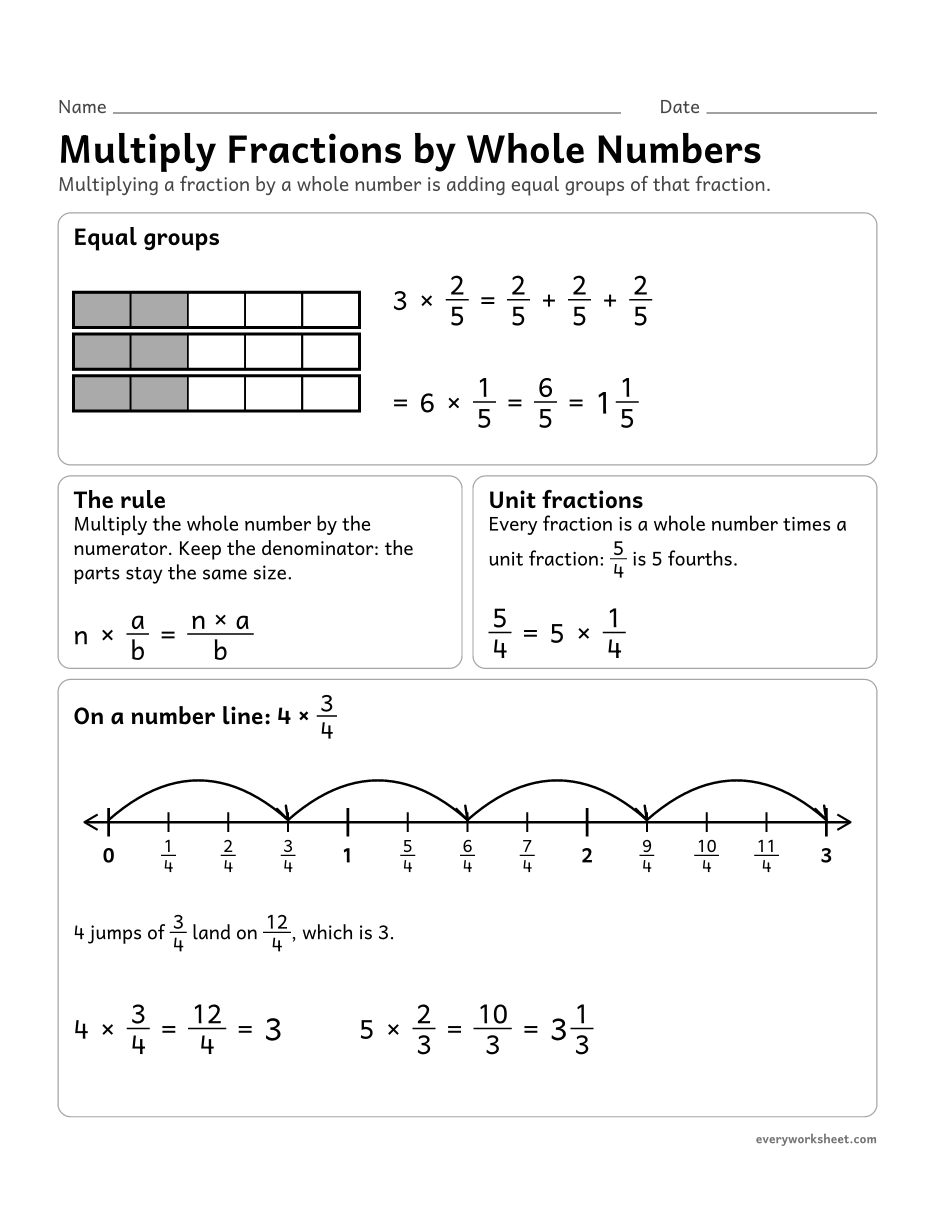
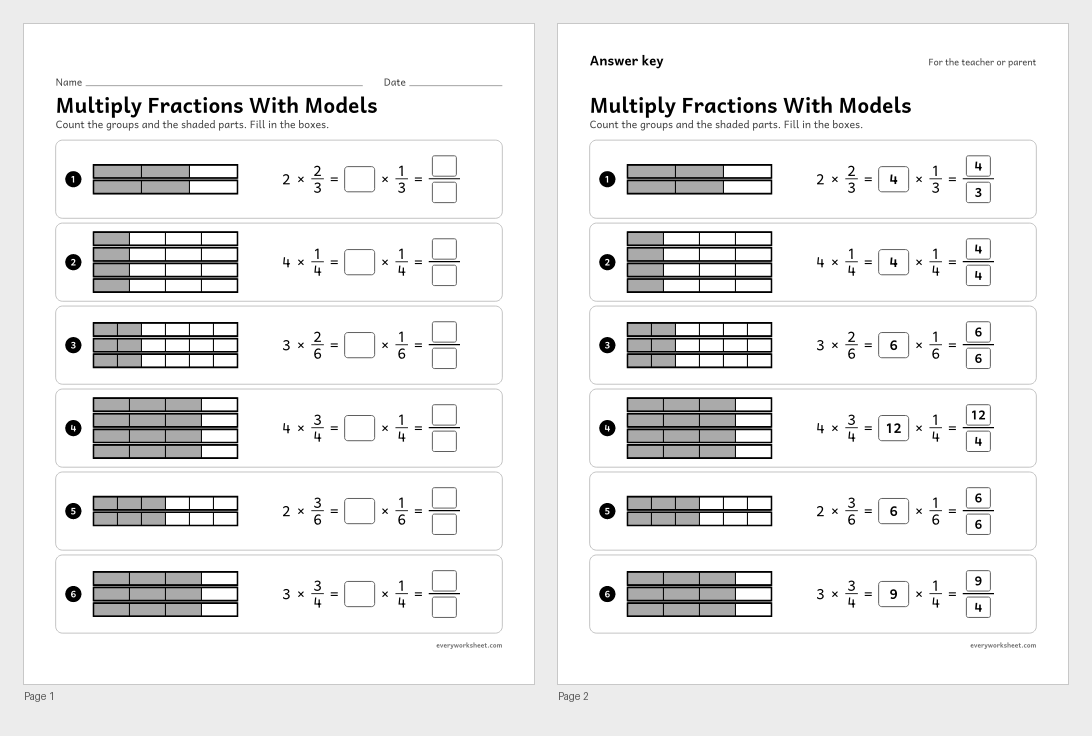
Showing n × (a/b) as n groups of a/b, then as (n × a) unit fractions, with fraction bars
Answer key on page 2
2 pages40 KB
 View all 2 pages
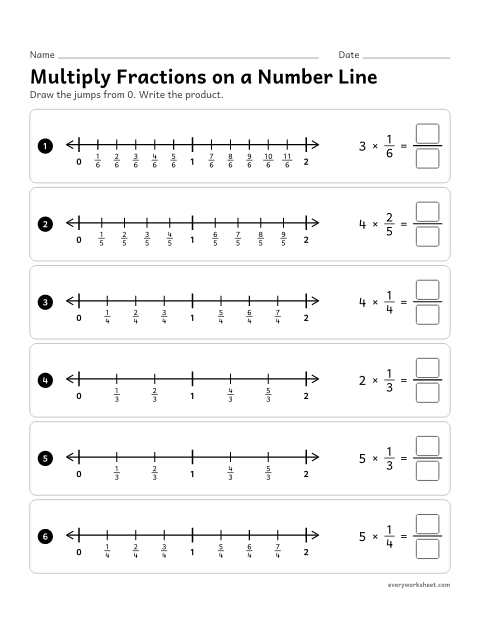
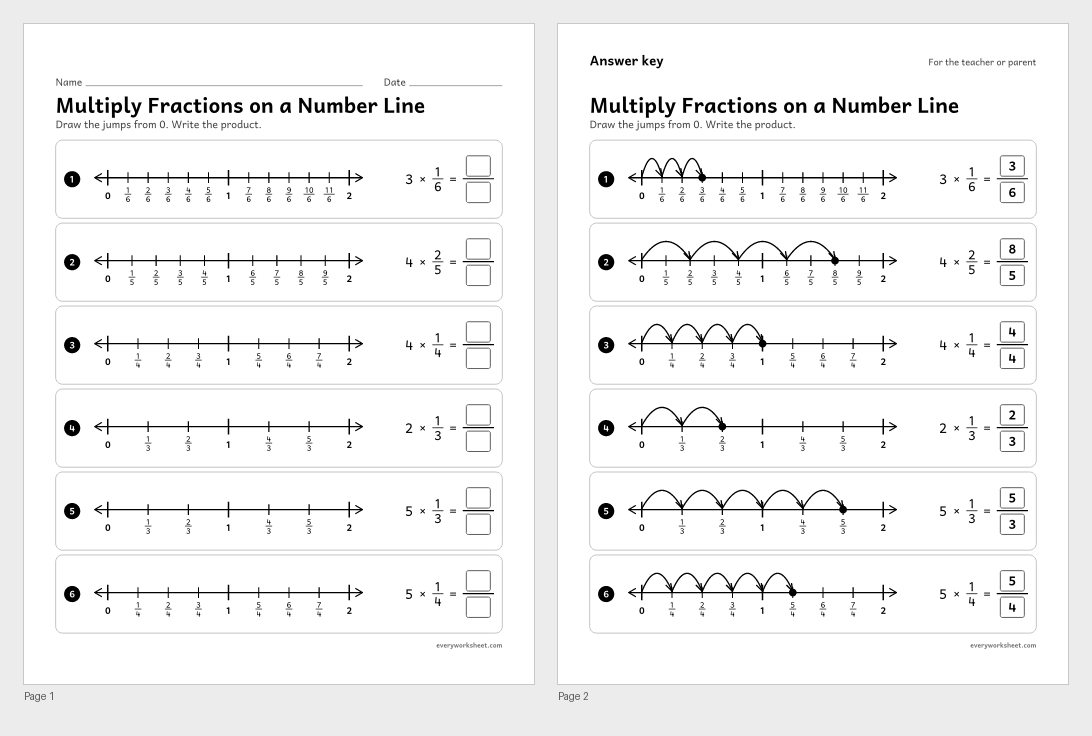
Showing a whole number times a fraction as equal jumps on a number line
Answer key on page 2
2 pages48 KB
 View all 2 pages
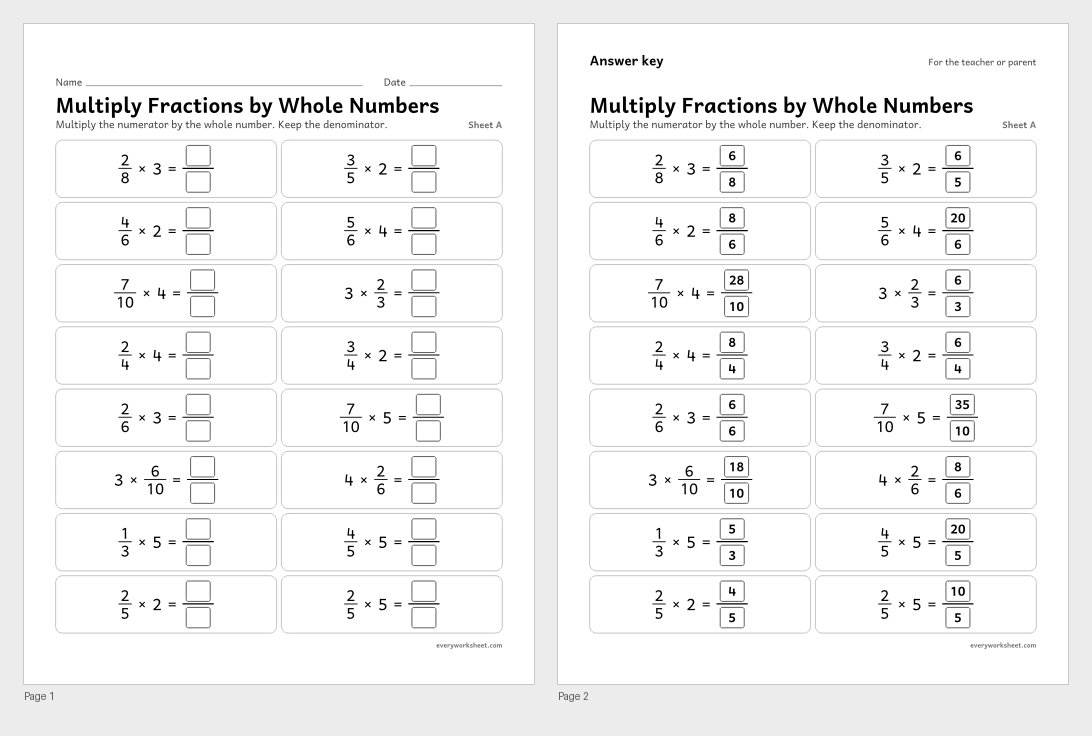
Multiplying a fraction by a whole number: multiply the numerator, keep the denominator
Answer key on page 2
2 pages41 KB
 View all 2 pages
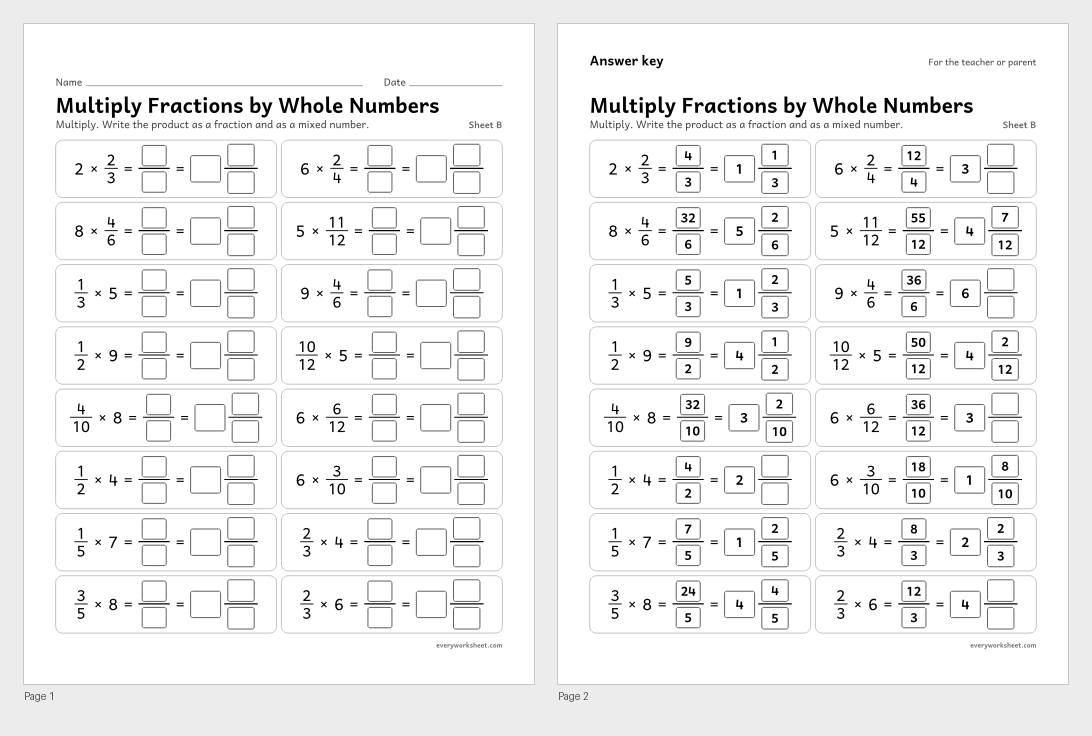
Multiplying a fraction by a whole number and writing the product as a mixed number
Answer key on page 2
2 pages45 KB
 View all 2 pages
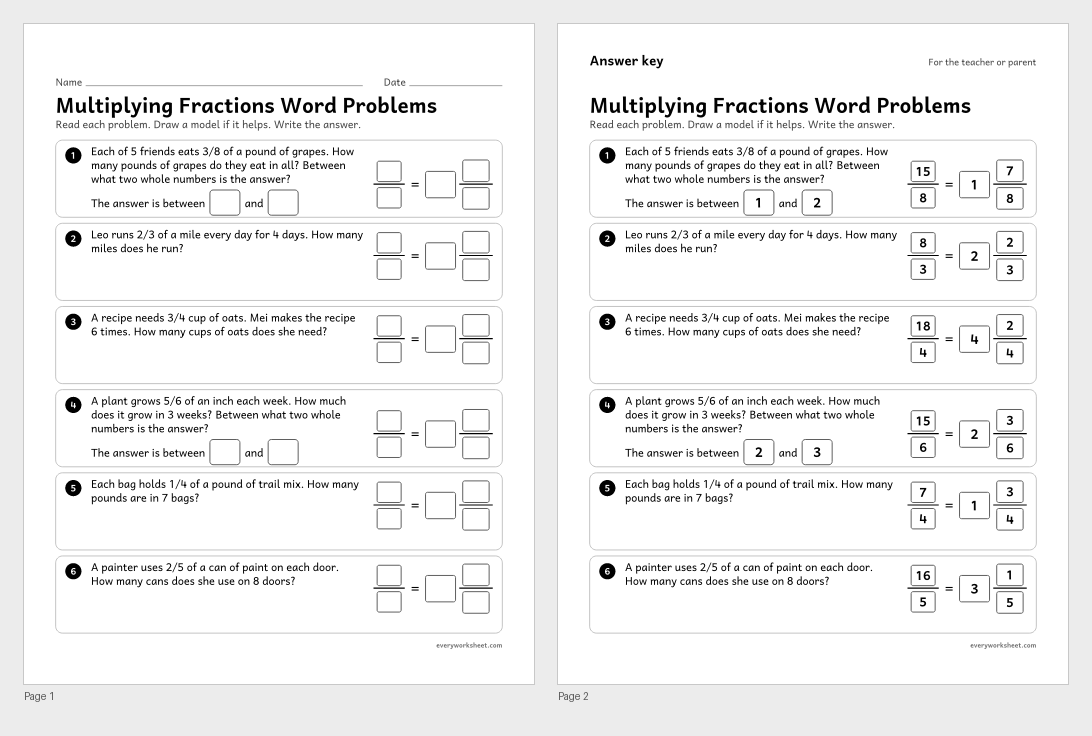
Solving word problems that multiply a fraction by a whole number, and saying between which whole numbers the answer lies
Answer key on page 2
2 pages44 KB
Print at 100% (actual size) for the cleanest tracing lines.
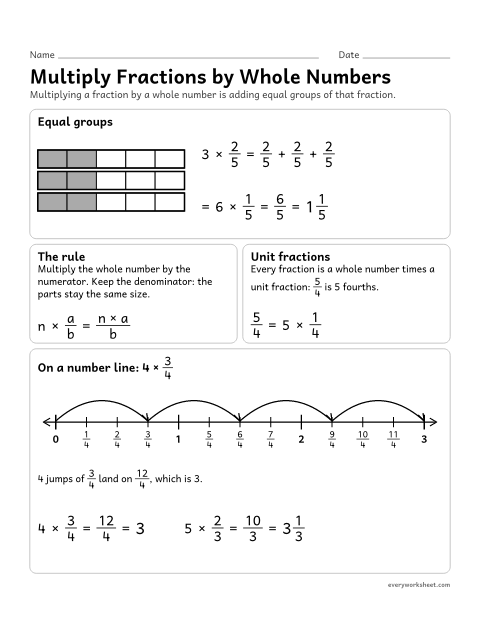
Multiplying a fraction by a whole number means adding equal groups of that fraction. 3 × 2/5 is 2/5 + 2/5 + 2/5, which is 6 fifths, or 6/5. In general, multiply the whole number by the numerator and keep the denominator: n × a/b = (n × a)/b.
It starts with seeing any fraction as a whole number times a unit fraction: 5/4 = 5 × 1/4. The model pages show groups of fraction bars and jumps on a number line, so the rule makes sense before children use it.
Practice pages ask for the product as a fraction and, on Sheet B, as a mixed number. The word problems ask which two whole numbers the answer lies between. Every practice page has an answer key.
CCSS.MATH.CONTENT.4.NF.B.4.AUnderstand a fraction a/b as a multiple of 1/b. For example, use a visual fraction model to represent 5/4 as the product 5 × (1/4), recording the conclusion by the equation 5/4 = 5 × (1/4).CCSS.MATH.CONTENT.4.NF.B.4.BUnderstand a multiple of a/b as a multiple of 1/b, and use this understanding to multiply a fraction by a whole number. For example, use a visual fraction model to express 3 × (2/5) as 6 × (1/5), recognizing this product as 6/5. (In general, n × (a/b) = (n × a)/b.)CCSS.MATH.CONTENT.4.NF.B.4.CSolve word problems involving multiplication of a fraction by a whole number, e.g., by using visual fraction models and equations to represent the problem. For example, if each person at a party will eat 3/8 of a pound of roast beef, and there will be 5 people at the party, how many pounds of roast beef will be needed? Between what two whole numbers does your answer lie?Multiply the whole number by the numerator and keep the denominator. 4 × 2/3 = 8/3, which is 2 2/3.
No. In 4th grade one factor is a whole number. Multiplying a fraction by a fraction comes in 5th grade.