 View larger
Prepositions Worksheets
Learn what a preposition does, find its object, and tell prepositions from adverbs, with keyed practice.
Download the prepositions worksheets
Learn Prepositions
 View larger
 View all 2 pages
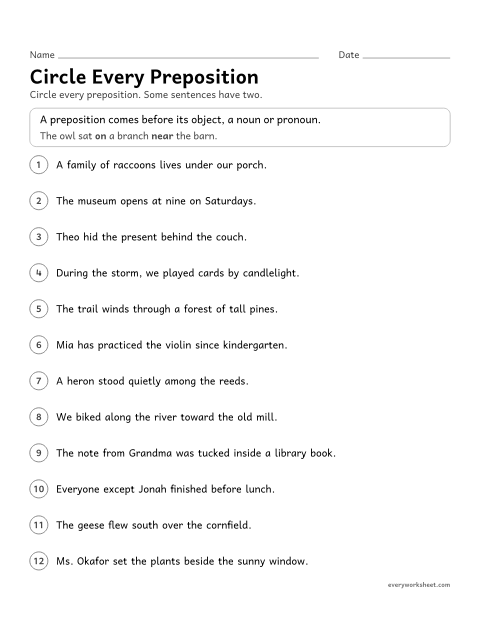
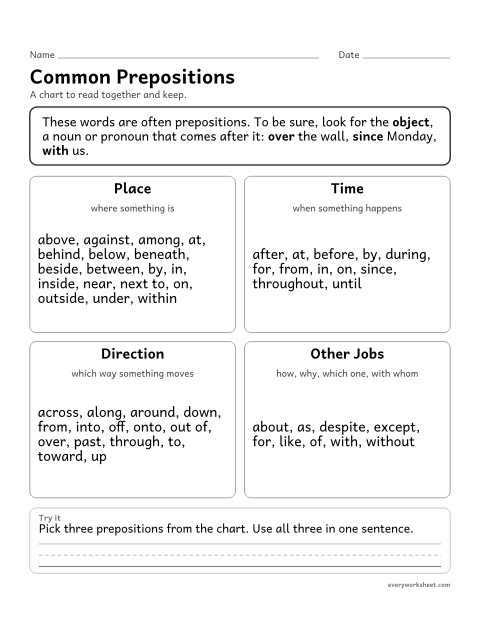
Circle every preposition
Finding prepositions in sentences
Answer key on page 2
2 pages55 KB
 View all 2 pages
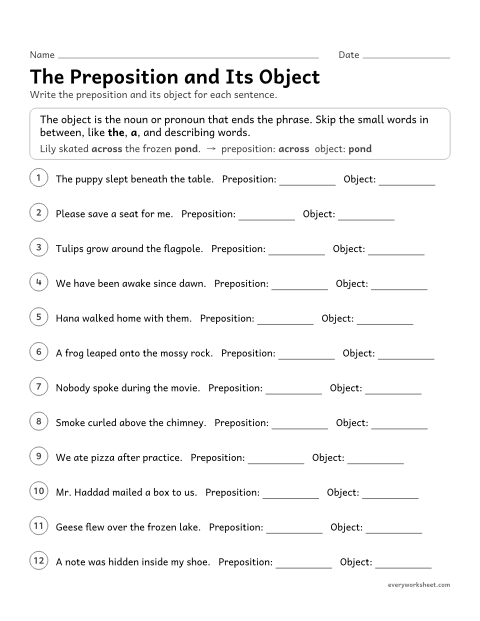
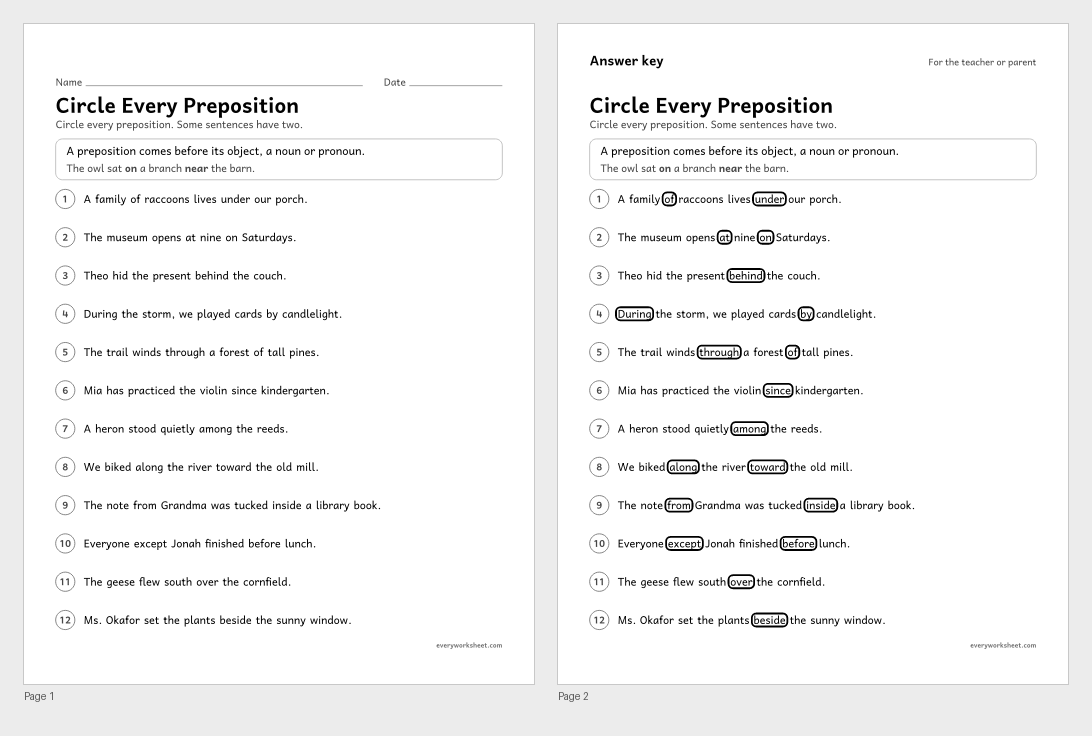
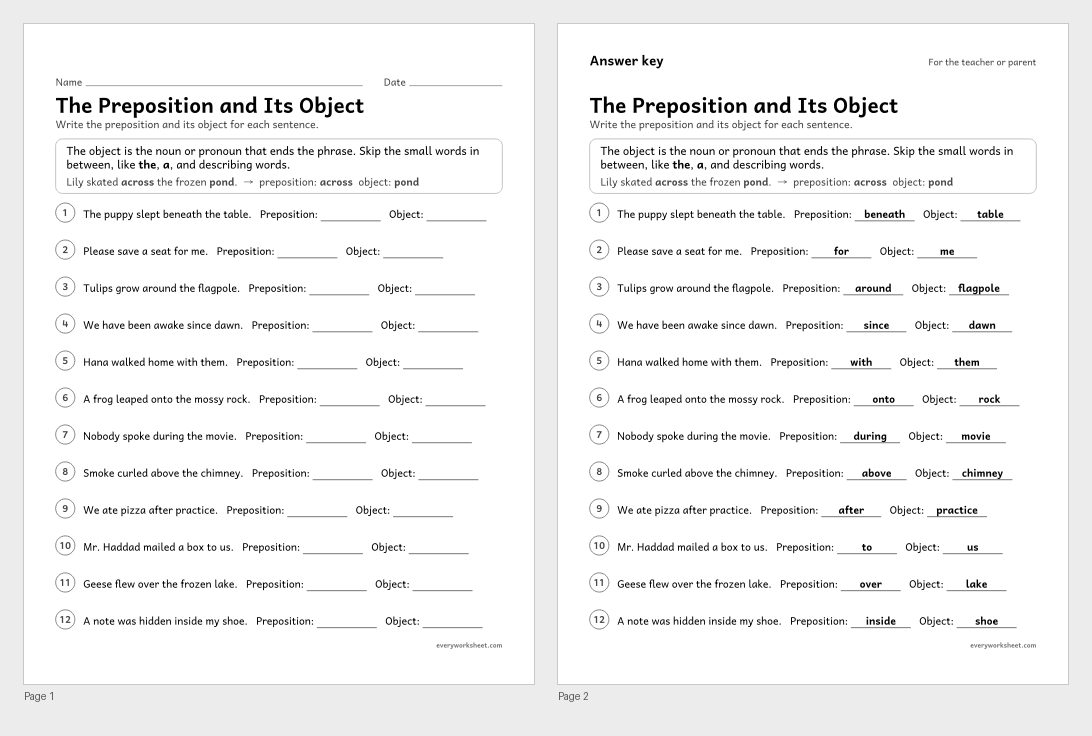
The preposition and its object
Finding a preposition and its object
Answer key on page 2
2 pages53 KB
 View larger
Place, Time, Direction, and More
 View all 2 pages
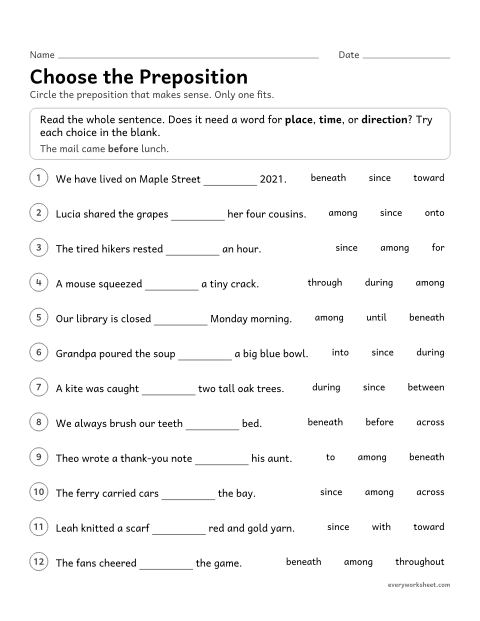
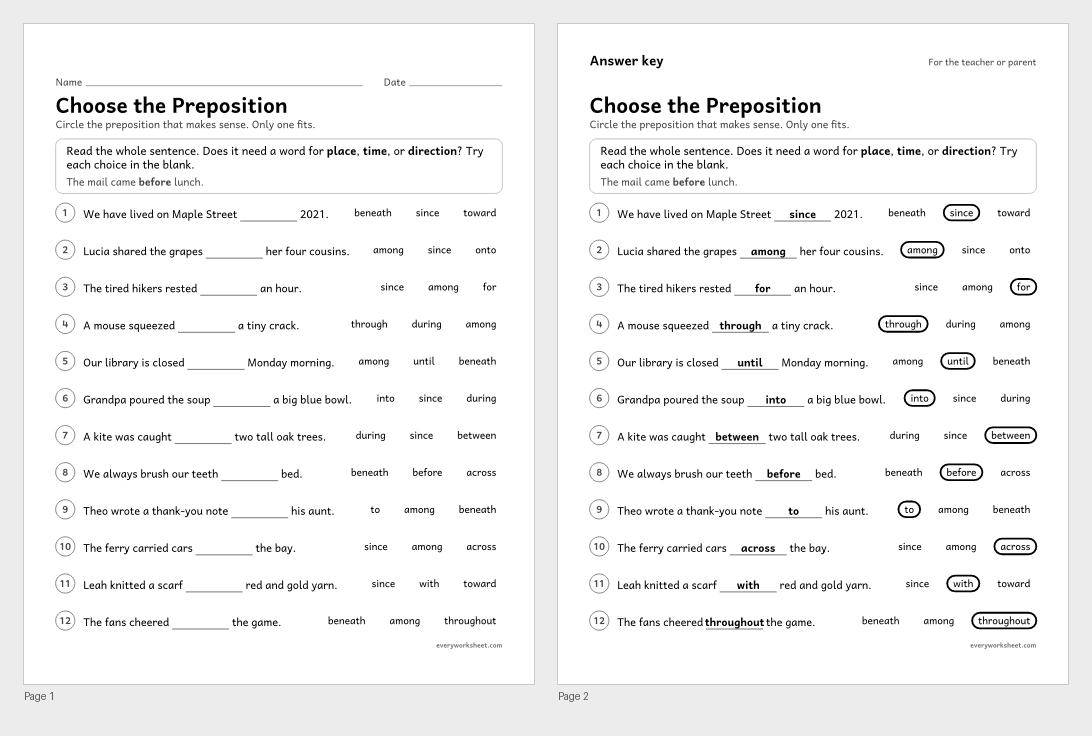
Choose the preposition
Choosing a preposition that fits the meaning of a sentence
Answer key on page 2
2 pages59 KB
 View all 2 pages
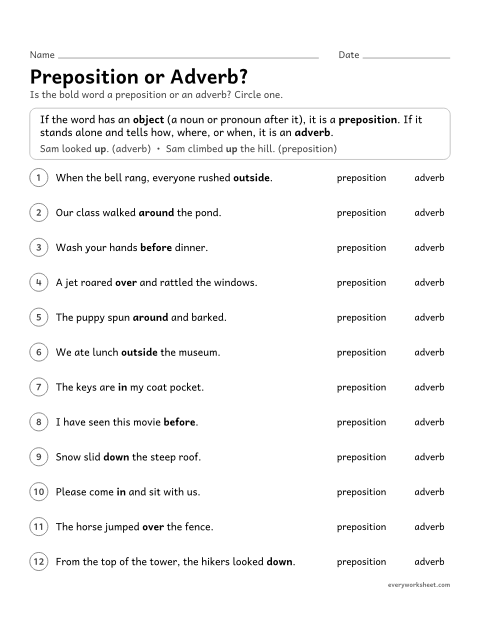
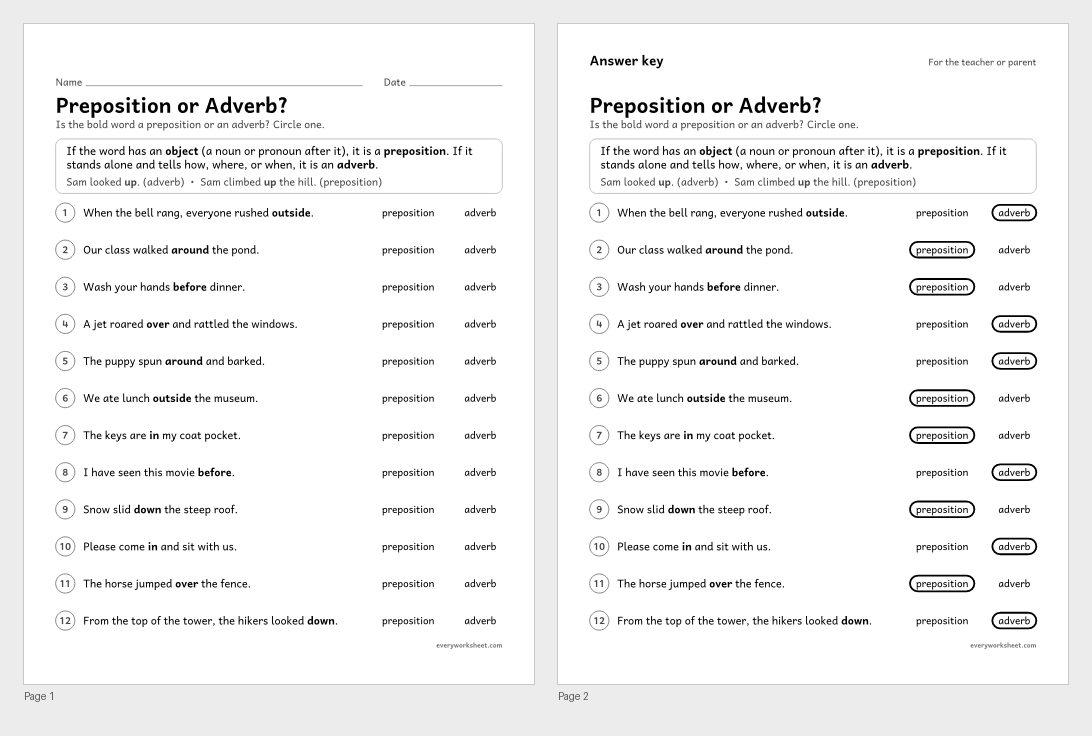
Preposition or Adverb?
Telling a preposition (with an object) from an adverb (with no object)
Answer key on page 2
2 pages59 KB
 View all 2 pages
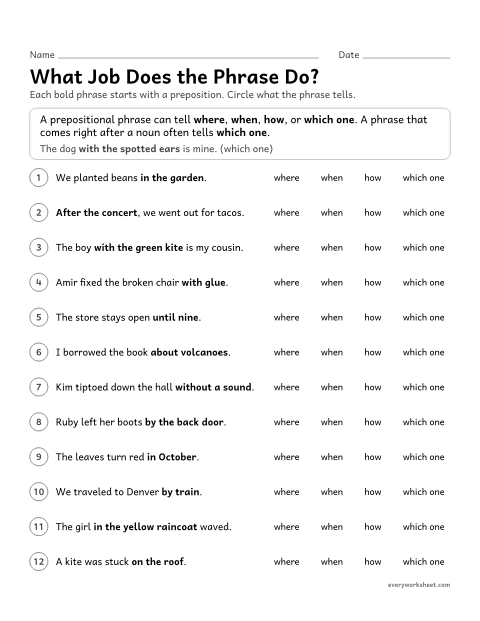
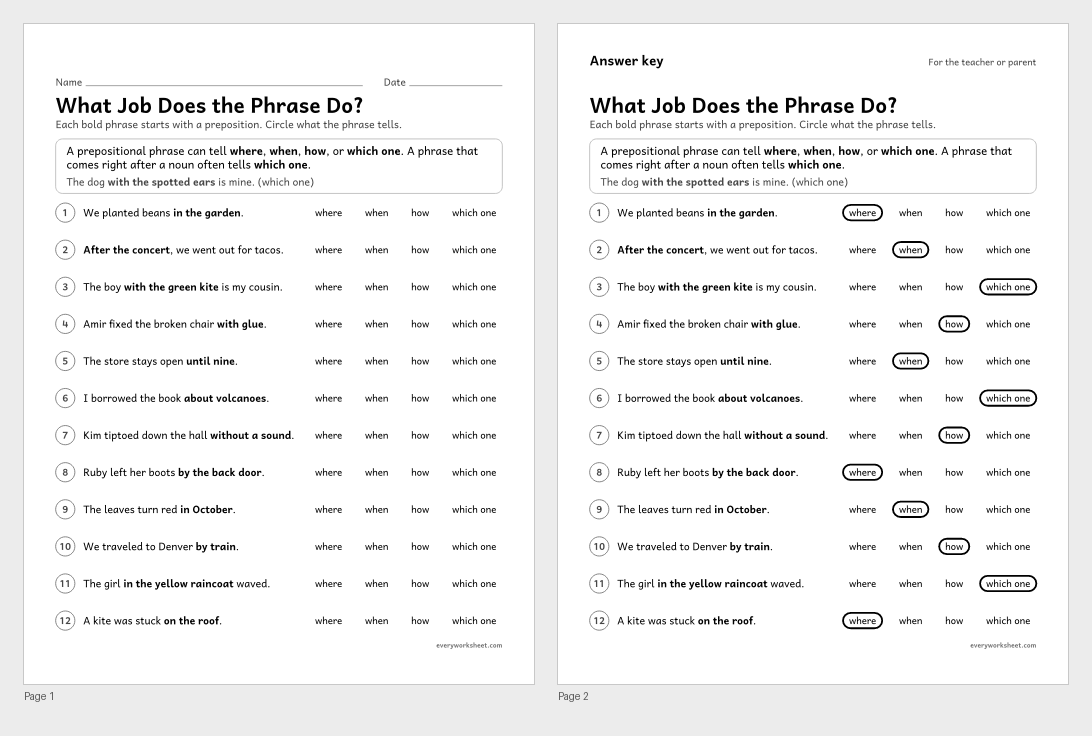
What job does the phrase Do?
Explaining the job of a prepositional phrase in a sentence
Answer key on page 2
2 pages61 KB
 View all 2 pages
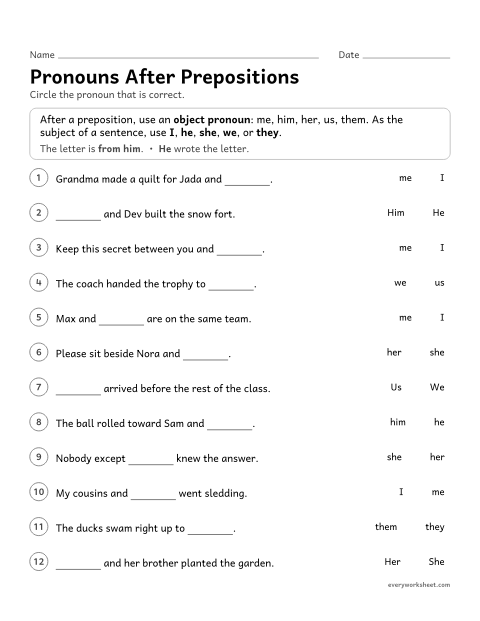
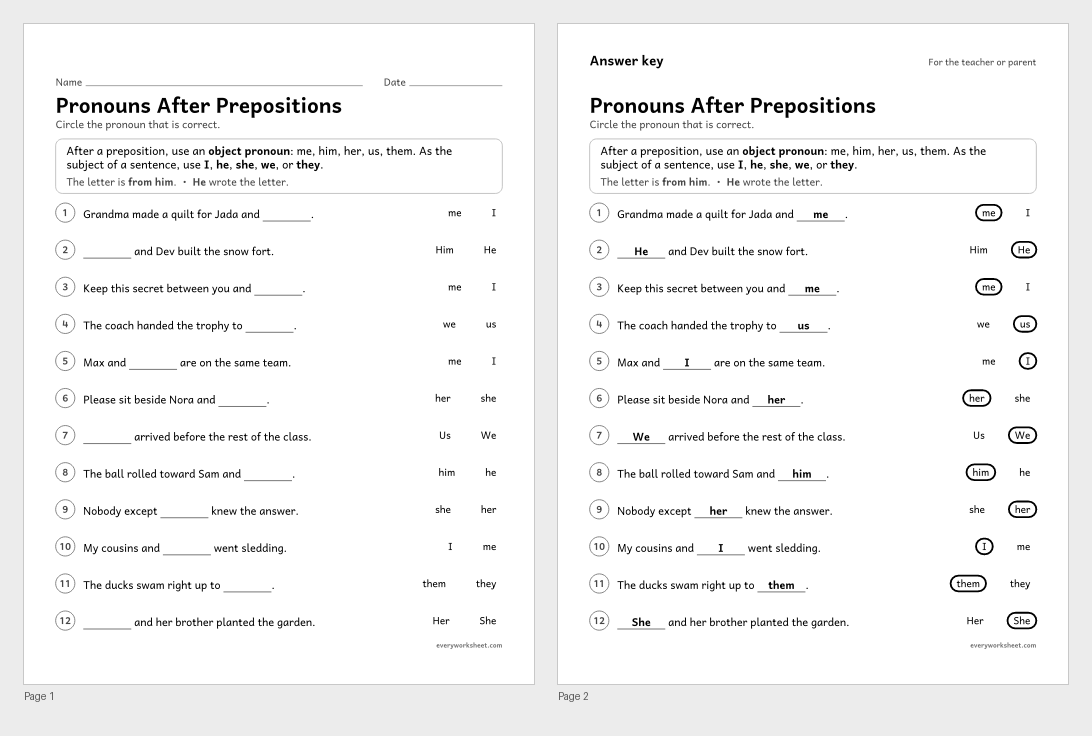
Pronouns after prepositions
Using object pronouns (me, him, her, us, them) as the object of a preposition
Answer key on page 2
2 pages59 KB
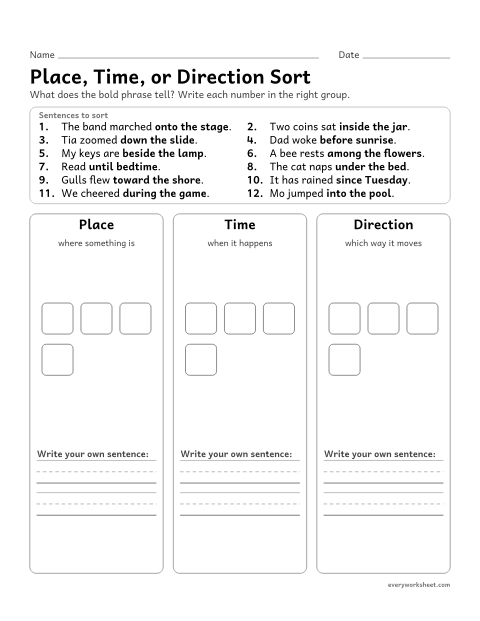 View all 2 pages
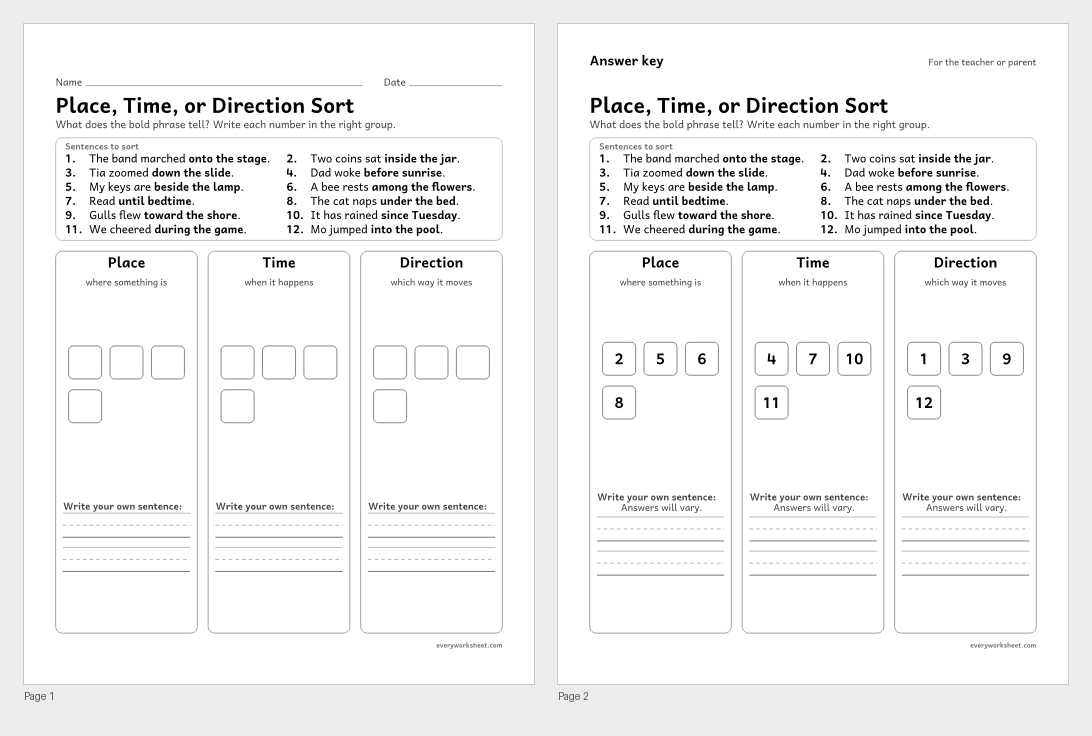
Place, Time, or direction sort
Sorting prepositional phrases that tell place, time, and direction
Answer key on page 2
2 pages59 KB
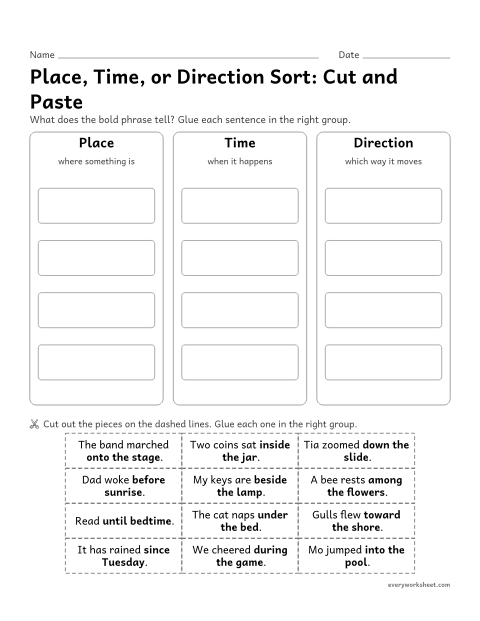 View all 2 pages
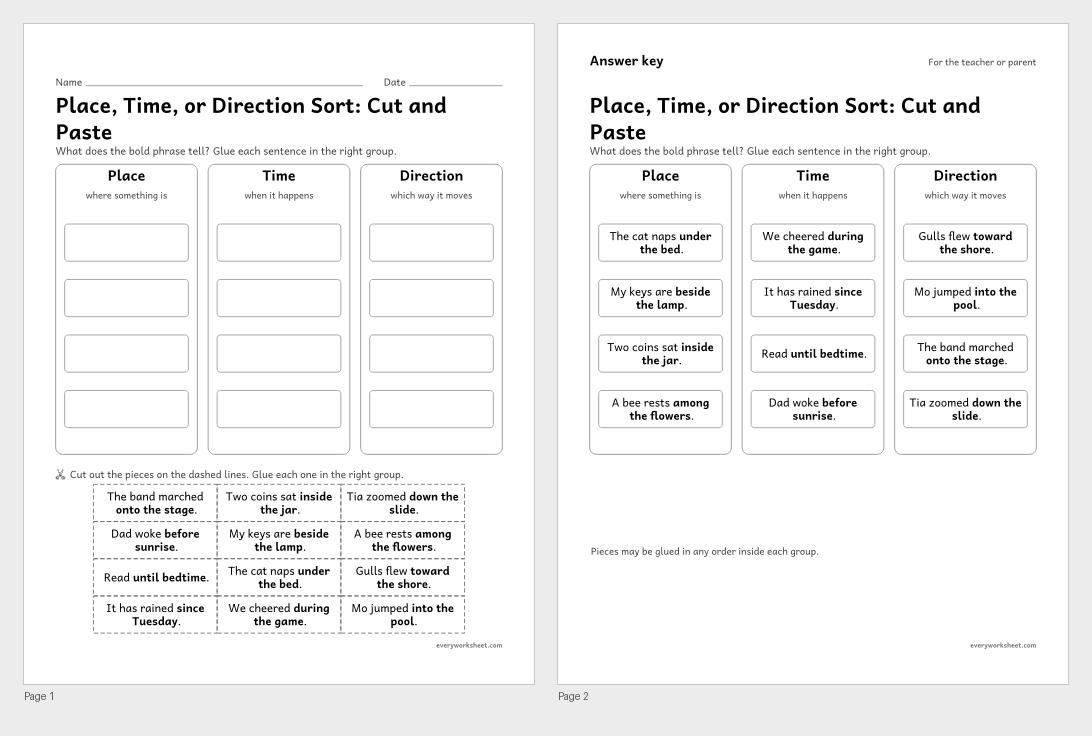
Place, Time, or direction Sort: cut and paste
Sorting prepositional phrases that tell place, time, and direction (cut and paste)
Answer key on page 2
2 pages73 KB
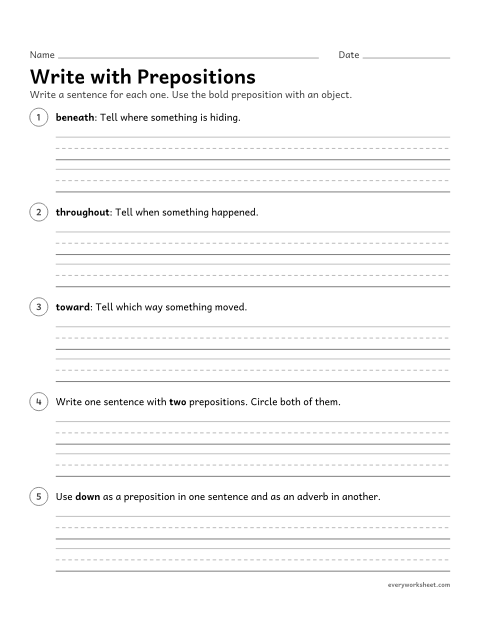
Write with Prepositions
 View all 2 pages
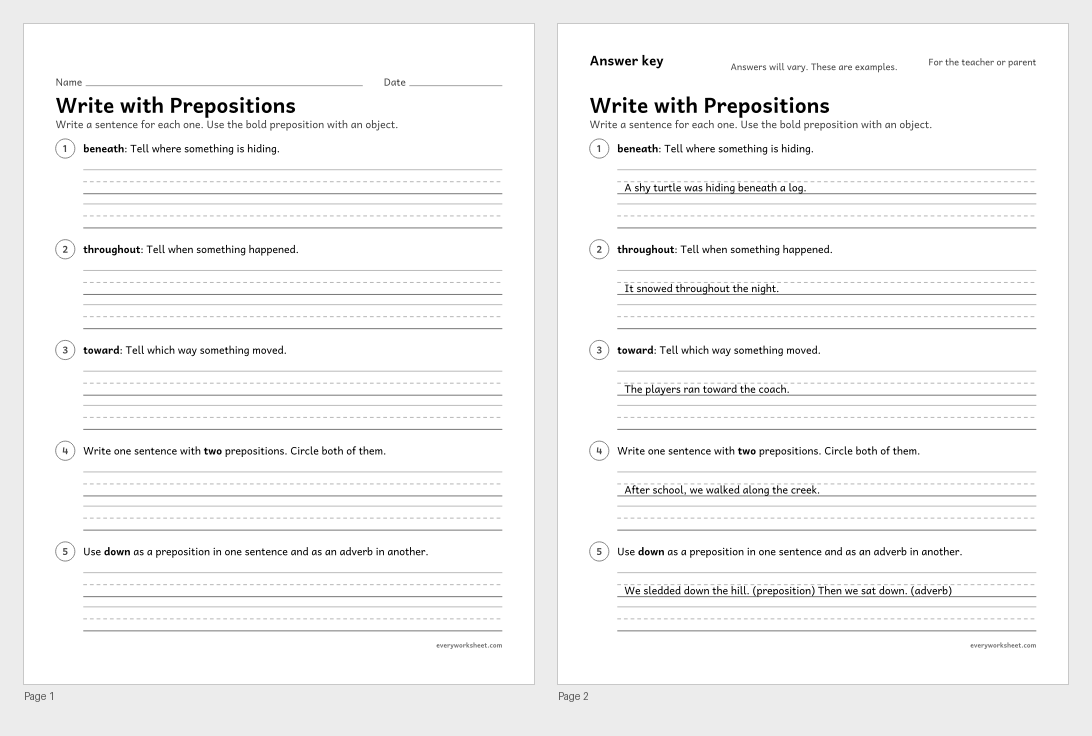
Write with prepositions
Writing sentences with prepositions that tell place, time, direction, and how
Answer key on page 2
2 pages38 KB
Print at 100% (actual size) for the cleanest tracing lines.
About these prepositions worksheets
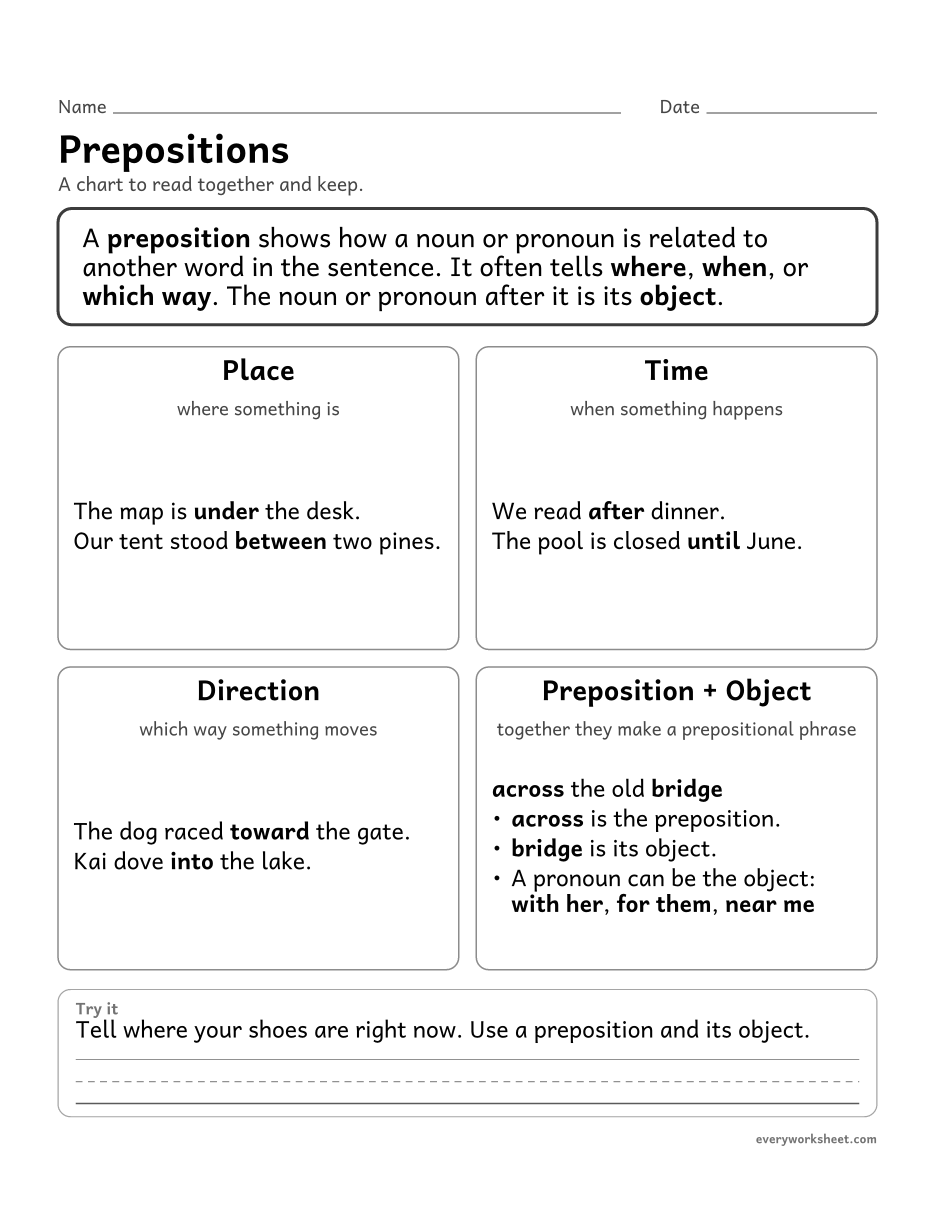
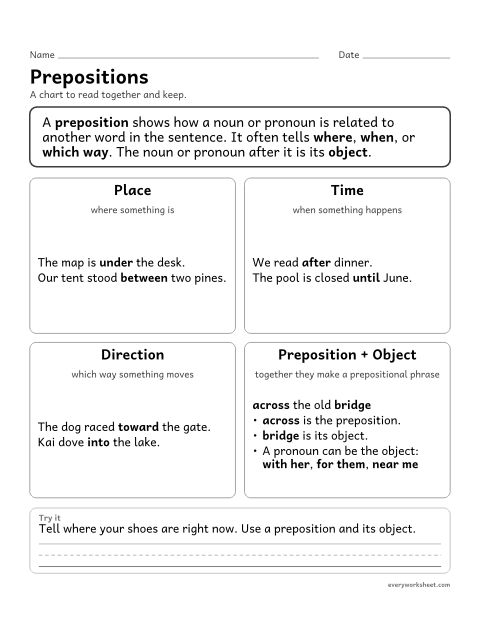
A preposition is a word that shows how a noun or pronoun is related to another word in the sentence. It often tells where something is (under the desk), when something happens (after dinner), or which way something moves (toward the gate). The noun or pronoun that comes after the preposition is its object. In "Kai dove into the lake," into is the preposition and lake is its object. Together, into the lake is a prepositional phrase.
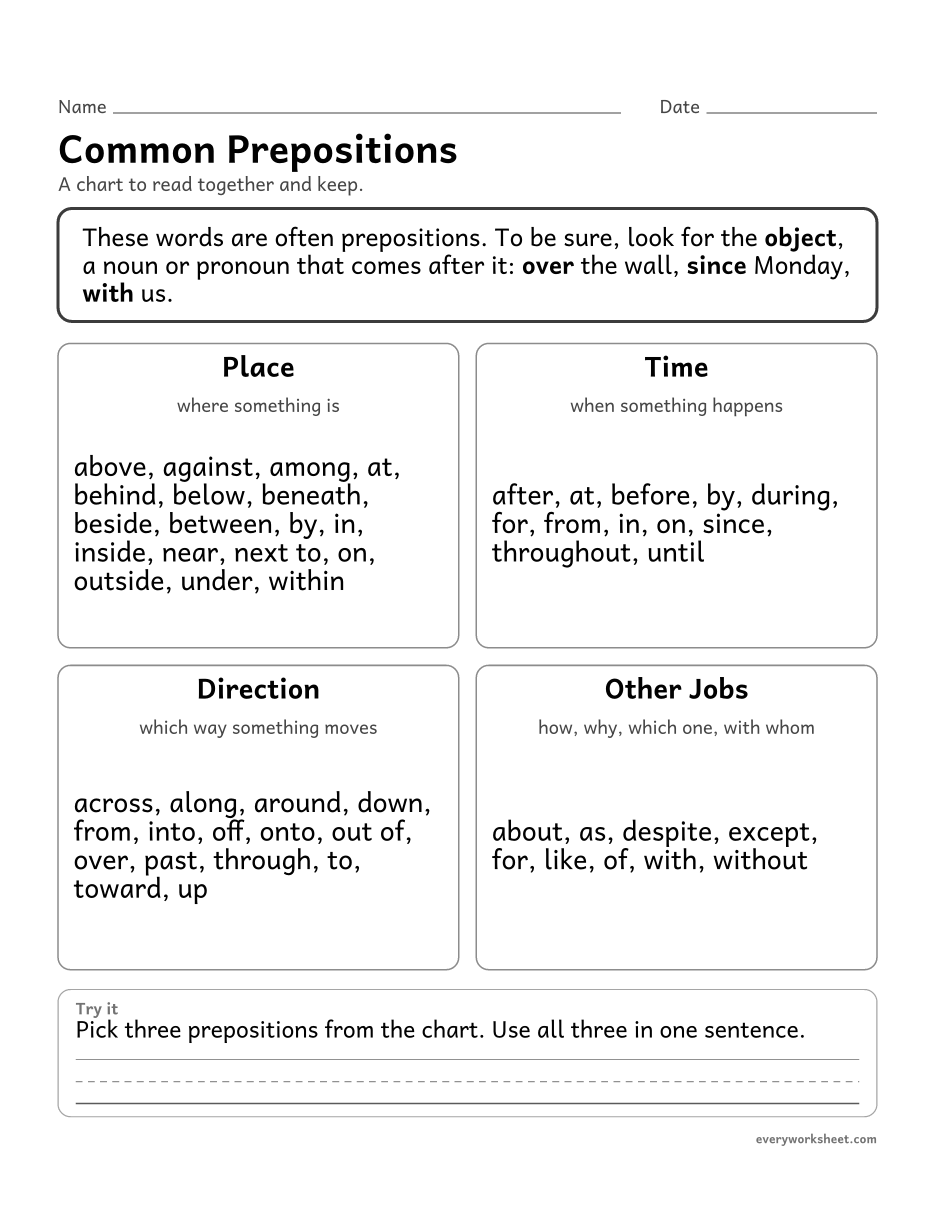
Common prepositions include about, above, across, after, against, along, among, around, at, before, behind, below, beneath, beside, between, by, down, during, except, for, from, in, inside, into, near, of, off, on, onto, over, past, since, through, to, toward, under, until, up, with, within, and without. A quick test: if a word on the list has an object after it, it is working as a preposition. In "Sam climbed up the hill," up is a preposition. In "Sam looked up," there is no object, so up is an adverb.
These printable worksheets start with a prepositions chart and a list of common prepositions grouped by place, time, and direction. Children circle prepositions, write each preposition and its object, sort phrases by what they tell, choose the one preposition that fits a sentence, tell prepositions from adverbs, name the job a phrase does, and use object pronouns after prepositions. A writing page finishes the set, and every practice page has an answer key.
Looking for more on phrases? The prepositional phrases page has 4th grade practice with adding and combining phrases.
Standards
CCSS.ELA-LITERACY.L.5.1Demonstrate command of the conventions of standard English grammar and usage when writing or speaking.CCSS.ELA-LITERACY.L.5.1.AExplain the function of conjunctions, prepositions, and interjections in general and their function in particular sentences.
How to use them
- Read the chart together, then play a quick game: hide a pencil and describe where it is with different prepositions.
- Keep the list of common prepositions handy while children circle prepositions and find each object.
- Practice with the place, time, or direction sort, Choose the Preposition, and Preposition or Adverb.
- Finish with the job of the phrase, pronouns after prepositions, and sentences of their own.
Teaching tips
- Every preposition needs an object. If no noun or pronoun follows, the word is probably an adverb.
- To find the object, ask "under what?" or "with whom?" and skip small words like the and a.
- After a preposition, use me, him, her, us, and them: "between you and me," not "between you and I."
- The word to before a verb, as in "to swim," is not a preposition.
Questions teachers and parents ask
What is a preposition?
A word that shows how a noun or pronoun is related to another word in the sentence, often telling where, when, or which way. Examples: under, after, toward, with.
What is the object of a preposition?
The noun or pronoun that comes after the preposition. In "across the old bridge," the object is bridge. In "near me," the object is me.
How can a word be a preposition in one sentence and an adverb in another?
It depends on whether it has an object. "The horse jumped over the fence" uses over as a preposition. "The milk boiled over" has no object, so over is an adverb.
What grade learns prepositions?
Children use prepositions from the early grades. Explaining what prepositions do in a sentence is a 5th grade grammar skill.
Do the worksheets include answer keys?
Yes. Every practice page has a key, and the writing page shows example answers.