 View larger
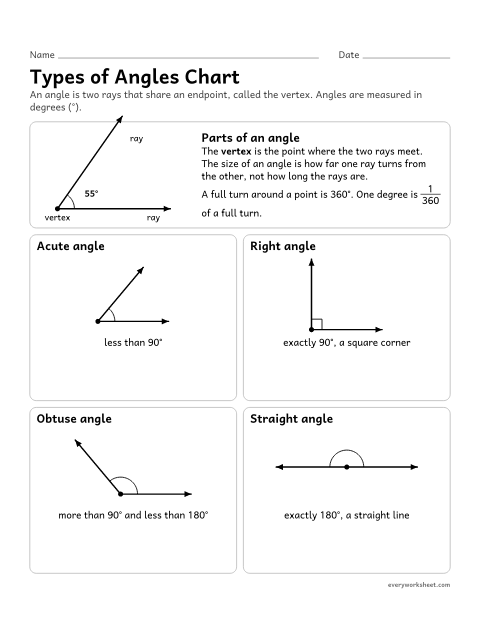
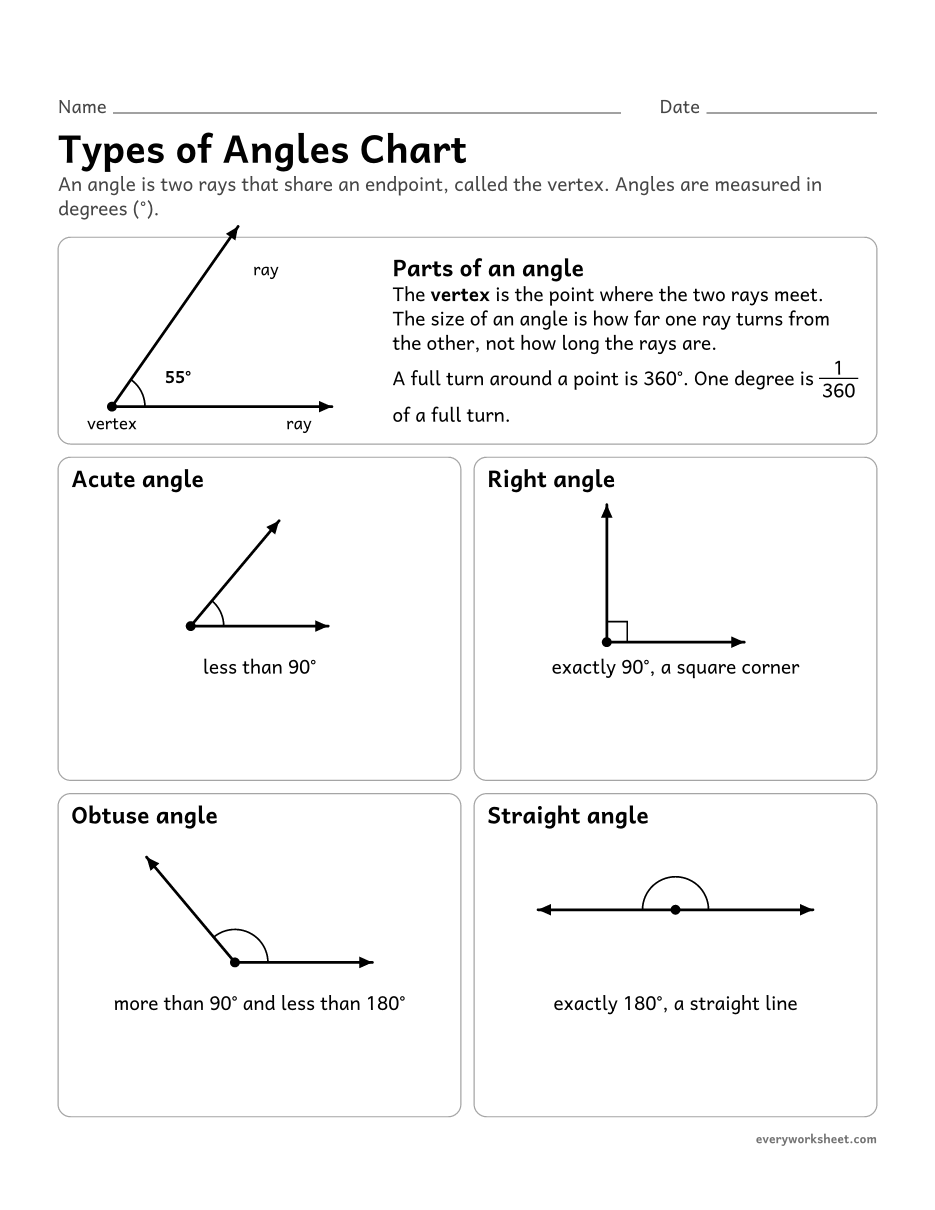
Types of angles chart
Acute, right, obtuse and straight angles, with how many degrees each one has
1 page31 KB
Types of angles, measuring and drawing with a protractor, a printable protractor, angles as turns, adding angles and word problems. With answer keys.
View largerAcute, right, obtuse and straight angles, with how many degrees each one has
1 page31 KB
 View all 2 pages
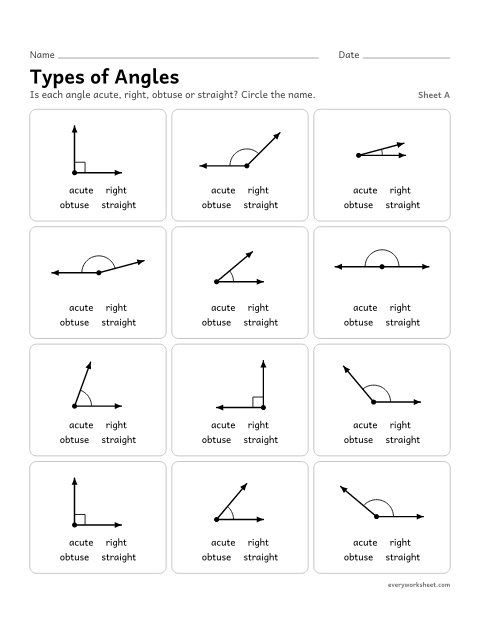
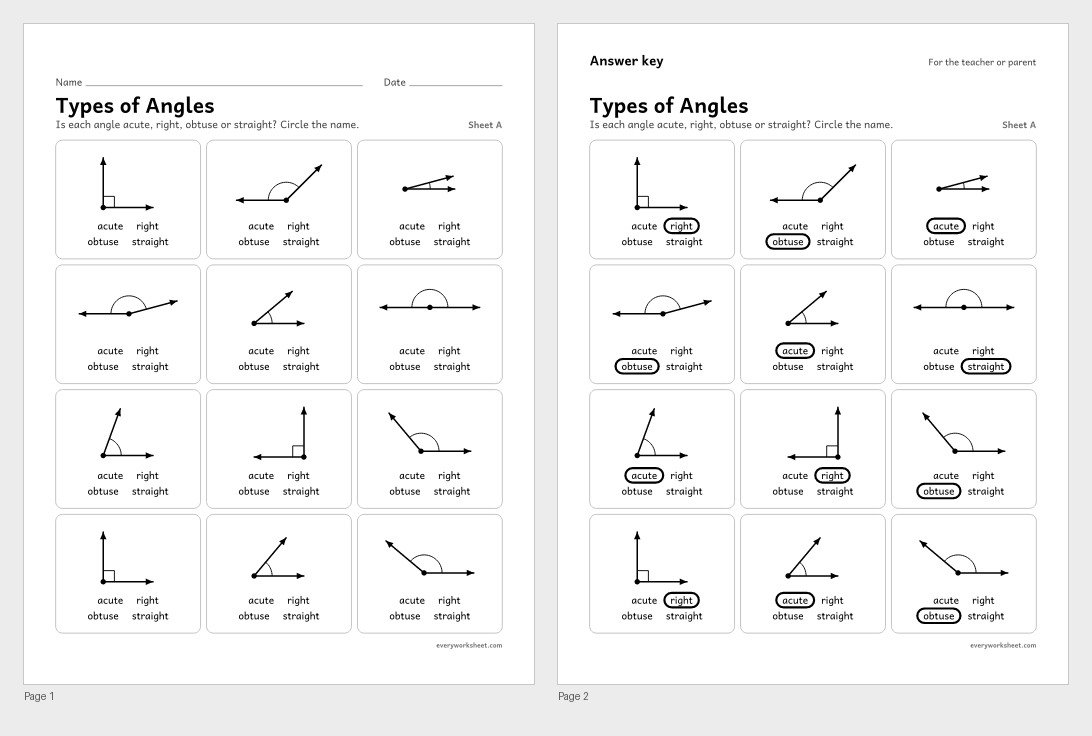
Naming angles as acute, right, obtuse or straight
Answer key on page 2
2 pages39 KB
 View all 2 pages
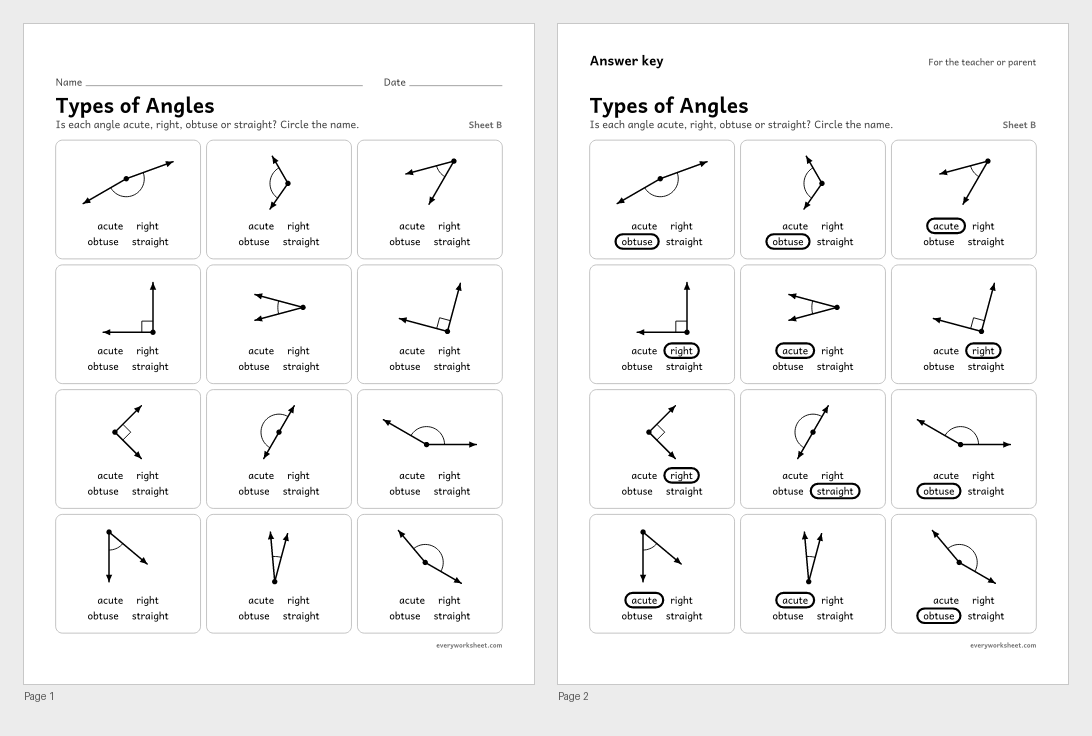
Naming turned angles as acute, right, obtuse or straight
Answer key on page 2
2 pages40 KB
 View all 2 pages
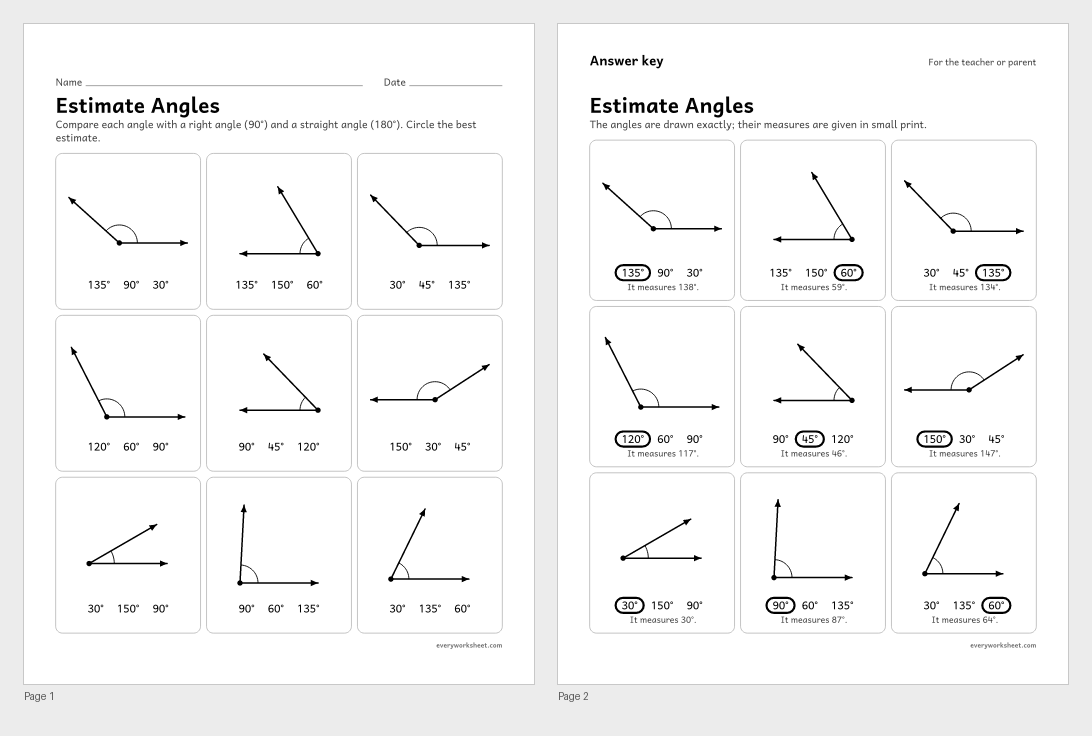
Estimating angles by comparing them with a right angle and a straight angle
Answer key on page 2
2 pages38 KB
 View all 2 pages
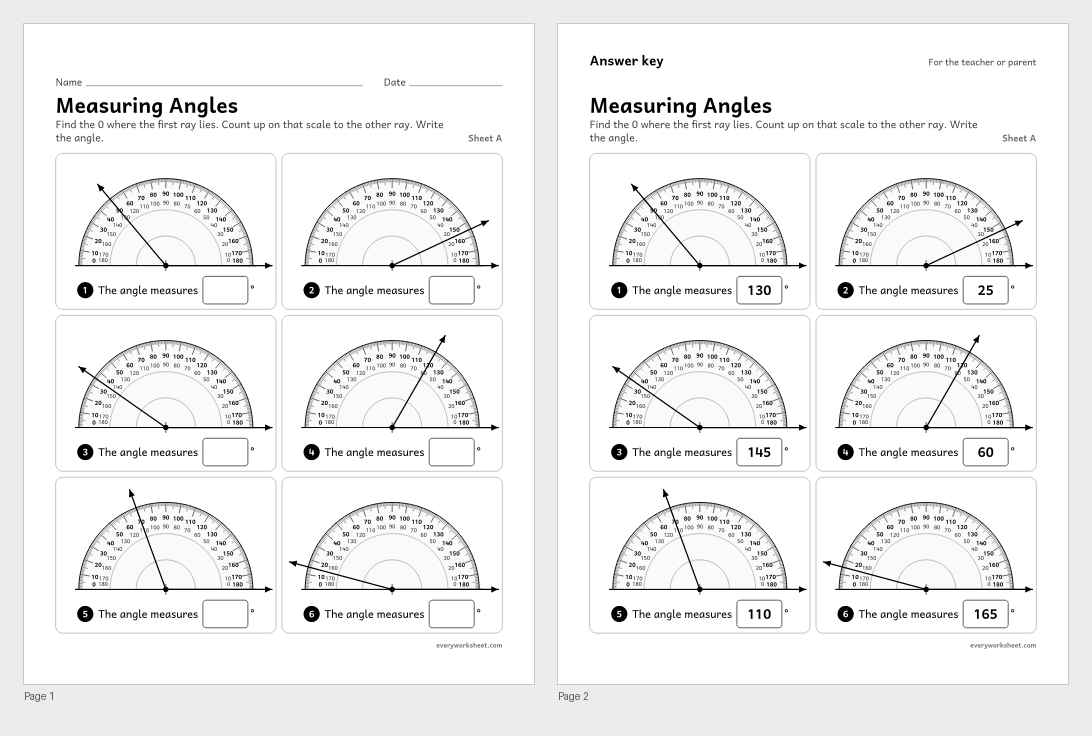
Reading a protractor on angles that start at 0 on the right, in steps of 5 degrees
Answer key on page 2
2 pages104 KB
 View all 2 pages
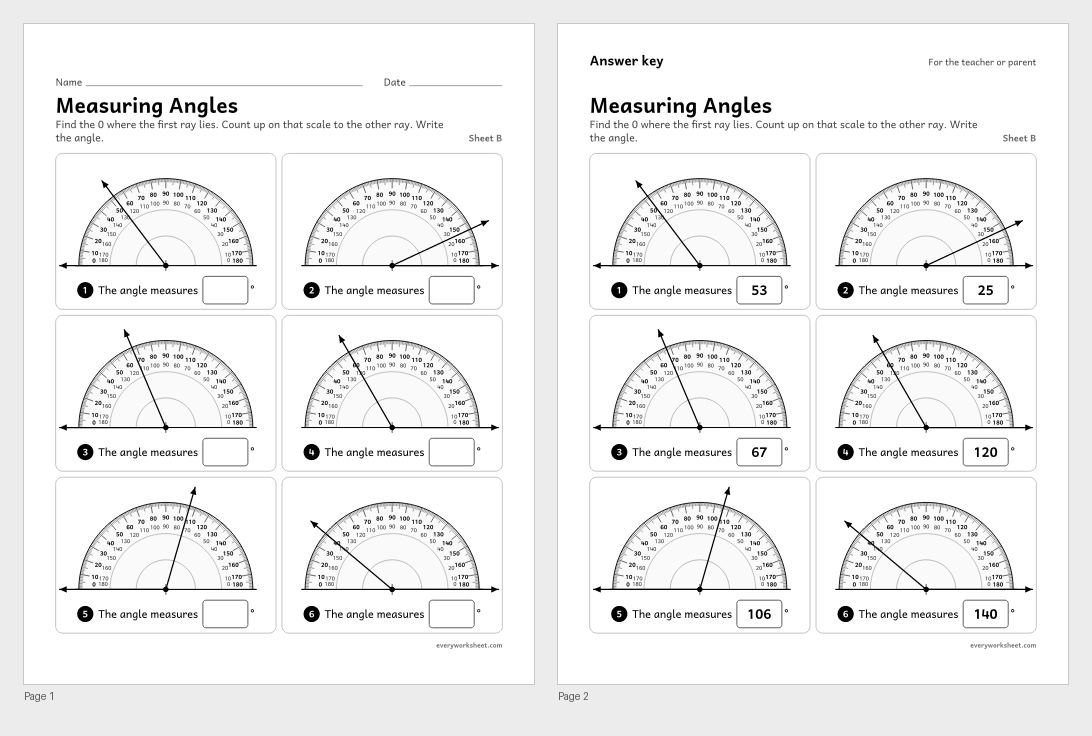
Reading a protractor when the angle starts on the left or the right, choosing the right scale
Answer key on page 2
2 pages104 KB
 View all 2 pages
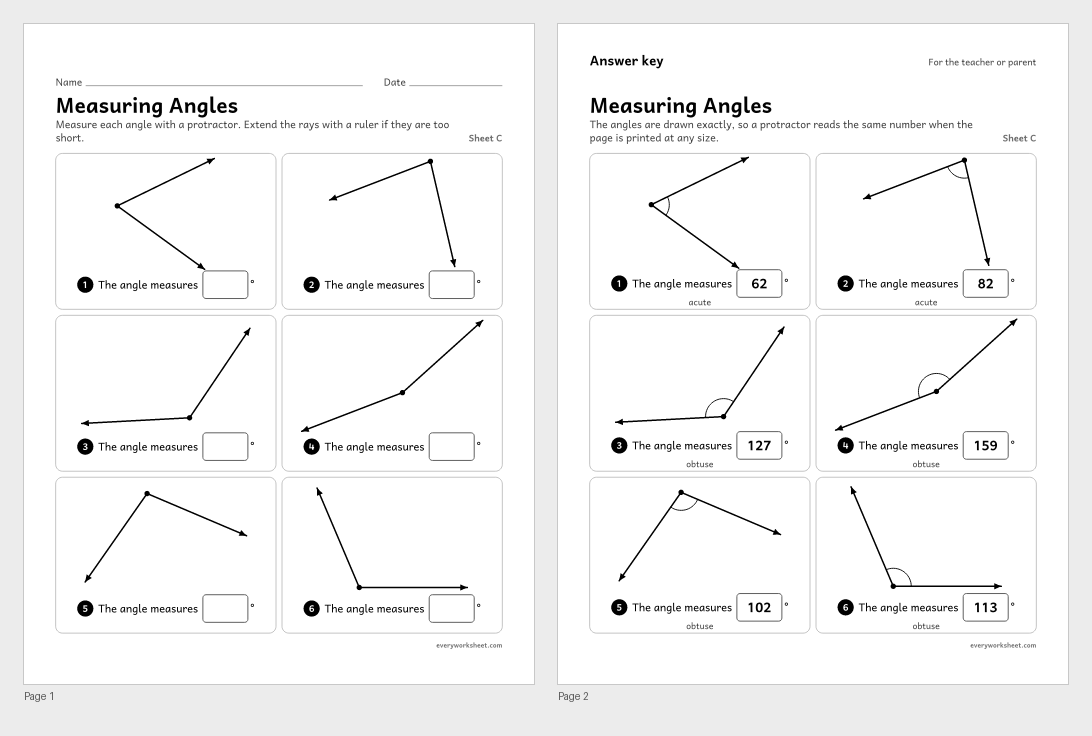
Measuring turned angles to the nearest degree with your own protractor
Answer key on page 2
2 pages36 KB
 View all 2 pages
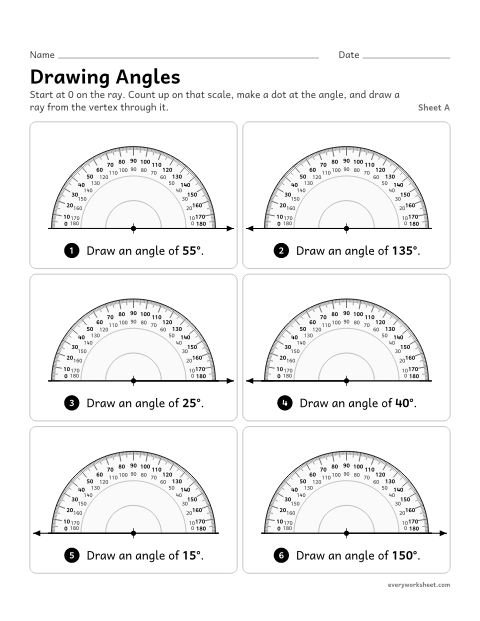
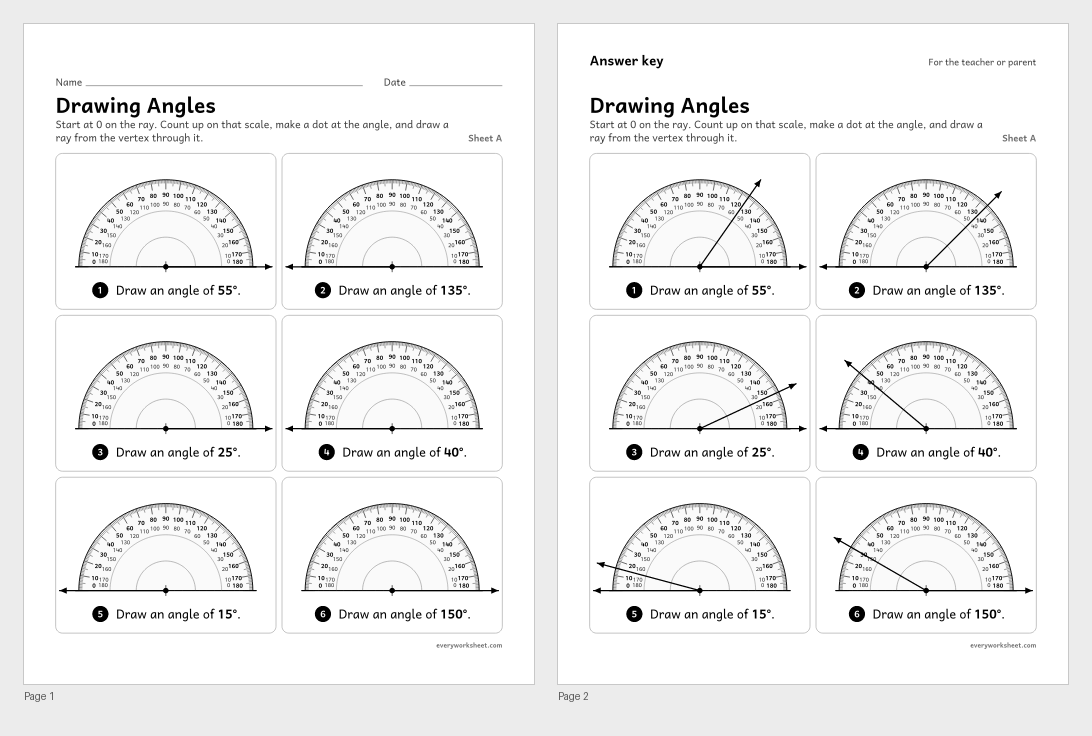
Drawing angles of a given size on a printed protractor
Answer key on page 2
2 pages106 KB
 View all 2 pages
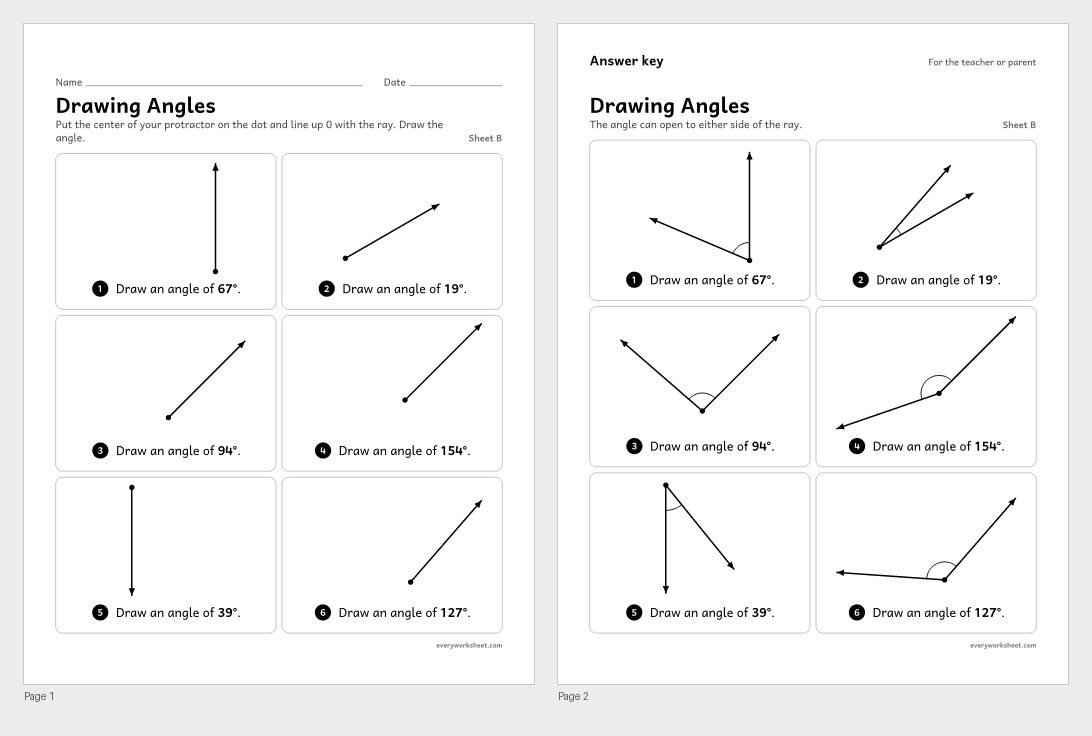
Drawing angles of a given size from a ray with your own protractor
Answer key on page 2
2 pages37 KB
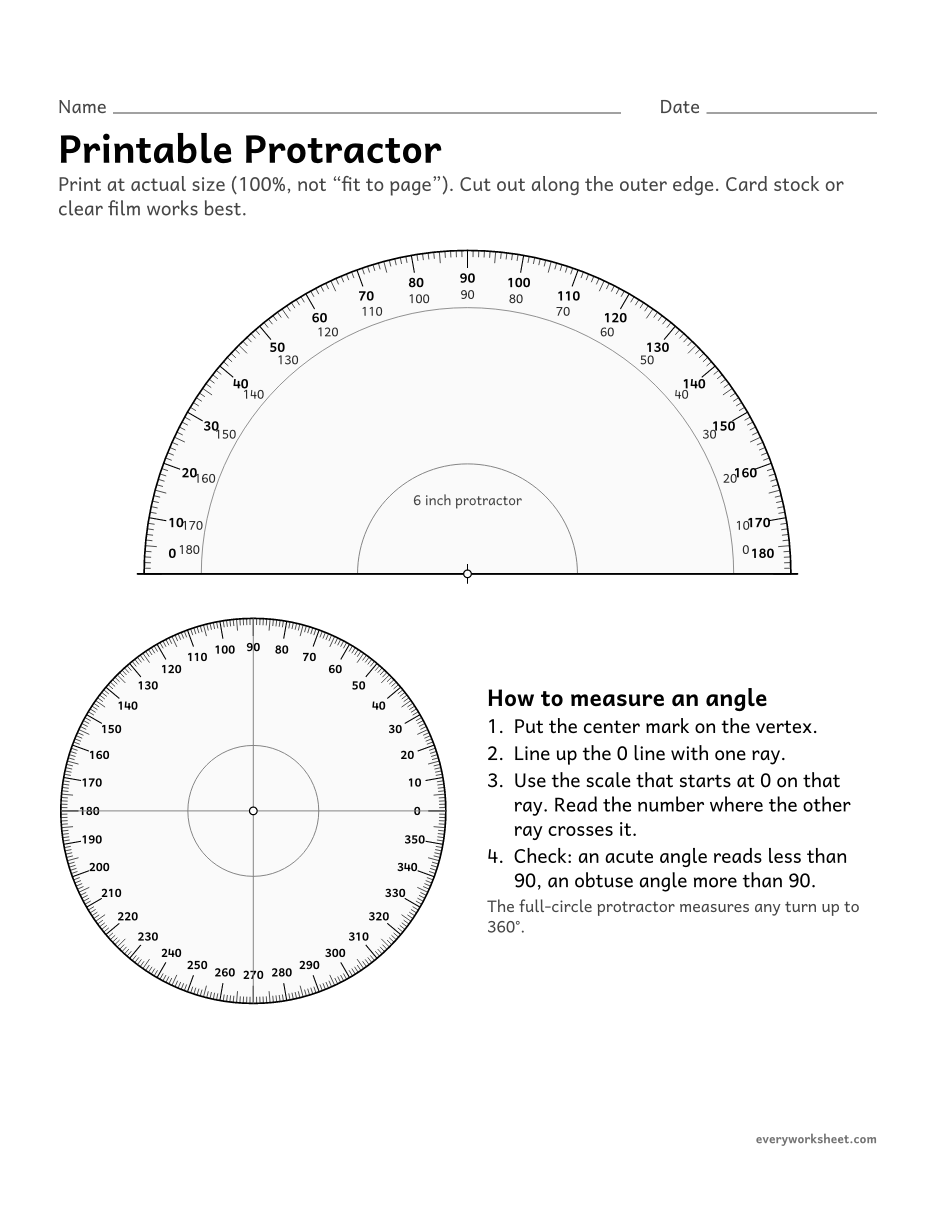 View larger
A 6 inch half-circle protractor and a full-circle protractor to print at actual size and cut out
1 page44 KB
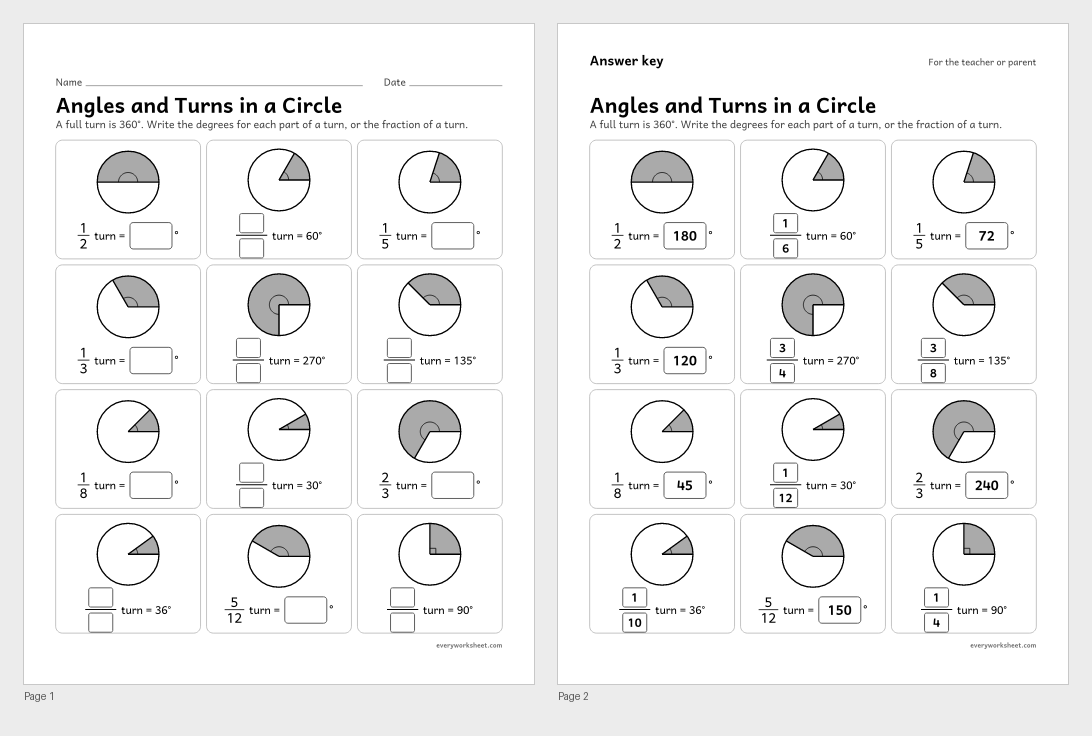 View all 2 pages
An angle as a turn through part of a circle: 1/4 turn is 90 degrees and a one-degree angle is 1/360 of a circle
Answer key on page 2
2 pages41 KB
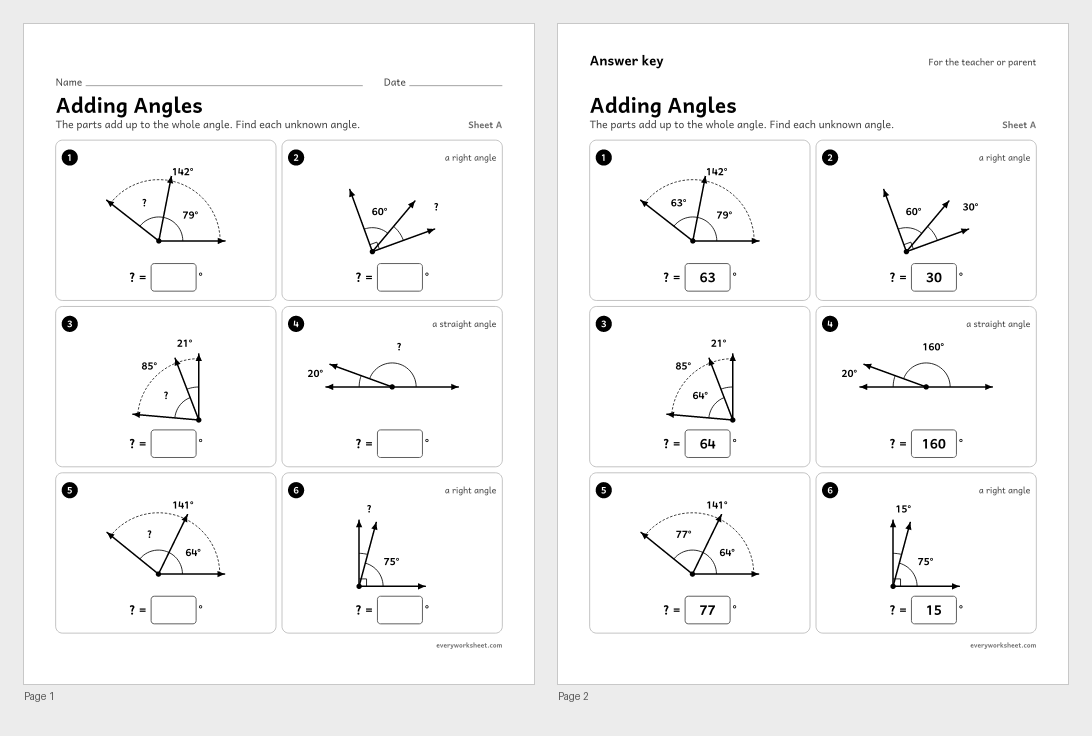 View all 2 pages
Adding and subtracting angle measures when an angle is split into parts
Answer key on page 2
2 pages45 KB
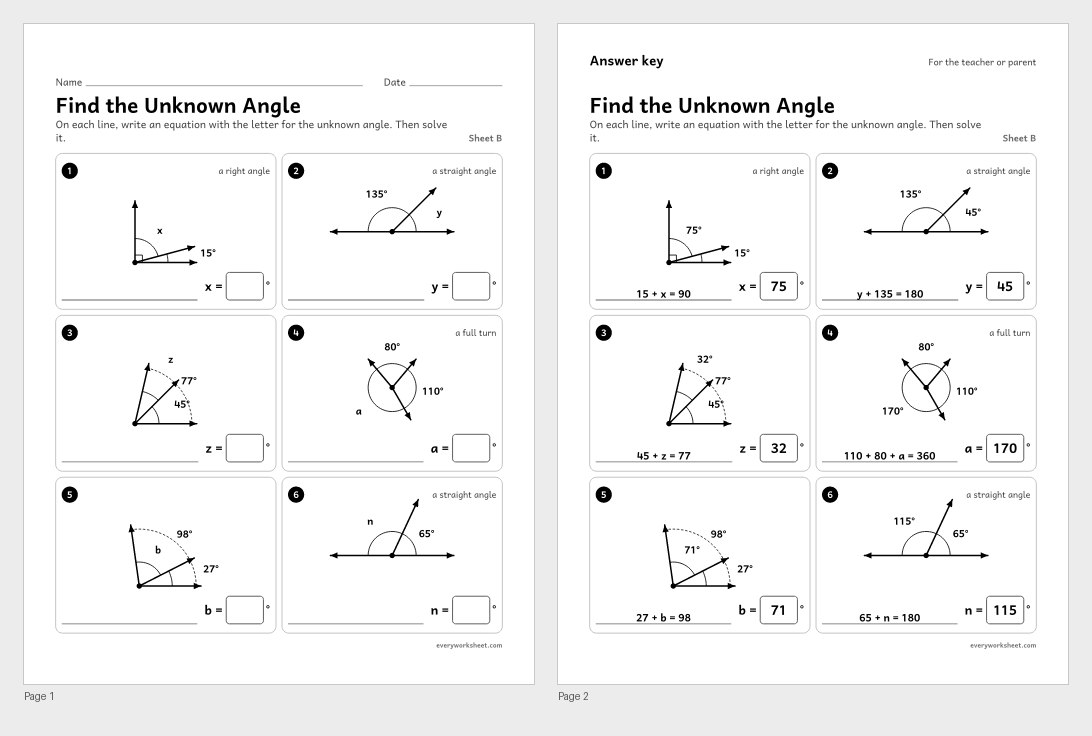 View all 2 pages
Writing an equation with a letter for the unknown angle in right angles, straight angles and full turns
Answer key on page 2
2 pages53 KB
 View all 2 pages
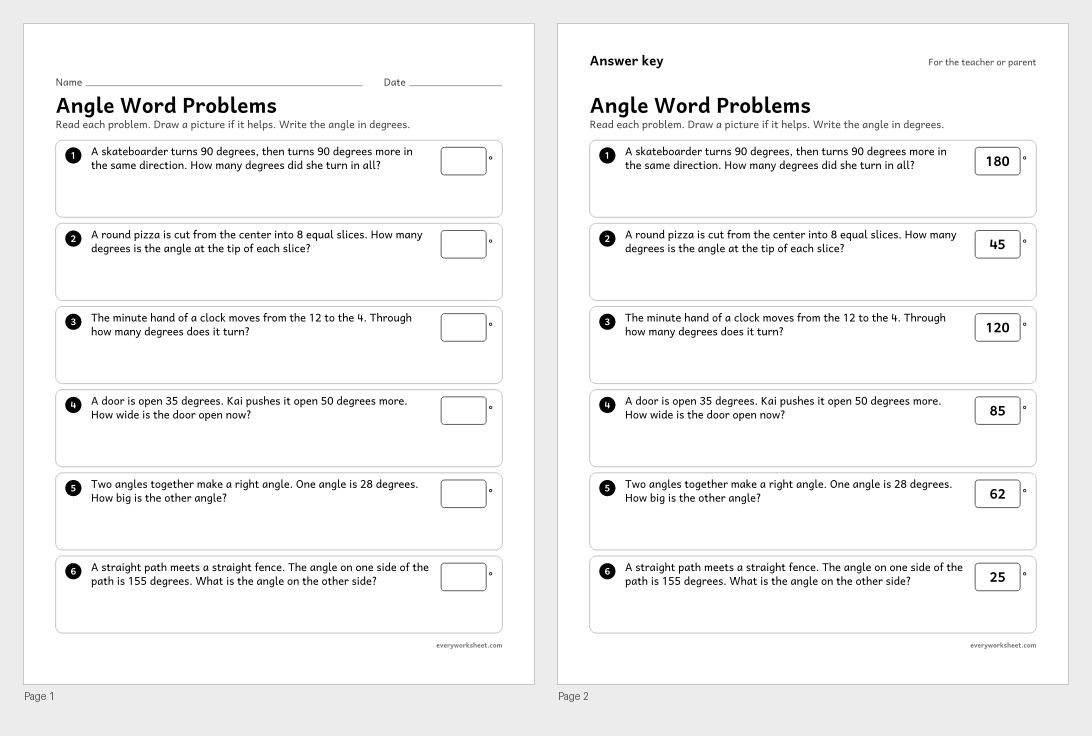
Solving word problems with turns, clocks and angles that add up to 90, 180 or 360 degrees
Answer key on page 2
2 pages41 KB
Print at 100% (actual size) for the cleanest tracing lines.
An angle is made by two rays that share an endpoint, the vertex. Angles are measured in degrees. A full turn is 360°, so one degree is 1/360 of a turn. An acute angle is less than 90°, a right angle is exactly 90°, an obtuse angle is between 90° and 180°, and a straight angle is 180°.
To measure an angle with a protractor, put the center mark on the vertex, line up the 0 line with one ray, and read the scale that starts at 0 on that ray. A protractor has two scales, so checking whether the angle is acute or obtuse catches most mistakes.
Every angle on these sheets is drawn exactly from its measure, and every protractor mark is at an exact degree, so a real protractor reads the same number. Angle measures also add up: if a right angle is split into 35° and another part, that part is 55°. Practice pages have answer keys.
CCSS.MATH.CONTENT.4.G.A.1Draw points, lines, line segments, rays, angles (right, acute, obtuse), and perpendicular and parallel lines. Identify these in two-dimensional figures.CCSS.MATH.CONTENT.4.MD.C.5.AAn angle is measured with reference to a circle with its center at the common endpoint of the rays, by considering the fraction of the circular arc between the points where the two rays intersect the circle. An angle that turns through 1/360 of a circle is called a "one-degree angle," and can be used to measure angles.CCSS.MATH.CONTENT.4.MD.C.6Measure angles in whole-number degrees using a protractor. Sketch angles of specified measure.CCSS.MATH.CONTENT.4.MD.C.7Recognize angle measure as additive. When an angle is decomposed into non-overlapping parts, the angle measure of the whole is the sum of the angle measures of the parts. Solve addition and subtraction problems to find unknown angles on a diagram in real world and mathematical problems, e.g., by using an equation with a symbol for the unknown angle measure.Acute (less than 90°), right (exactly 90°), obtuse (more than 90° and less than 180°) and straight (exactly 180°). Angles greater than 180° are called reflex angles; they come later.
Put the center mark on the vertex and the 0 line on one ray. Find the 0 where that ray is, follow that scale to the other ray, and read the number.
Yes. An angle's size does not depend on the length of its rays, so the angles measure the same at any print size. Print the Printable Protractor at 100% so its outside edge is 6 inches.