 View larger
Dividing fractions
Dividing a unit fraction by a whole number and a whole number by a unit fraction, with bar models and multiplication checks
1 page33 KB
A dividing fractions chart, bar models and number lines, unit fractions and whole numbers, checking by multiplying and word problems. With keys.
View largerDividing a unit fraction by a whole number and a whole number by a unit fraction, with bar models and multiplication checks
1 page33 KB
 View all 2 pages
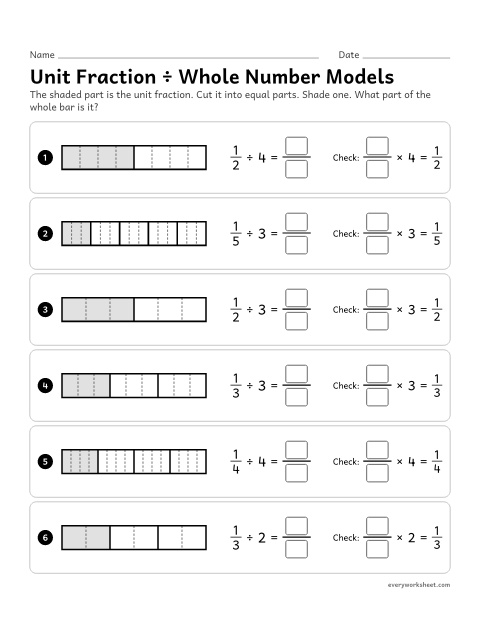
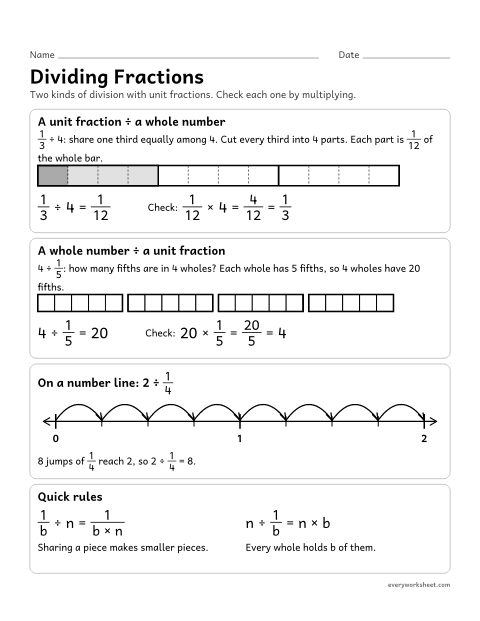
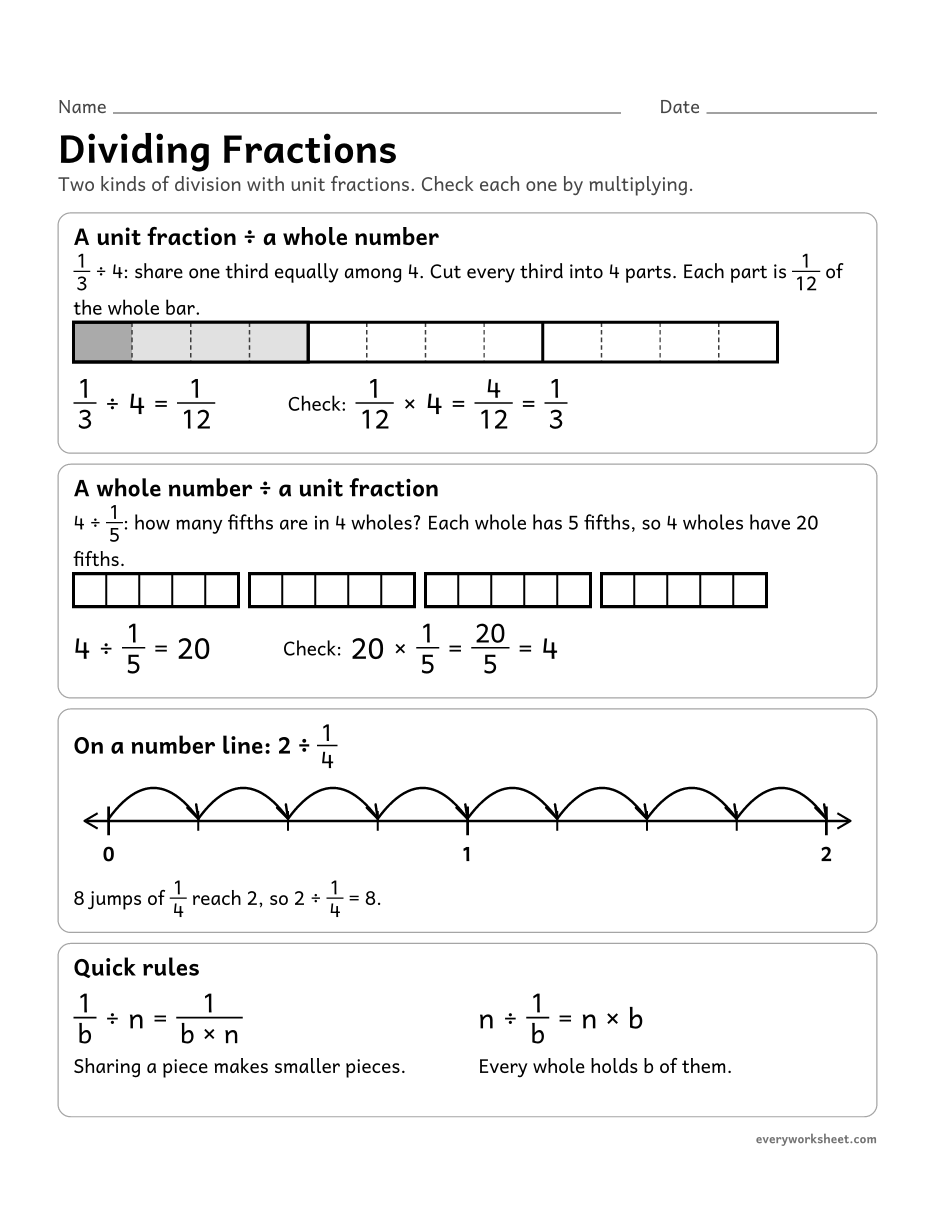
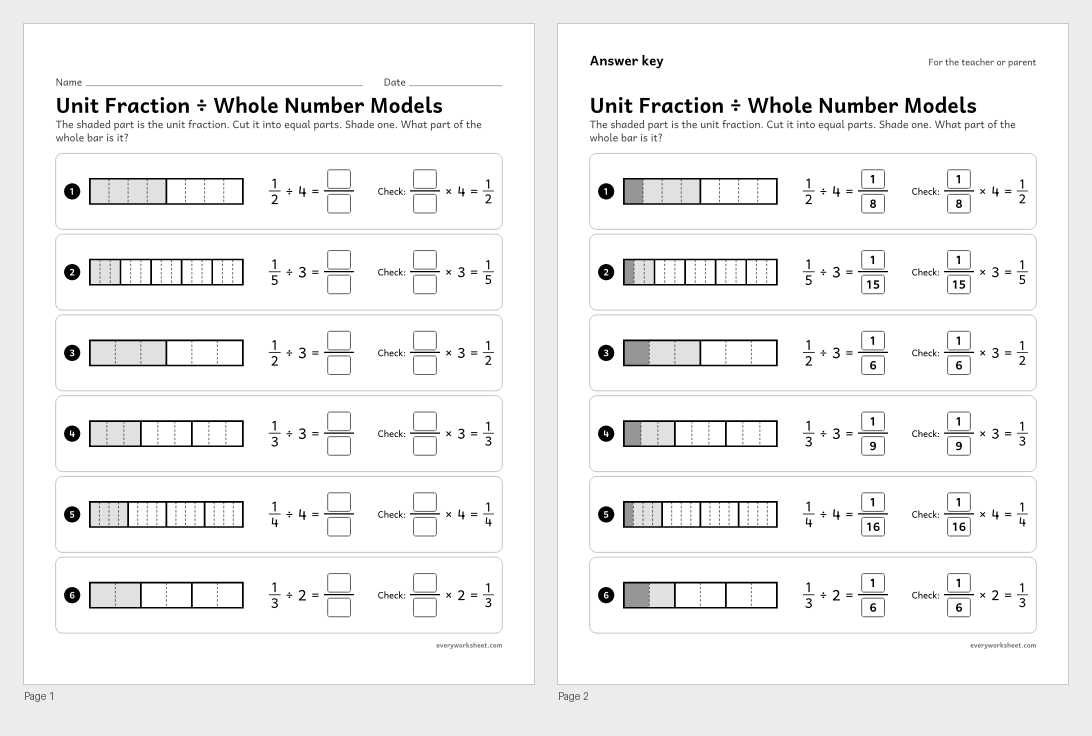
Using a fraction bar to split a unit fraction into equal parts: 1/3 ÷ 4 = 1/12 because 1/12 × 4 = 1/3
Answer key on page 2
2 pages43 KB
 View all 2 pages
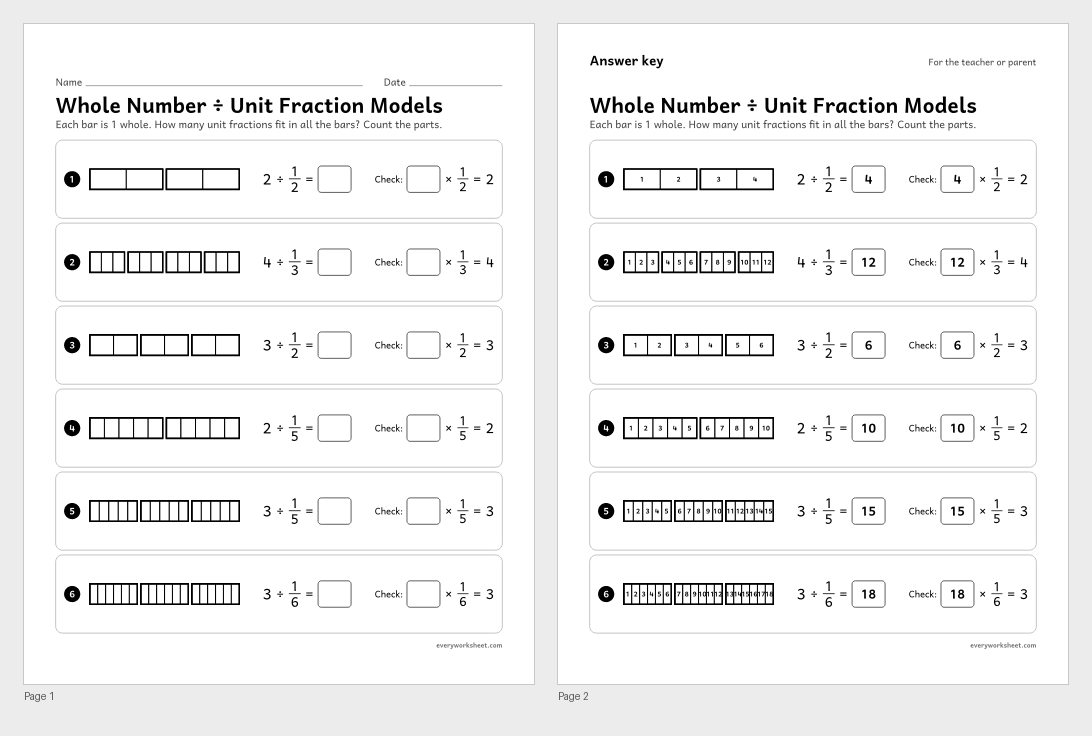
Counting how many unit fractions fit in a whole number with fraction bars: 4 ÷ 1/5 = 20 because 20 × 1/5 = 4
Answer key on page 2
2 pages46 KB
 View all 2 pages
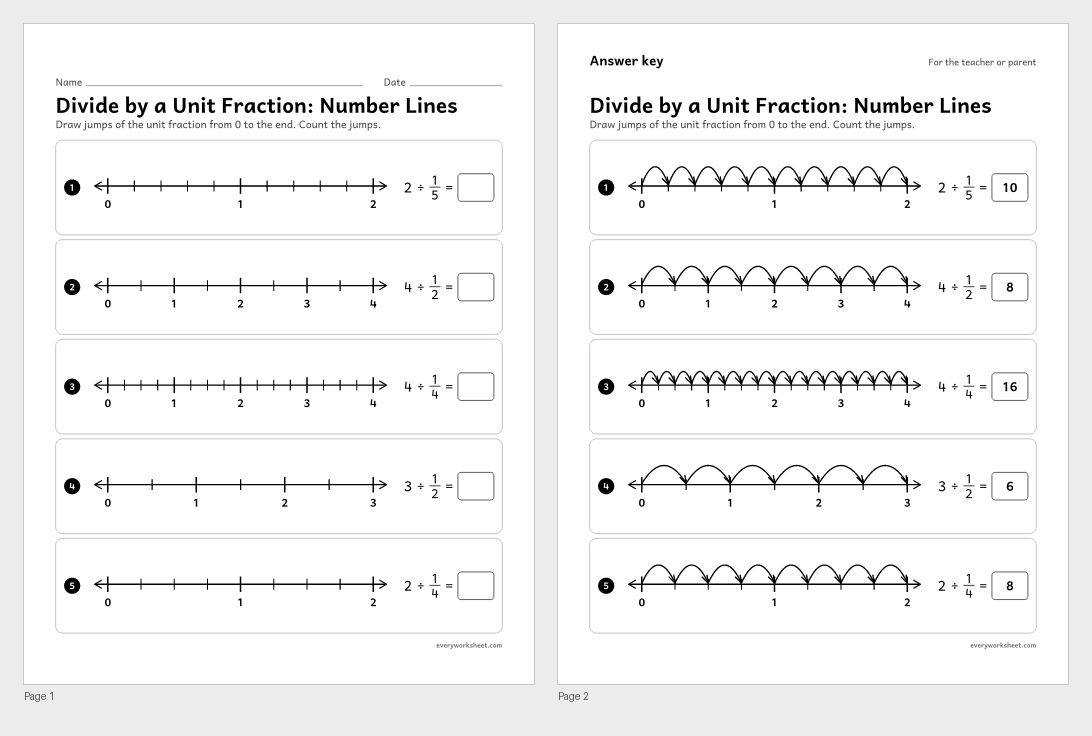
Counting jumps of a unit fraction from 0 to a whole number on a number line to divide
Answer key on page 2
2 pages46 KB
 View all 2 pages
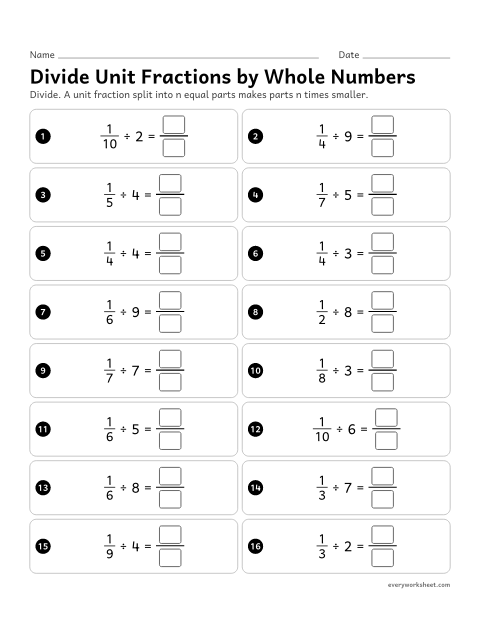
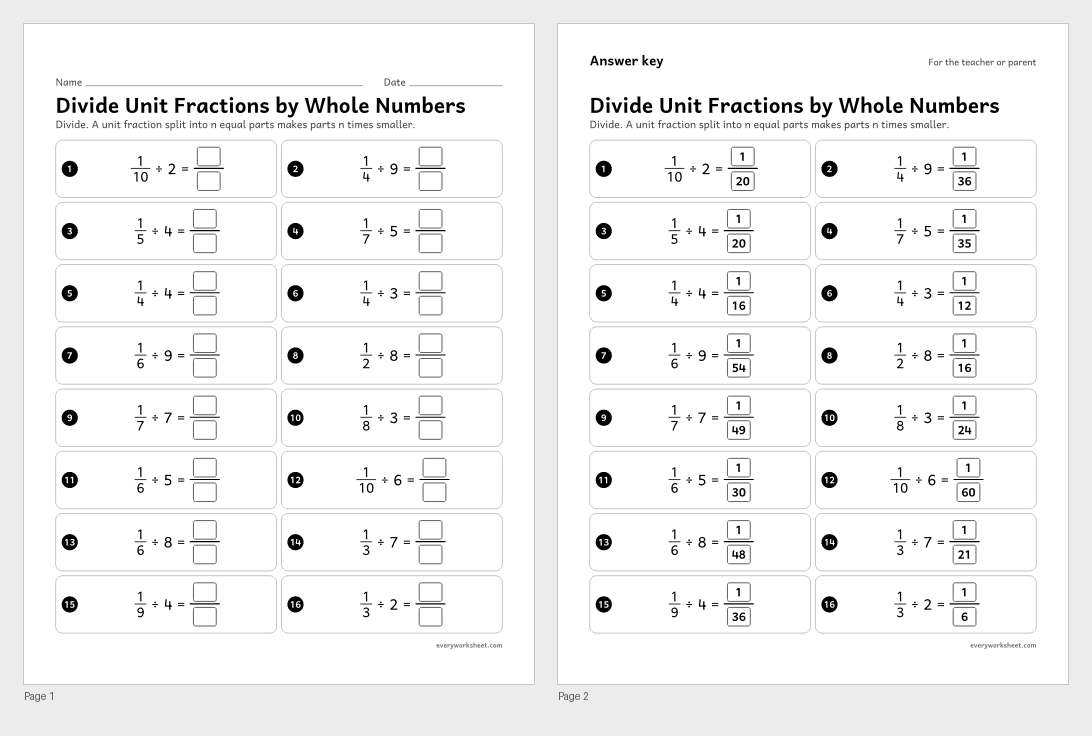
Dividing a unit fraction by a whole number: 1/b ÷ n = 1/(b × n)
Answer key on page 2
2 pages55 KB
 View all 2 pages
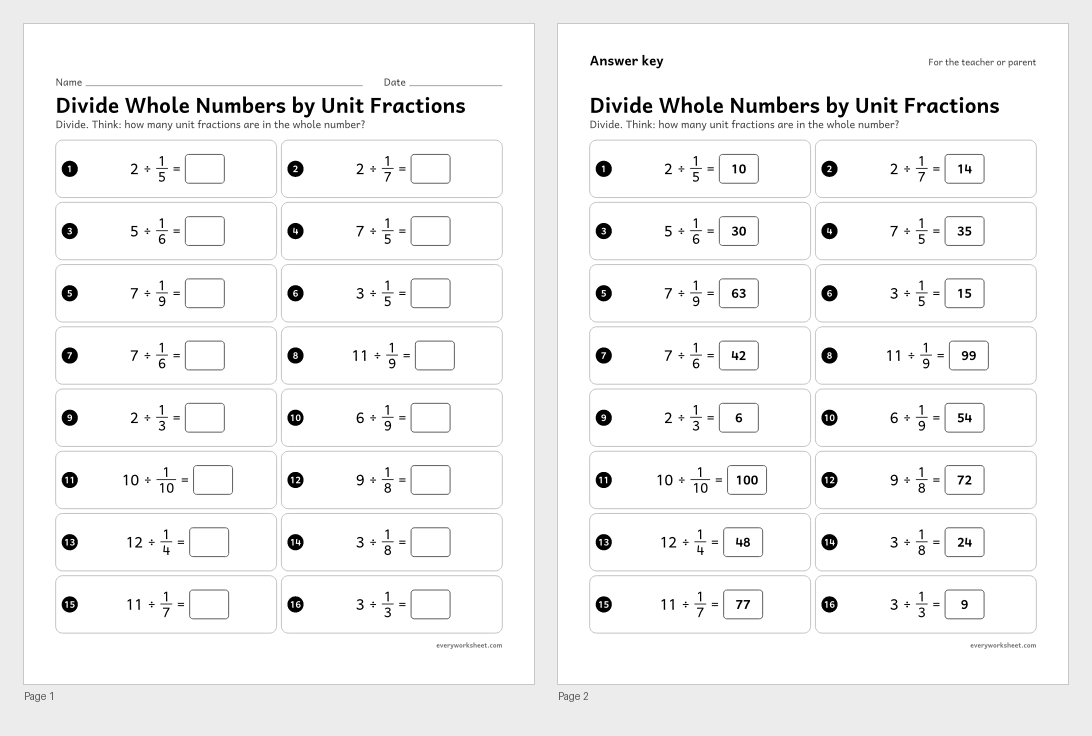
Dividing a whole number by a unit fraction: n ÷ 1/b = n × b, because there are b unit fractions in every whole
Answer key on page 2
2 pages54 KB
 View all 2 pages
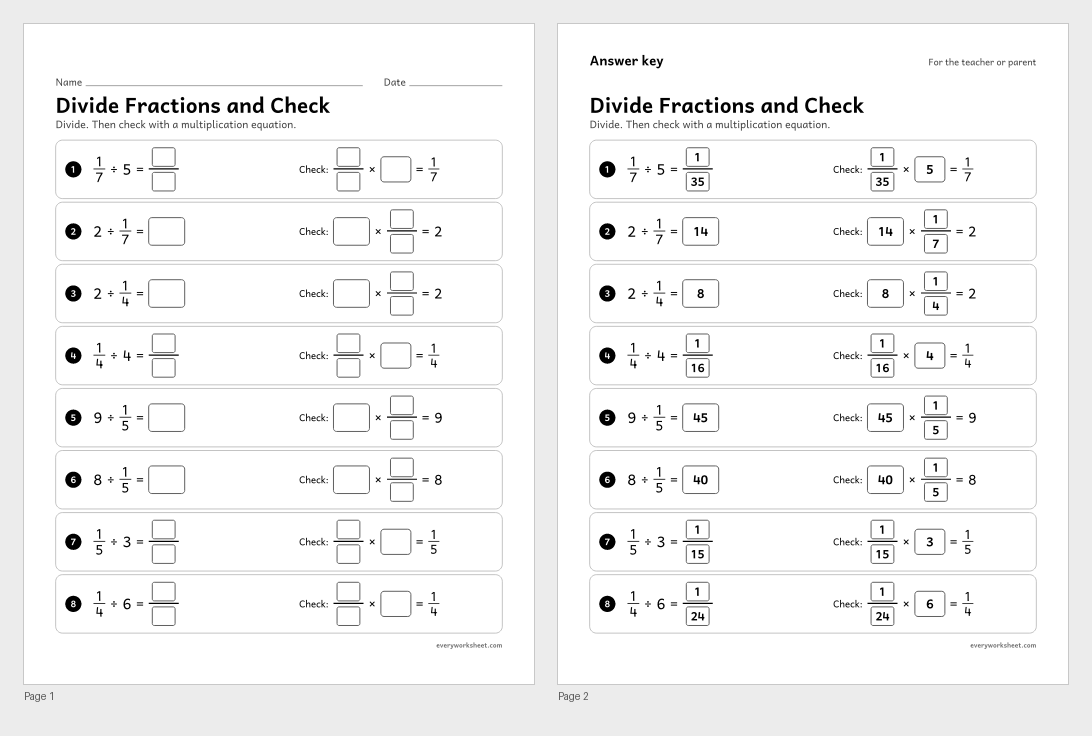
Dividing unit fractions and whole numbers, then checking each quotient with a multiplication equation
Answer key on page 2
2 pages46 KB
 View all 2 pages
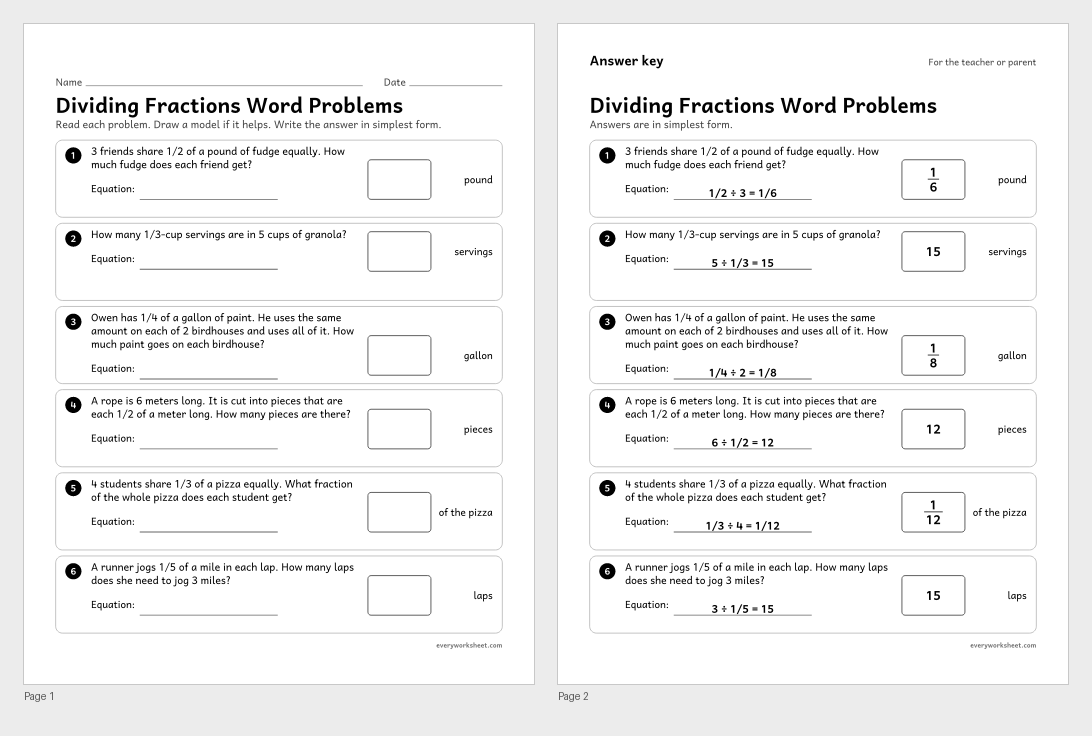
Solving real-world problems that divide a unit fraction by a whole number or a whole number by a unit fraction
Answer key on page 2
2 pages42 KB
Print at 100% (actual size) for the cleanest tracing lines.
In 5th grade, children divide in two ways with unit fractions. Dividing a unit fraction by a whole number shares it into smaller pieces: 1/3 ÷ 4 = 1/12, because cutting each third into 4 parts makes twelfths. Check it by multiplying: 1/12 × 4 = 4/12 = 1/3.
Dividing a whole number by a unit fraction counts how many pieces fit: 4 ÷ 1/5 = 20, because each whole holds 5 fifths and 4 wholes hold 20. Check: 20 × 1/5 = 4. A number line shows the same thing as equal jumps from 0.
These worksheets start with the chart and drawn bar models, then number lines, practice for each kind of division, a sheet that checks every answer by multiplying, and word problems. Every practice page has an answer key.
CCSS.MATH.CONTENT.5.NF.B.7Apply and extend previous understandings of division to divide unit fractions by whole numbers and whole numbers by unit fractions.CCSS.MATH.CONTENT.5.NF.B.7.AInterpret division of a unit fraction by a non-zero whole number, and compute such quotients. For example, create a story context for (1/3) ÷ 4, and use a visual fraction model to show the quotient. Use the relationship between multiplication and division to explain that (1/3) ÷ 4 = 1/12 because (1/12) × 4 = 1/3.CCSS.MATH.CONTENT.5.NF.B.7.BInterpret division of a whole number by a unit fraction, and compute such quotients. For example, create a story context for 4 ÷ (1/5), and use a visual fraction model to show the quotient. Use the relationship between multiplication and division to explain that 4 ÷ (1/5) = 20 because 20 × (1/5) = 4.CCSS.MATH.CONTENT.5.NF.B.7.CSolve real world problems involving division of unit fractions by non-zero whole numbers and division of whole numbers by unit fractions, e.g., by using visual fraction models and equations to represent the problem. For example, how much chocolate will each person get if 3 people share 1/2 lb of chocolate equally? How many 1/3-cup servings are in 2 cups of raisins?1/6. Sharing half of something among 3 people gives each person 1/6 of the whole, and 1/6 × 3 = 1/2.
12. Each whole holds 4 fourths, so 3 wholes hold 12 fourths, and 12 × 1/4 = 3.