 View larger
5th grade fractions chart
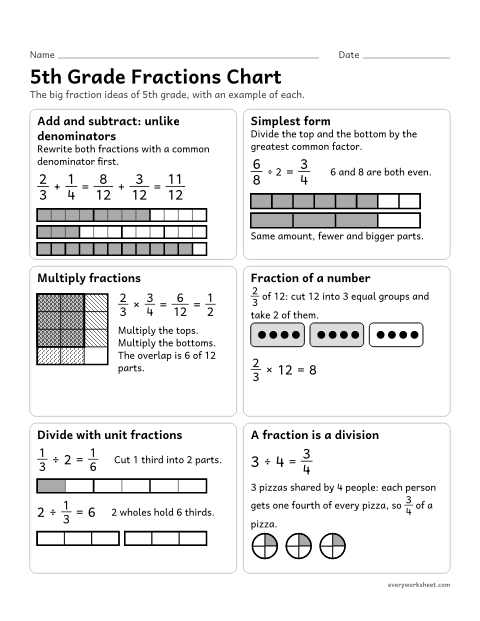
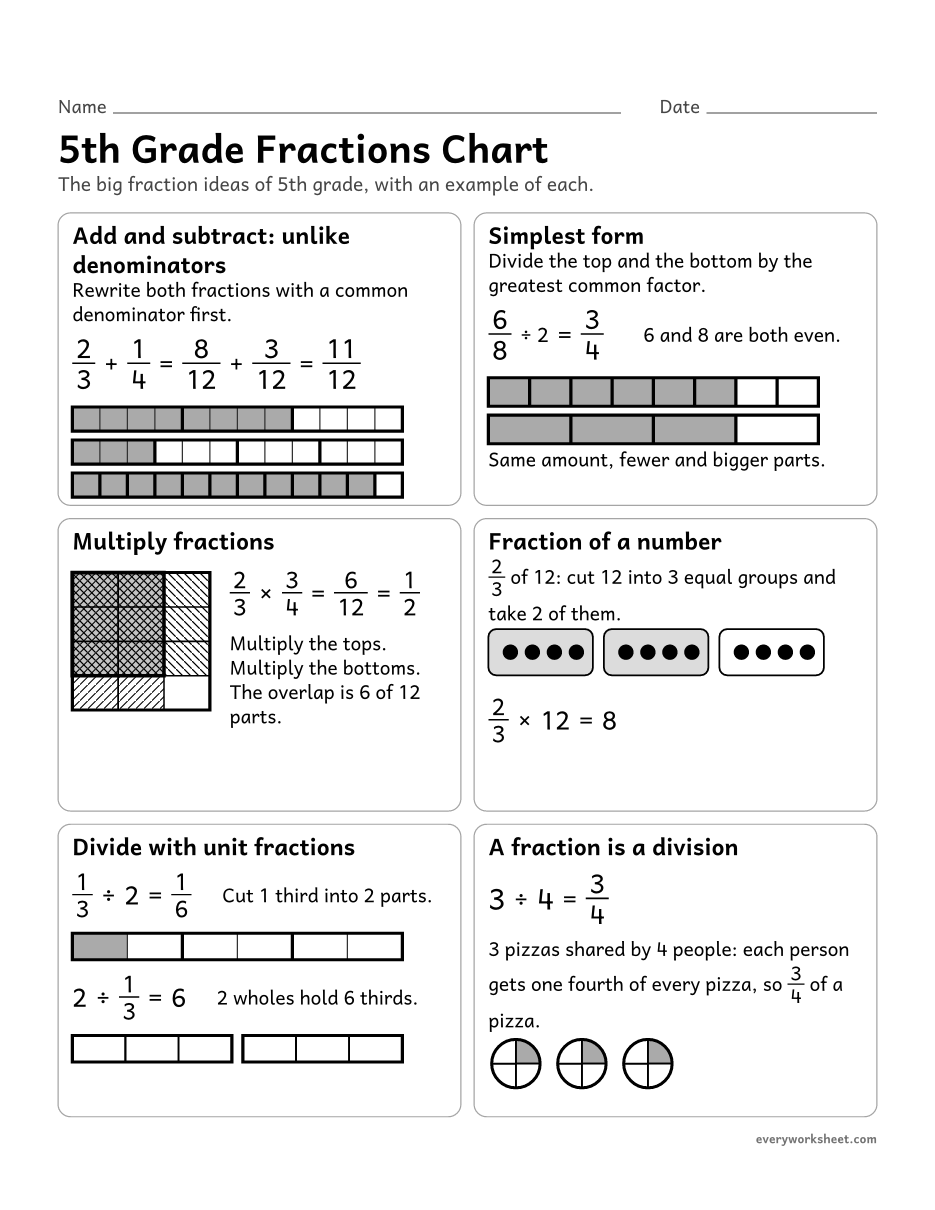
The 5th grade fraction ideas on one page: unlike denominators, simplest form, multiplying, dividing and fractions as division
1 page35 KB
Every 5th grade fraction skill in one place: a chart, review sheets, fractions as division, word problems and links to each fraction topic. With keys.
View largerThe 5th grade fraction ideas on one page: unlike denominators, simplest form, multiplying, dividing and fractions as division
1 page35 KB
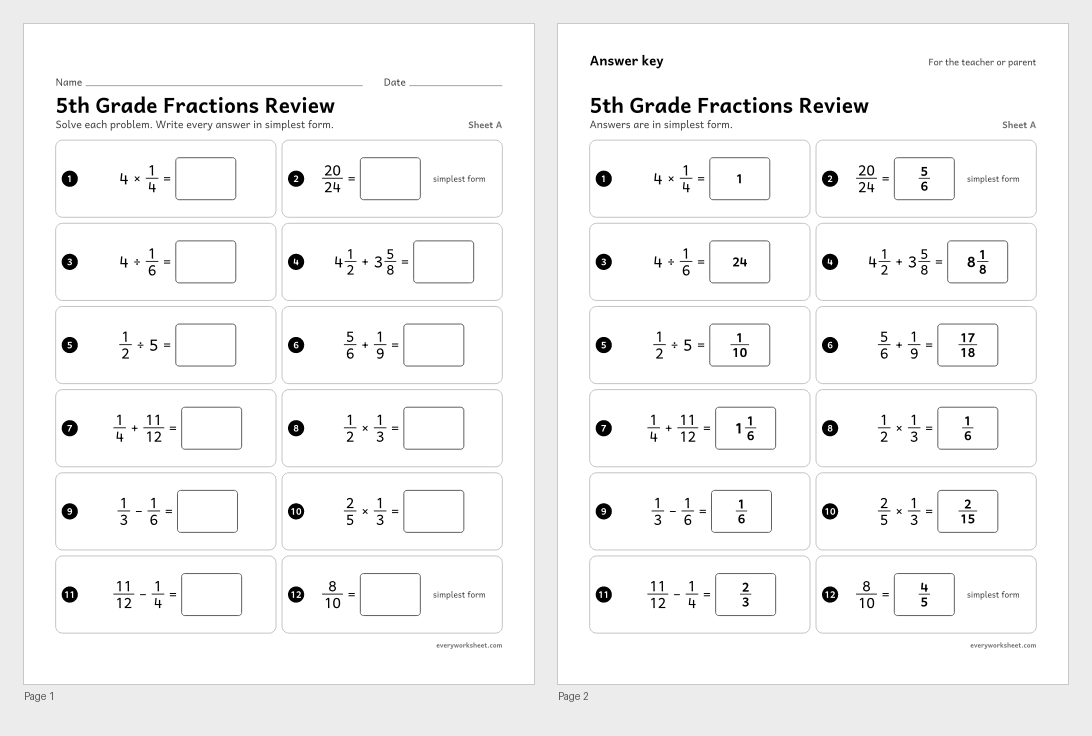 View all 2 pages
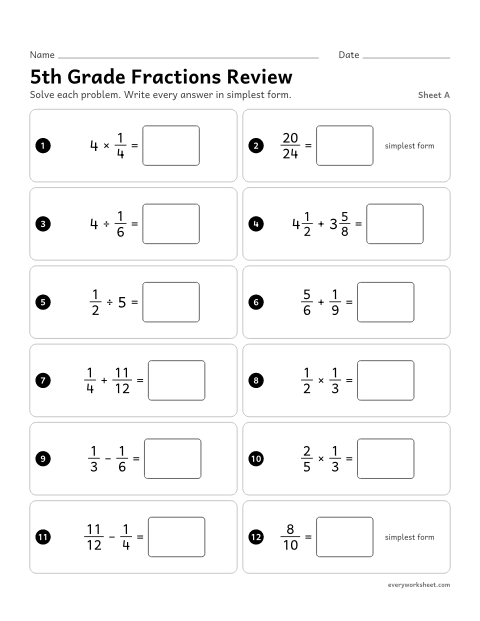
Mixed review: adding and subtracting with unlike denominators, simplest form, multiplying and dividing fractions
Answer key on page 2
2 pages49 KB
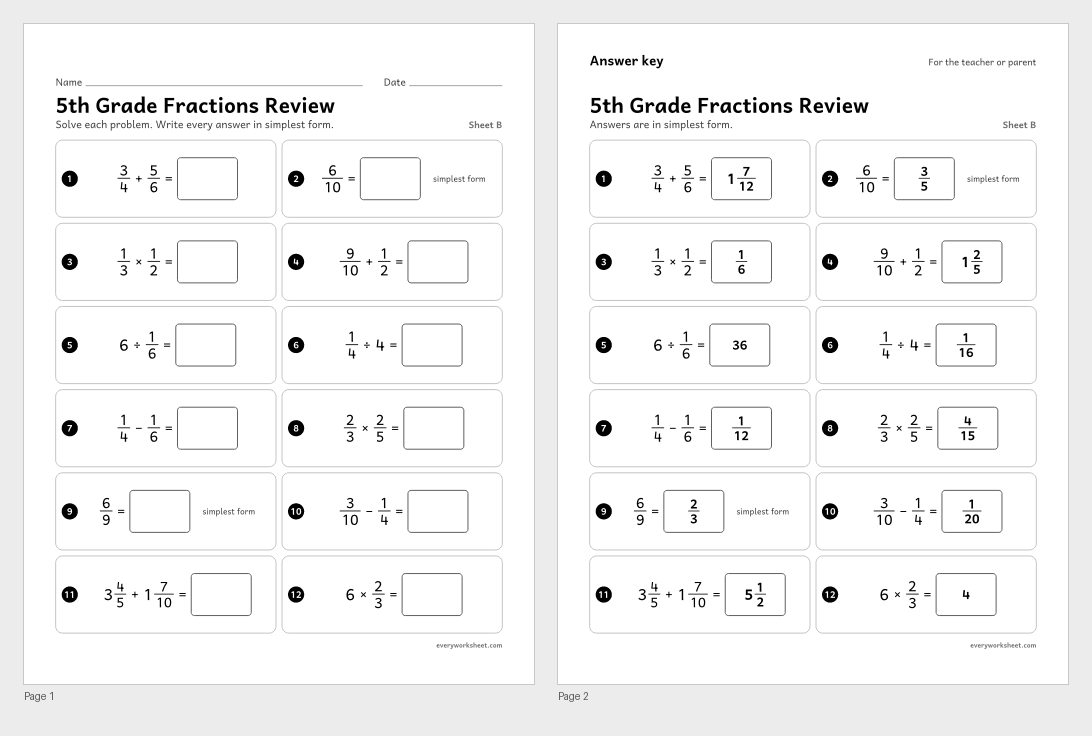 View all 2 pages
Mixed review: adding and subtracting with unlike denominators, simplest form, multiplying and dividing fractions
Answer key on page 2
2 pages49 KB
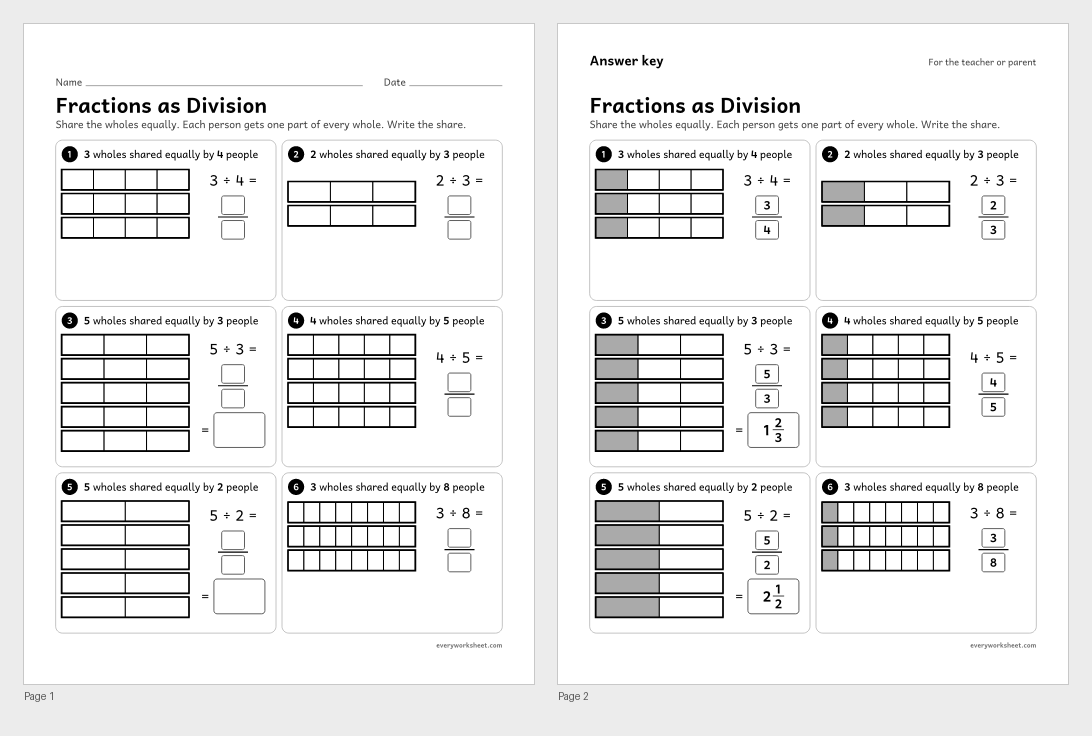 View all 2 pages
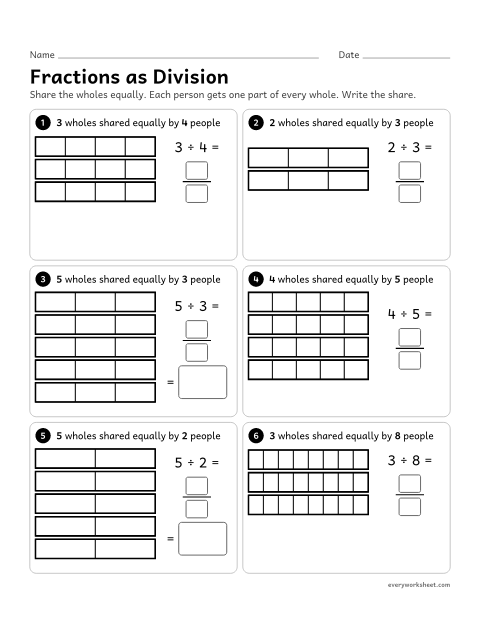
Sharing wholes equally to see that a/b = a ÷ b, with fraction bars cut into equal parts
Answer key on page 2
2 pages50 KB
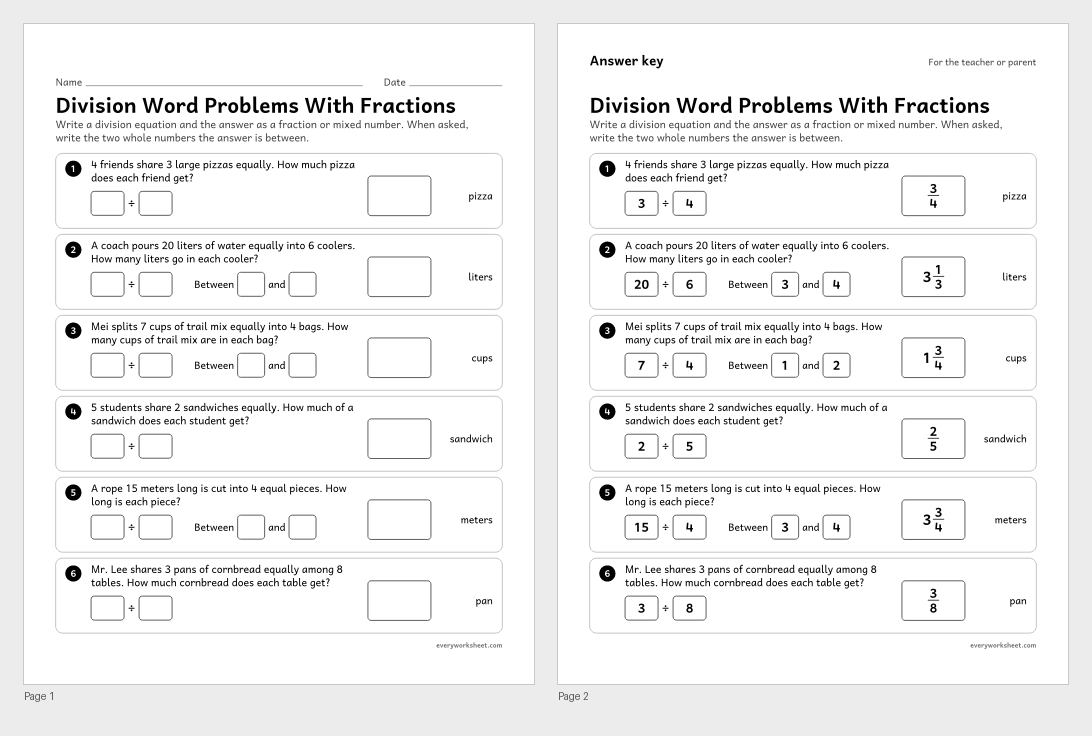 View all 2 pages
Solving sharing problems where dividing whole numbers gives a fraction or mixed number, and saying between which whole numbers it lies
Answer key on page 2
2 pages44 KB
 View all 2 pages
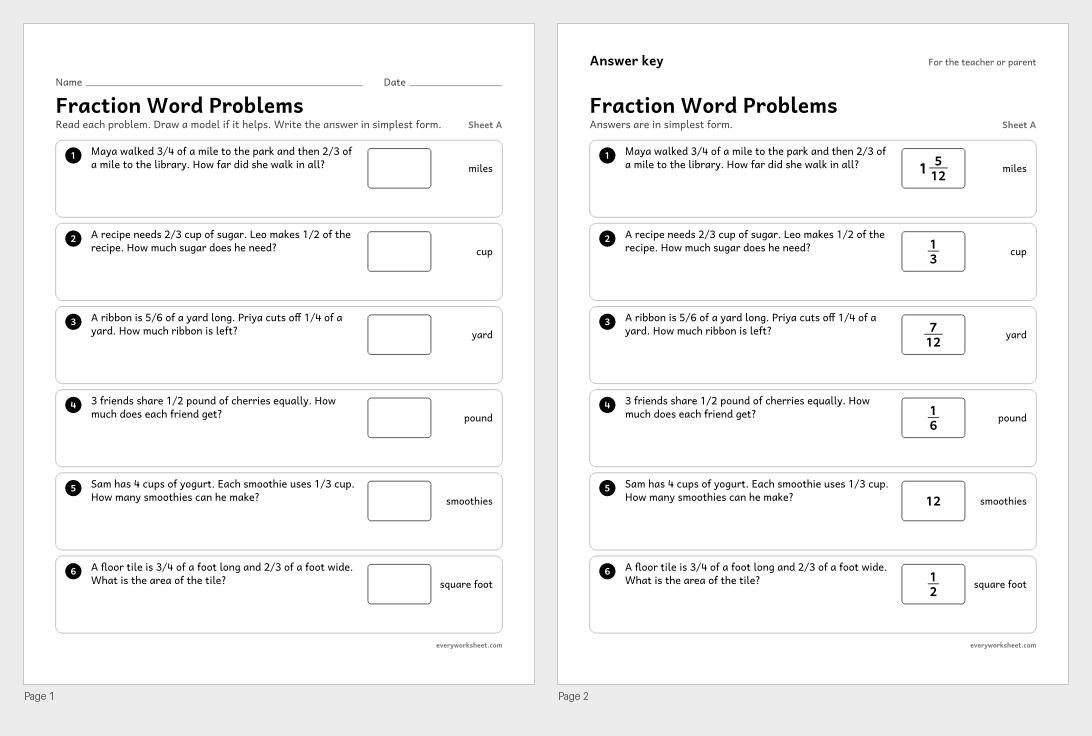
Choosing whether to add, subtract, multiply or divide fractions to solve real-world problems
Answer key on page 2
2 pages42 KB
 View all 2 pages
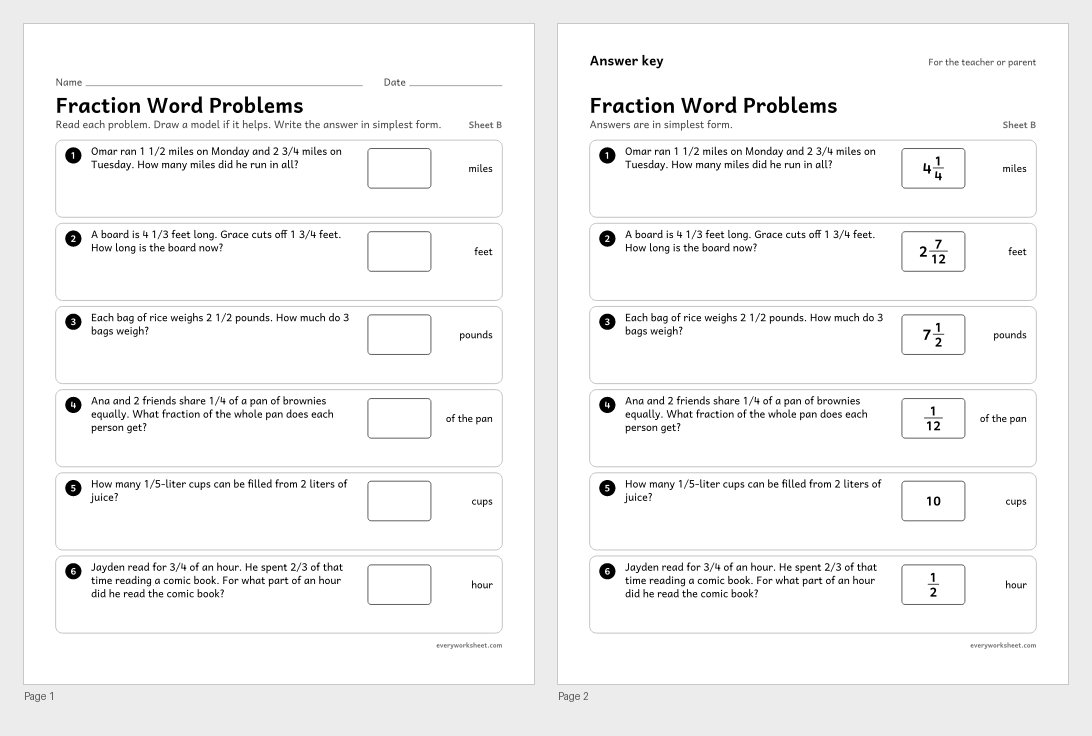
Solving real-world problems with mixed numbers and all four operations on fractions
Answer key on page 2
2 pages43 KB
Print at 100% (actual size) for the cleanest tracing lines.
5th grade finishes the big fraction ideas of elementary school. Children add and subtract fractions with unlike denominators, like 2/3 + 1/4, multiply fractions, divide unit fractions and whole numbers, and learn that a fraction is a division: 3 ÷ 4 = 3/4.
Start with the 5th Grade Fractions Chart, which shows one example of each idea. The two review sheets mix every skill on one page, and the fractions as division sheets show with fraction bars why sharing 3 pizzas among 4 people gives each person 3/4 of a pizza.
Each skill has its own page below with charts, models and practice. Every picture is drawn exactly, every practice page has an answer key on page 2 with answers in simplest form, and everything prints in black and white on US Letter or A4.
CCSS.MATH.CONTENT.5.NF.A.1Add and subtract fractions with unlike denominators (including mixed numbers) by replacing given fractions with equivalent fractions in such a way as to produce an equivalent sum or difference of fractions with like denominators. For example, 2/3 + 5/4 = 8/12 + 15/12 = 23/12. (In general, a/b + c/d = (ad + bc)/bd.)CCSS.MATH.CONTENT.5.NF.B.3Interpret a fraction as division of the numerator by the denominator (a/b = a ÷ b). Solve word problems involving division of whole numbers leading to answers in the form of fractions or mixed numbers, e.g., by using visual fraction models or equations to represent the problem. For example, interpret 3/4 as the result of dividing 3 by 4, noting that 3/4 multiplied by 4 equals 3, and that when 3 wholes are shared equally among 4 people each person has a share of size 3/4. If 9 people want to share a 50-pound sack of rice equally by weight, how many pounds of rice should each person get? Between what two whole numbers does your answer lie?CCSS.MATH.CONTENT.5.NF.B.6Solve real world problems involving multiplication of fractions and mixed numbers, e.g., by using visual fraction models or equations to represent the problem.Adding and subtracting fractions and mixed numbers with unlike denominators, multiplying fractions and mixed numbers, dividing a unit fraction by a whole number and a whole number by a unit fraction, and seeing a fraction as a division.
Not yet. In 5th grade the divisions are a unit fraction by a whole number, like 1/3 ÷ 4, and a whole number by a unit fraction, like 4 ÷ 1/5. Dividing any fraction by any fraction comes in 6th grade.