 View larger
Hyperbole
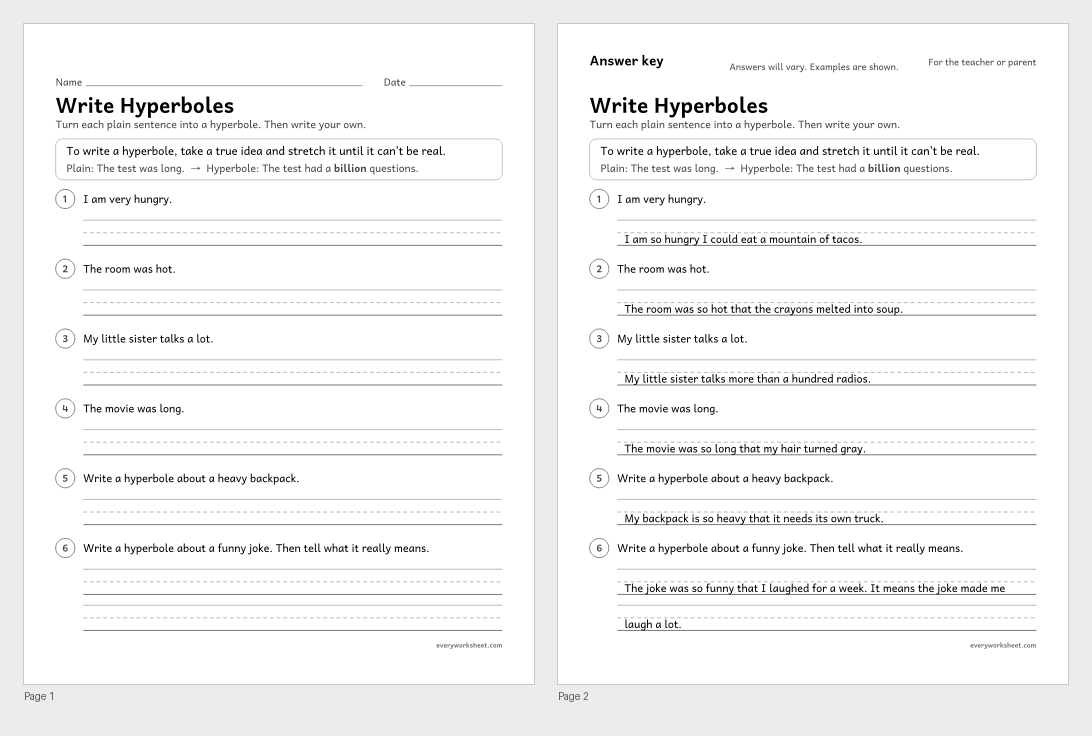
Knowing that a hyperbole is a huge exaggeration that is not meant literally
1 page39 KB
Spot, explain, and write hyperboles, with a chart, practice pages, and an original tall tale.
View largerKnowing that a hyperbole is a huge exaggeration that is not meant literally
1 page39 KB
 View all 2 pages
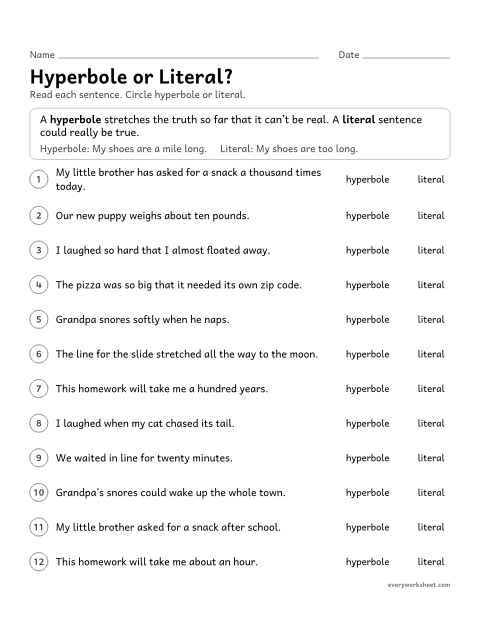
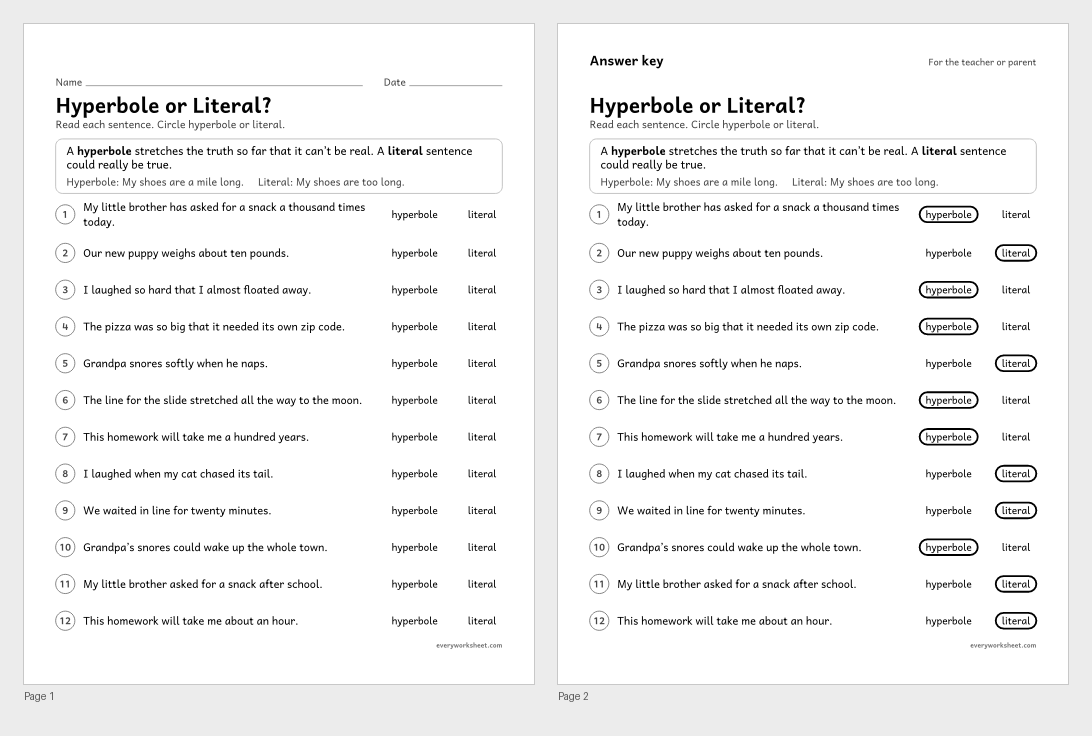
Telling hyperbole from literal statements
Answer key on page 2
2 pages55 KB
 View all 2 pages
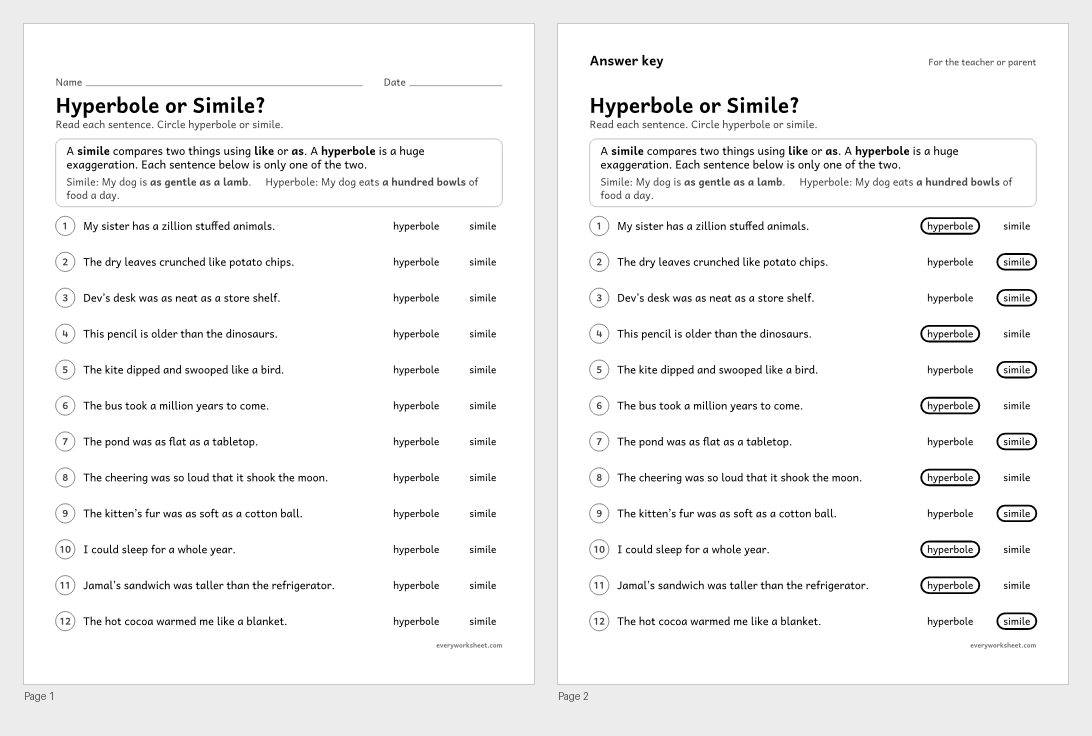
Telling hyperbole (exaggeration) from simile (comparison with like or as)
Answer key on page 2
2 pages57 KB
 View all 2 pages
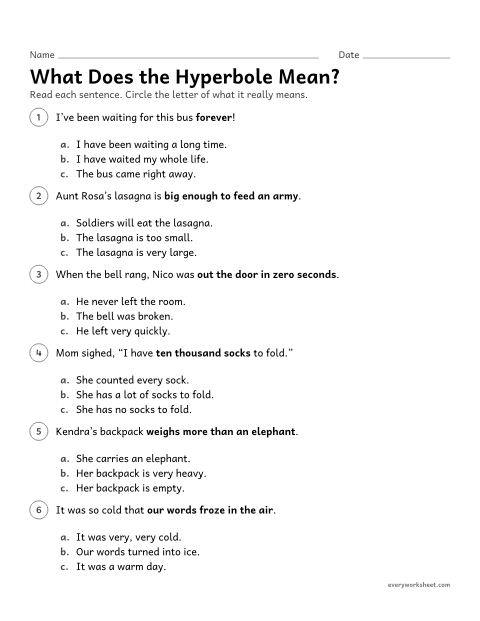
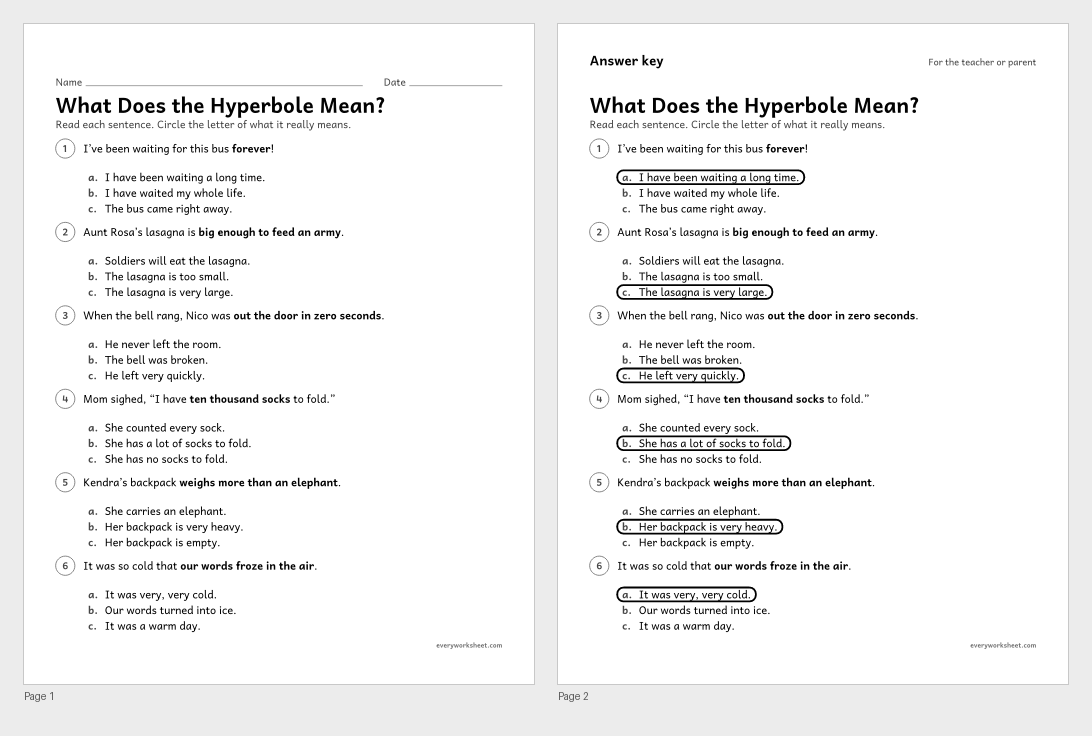
Explaining what a hyperbole really means
Answer key on page 2
2 pages62 KB
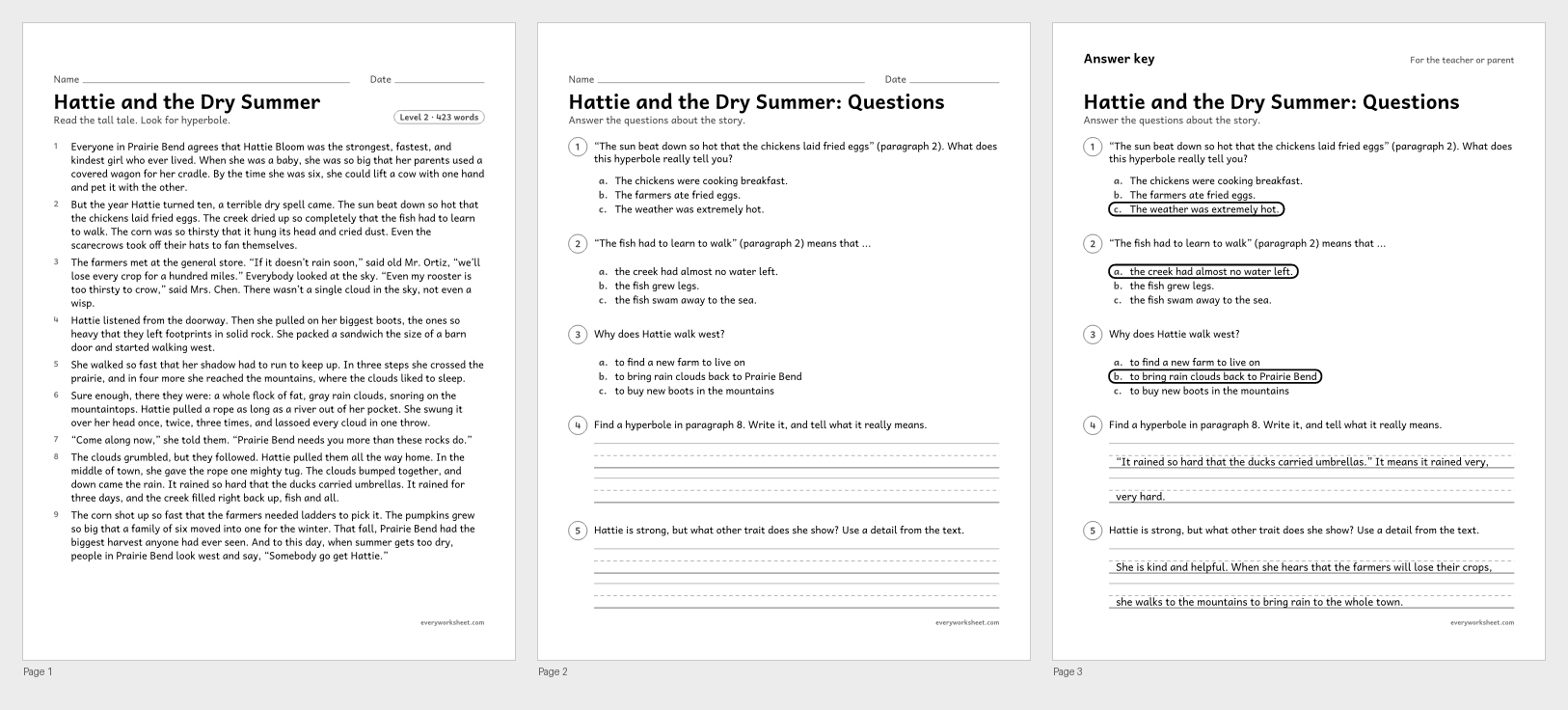 3 pagesView all 3 pages
Explaining hyperbole in an original tall tale
Answer key on page 3
3 pages58 KB
Print at 100% (actual size) for the cleanest tracing lines.
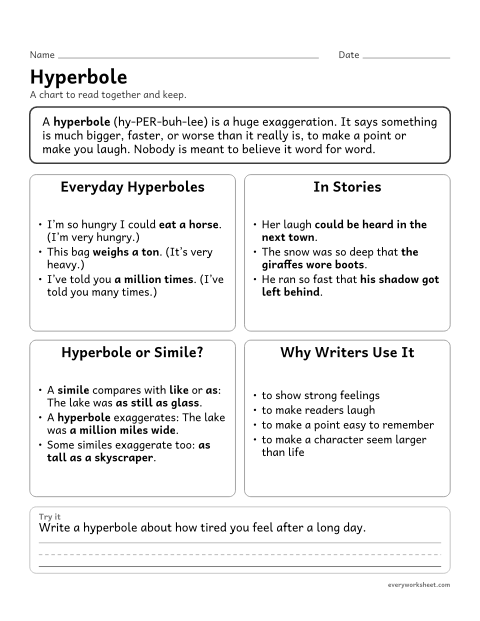
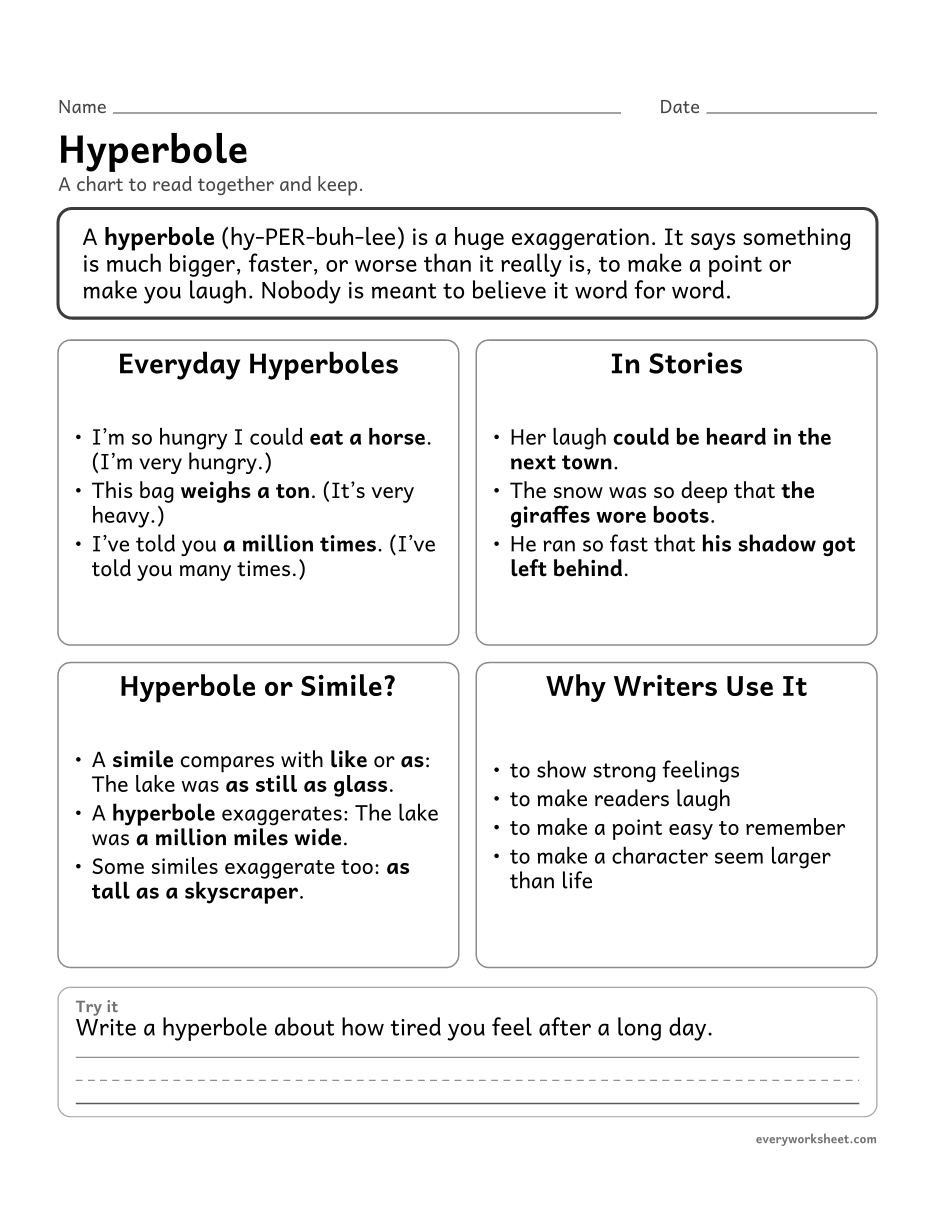
A hyperbole (say it hy-PER-buh-lee) is a huge exaggeration that is not meant to be taken literally. "I'm so hungry I could eat a horse" means "I'm very hungry." "This bag weighs a ton" means it is very heavy. "I've told you a million times" means "I've told you many times." The speaker knows it isn't true, and so does the listener.
A good test: could the sentence really be true? "We waited in line for twenty minutes" could be true, so it is literal. "The line stretched all the way to the moon" could never be true, so it is a hyperbole. The exaggeration is the point. It shows how strongly the speaker feels.
Hyperbole is often confused with a simile. A simile compares two things using like or as ("the pond was as flat as a tabletop"). A hyperbole exaggerates ("the pond was a million miles wide"). Some similes exaggerate too, such as "as tall as a skyscraper," so they are both at once. Hyperbole is the heart of tall tales, where heroes are bigger, stronger, and faster than anyone could really be.
Writers use hyperbole to show strong feelings, to make readers laugh, and to make a point easy to remember. These worksheets include a chart, hyperbole or literal, what each hyperbole really means, hyperbole vs. simile, writing your own, and an original tall tale about a girl who lassoes rain clouds.
CCSS.ELA-LITERACY.RL.4.4Determine the meaning of words and phrases as they are used in a text, including those that allude to significant characters found in mythology (e.g., Herculean).CCSS.ELA-LITERACY.L.4.3.AChoose words and phrases to convey ideas precisely.CCSS.ELA-LITERACY.L.4.5Demonstrate understanding of figurative language, word relationships, and nuances in word meanings.A hyperbole is an extreme exaggeration used for effect. "My backpack weighs more than an elephant" means the backpack is very heavy.
"This homework will take me a hundred years," "Grandpa's snores could wake up the whole town," and "It was so cold that our words froze in the air" are all hyperboles.
Say it hy-PER-buh-lee, with four syllables and the stress on PER. It does not rhyme with "bowl."
A simile compares two things using like or as: "The kitten's fur was as soft as a cotton ball." A hyperbole exaggerates: "I could sleep for a whole year." A simile that also exaggerates, like "as tall as a skyscraper," is both.
Writers use hyperbole to show strong feelings, to add humor, to make a point stick, and to make characters seem larger than life, as in tall tales.