 View larger
Multiplying fractions
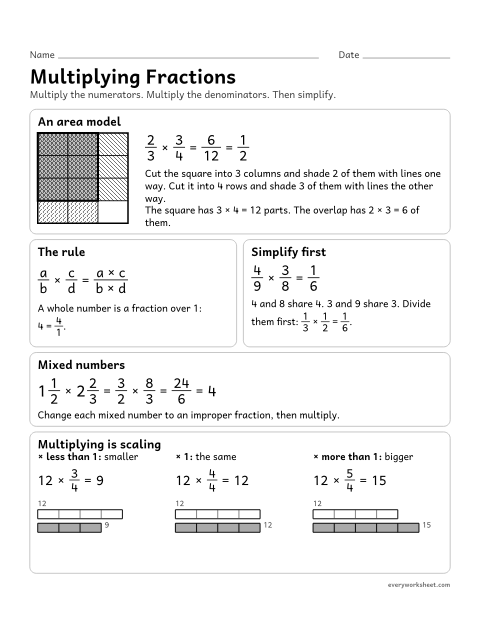
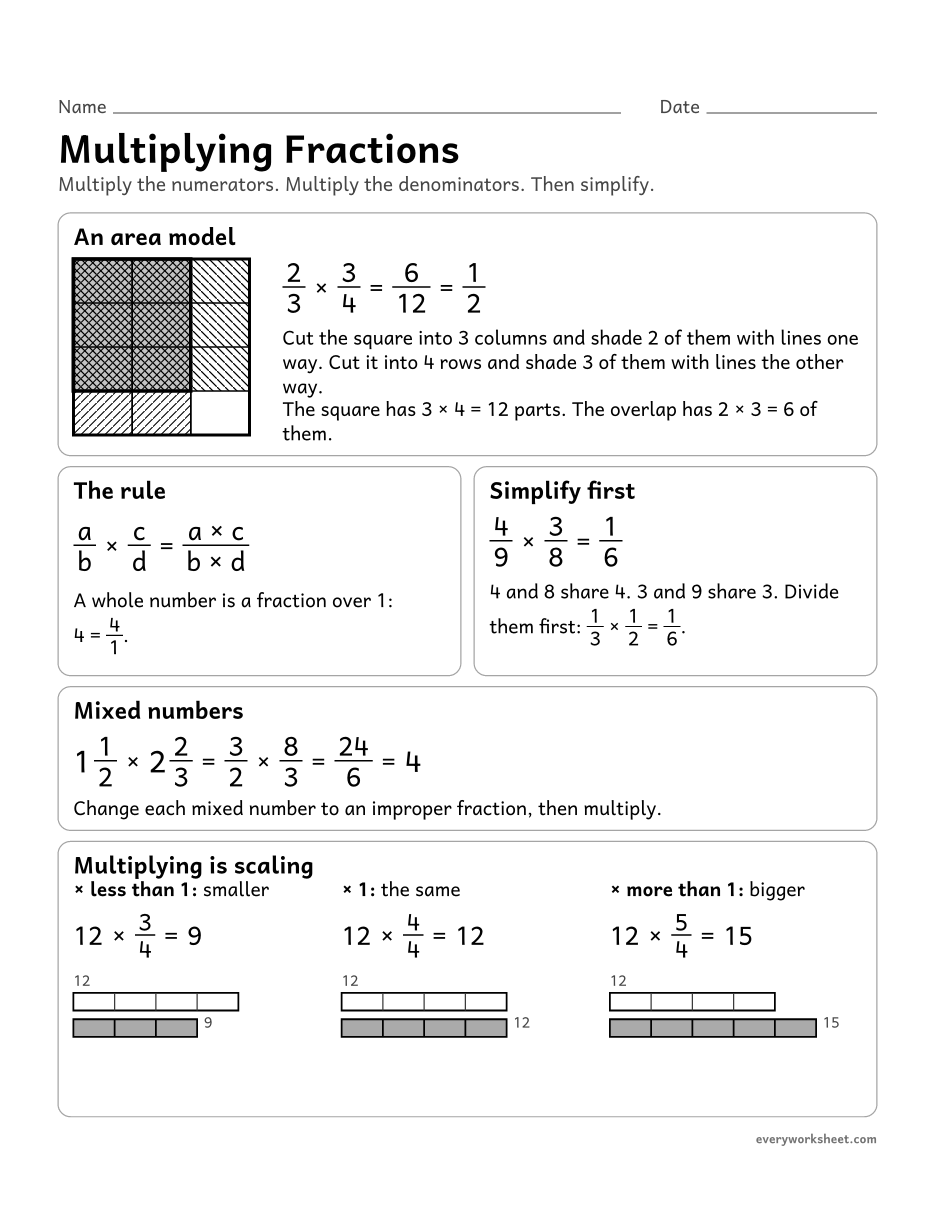
Multiplying fractions with groups and area models, the rule (a/b) × (c/d) = (a × c)/(b × d), mixed numbers and scaling
1 page34 KB
A multiplying fractions chart, area models, fractions of whole numbers, fraction side lengths, mixed numbers, scaling and word problems. With answer keys.
View largerMultiplying fractions with groups and area models, the rule (a/b) × (c/d) = (a × c)/(b × d), mixed numbers and scaling
1 page34 KB
 View all 2 pages
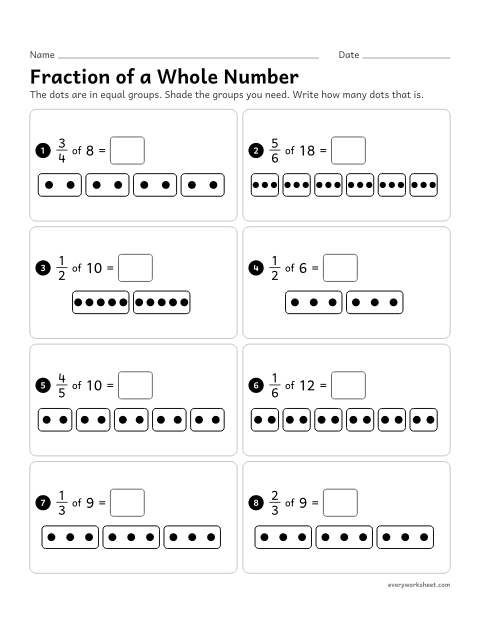
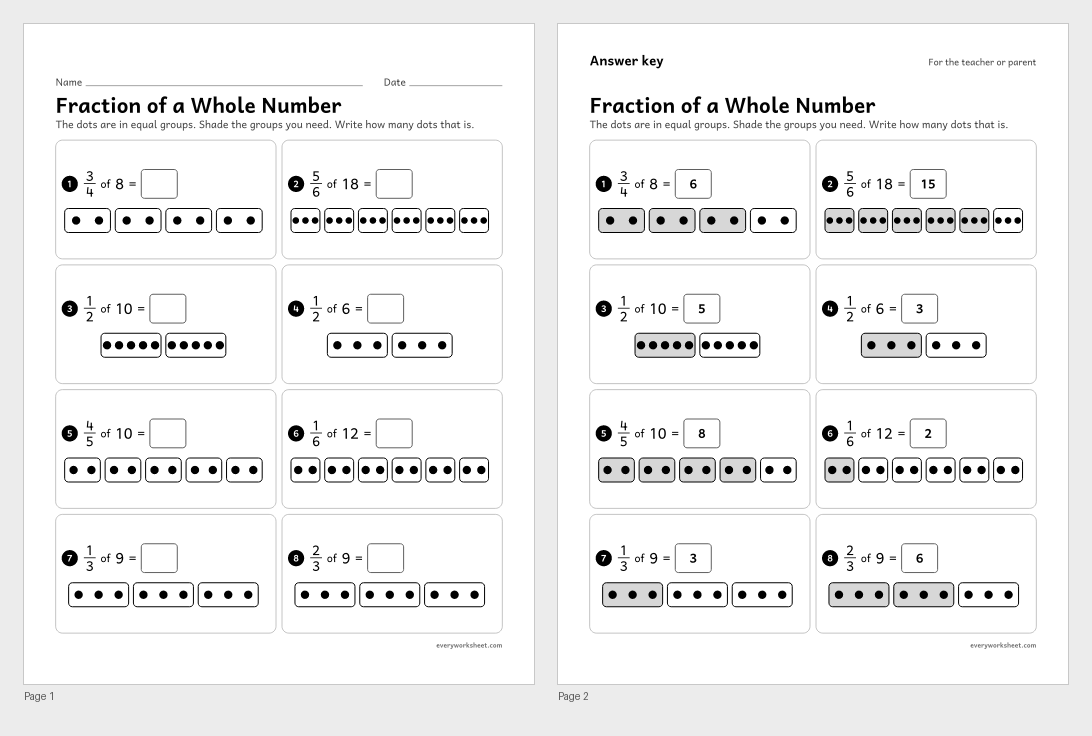
Finding a/b of a whole number by cutting it into b equal groups and taking a of them
Answer key on page 2
2 pages44 KB
 View all 2 pages
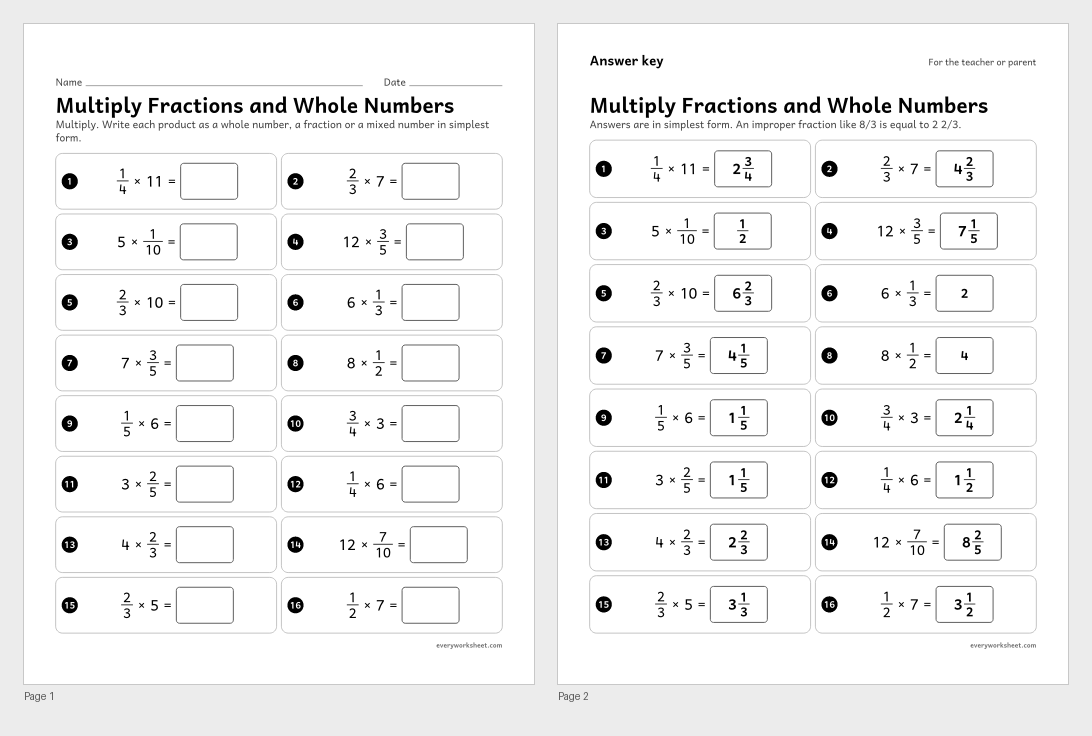
Multiplying a fraction by a whole number as a × q ÷ b, with products as whole numbers, fractions or mixed numbers
Answer key on page 2
2 pages56 KB
 View all 2 pages
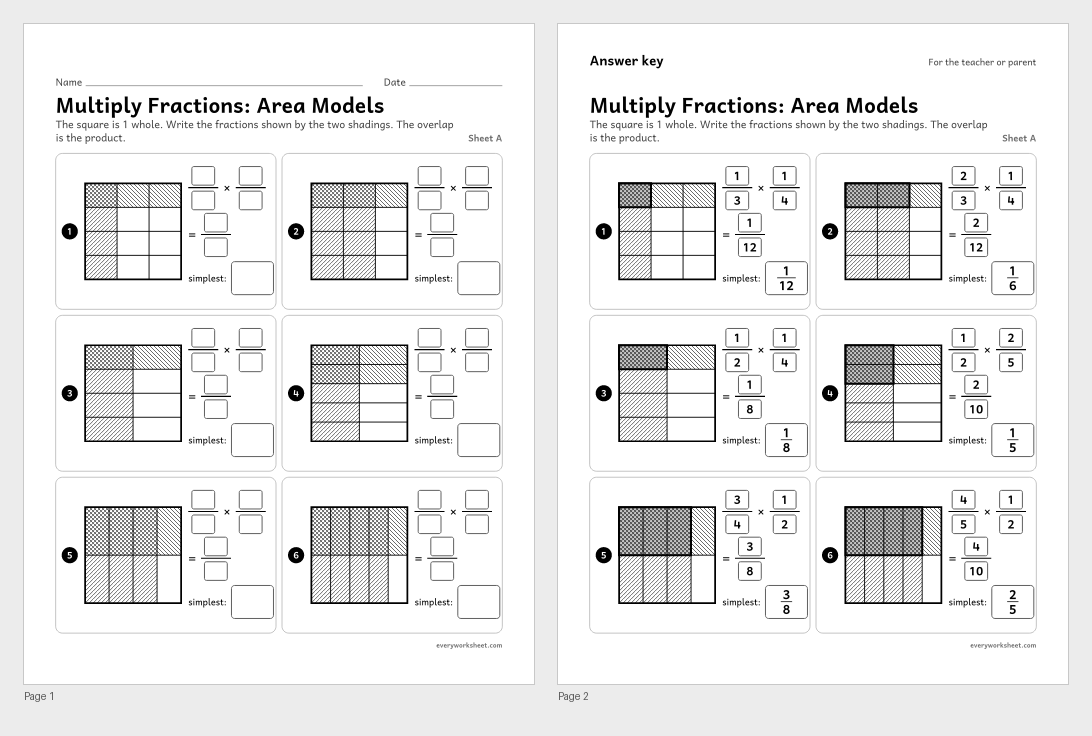
Reading an area model: the overlap of a/b of the columns and c/d of the rows is (a × c)/(b × d) of the square
Answer key on page 2
2 pages46 KB
 View all 2 pages
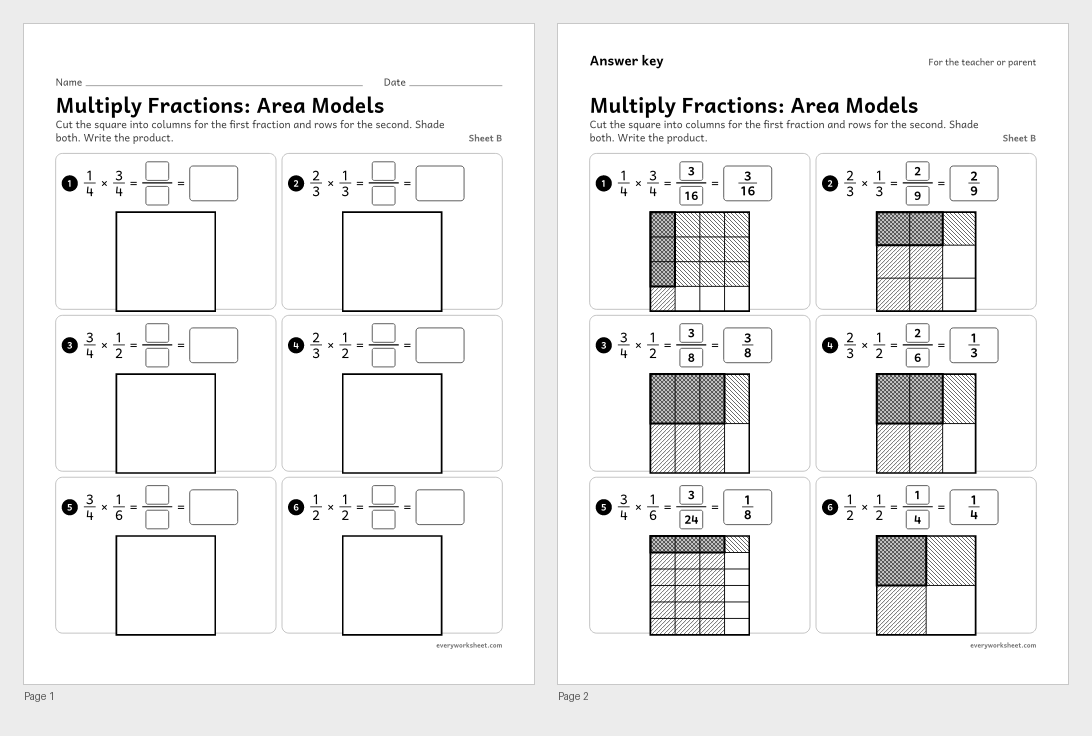
Drawing area models on a unit square to multiply two fractions, then writing the product
Answer key on page 2
2 pages45 KB
 View all 2 pages
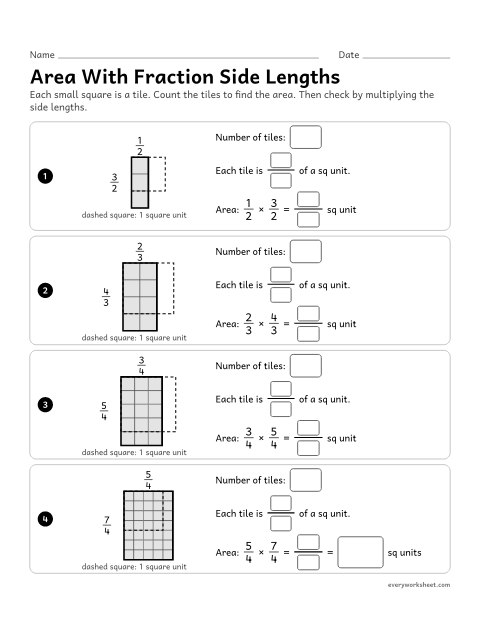
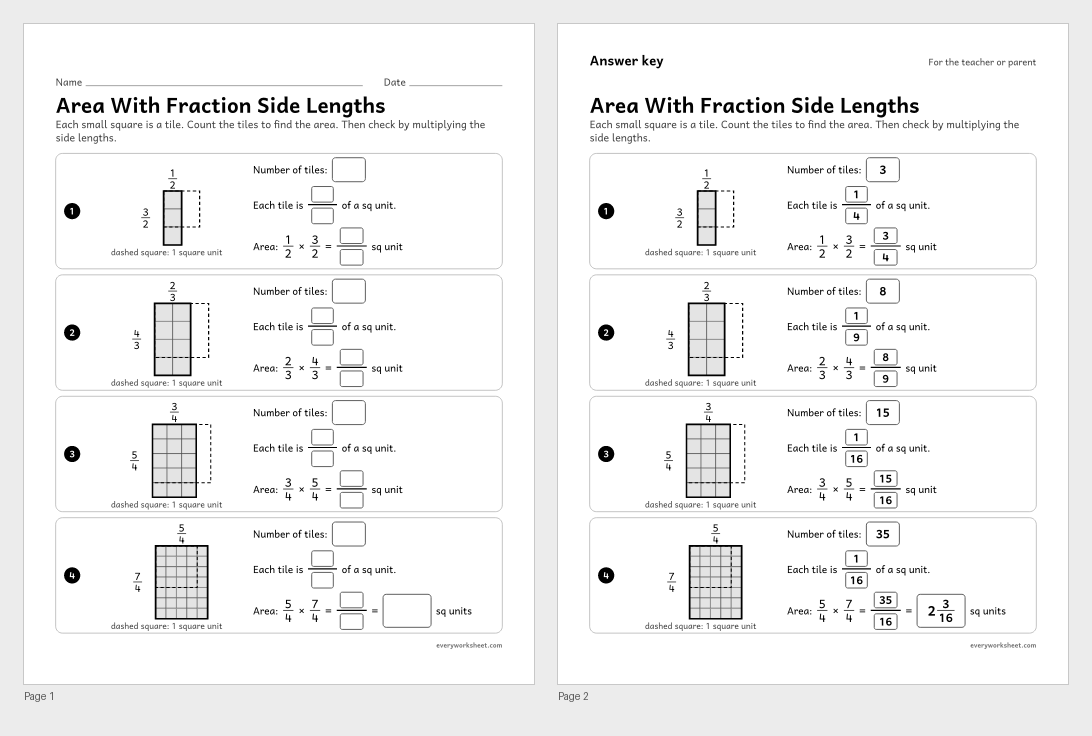
Tiling a rectangle with fraction side lengths using small unit-fraction squares, and checking by multiplying the side lengths
Answer key on page 2
2 pages41 KB
 View all 2 pages
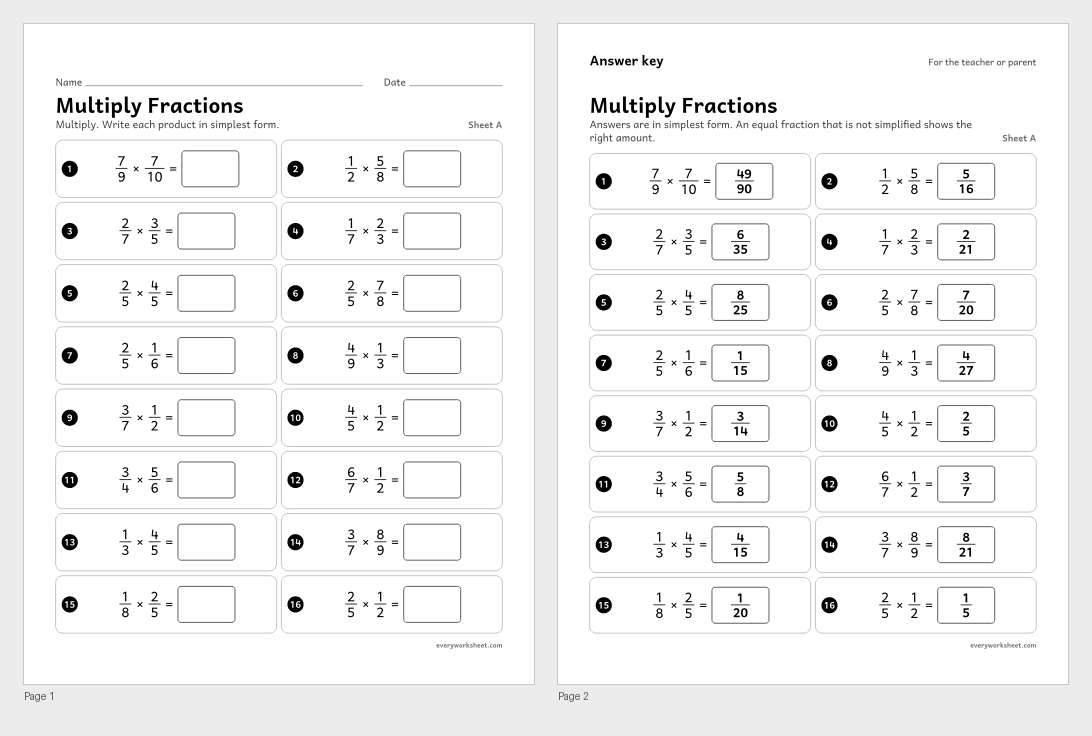
Multiplying two fractions less than 1: multiply the numerators, multiply the denominators, simplify
Answer key on page 2
2 pages56 KB
 View all 2 pages
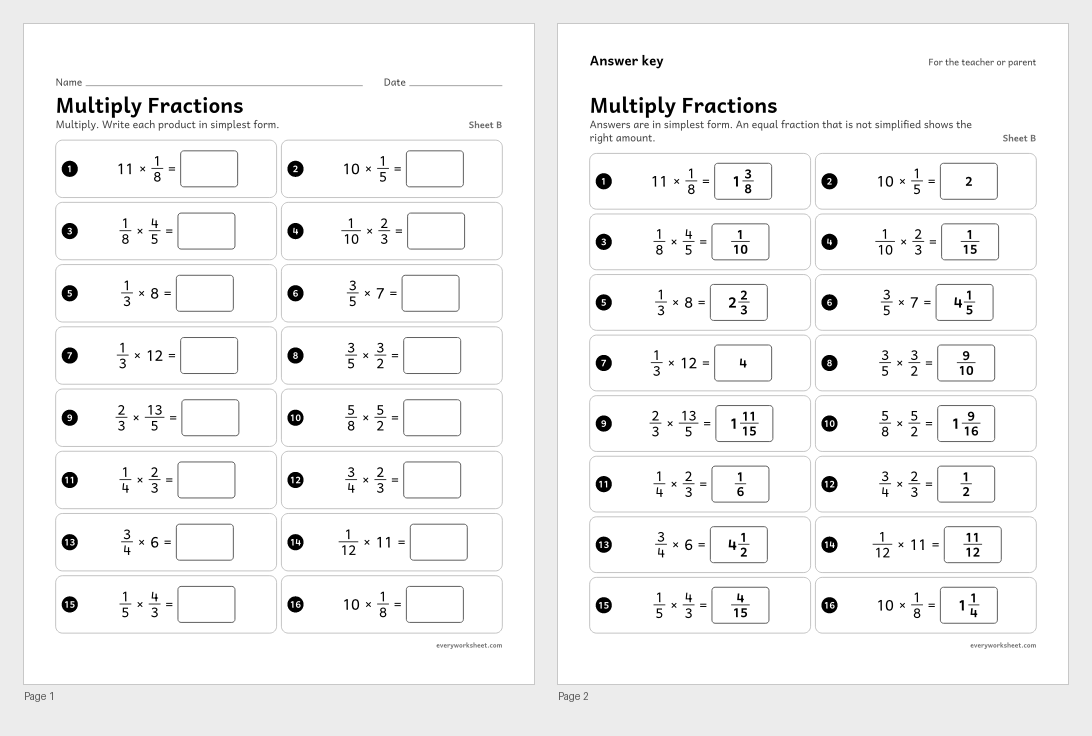
Multiplying fractions, whole numbers and fractions greater than 1, simplifying before or after multiplying
Answer key on page 2
2 pages56 KB
 View all 2 pages
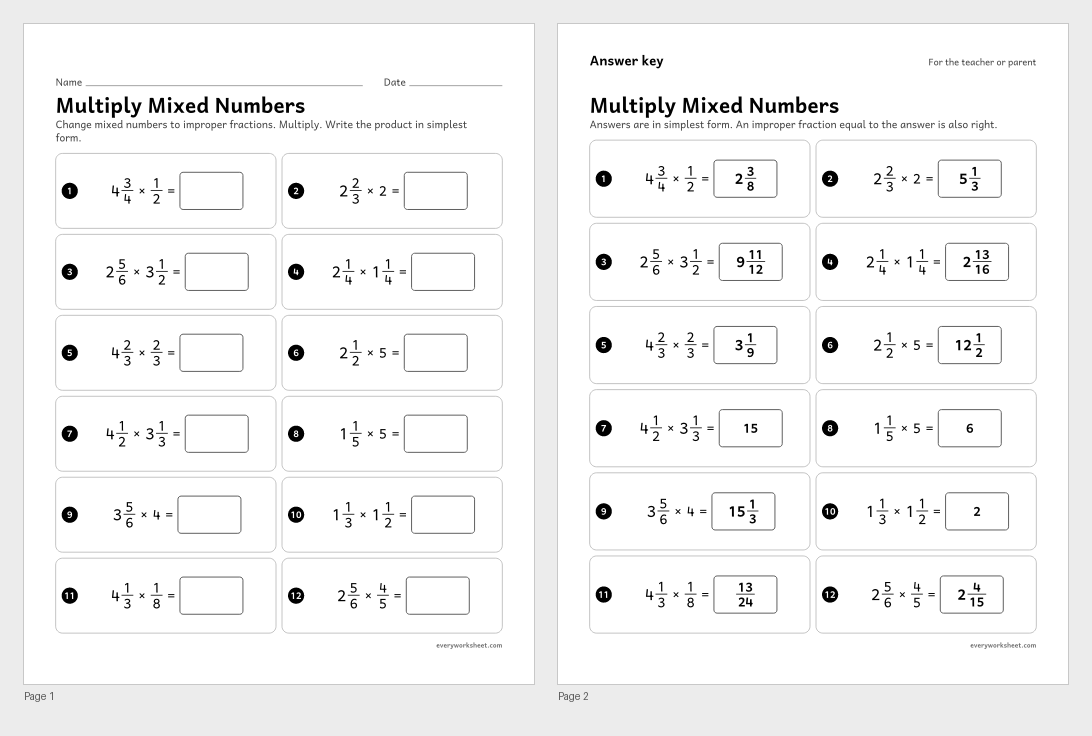
Multiplying mixed numbers by whole numbers, fractions and mixed numbers by changing them to improper fractions first
Answer key on page 2
2 pages50 KB
 View all 2 pages
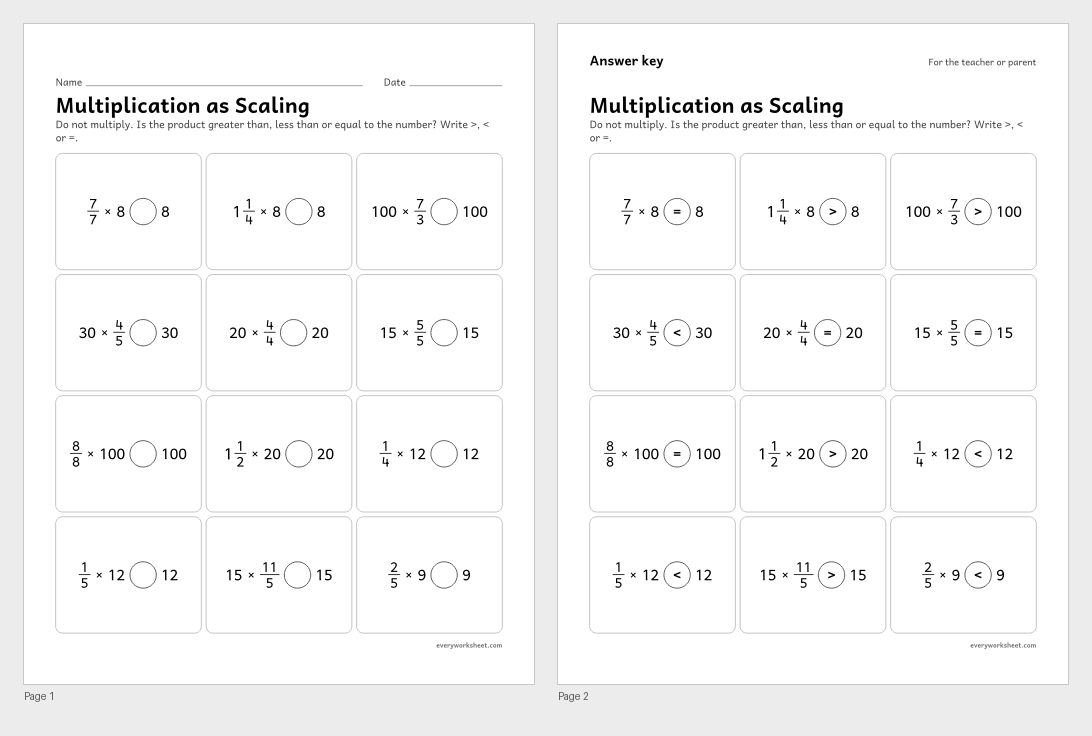
Deciding without multiplying whether a product is greater than, less than or equal to a number, from the size of the fraction
Answer key on page 2
2 pages37 KB
 View all 2 pages
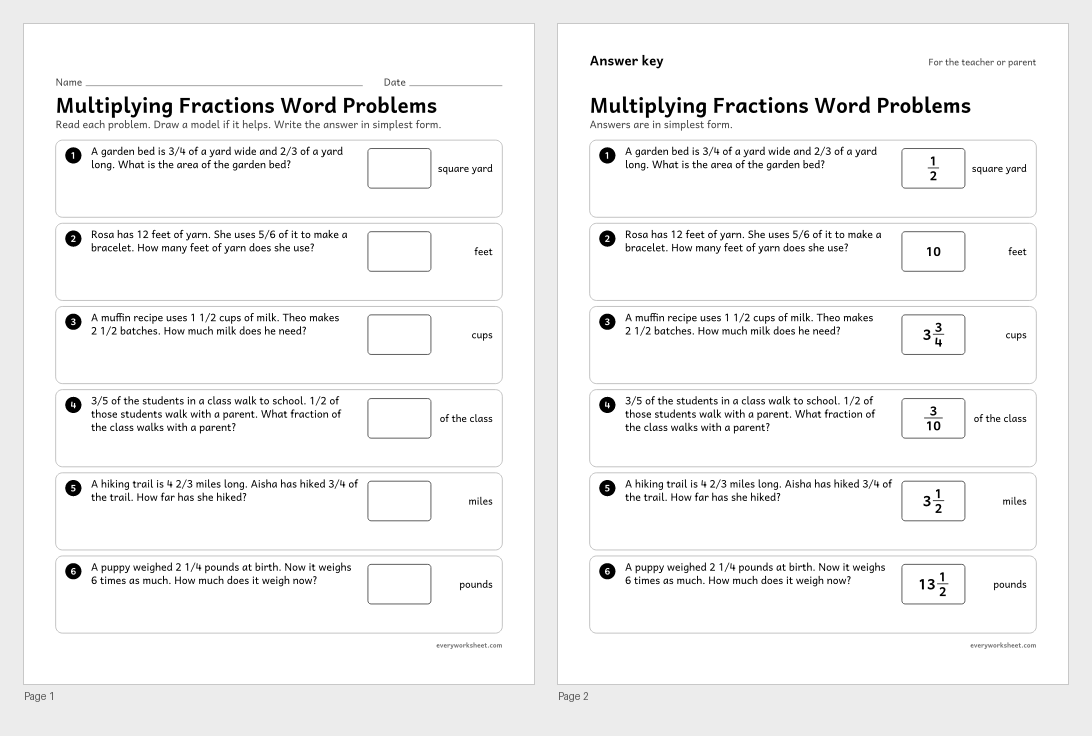
Solving real-world problems that multiply fractions, whole numbers and mixed numbers
Answer key on page 2
2 pages42 KB
Print at 100% (actual size) for the cleanest tracing lines.
To multiply fractions, multiply the numerators and multiply the denominators: 2/3 × 3/4 = 6/12, which simplifies to 1/2. An area model shows why. Cut a square into 3 columns and shade 2 of them, then cut it into 4 rows and shade 3 of them. The square now has 3 × 4 = 12 parts, and the overlap has 2 × 3 = 6 of them.
A fraction of a whole number works the same way: 2/3 of 12 means cut 12 into 3 equal groups and take 2 of them, which is 8. To multiply mixed numbers, change them to improper fractions first: 1 1/2 × 2 2/3 = 3/2 × 8/3 = 4. Multiplying by a fraction less than 1 makes a number smaller, and multiplying by a fraction greater than 1 makes it bigger.
These worksheets start with the chart and visual models, then move to area models, rectangles with fraction side lengths, practice with fractions, whole numbers and mixed numbers, multiplication as scaling and word problems. Every practice page has an answer key with answers in simplest form.
CCSS.MATH.CONTENT.5.NF.B.4.AInterpret the product (a/b) × q as a parts of a partition of q into b equal parts; equivalently, as the result of a sequence of operations a × q ÷ b. For example, use a visual fraction model to show (2/3) × 4 = 8/3, and create a story context for this equation. Do the same with (2/3) × (4/5) = 8/15. (In general, (a/b) × (c/d) = ac/bd.)CCSS.MATH.CONTENT.5.NF.B.4.BFind the area of a rectangle with fractional side lengths by tiling it with unit squares of the appropriate unit fraction side lengths, and show that the area is the same as would be found by multiplying the side lengths. Multiply fractional side lengths to find areas of rectangles, and represent fraction products as rectangular areas.CCSS.MATH.CONTENT.5.NF.B.5.BExplaining why multiplying a given number by a fraction greater than 1 results in a product greater than the given number (recognizing multiplication by whole numbers greater than 1 as a familiar case); explaining why multiplying a given number by a fraction less than 1 results in a product smaller than the given number; and relating the principle of fraction equivalence a/b = (n × a)/(n × b) to the effect of multiplying a/b by 1.CCSS.MATH.CONTENT.5.NF.B.6Solve real world problems involving multiplication of fractions and mixed numbers, e.g., by using visual fraction models or equations to represent the problem.Multiply the numerators, multiply the denominators, then simplify. 3/4 × 2/5 = 6/20 = 3/10.
Multiplying by a fraction less than 1 takes only part of the number. 1/2 × 10 is half of 10, which is 5.