 View all 2 pages
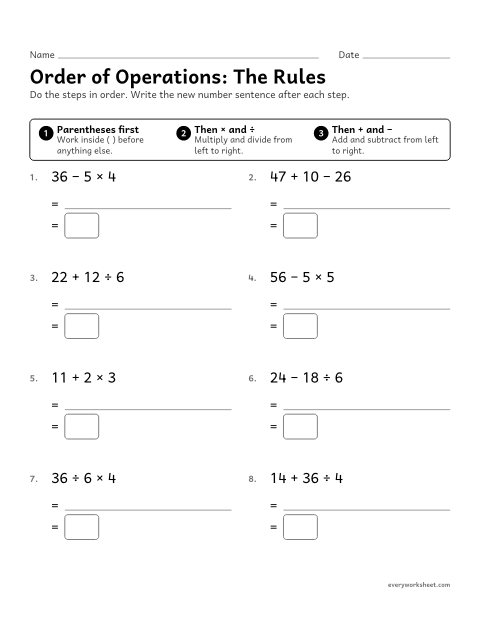
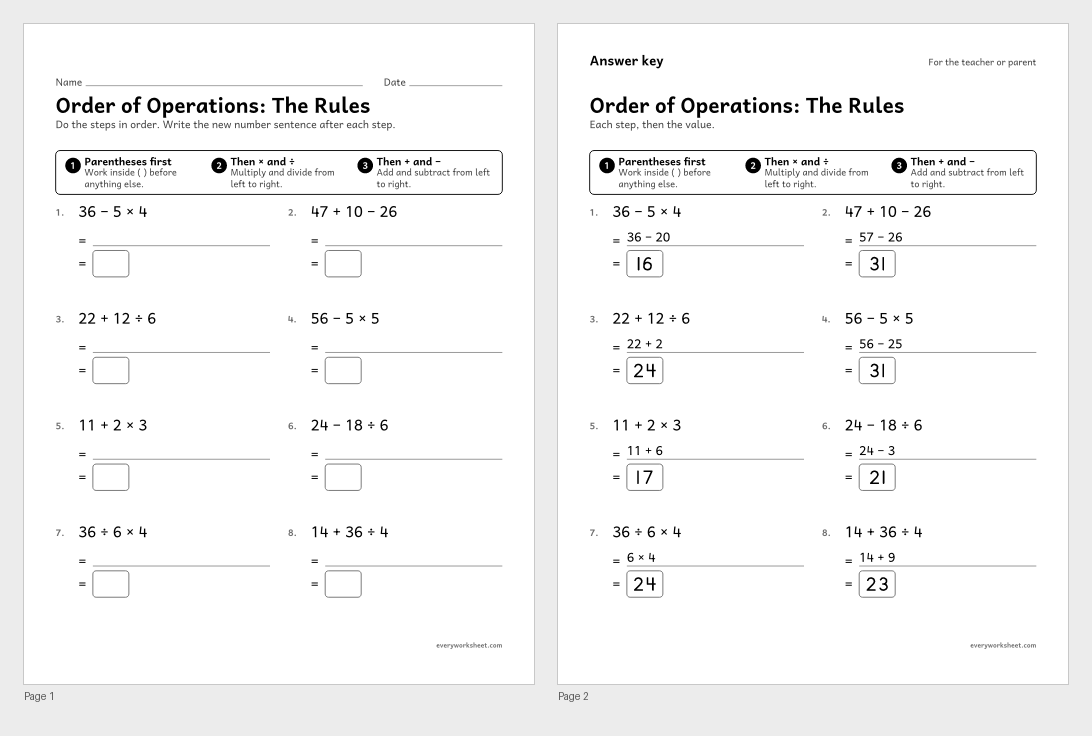
Order of Operations: the rules
Using the order of operations (no exponents)
Answer key on page 2
2 pages61 KB
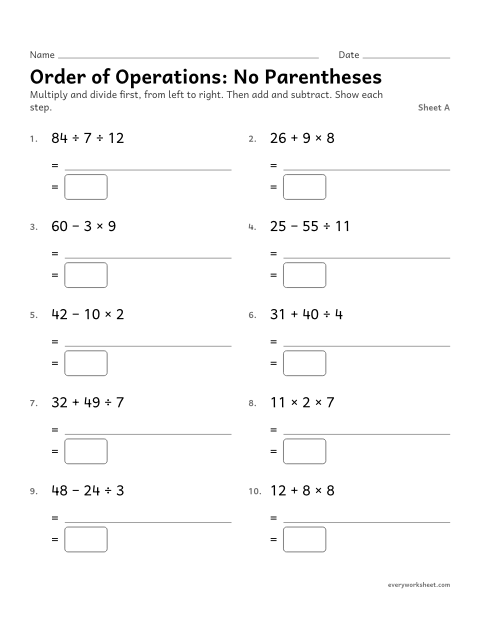
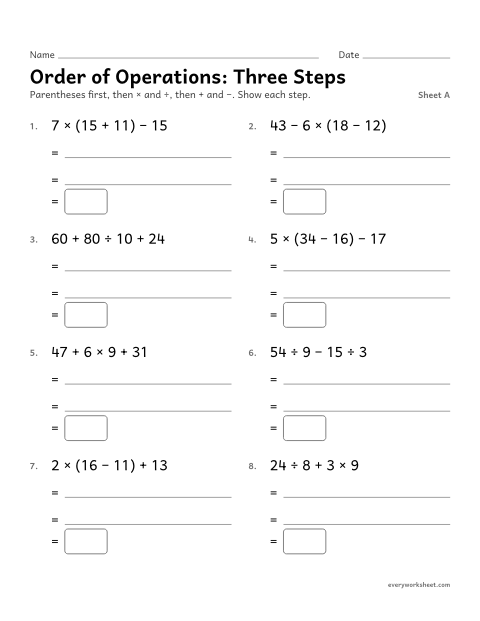
Order of operations without exponents: parentheses first, then multiply and divide, then add and subtract, with one line for each step and keys that show them.
View all 2 pagesUsing the order of operations (no exponents)
Answer key on page 2
2 pages61 KB
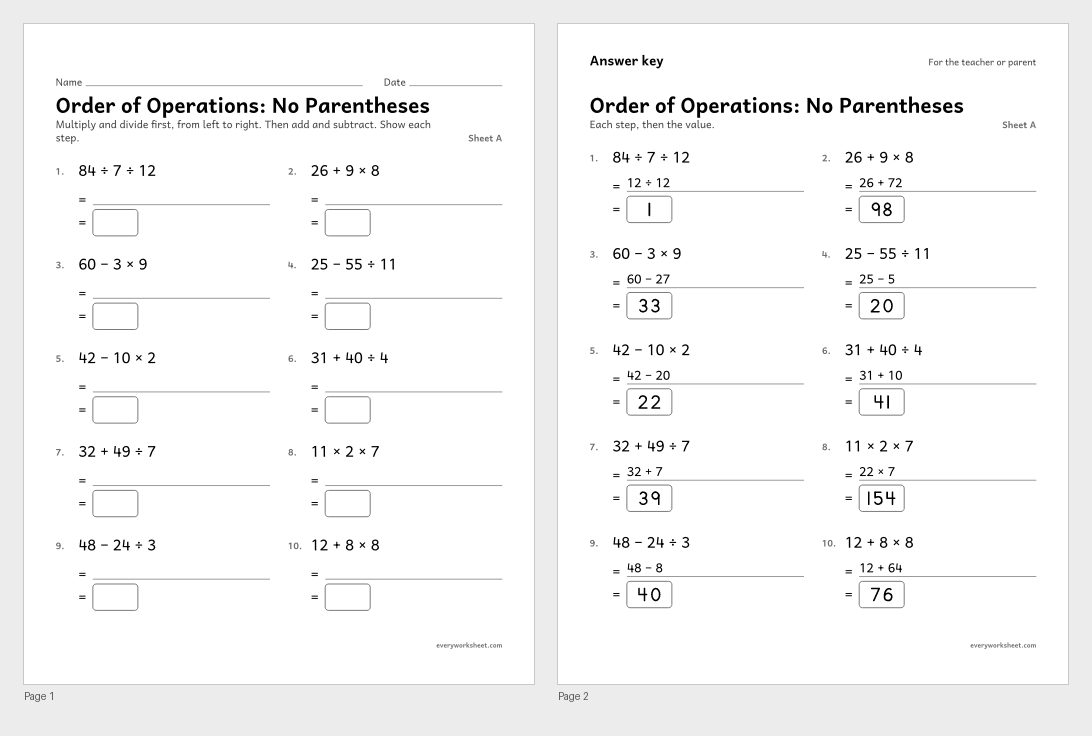 View all 2 pages
Order of operations with + − × ÷
Answer key on page 2
2 pages63 KB
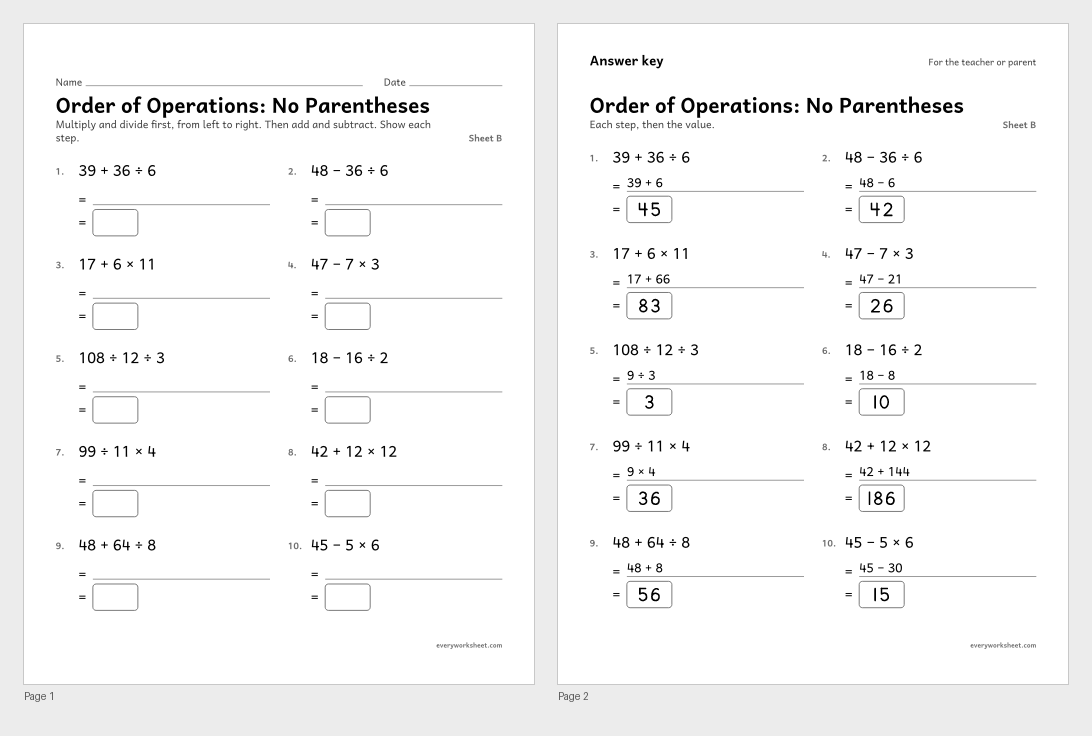 View all 2 pages
Order of operations with + − × ÷
Answer key on page 2
2 pages63 KB
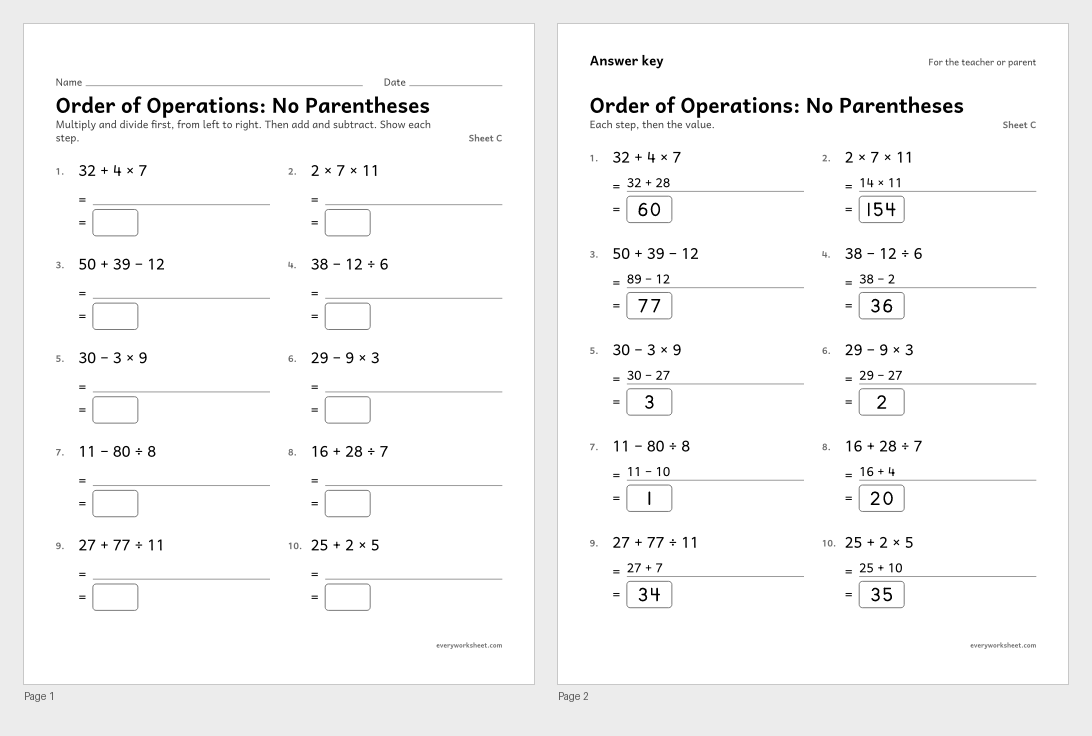 View all 2 pages
Order of operations with + − × ÷
Answer key on page 2
2 pages63 KB
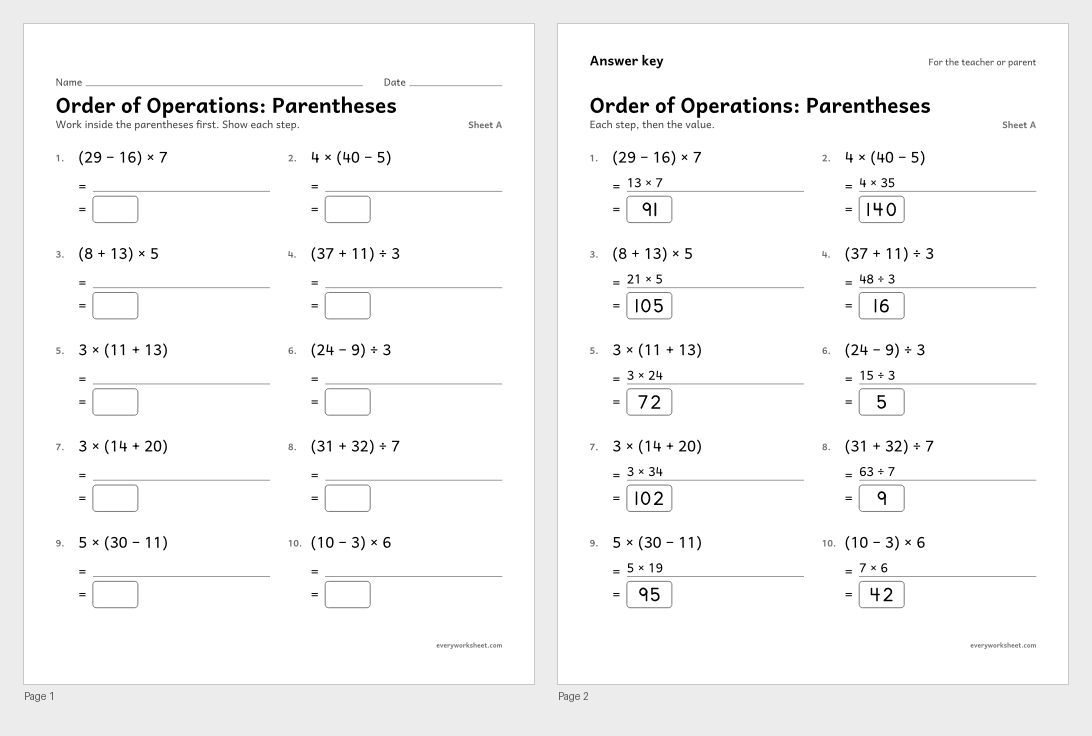 View all 2 pages
Order of operations with parentheses
Answer key on page 2
2 pages62 KB
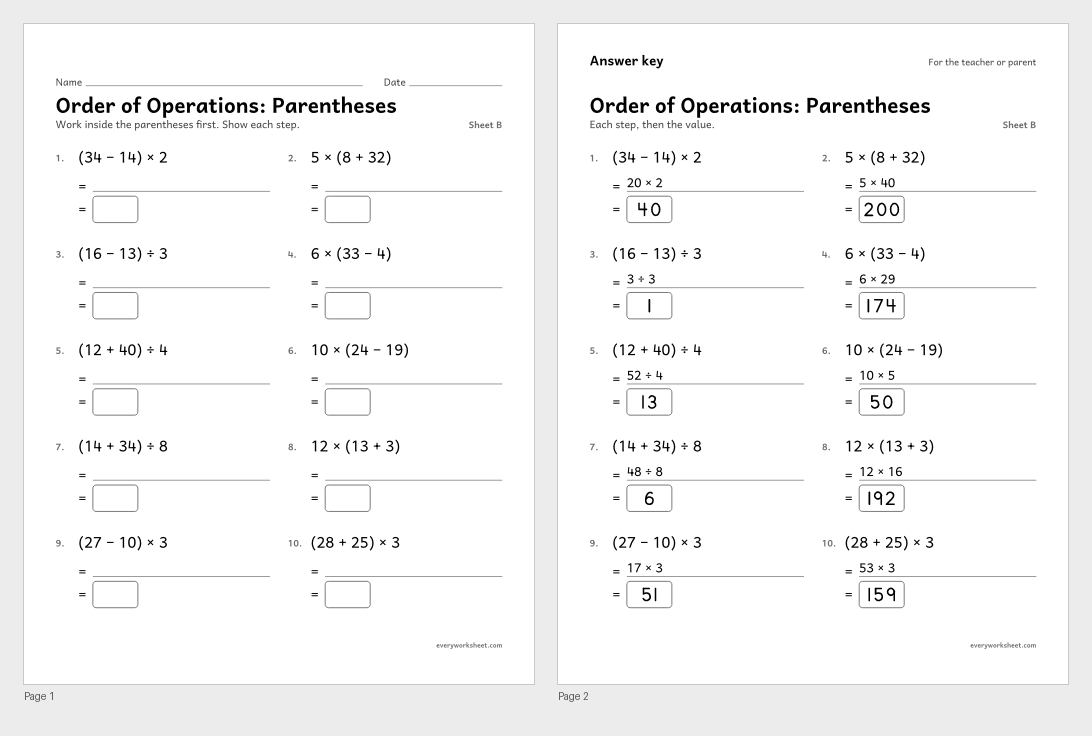 View all 2 pages
Order of operations with parentheses
Answer key on page 2
2 pages62 KB
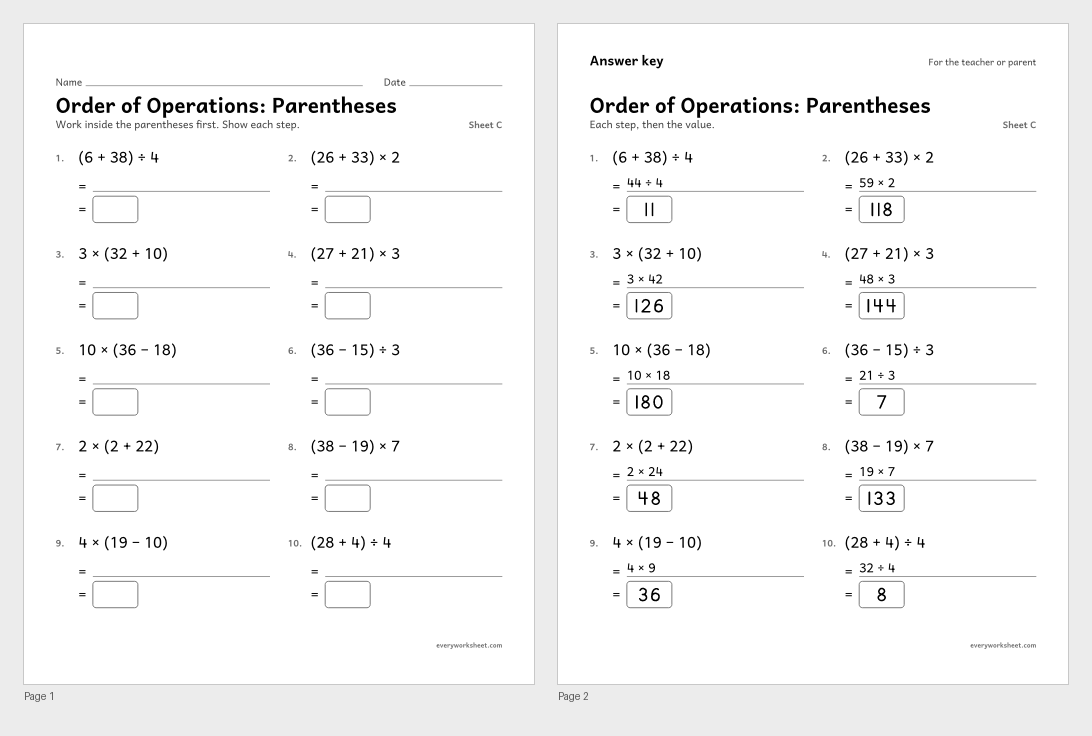 View all 2 pages
Order of operations with parentheses
Answer key on page 2
2 pages62 KB
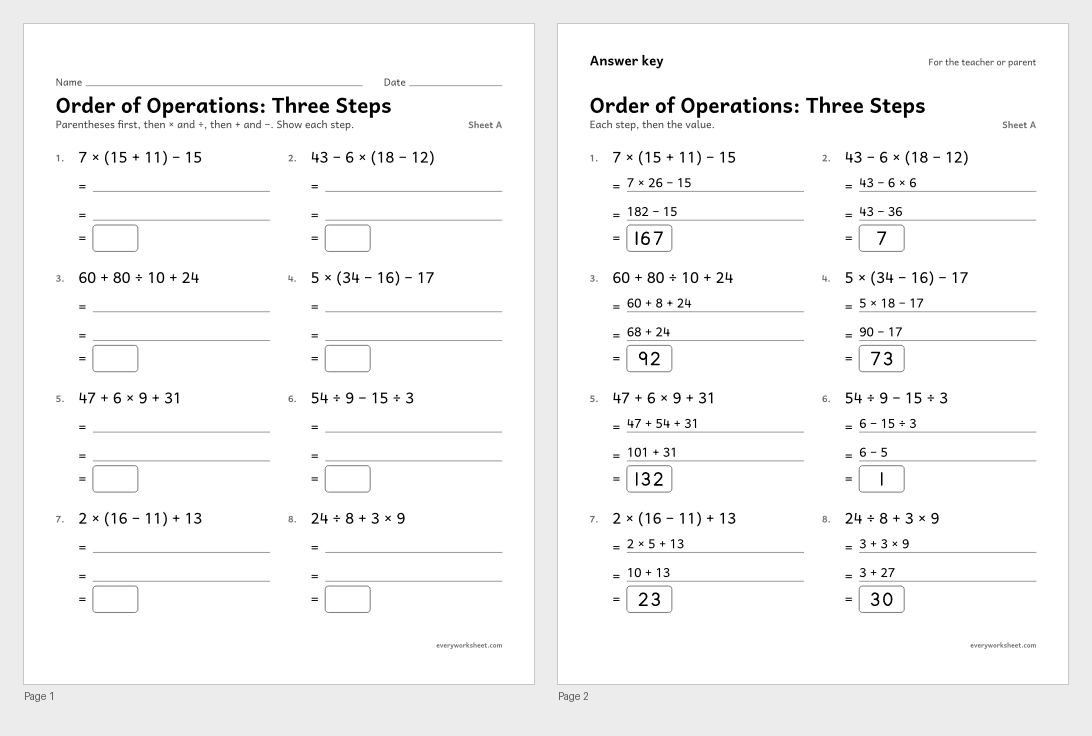 View all 2 pages
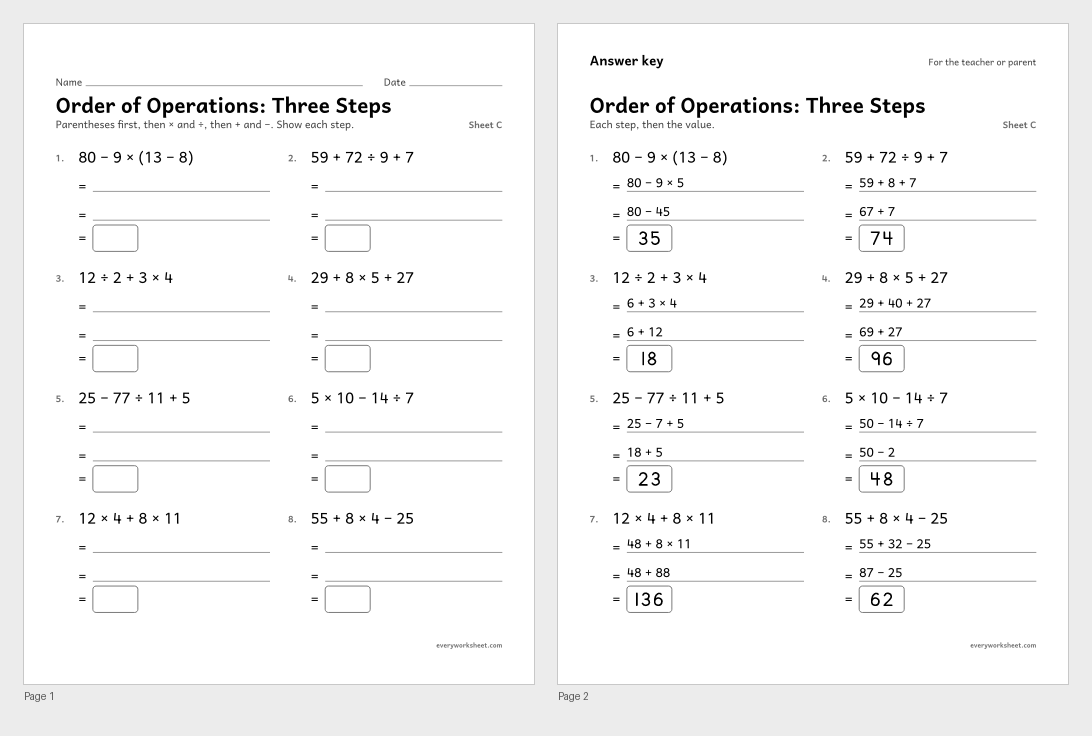
Order of operations with three operations
Answer key on page 2
2 pages63 KB
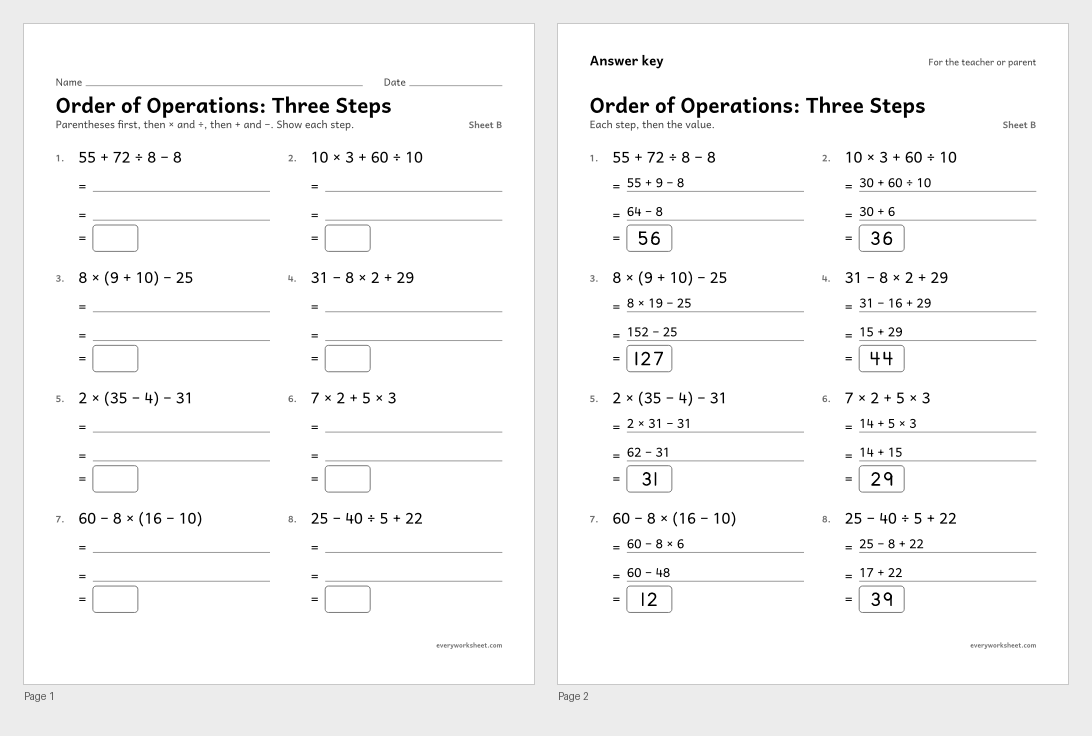 View all 2 pages
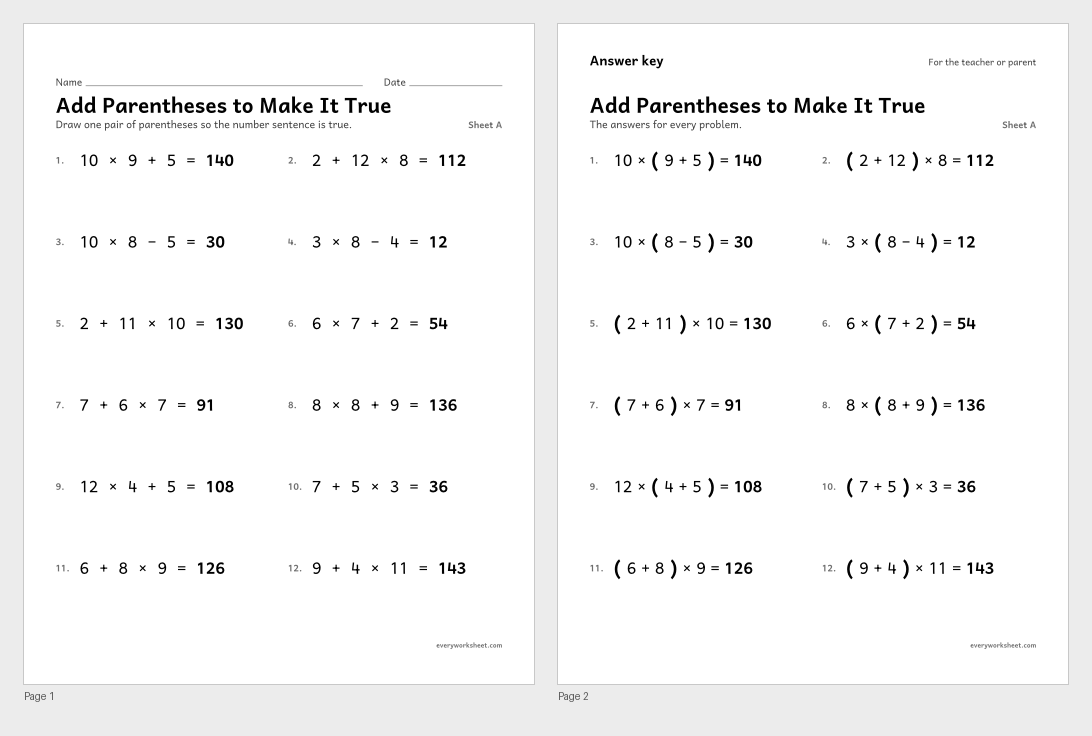
Order of operations with three operations
Answer key on page 2
2 pages63 KB
 View all 2 pages
Order of operations with three operations
Answer key on page 2
2 pages63 KB
 View all 2 pages
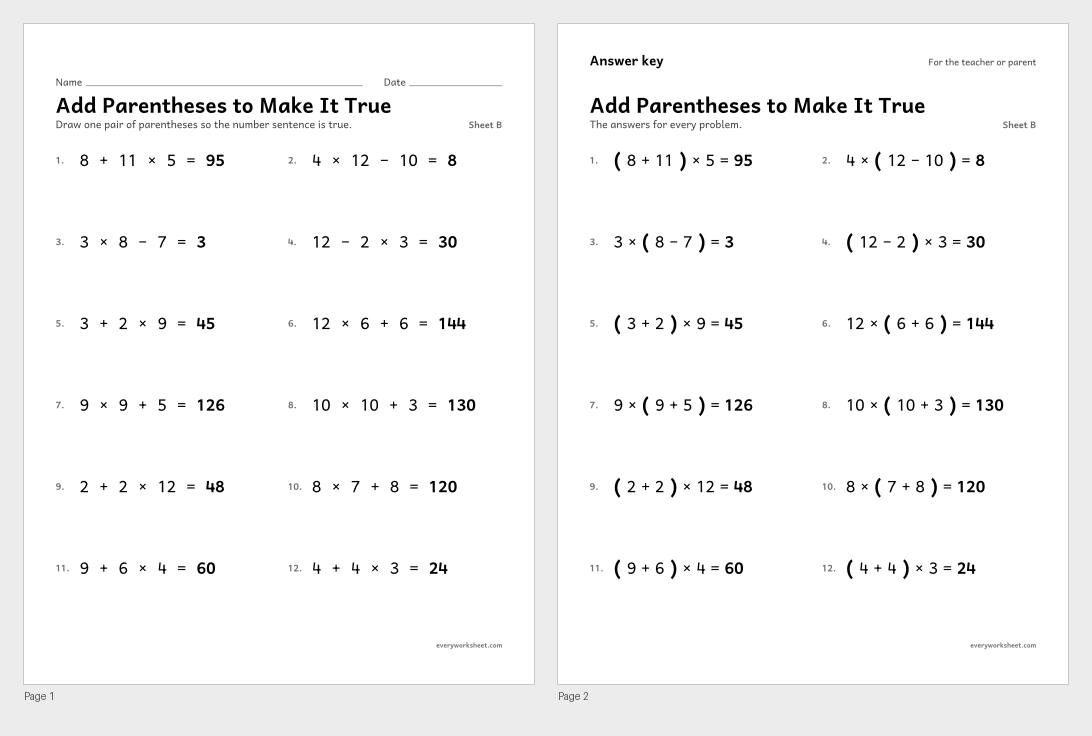
Placing parentheses to make an equation true
Answer key on page 2
2 pages88 KB
 View all 2 pages
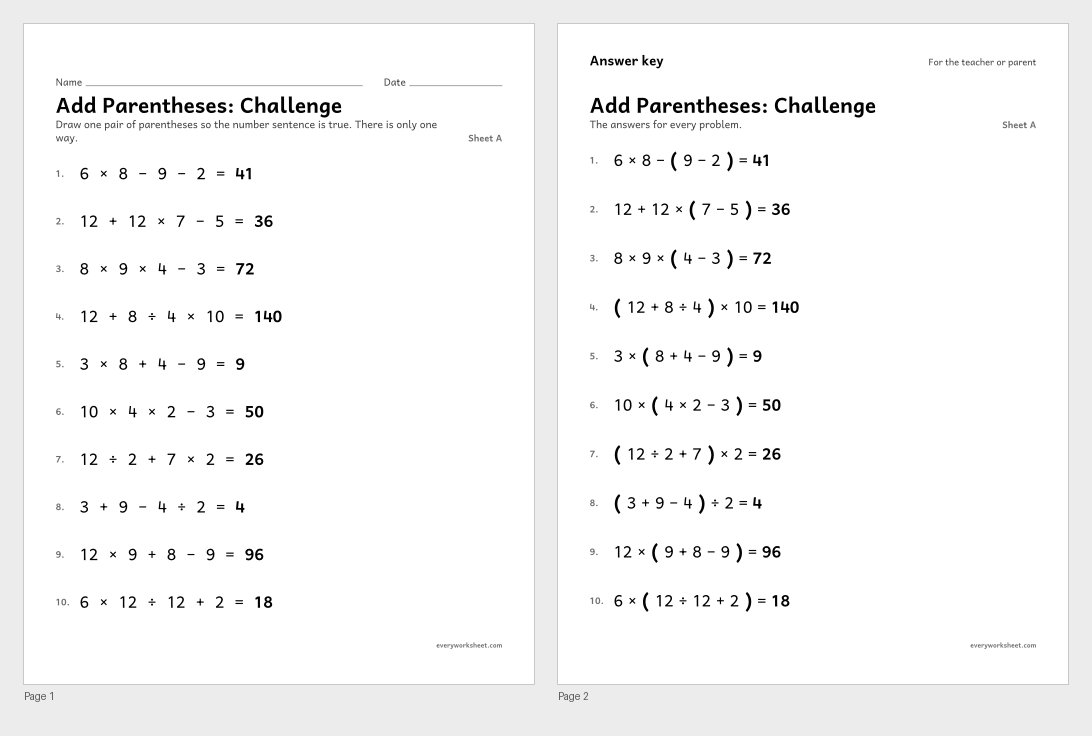
Placing parentheses to make an equation true
Answer key on page 2
2 pages88 KB
 View all 2 pages
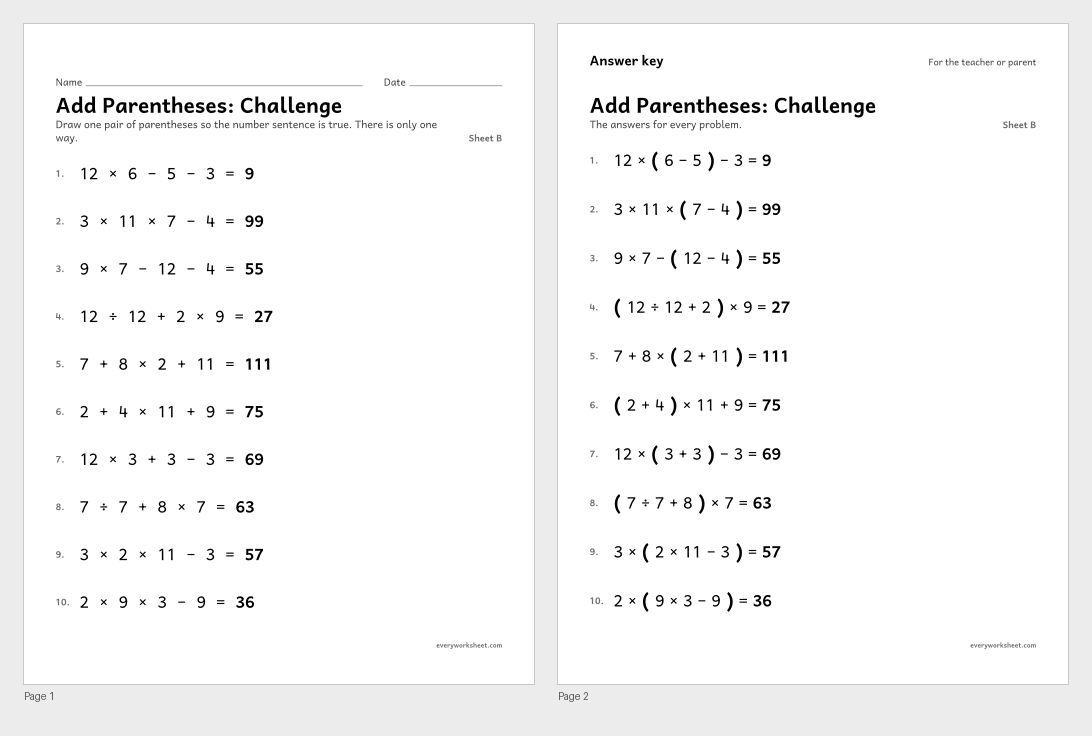
Placing parentheses in a four-number expression
Answer key on page 2
2 pages88 KB
 View all 2 pages
Placing parentheses in a four-number expression
Answer key on page 2
2 pages88 KB
Print at 100% (actual size) for the cleanest tracing lines.
When a number sentence has more than one operation, everyone has to do the steps in the same order, or the same problem gets different answers. The rule has three parts. Work inside parentheses first. Then multiply and divide, from left to right. Then add and subtract, from left to right. So 3 + 4 × 2 is 3 + 8 = 11, but (3 + 4) × 2 is 7 × 2 = 14.
These pages are written for upper elementary, with whole numbers and no exponents. Children rewrite the number sentence after every step, so each line has one operation fewer than the line before, and the answer key shows every step. That makes it easy to see where an answer went wrong.
The pages go from two operations without parentheses, to parentheses, to three-step problems. The add-the-parentheses puzzles turn the rule around: children decide where the parentheses must go to make a number sentence true.
CCSS.MATH.CONTENT.4.OA.A.3Solve multistep word problems posed with whole numbers and having whole-number answers using the four operations, including problems in which remainders must be interpreted. Represent these problems using equations with a letter standing for the unknown quantity. Assess the reasonableness of answers using mental computation and estimation strategies including rounding.Work inside parentheses first, then multiply and divide from left to right, then add and subtract from left to right.
No. Multiplication and division have the same rank, so you do whichever comes first reading from the left. The same is true of addition and subtraction.
No. They are written for 4th and 5th grade, with whole numbers, the four operations and parentheses only.