 View all 2 pages
Prime Factorization Worksheets
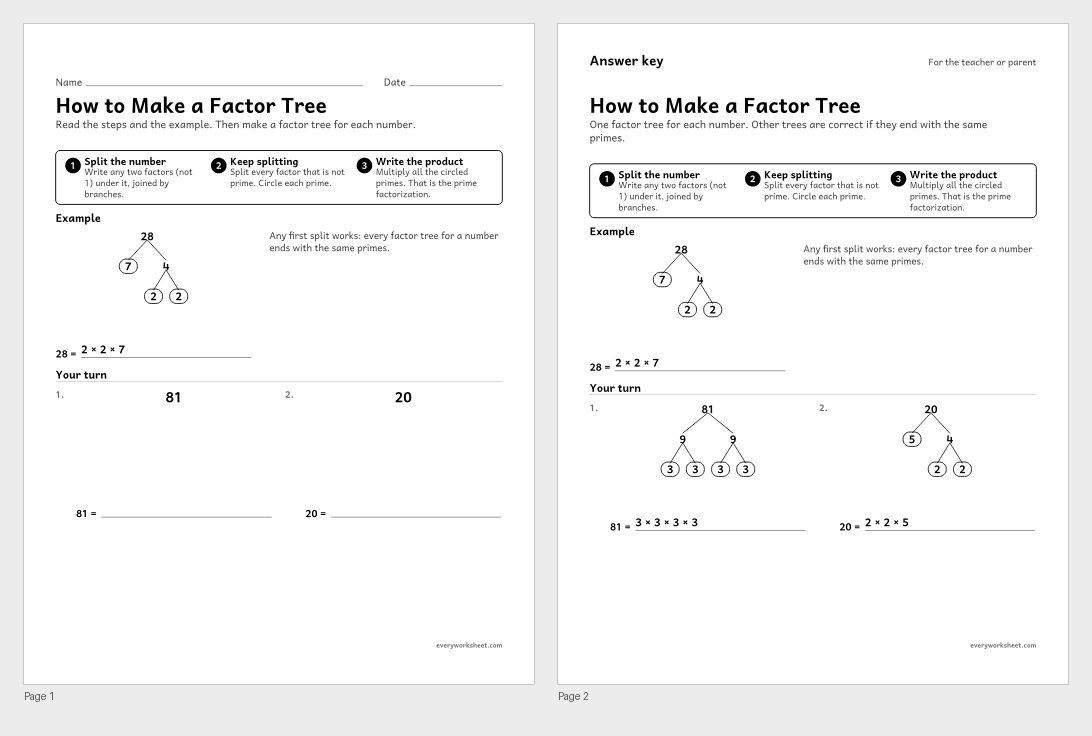
Factor trees step by step, trees with the first split given, and writing prime factorizations with exponents.
Download the prime factorization worksheets
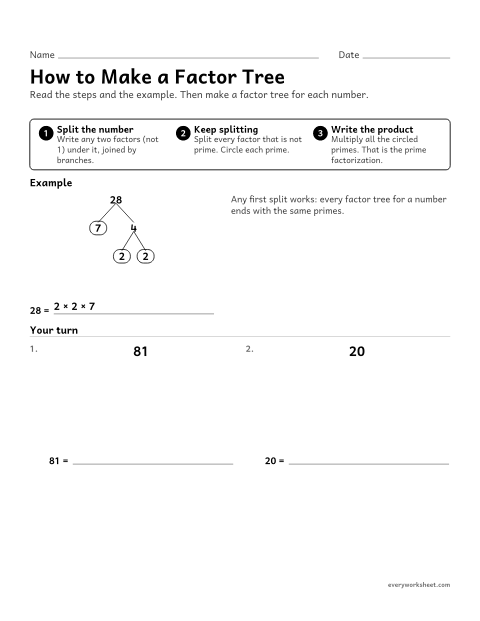
Learn factor trees
 View all 2 pages
Prime factorization practice
 View all 2 pages
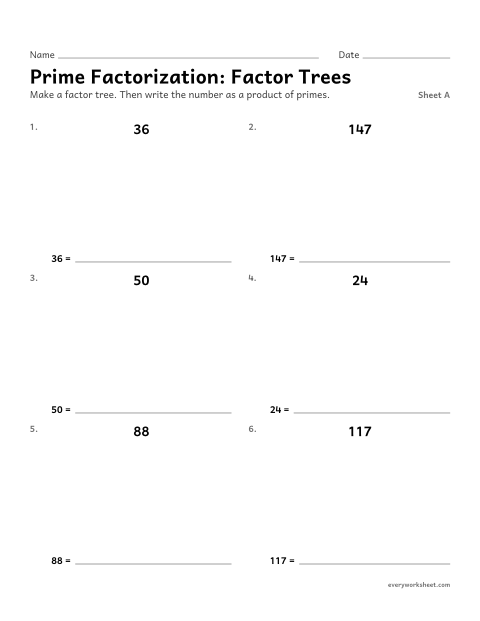
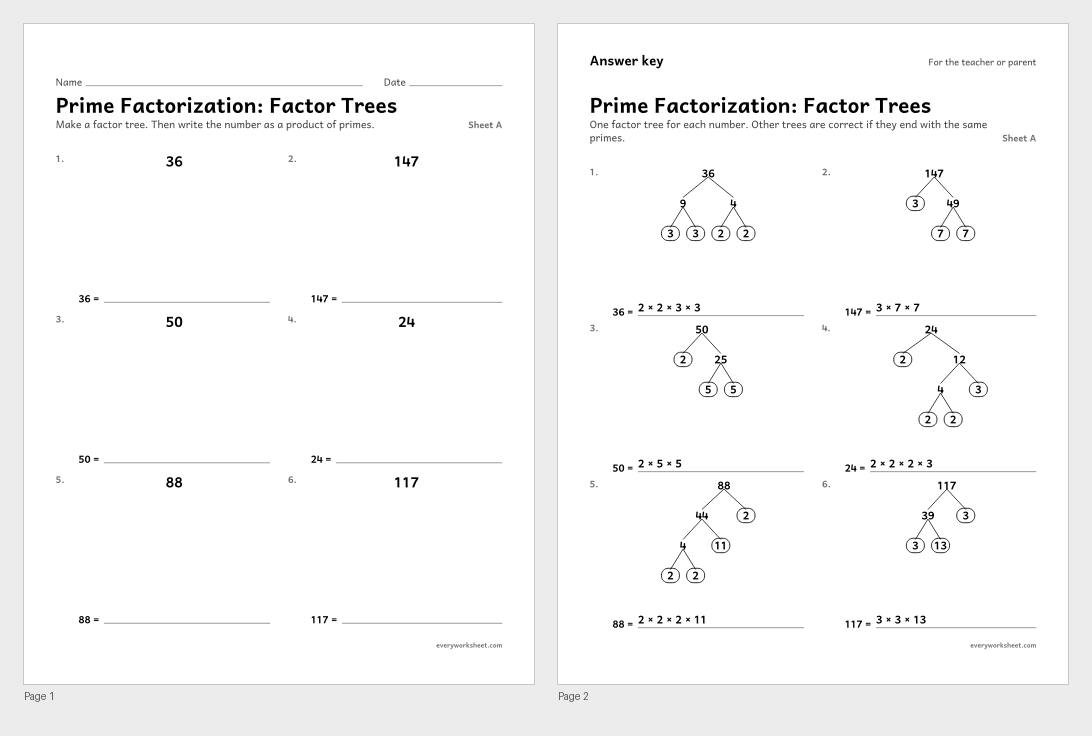
Prime Factorization: factor Trees, sheet A
Writing the prime factorization of a number
Answer key on page 2
2 pages43 KB
 View all 2 pages
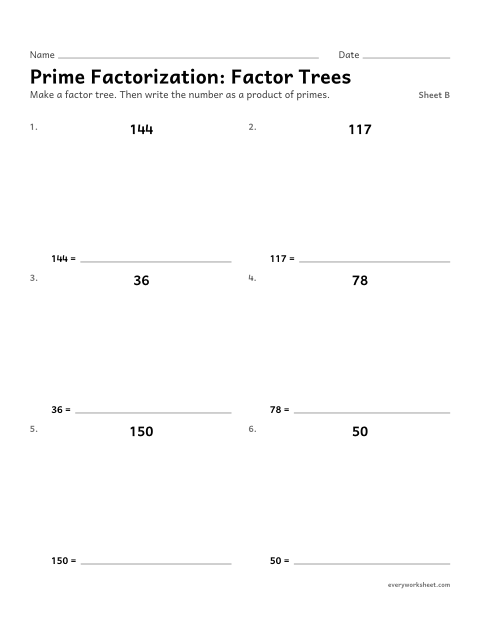
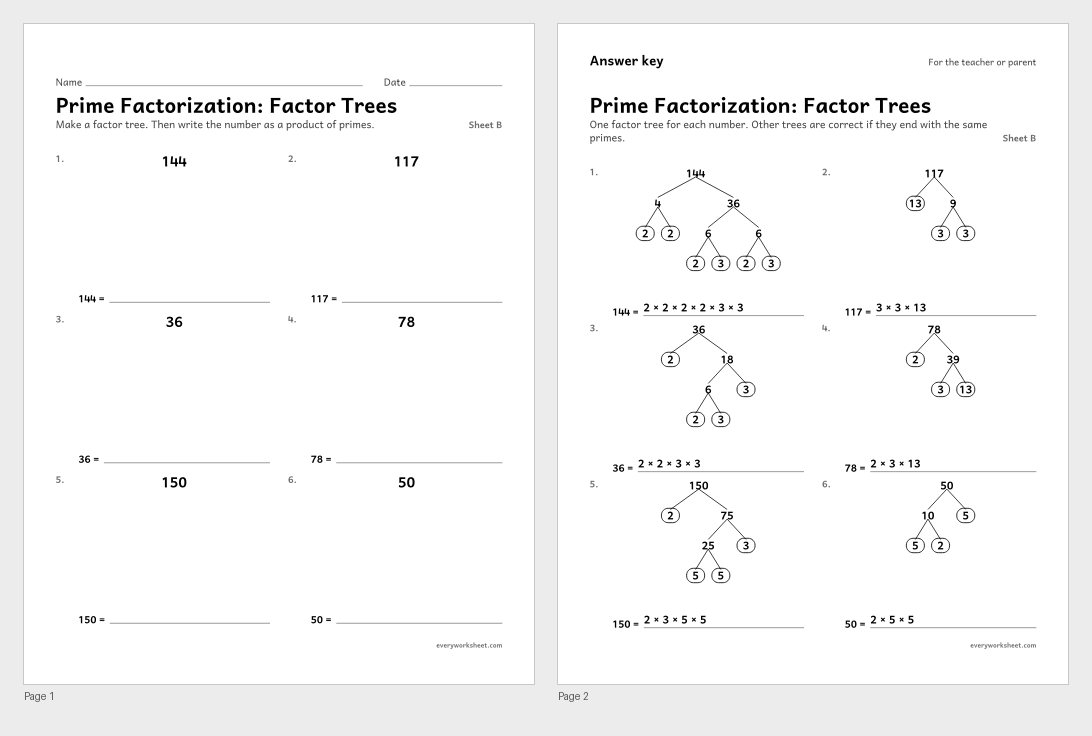
Prime Factorization: factor Trees, sheet B
Writing the prime factorization of a number
Answer key on page 2
2 pages43 KB
 View all 2 pages
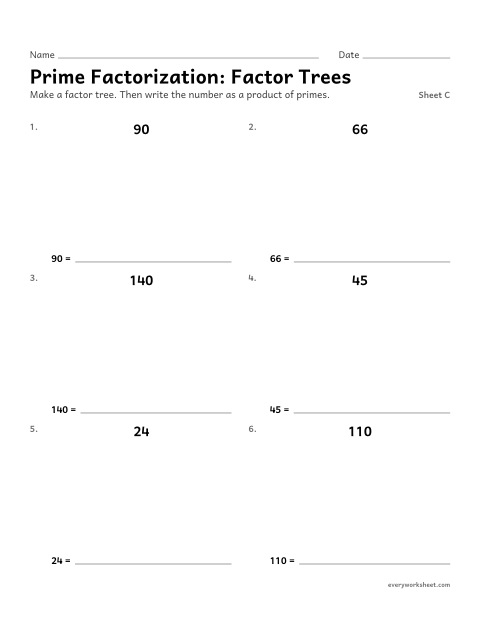
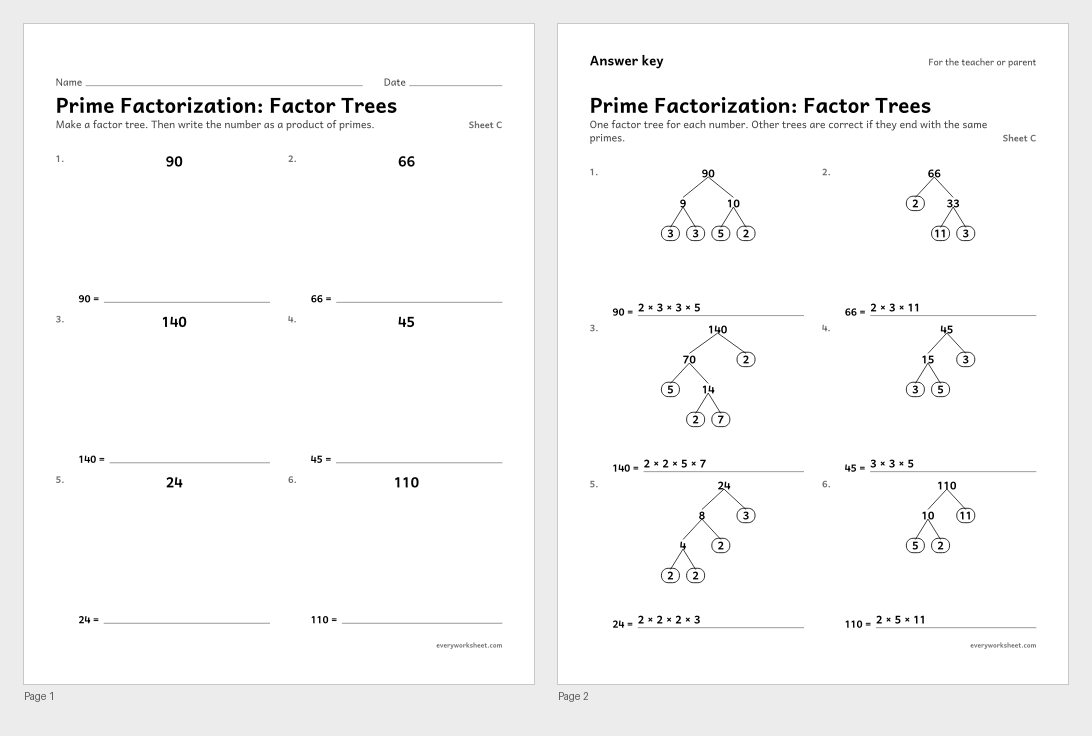
Prime Factorization: factor Trees, sheet C
Writing the prime factorization of a number
Answer key on page 2
2 pages43 KB
 View all 2 pages
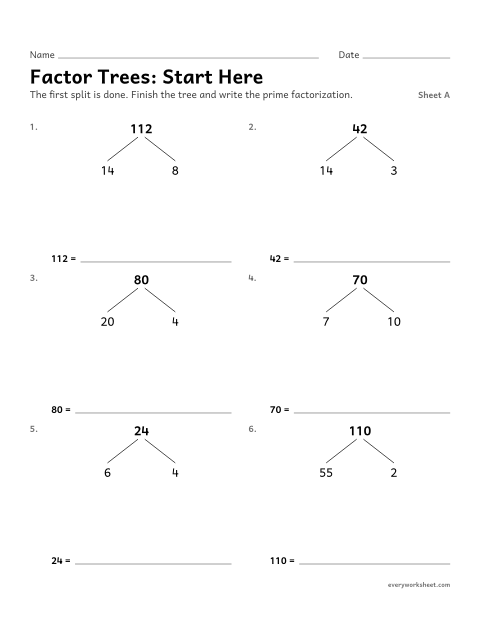
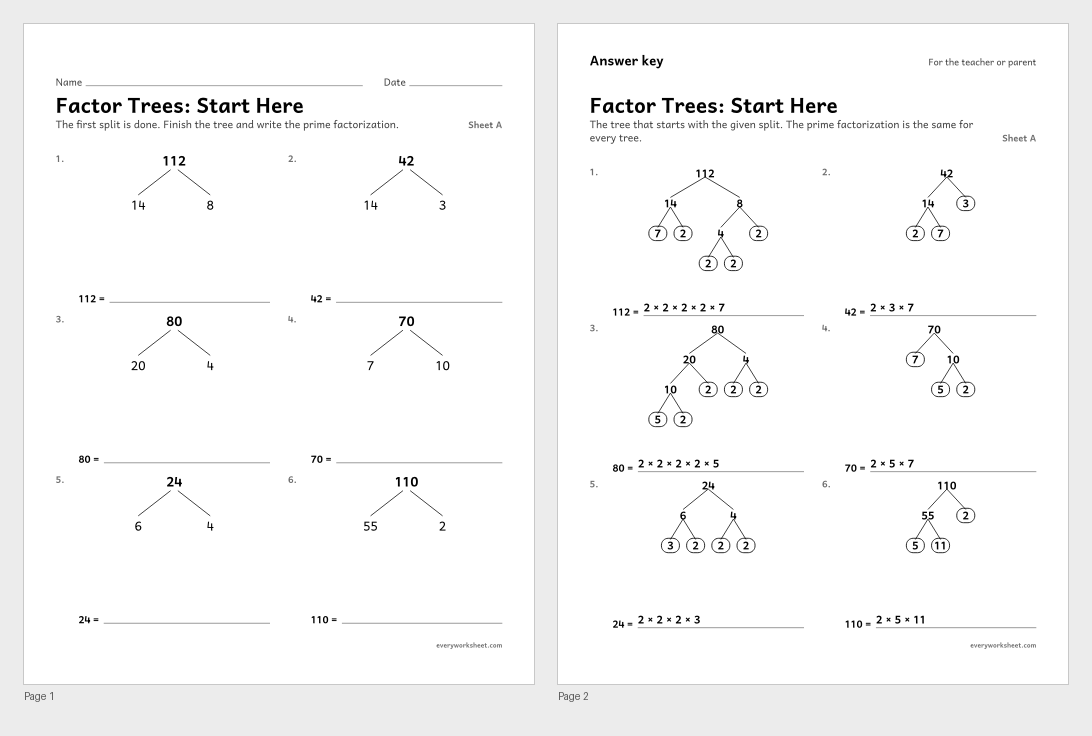
Factor Trees: start Here, sheet A
Finishing a factor tree from a given first split
Answer key on page 2
2 pages44 KB
 View all 2 pages
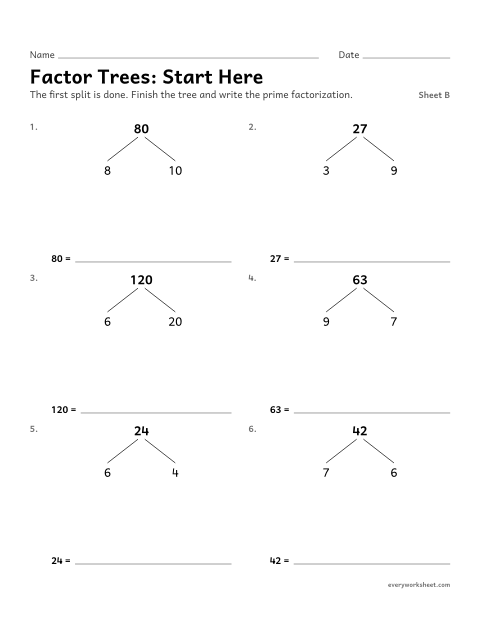
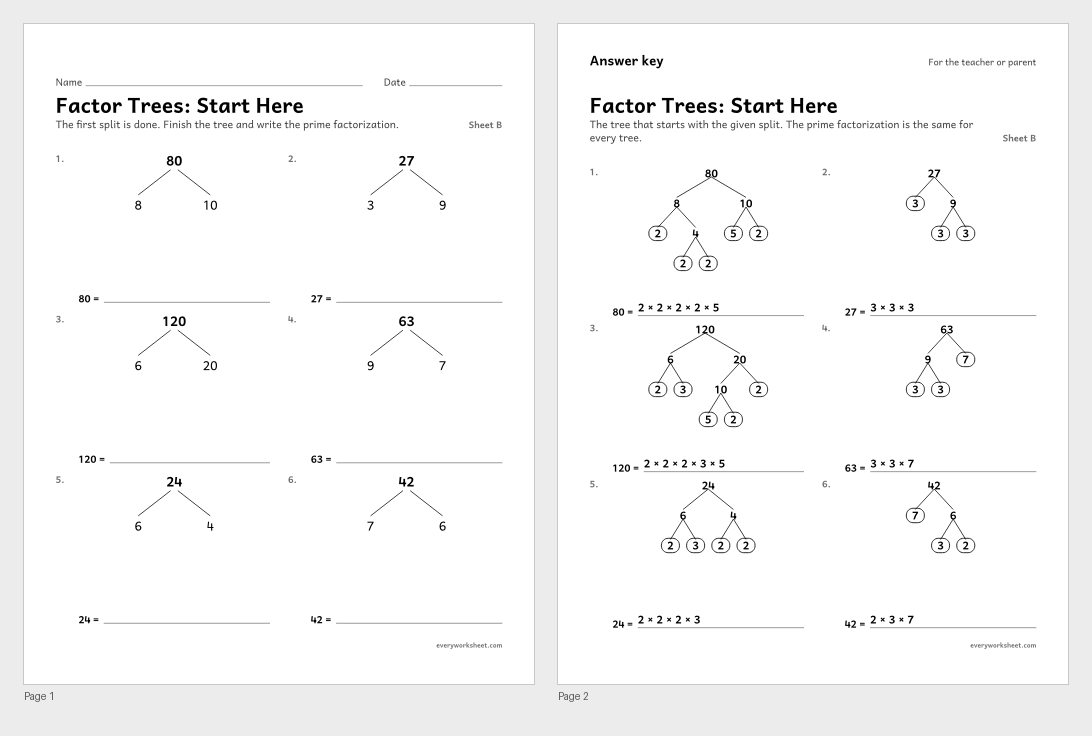
Factor Trees: start Here, sheet B
Finishing a factor tree from a given first split
Answer key on page 2
2 pages44 KB
 View all 2 pages
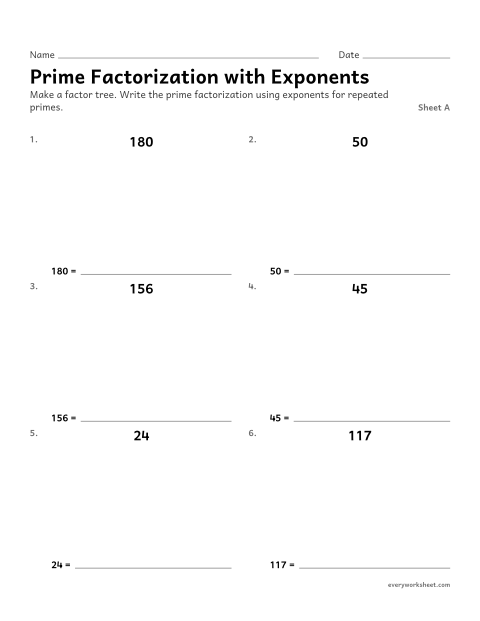
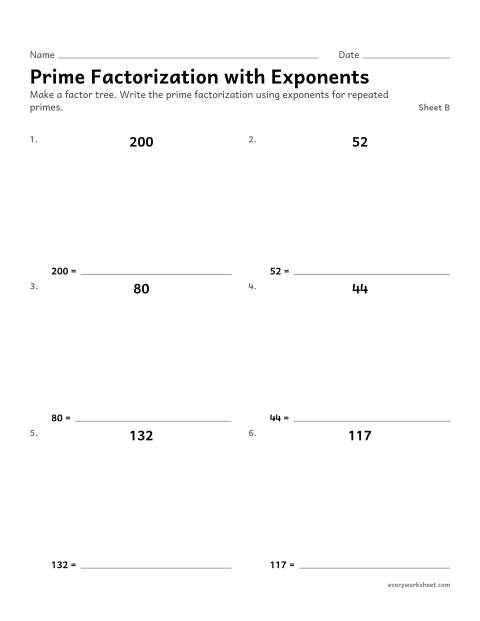
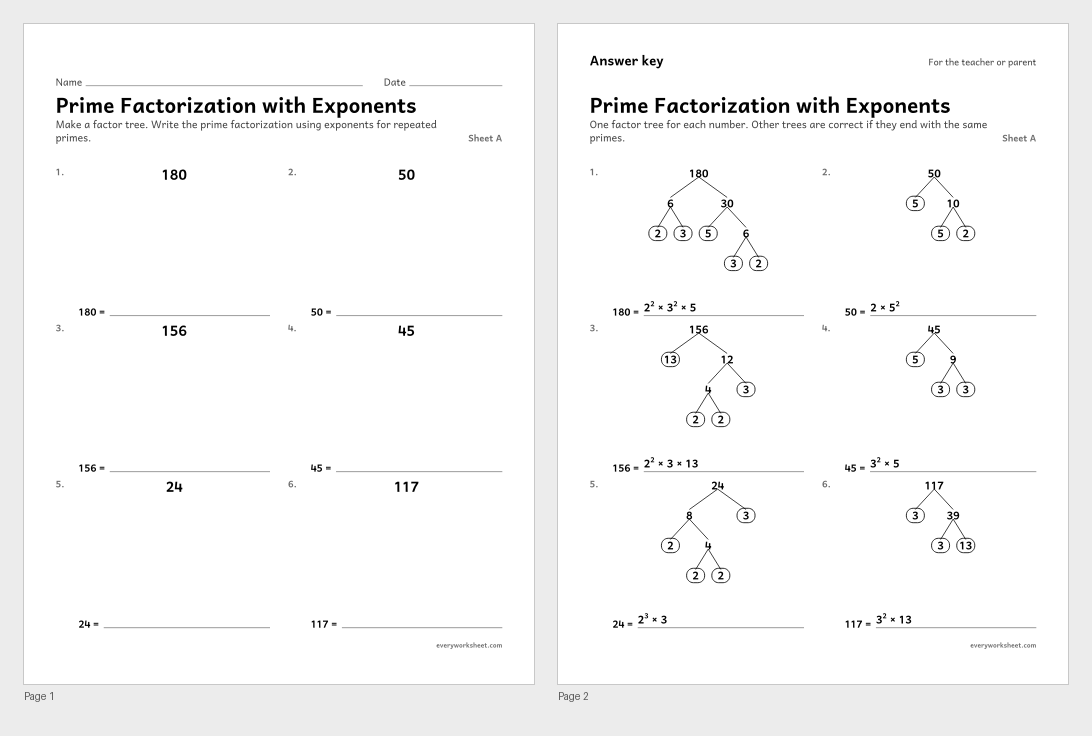
Prime factorization with Exponents, sheet A
Writing prime factorizations with exponents
Answer key on page 2
2 pages46 KB
 View all 2 pages
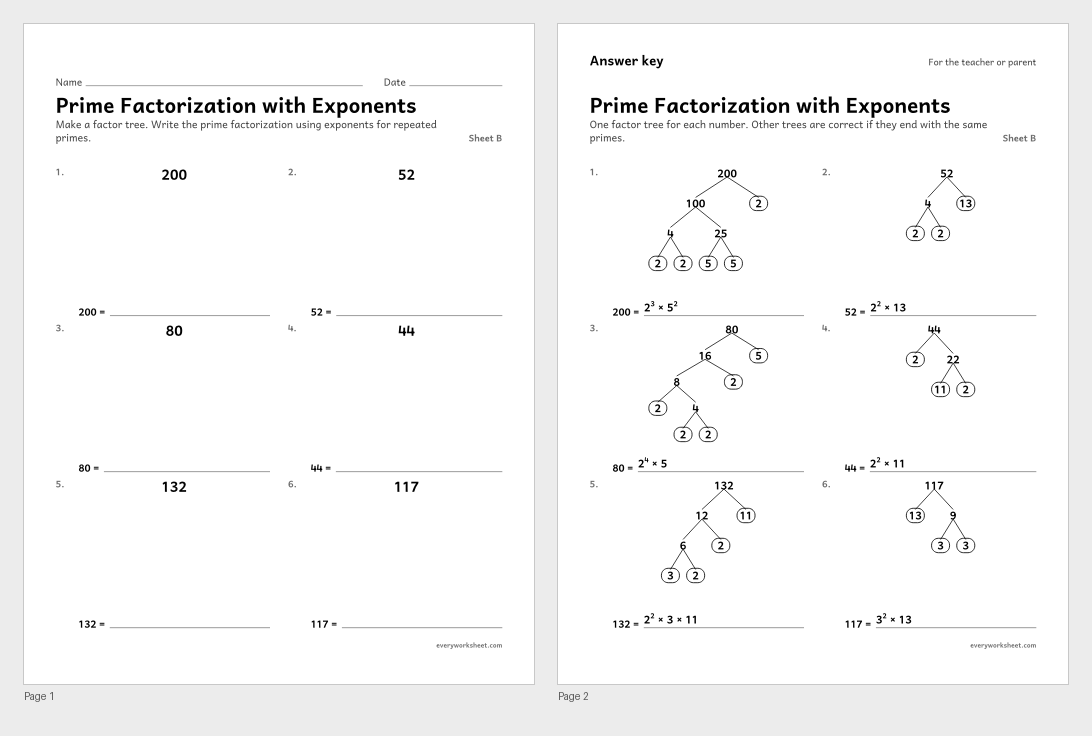
Prime factorization with Exponents, sheet B
Writing prime factorizations with exponents
Answer key on page 2
2 pages46 KB
Print at 100% (actual size) for the cleanest tracing lines.
About these prime factorization worksheets
Prime factorization writes a number as a product of prime numbers: 60 = 2 × 2 × 3 × 5. A factor tree is the easiest way to find it. Split the number into any two factors, keep splitting until every branch ends in a prime, and circle the primes.
Every factor tree for a number ends with the same primes, whichever first split you choose. That surprise is worth showing children: 60 can start as 6 × 10 or 4 × 15, and both trees end with 2, 2, 3 and 5. With exponents, 60 = 2² × 3 × 5.
These pages build from a worked example to blank trees, trees with the first split given, and prime factorizations with exponents. The answer keys draw one full tree for each number and explain that other trees are correct when they end with the same primes.
Standards
CCSS.MATH.CONTENT.4.OA.B.4Find all factor pairs for a whole number in the range 1-100. Recognize that a whole number is a multiple of each of its one-digit factors. Determine whether a given whole number in the range 1-100 is a multiple of a given one-digit number. Determine whether a given whole number in the range 1-100 is prime or composite.CCSS.MATH.CONTENT.5.NBT.A.2Explain patterns in the number of zeros of the product when multiplying a number by powers of 10, and explain patterns in the placement of the decimal point when a decimal is multiplied or divided by a power of 10. Use whole-number exponents to denote powers of 10.
How to use them
- Start with How to Make a Factor Tree.
- Use Factor Trees: Start Here for children who are unsure how to begin.
- Then use the blank tree pages and the exponent page.
- Compare two different trees for the same number as a class.
Teaching tips
- Never split off a 1: 1 is not prime and does not help.
- Start with an easy split: an even number splits into 2 × something.
- Check by multiplying the circled primes back together.
Questions teachers and parents ask
What is prime factorization?
Writing a number as a product of prime numbers only, like 36 = 2 × 2 × 3 × 3.
Does every factor tree give the same answer?
Yes. Different first splits make different trees, but the circled primes are always the same.
How do you write prime factorization with exponents?
Group repeated primes: 2 × 2 × 2 × 3 is written 2³ × 3.