 3 pagesView all 3 pages
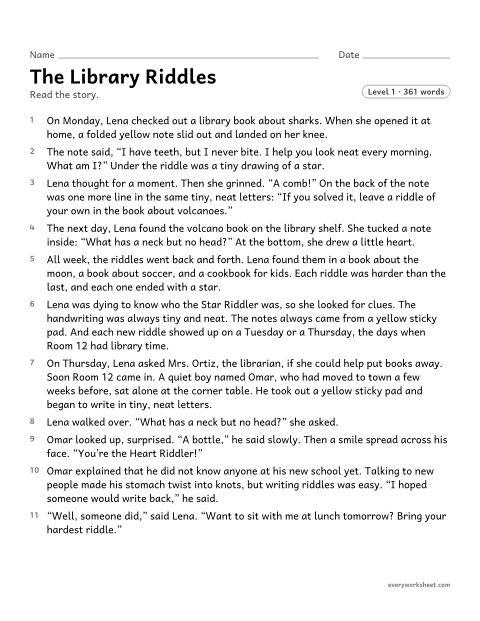
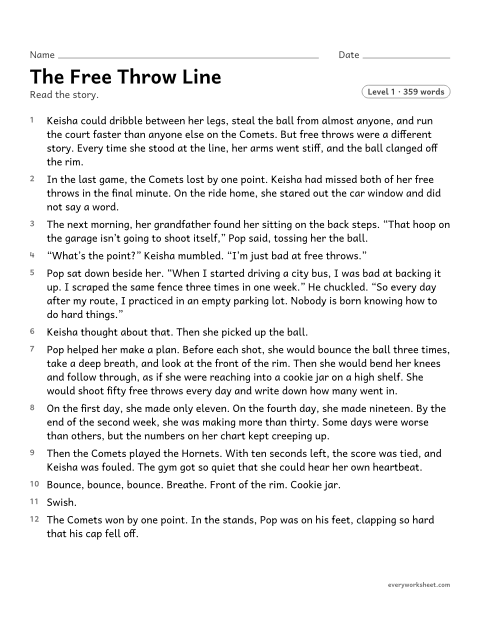
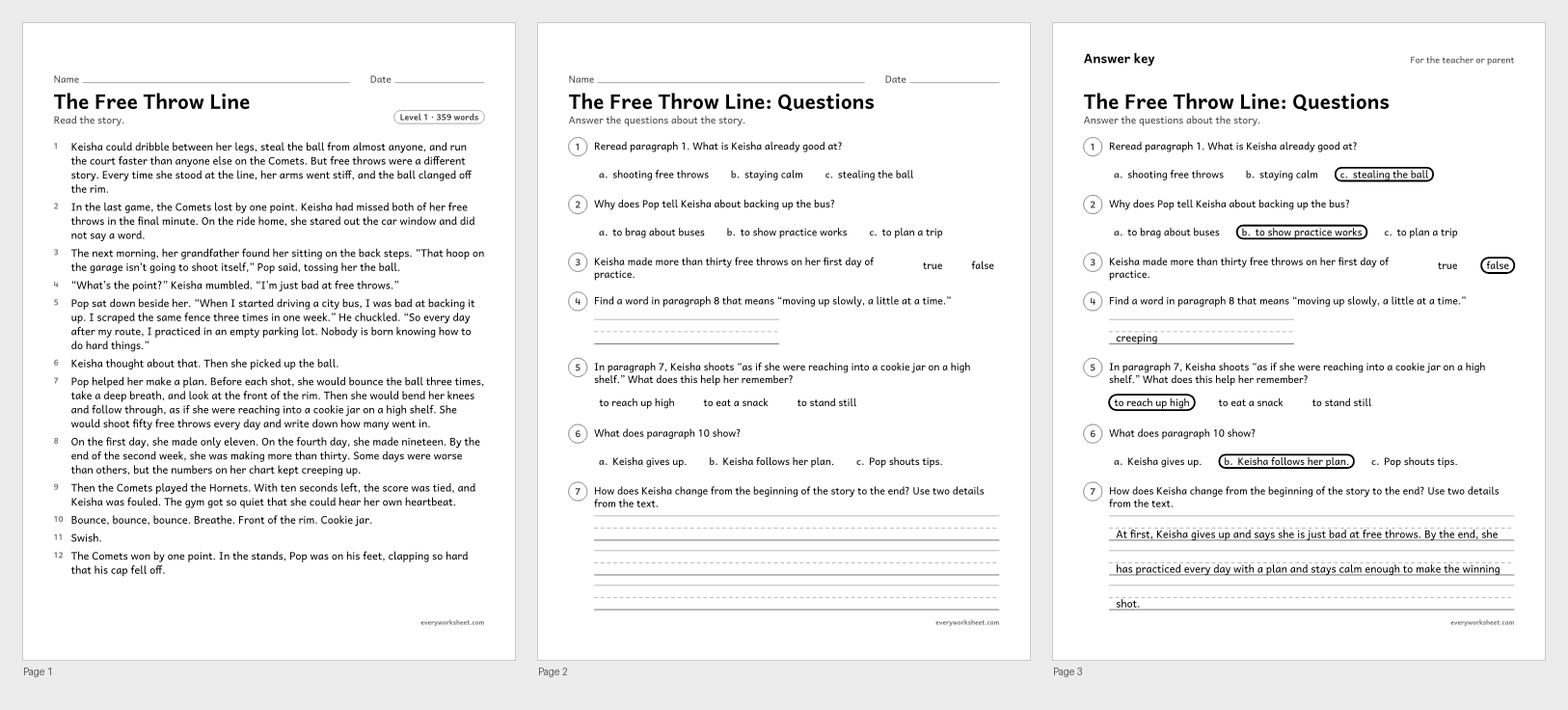
The free throw line
Describing how a character changes, using details from the story
Answer key on page 3
3 pages54 KB
Original stories and nonfiction texts at three levels, with evidence questions and answer keys.
3 pagesView all 3 pagesDescribing how a character changes, using details from the story
Answer key on page 3
3 pages54 KB
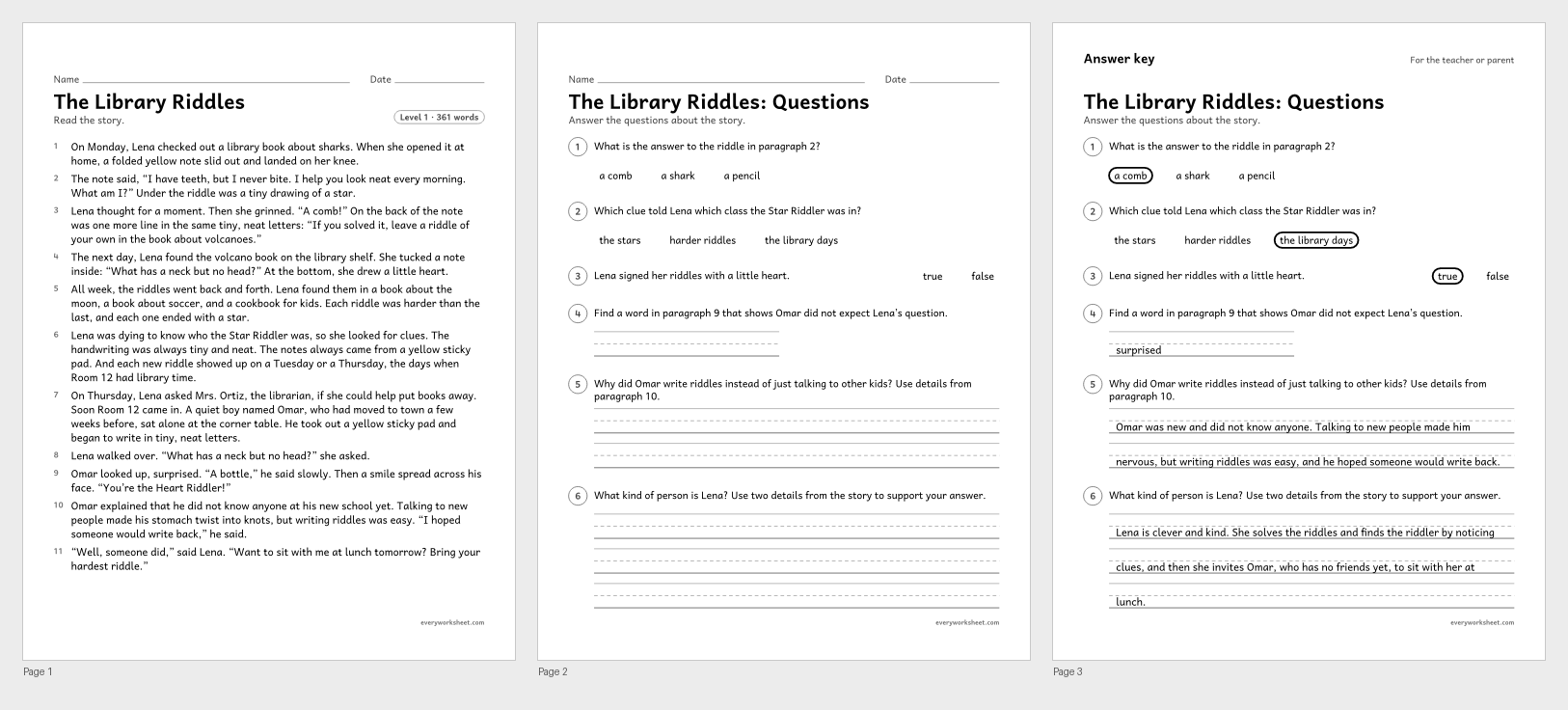 3 pagesView all 3 pages
Using details from the story to explain what happens and to make inferences
Answer key on page 3
3 pages52 KB
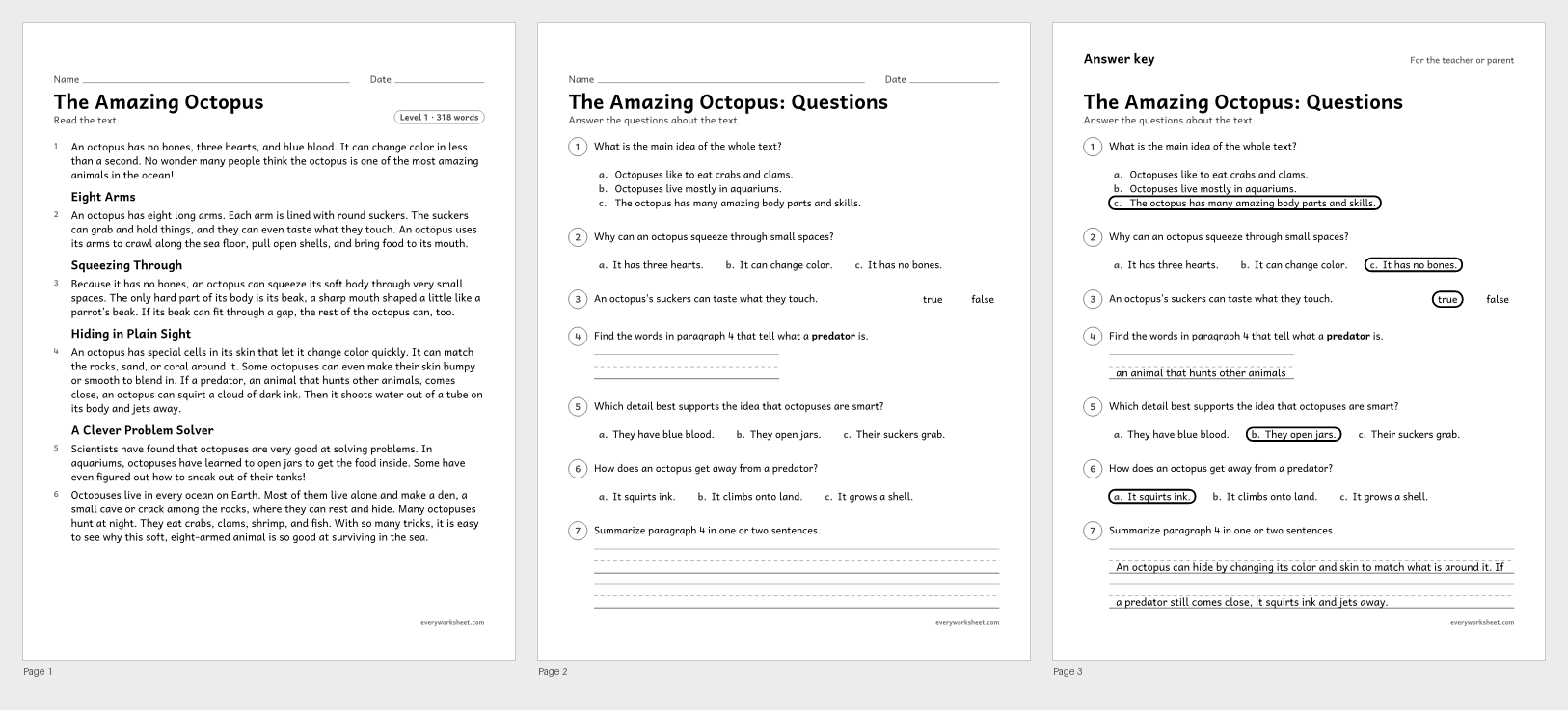 3 pagesView all 3 pages
Finding the main idea of a text and the key details that support it
Answer key on page 3
3 pages55 KB
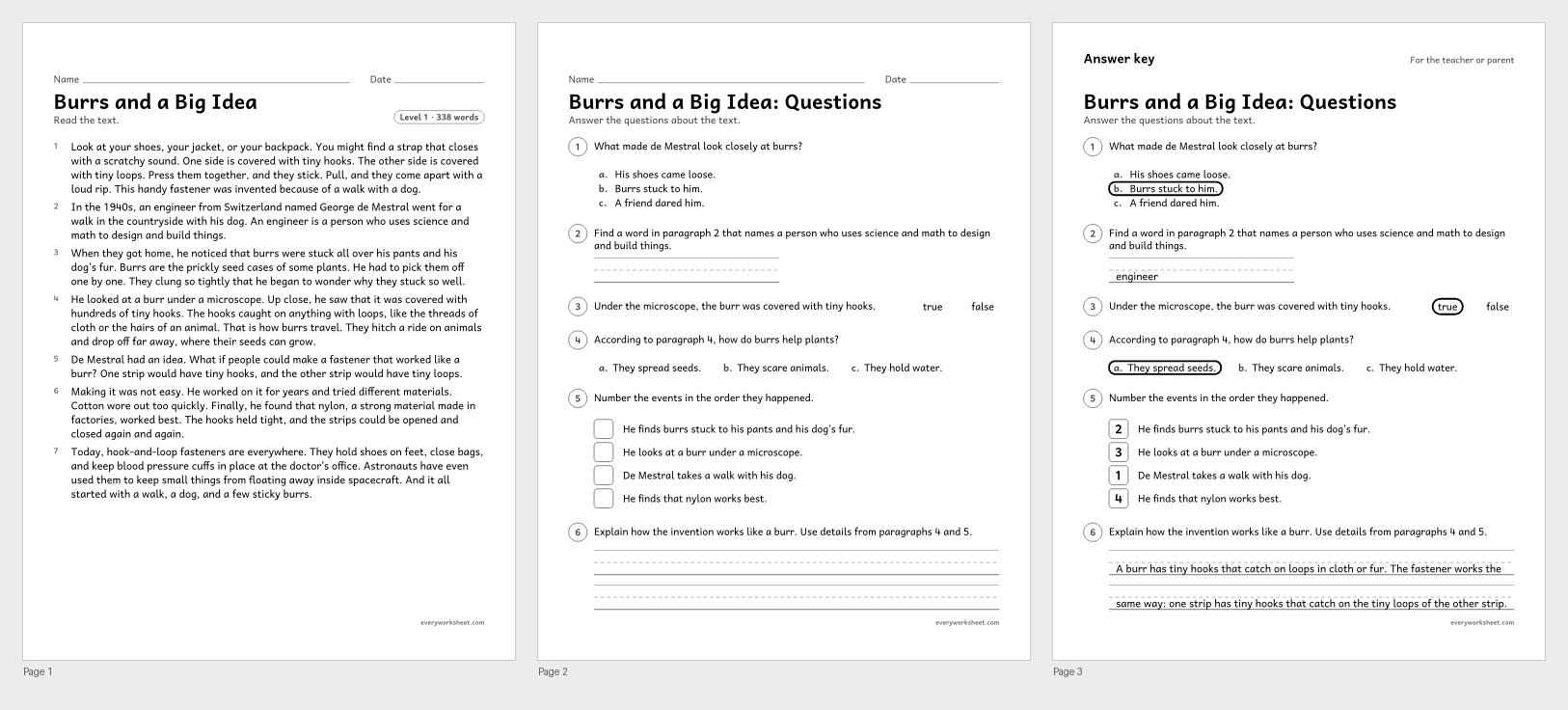 3 pagesView all 3 pages
Explaining what happened and why in the story of an invention
Answer key on page 3
3 pages57 KB
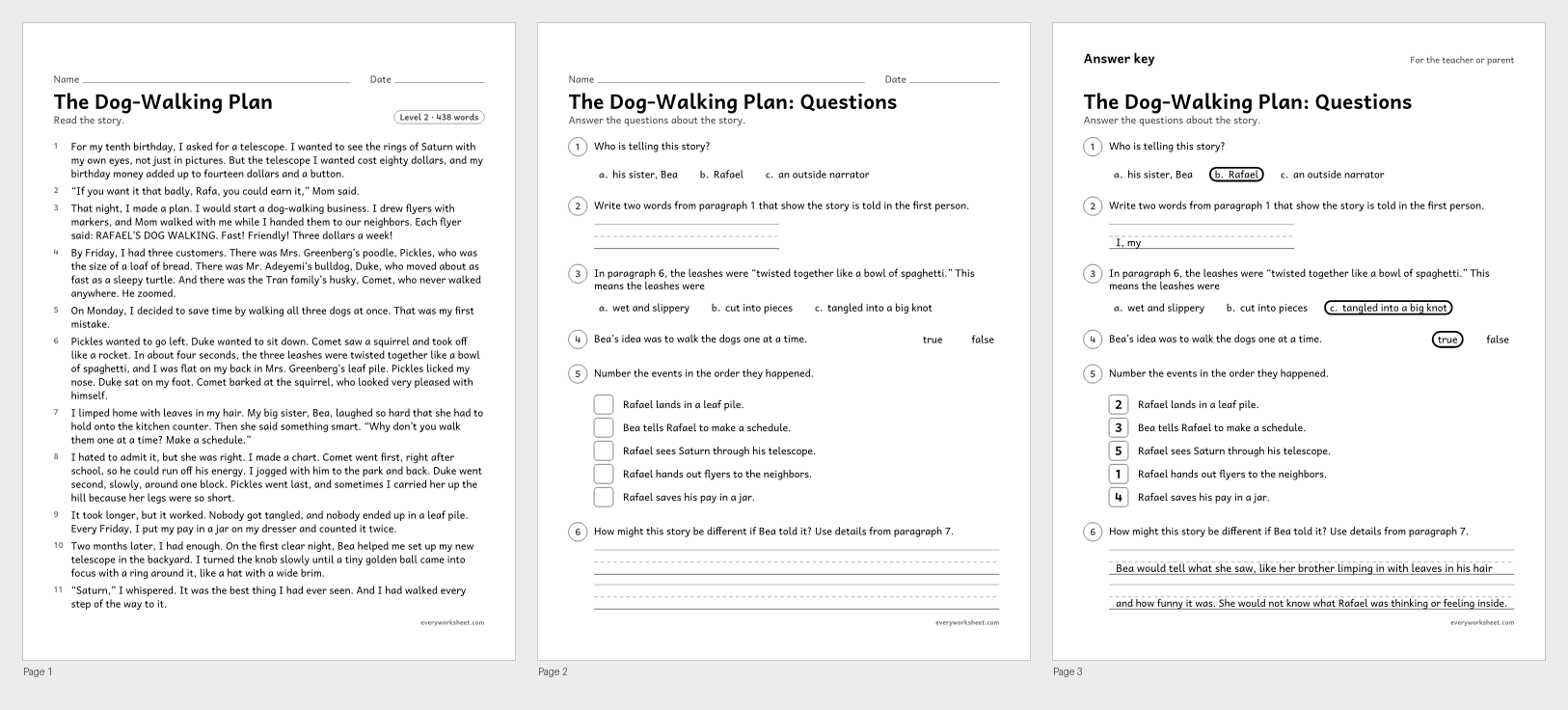 3 pagesView all 3 pages
Telling who narrates a story told in the first person, and how another narrator would tell it
Answer key on page 3
3 pages59 KB
 3 pagesView all 3 pages
Finding the theme of a story from what the characters do and learn
Answer key on page 3
3 pages58 KB
 3 pagesView all 3 pages
Working out science words from context in an informational text
Answer key on page 3
3 pages56 KB
 3 pagesView all 3 pages
Using details from a history text to explain what it says and to make inferences
Answer key on page 3
3 pages57 KB
 3 pagesView all 3 pages
Working out a word that comes from mythology (herculean) and finding the theme of a traditional-style tale
Answer key on page 3
3 pages61 KB
 3 pagesView all 3 pages
Describing a character in depth from her thoughts, words, and actions, and how the setting changes
Answer key on page 3
3 pages57 KB
 3 pagesView all 3 pages
Explaining how and why a natural process happens, using details from a science text
Answer key on page 3
3 pages62 KB
 3 pagesView all 3 pages
Describing the time-order structure of a history text with headings and a fact box
Answer key on page 3
3 pages61 KB
 4 pagesView all 4 pages
Finding the theme of a chapter story from what a character does and learns
Answer key on page 4
4 pages77 KB
 4 pagesView all 4 pages
Comparing two characters and describing how one of them changes, using details from a chapter story
Answer key on page 4
4 pages119 KB
 4 pagesView all 4 pages
Describing the time-order structure of a biography and using a timeline to answer questions
Answer key on page 4
4 pages84 KB
 4 pagesView all 4 pages
Explaining how a body system works, using details, headings, and a text feature in a science text
Answer key on page 4
4 pages91 KB
 View larger
Describing a character in depth from the character's thoughts, words, and actions in any book
1 page30 KB
 View larger
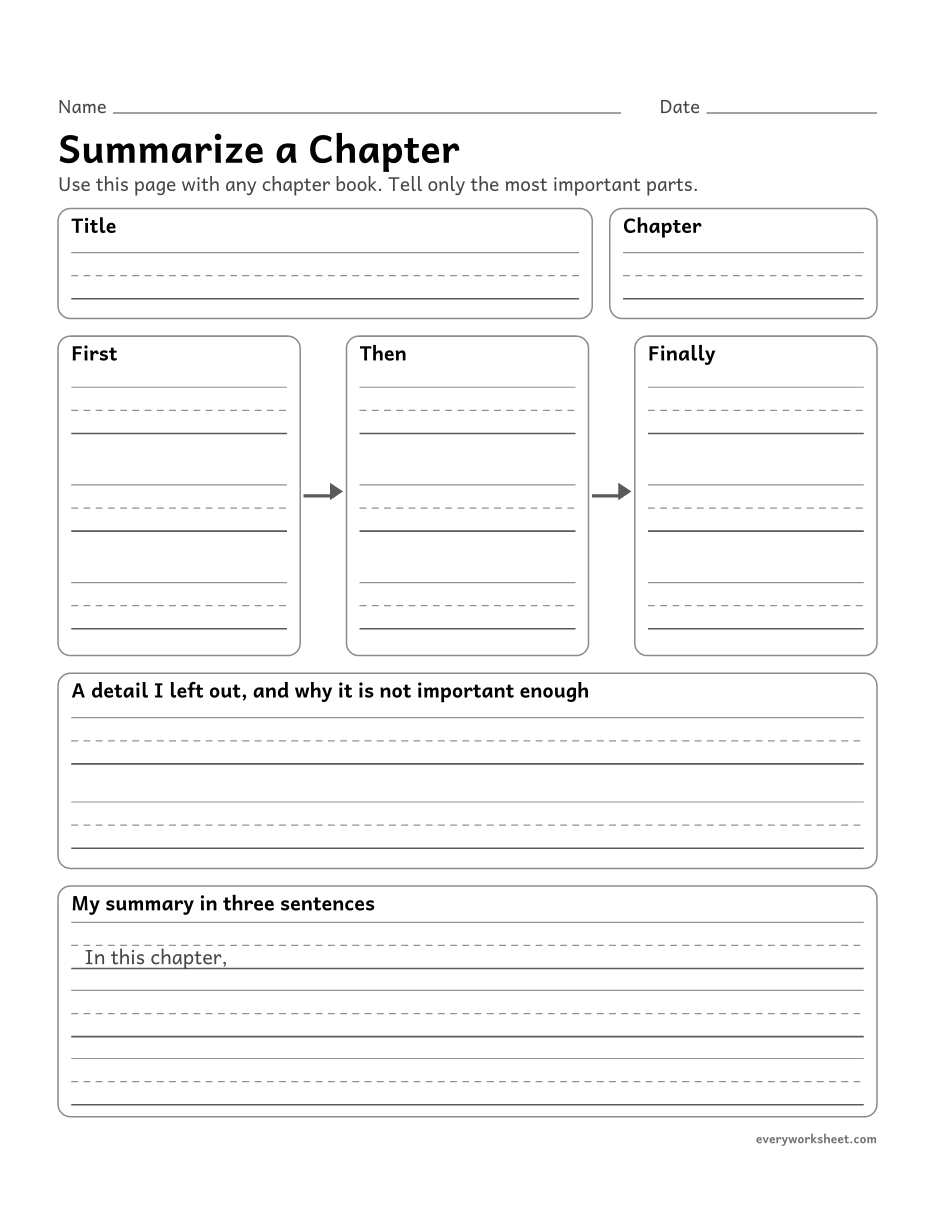
Summarizing a chapter of any book by choosing only its most important events
1 page28 KB
 View larger
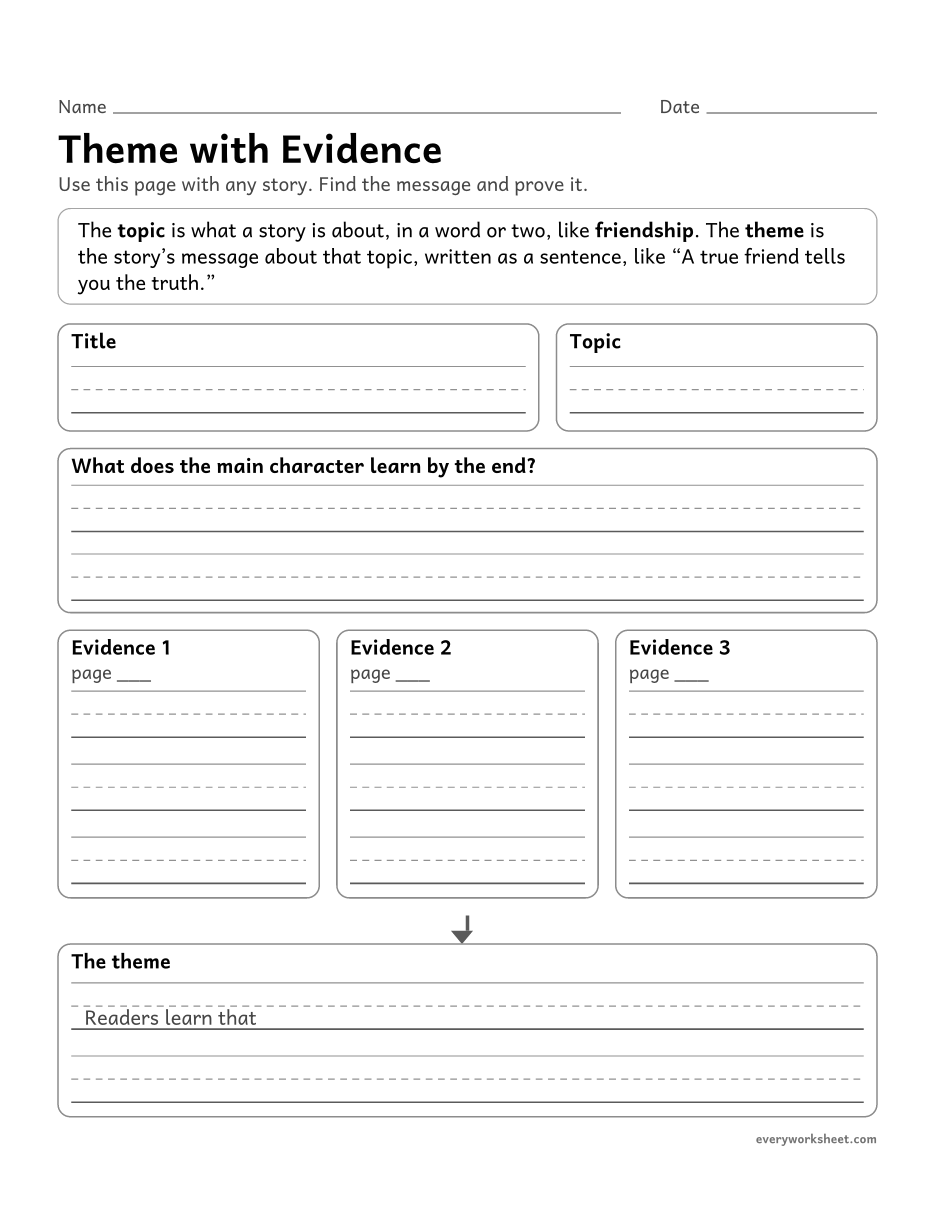
Finding the theme of any story and supporting it with evidence from the text
1 page30 KB
Print at 100% (actual size) for the cleanest tracing lines.
Reading comprehension means understanding what you read: not just saying the words, but knowing what happened, why it happened, and what the writer wants you to learn. In 4th grade, children are asked to prove their thinking. Instead of "Keisha is brave," they write "Keisha is brave because she practices every day, even after she loses the game." Every passage here asks for that kind of answer, with details from the text.
Each worksheet is an original story or nonfiction text written for 9 and 10 year olds: a girl who practices free throws, a boy who learns to listen to his robot team, the Pony Express, how burrs inspired a famous invention, and how volcanoes built the Hawaiian Islands. Paragraphs are numbered, so questions can say "Reread paragraph 4" and children can find their evidence quickly.
The passages come in three levels. Level 1 texts are shorter, with plain words. Level 2 texts are longer and add skills like first person narration and science words. Level 3 texts are the most challenging, with headings, a fact box, harder vocabulary, and a traditional-style tale that explains a word from mythology. For readers ready to stretch, the longer reads run across two pages, with chapter stories full of dialogue and nonfiction with a timeline or a step-by-step box.
Every sheet mixes question types: multiple choice, true or false, numbering events in order, finding a word in the text, and short written answers. A full answer key is on the last page.
CCSS.ELA-LITERACY.RL.4.1Refer to details and examples in a text when explaining what the text says explicitly and when drawing inferences from the text.CCSS.ELA-LITERACY.RL.4.2Determine a theme of a story, drama, or poem from details in the text; summarize the text.CCSS.ELA-LITERACY.RL.4.3Describe in depth a character, setting, or event in a story or drama, drawing on specific details in the text (e.g., a character's thoughts, words, or actions).CCSS.ELA-LITERACY.RL.4.4Determine the meaning of words and phrases as they are used in a text, including those that allude to significant characters found in mythology (e.g., Herculean).CCSS.ELA-LITERACY.RL.4.6Compare and contrast the point of view from which different stories are narrated, including the difference between first- and third-person narrations.CCSS.ELA-LITERACY.RI.4.1Refer to details and examples in a text when explaining what the text says explicitly and when drawing inferences from the text.CCSS.ELA-LITERACY.RI.4.2Determine the main idea of a text and explain how it is supported by key details; summarize the text.CCSS.ELA-LITERACY.RI.4.3Explain events, procedures, ideas, or concepts in a historical, scientific, or technical text, including what happened and why, based on specific information in the text.CCSS.ELA-LITERACY.RI.4.4Determine the meaning of general academic and domain-specific words or phrases in a text relevant to a grade 4 topic or subject area.CCSS.ELA-LITERACY.RI.4.5Describe the overall structure (e.g., chronology, comparison, cause/effect, problem/solution) of events, ideas, concepts, or information in a text or part of a text.They are written for 4th grade. Level 1 is early 4th grade, Level 2 is the middle of the year, and Level 3 is late 4th grade. Each sheet shows its level and word count at the top.
Yes. The longer reads are 600 to 650 word texts that run across two pages: two chapter stories with dialogue and two nonfiction texts, about Louis Braille and about how the heart works, each with eight questions and an answer key.
Yes. Every story, poem, and nonfiction text was written for this site, so you can print and copy them freely for your class or family.
Using details from the text to explain and infer, finding the theme and main idea, describing a character in depth, working out word meanings from context, first and third person narration, and text structures like time order and cause and effect.
Yes. Every passage has an answer key on its last page, with sample answers for the written questions.