 View larger
Simplifying fractions
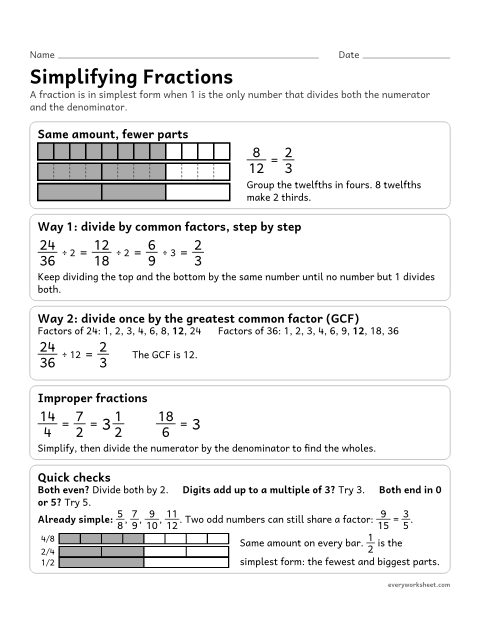
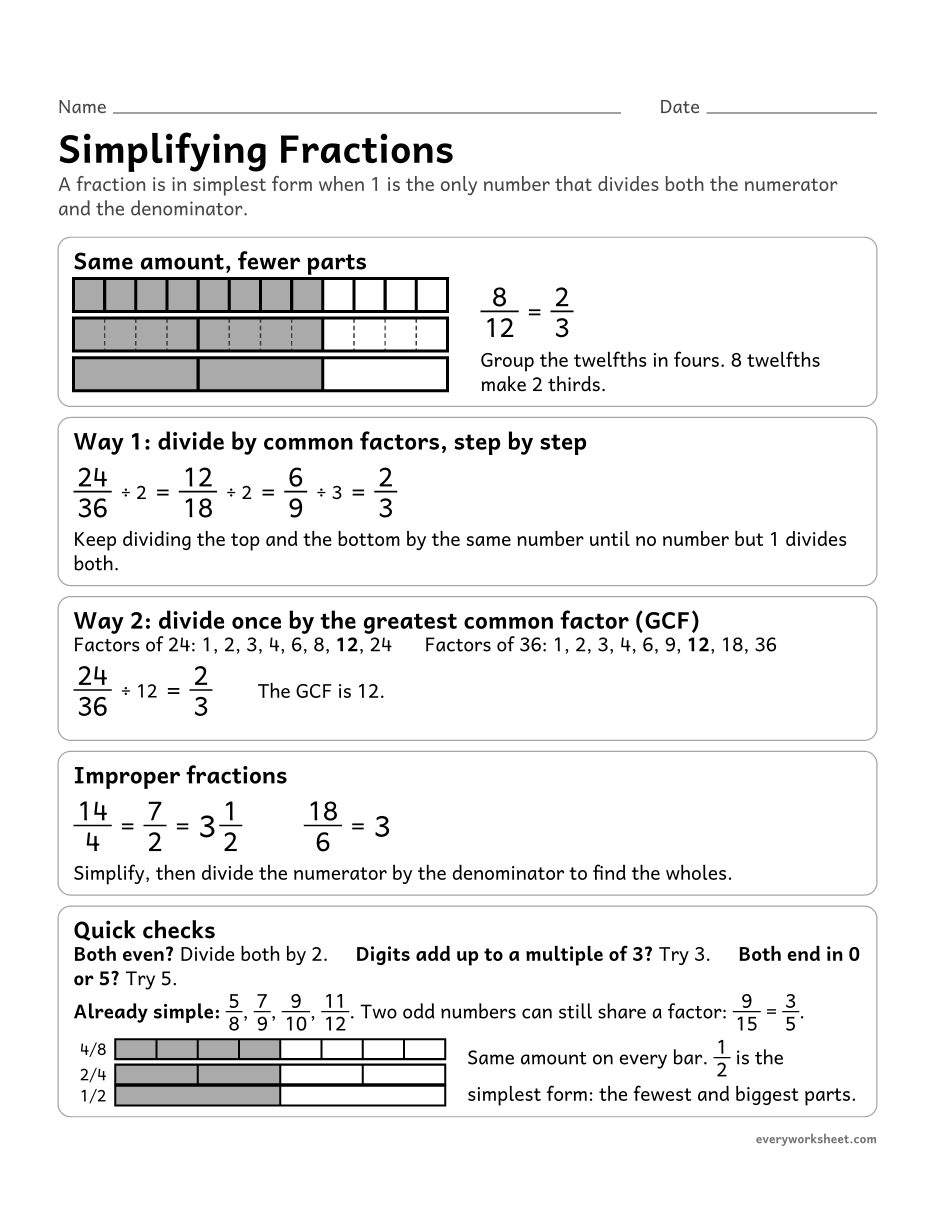
What simplest form means and two ways to simplify: divide by common factors, or divide once by the greatest common factor
1 page36 KB
A simplifying fractions chart, bar models, practice to 100, the greatest common factor, simplest form or not, and improper fractions. With answer keys.
View largerWhat simplest form means and two ways to simplify: divide by common factors, or divide once by the greatest common factor
1 page36 KB
 View all 2 pages
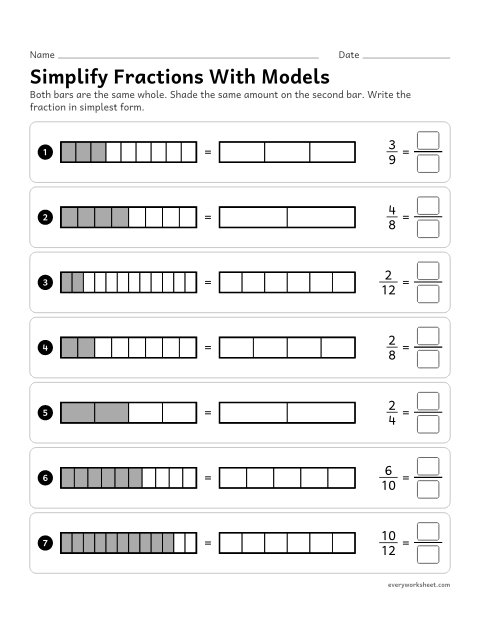
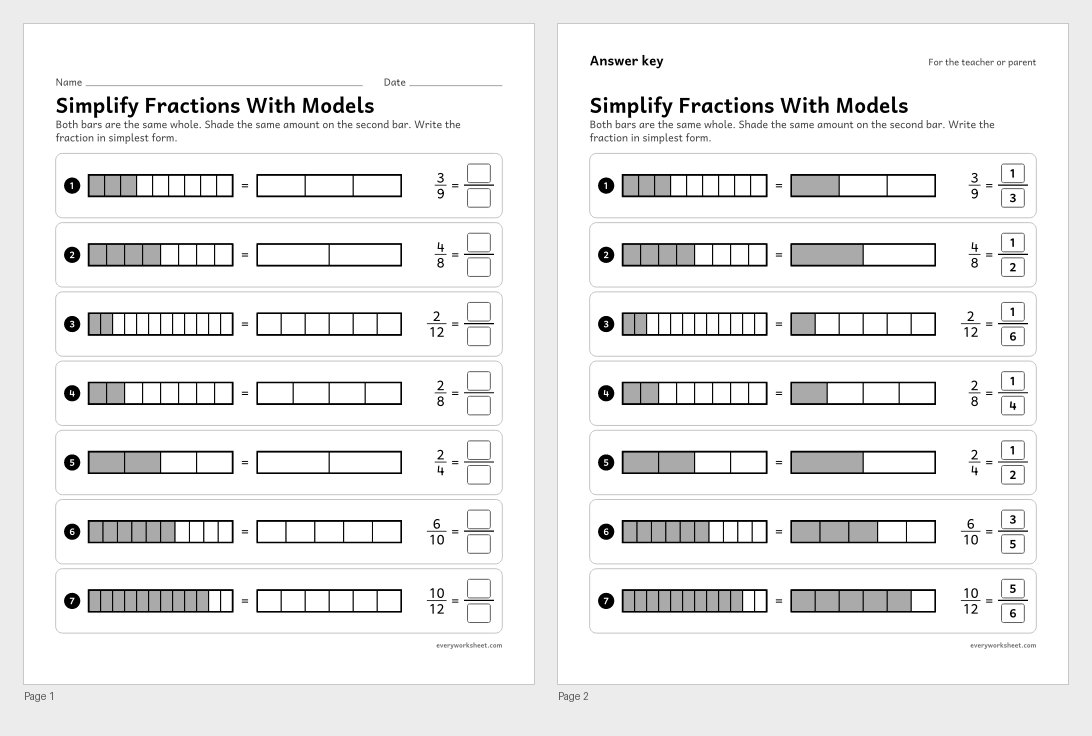
Seeing that a fraction and its simplest form cover the same part of a fraction bar, with fewer, bigger parts
Answer key on page 2
2 pages45 KB
 View all 2 pages
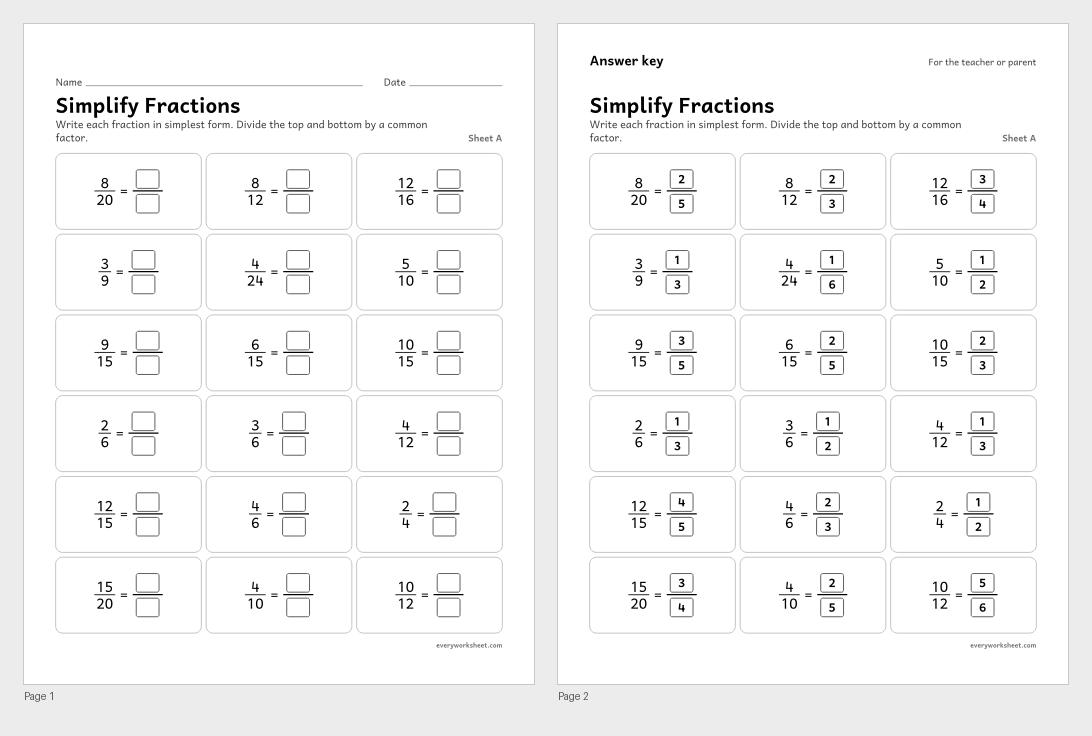
Writing fractions with denominators up to 24 in simplest form
Answer key on page 2
2 pages40 KB
 View all 2 pages
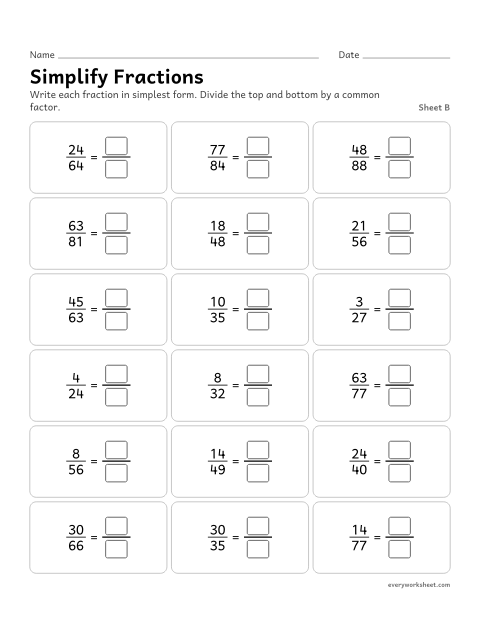
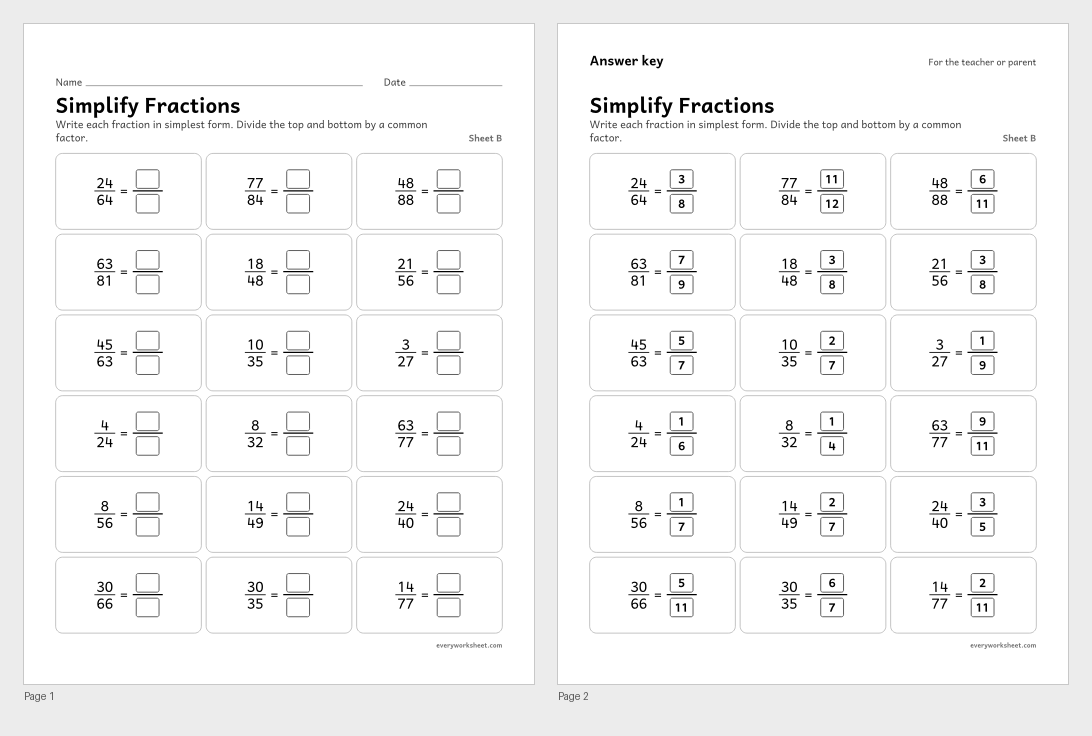
Writing fractions with denominators up to 100 in simplest form
Answer key on page 2
2 pages41 KB
 View all 2 pages
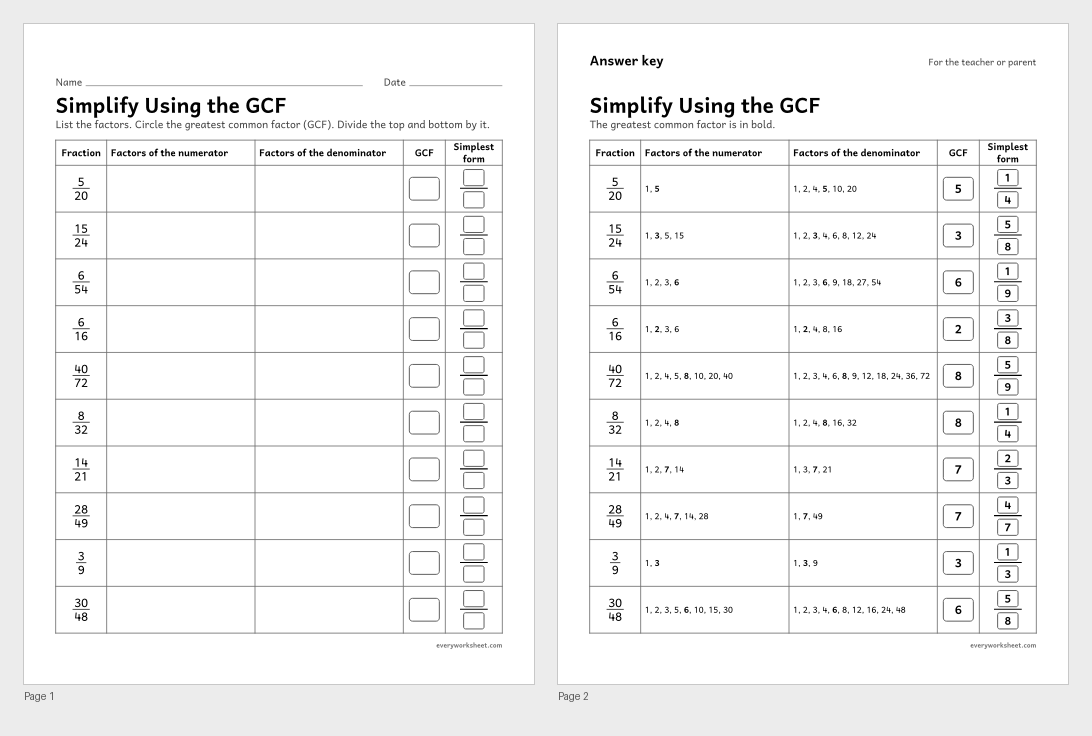
Listing factors to find the greatest common factor of the numerator and denominator, then dividing both by it
Answer key on page 2
2 pages55 KB
 View all 2 pages
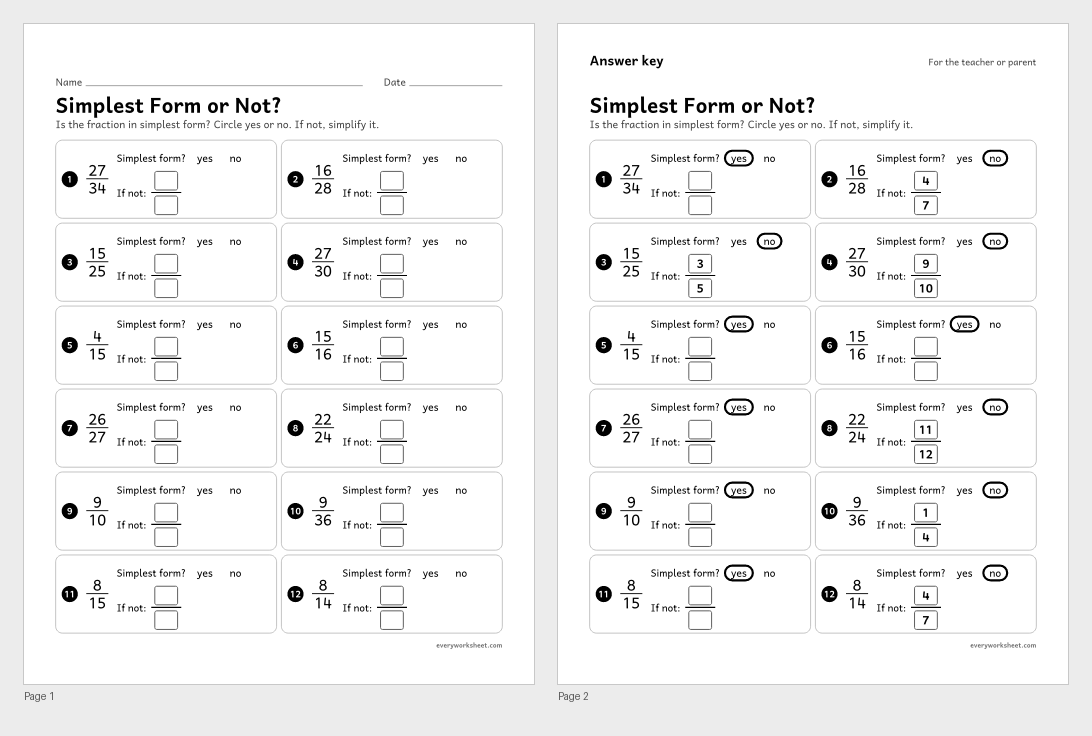
Deciding whether a fraction is in simplest form, and simplifying the ones that are not
Answer key on page 2
2 pages53 KB
 View all 2 pages
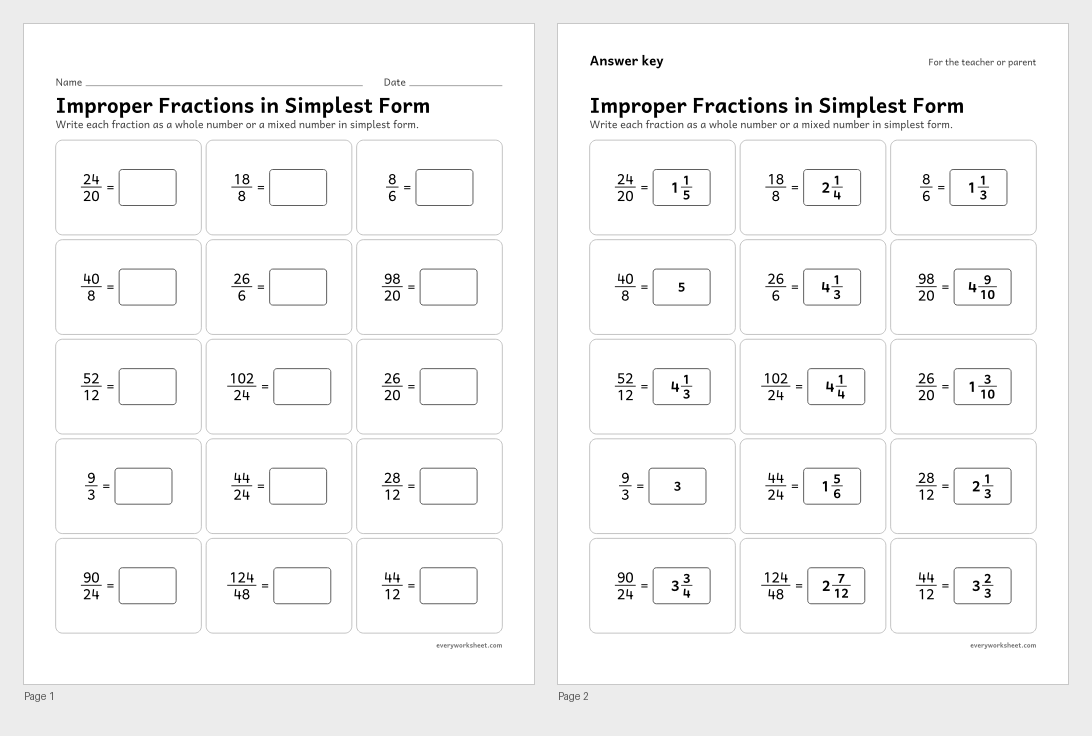
Writing improper fractions as mixed numbers or whole numbers in simplest form, like 14/4 = 3 1/2
Answer key on page 2
2 pages38 KB
Print at 100% (actual size) for the cleanest tracing lines.
A fraction is in simplest form when 1 is the only number that divides both its numerator and its denominator. To simplify, divide the top and the bottom by a common factor: 6/8 = 3/4, because 6 and 8 are both divisible by 2. The fraction keeps its size; it is just cut into fewer, bigger parts.
There are two ways to simplify. Divide by common factors step by step (24/36 = 12/18 = 6/9 = 2/3), or divide once by the greatest common factor, the biggest number that divides both (24/36 ÷ 12 = 2/3). For an improper fraction, simplify and then change it to a mixed number: 14/4 = 7/2 = 3 1/2.
These worksheets start with the chart and fraction bar models, then practice simplifying with small and large denominators, listing factors to find the GCF, deciding whether a fraction is already in simplest form, and simplifying improper fractions. Every practice page has an answer key.
CCSS.MATH.CONTENT.5.NF.A.1Add and subtract fractions with unlike denominators (including mixed numbers) by replacing given fractions with equivalent fractions in such a way as to produce an equivalent sum or difference of fractions with like denominators. For example, 2/3 + 5/4 = 8/12 + 15/12 = 23/12. (In general, a/b + c/d = (ad + bc)/bd.)Divide the numerator and the denominator by the same number. Keep going until no number but 1 divides both, or divide once by their greatest common factor. 18/24 ÷ 6 = 3/4.
No. 9 and 12 are both divisible by 3, so 9/12 = 3/4. 3 and 4 share no factor but 1, so 3/4 is in simplest form.