 View larger
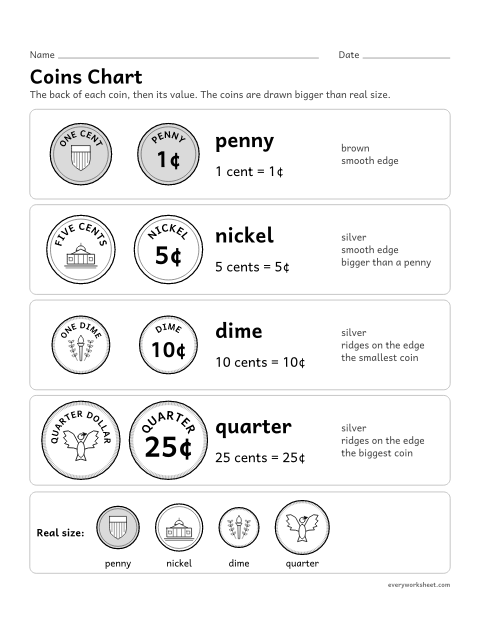
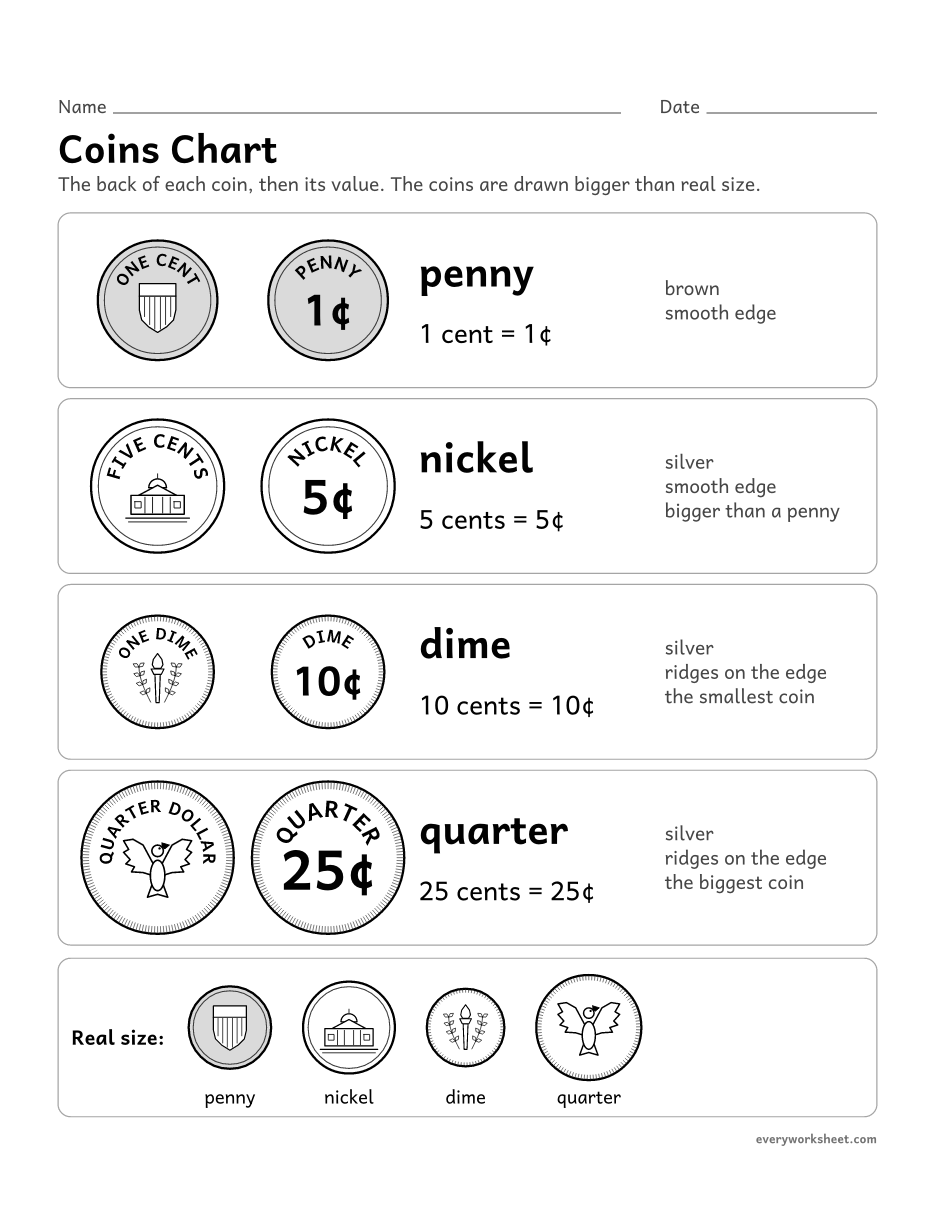
Coins chart
Knowing the penny, nickel, dime and quarter and what each is worth
1 page52 KB
Coin pages for 1st grade: a coins chart, name the coins, coin values, count pennies, nickels and dimes, count mixed coins, compare amounts and pay for toys.
View largerKnowing the penny, nickel, dime and quarter and what each is worth
1 page52 KB
 View all 2 pages
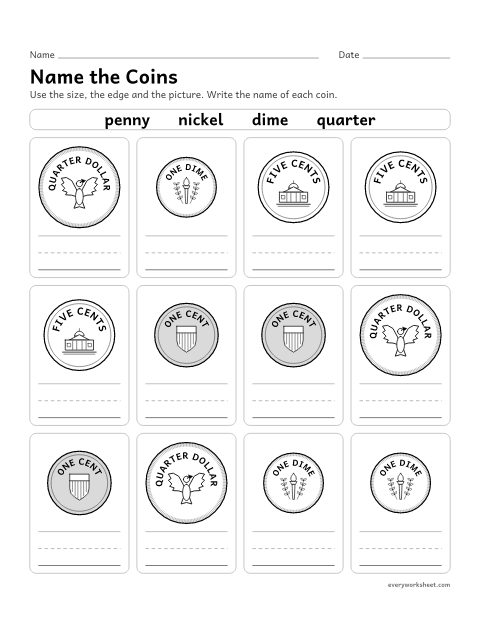
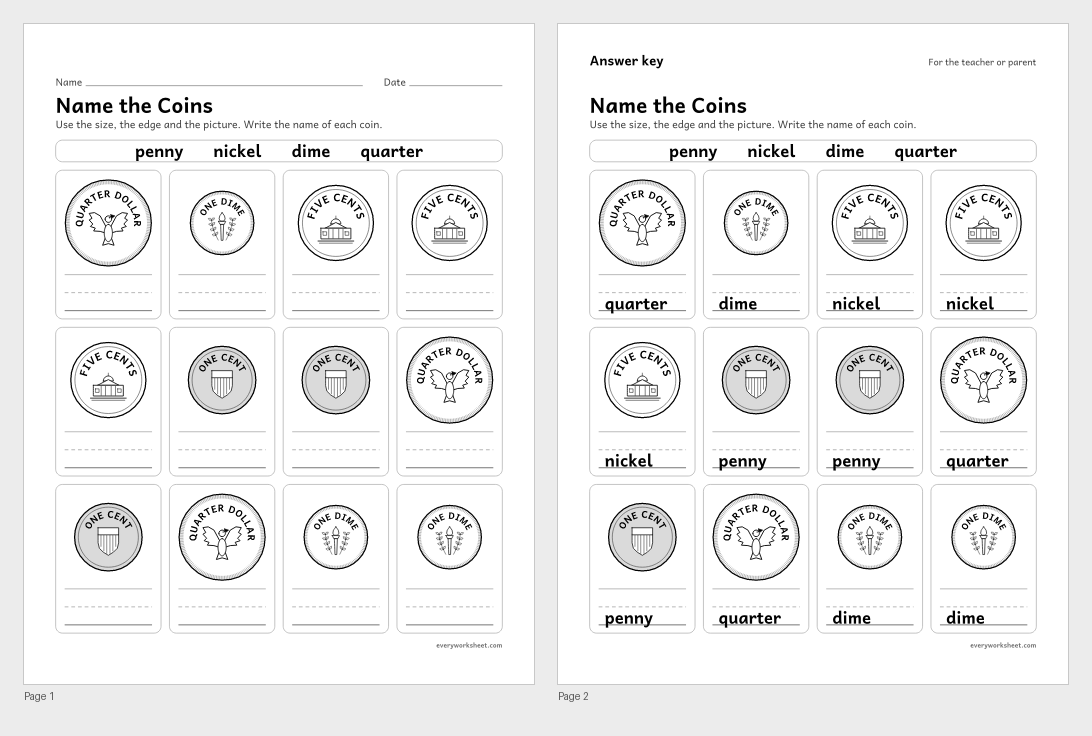
Naming coins by their size, edge and picture
Answer key on page 2
2 pages84 KB
 View all 2 pages
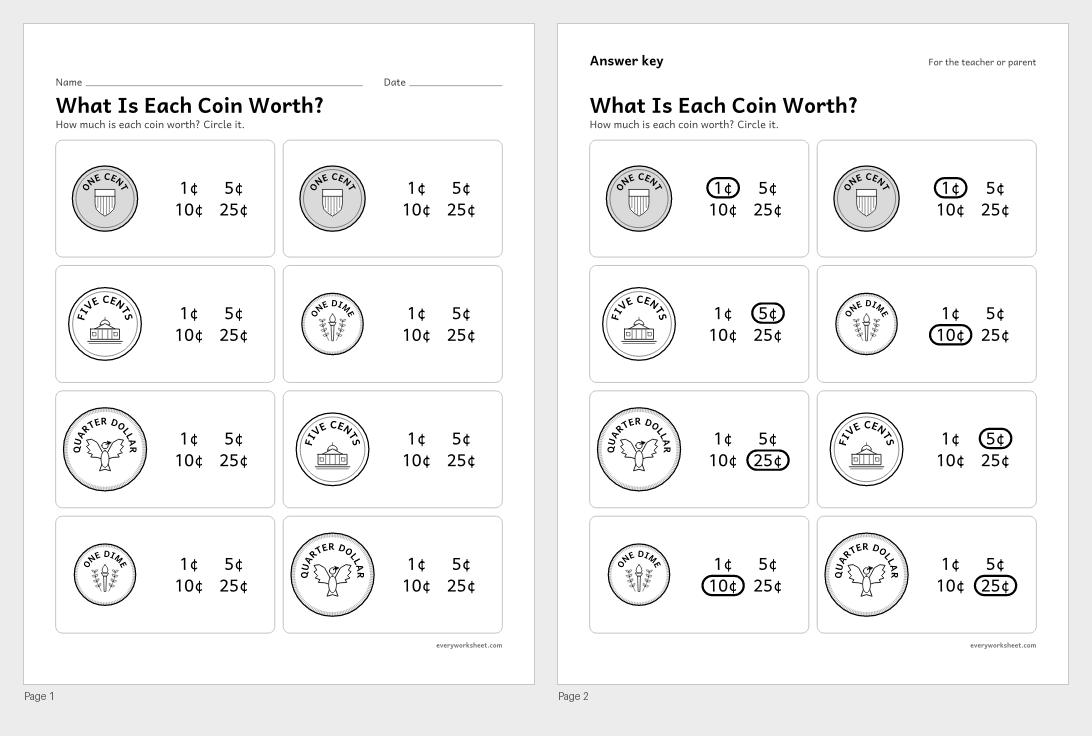
Matching each coin to its value in cents
Answer key on page 2
2 pages85 KB
 View all 2 pages
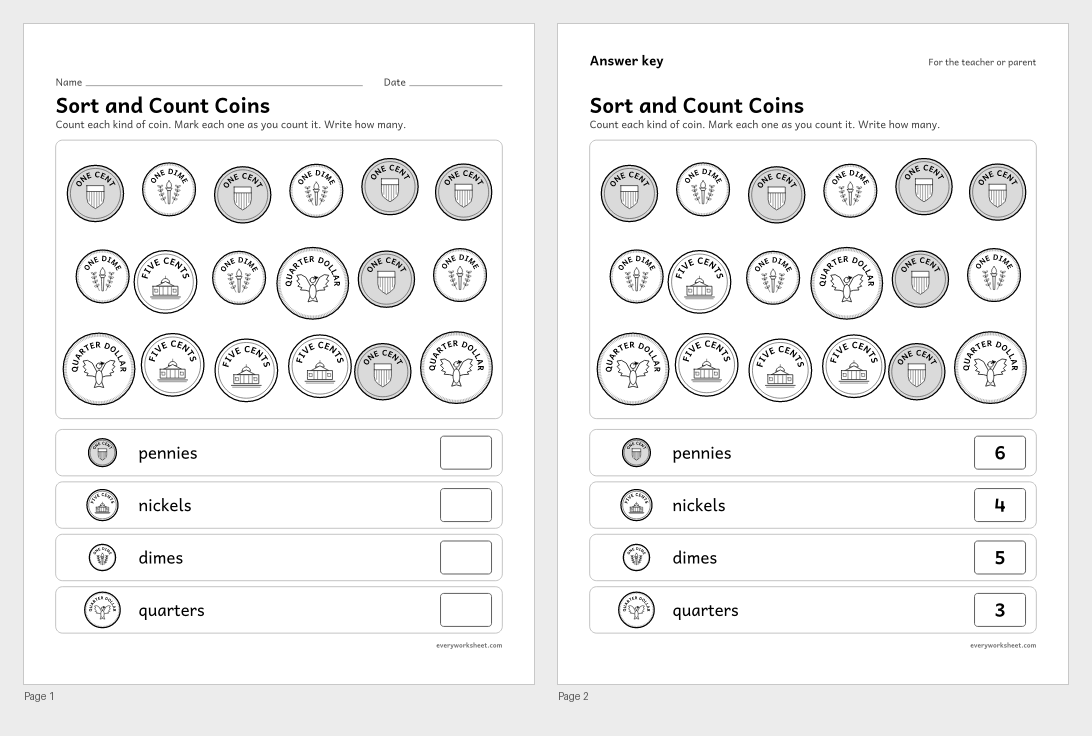
Sorting mixed coins and counting how many of each
Answer key on page 2
2 pages111 KB
 View all 2 pages
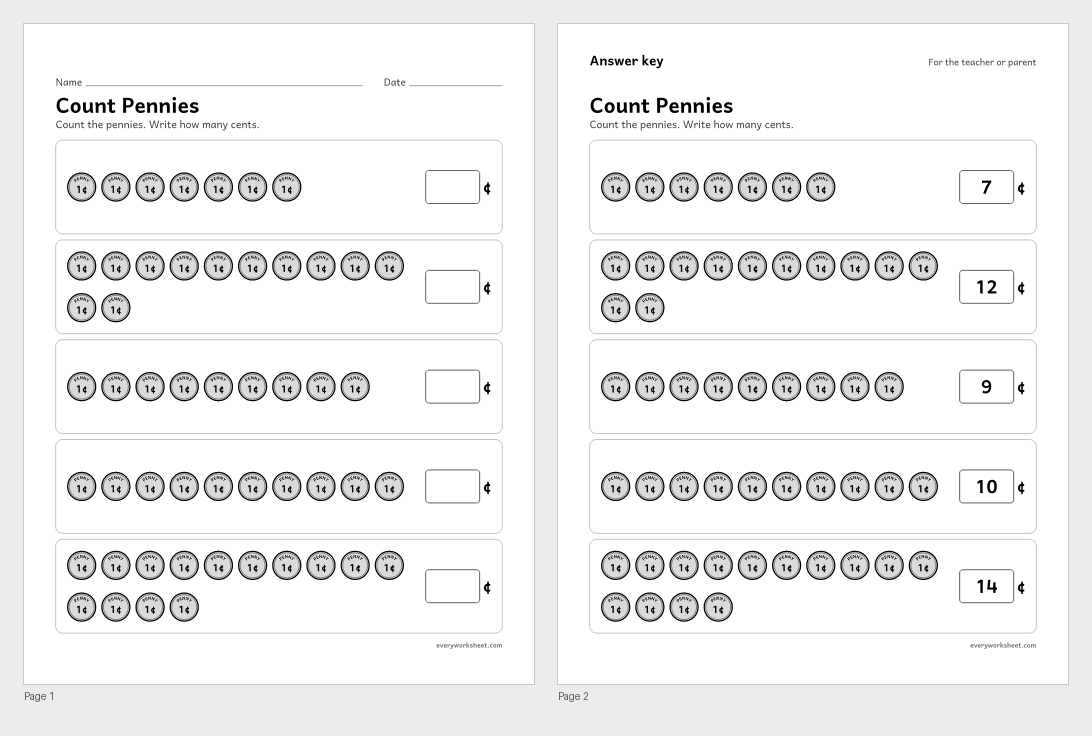
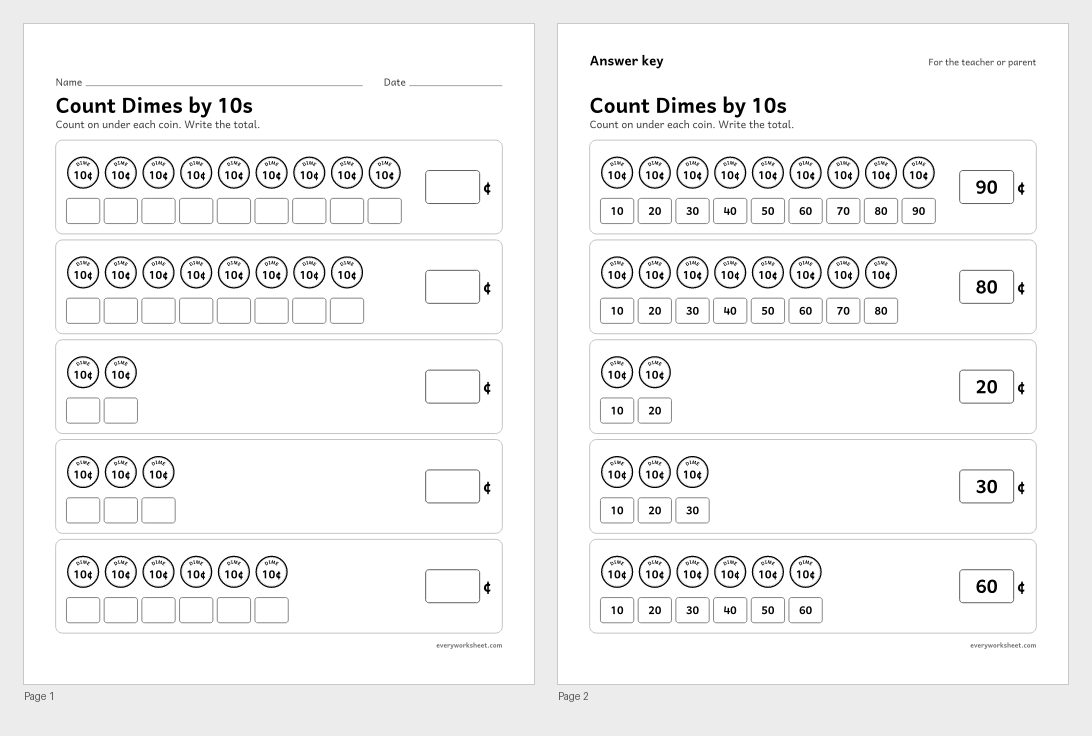
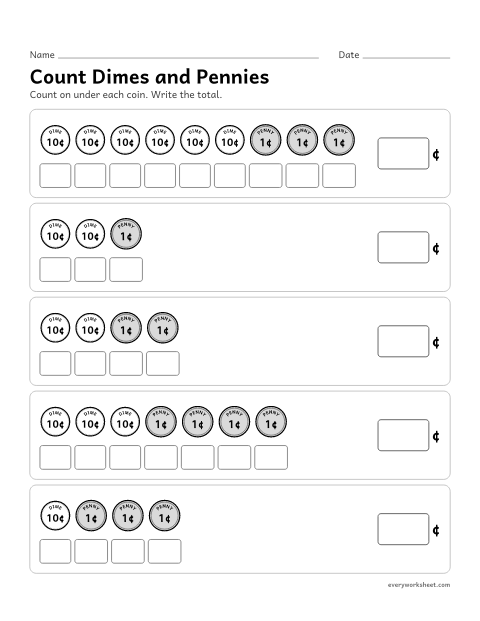
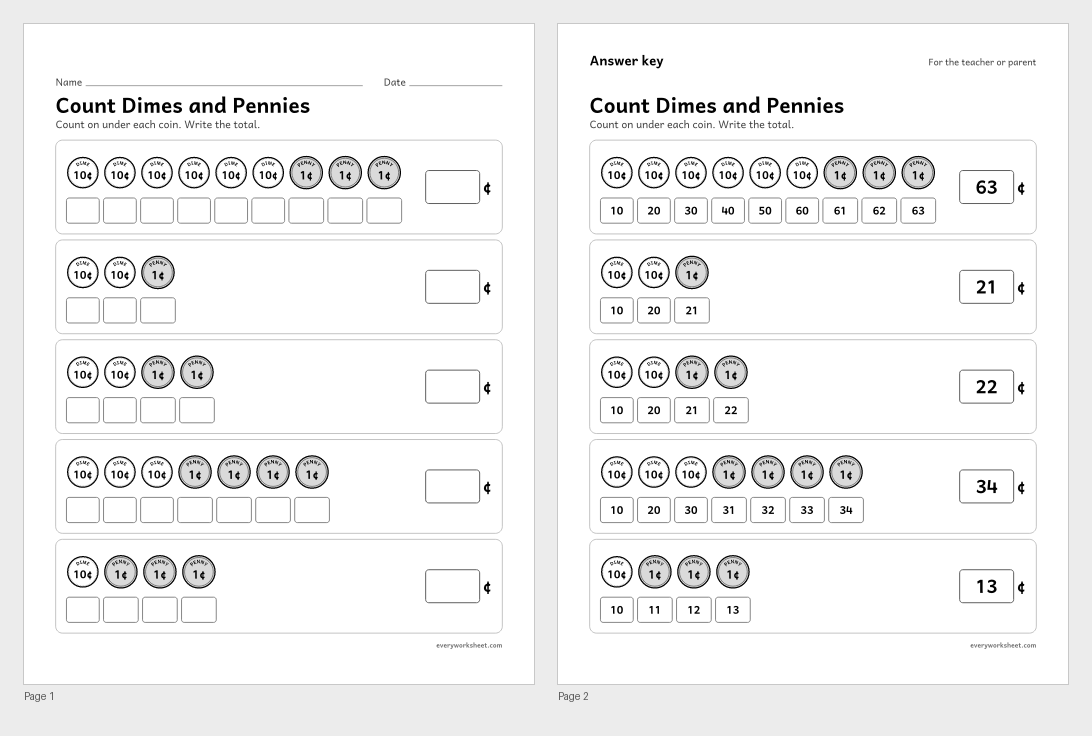
Counting dimes by tens, then pennies by ones (tens and ones)
Answer key on page 2
2 pages52 KB
 View all 2 pages
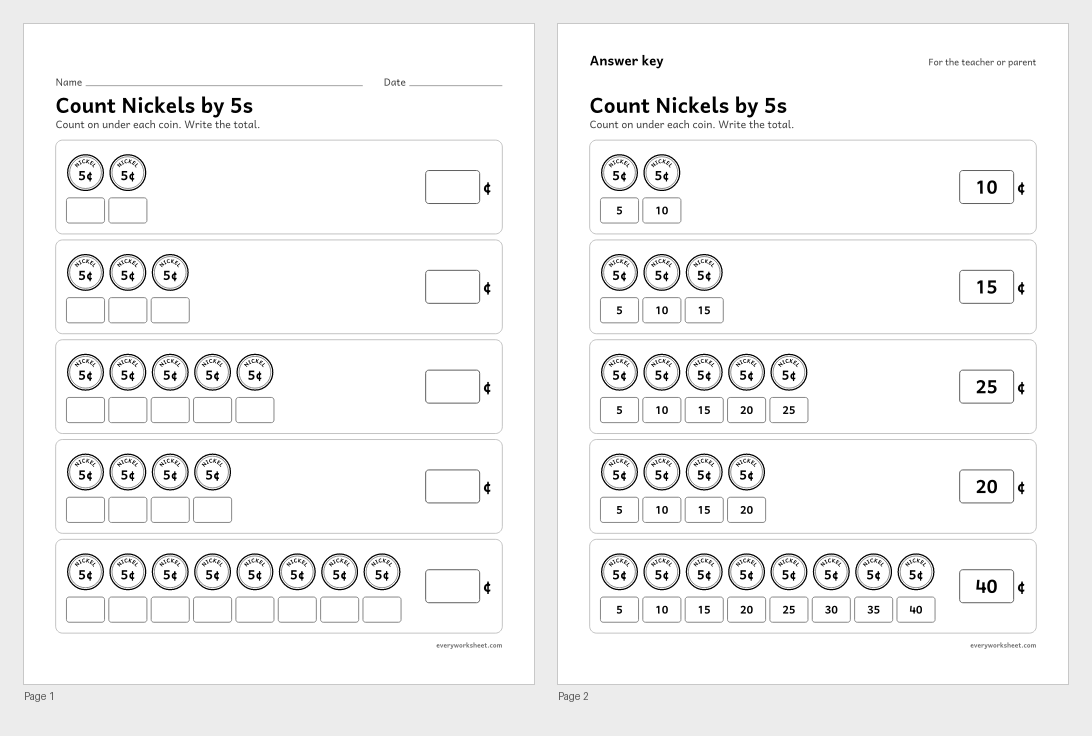
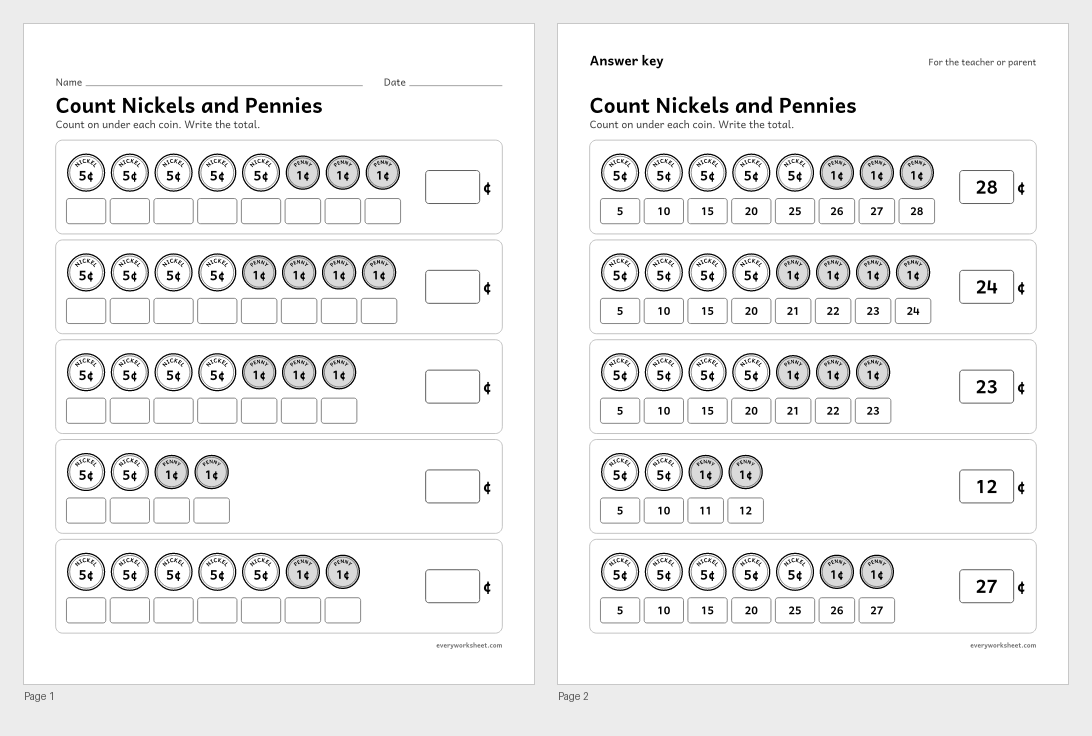
Counting on: nickels by fives, then pennies by ones
Answer key on page 2
2 pages46 KB
 View all 2 pages
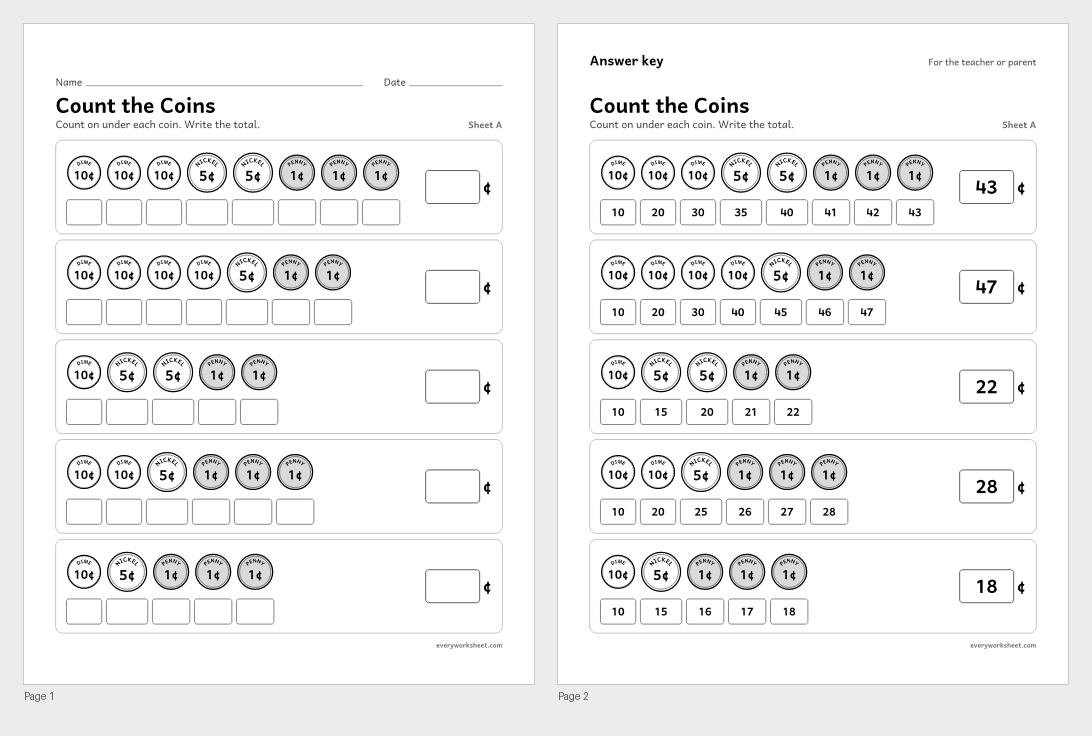
Counting dimes, nickels and pennies, biggest coins first
Answer key on page 2
2 pages56 KB
 View all 2 pages
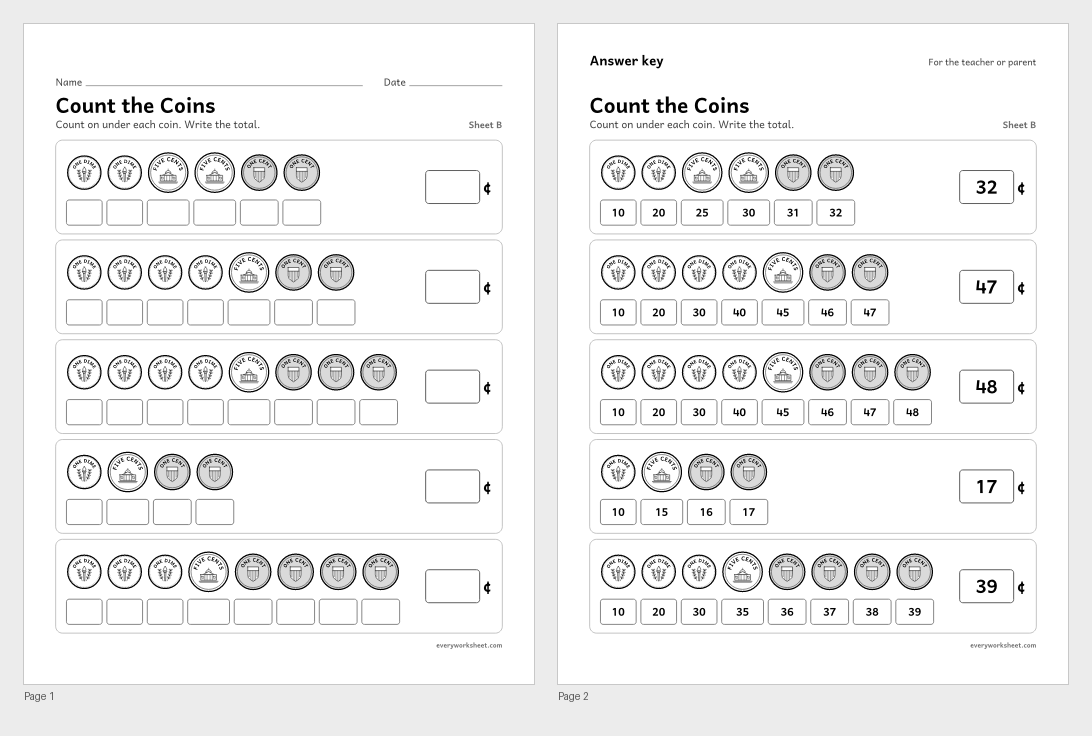
Counting real-looking coins with no labels: dimes, nickels and pennies
Answer key on page 2
2 pages85 KB
 View all 2 pages
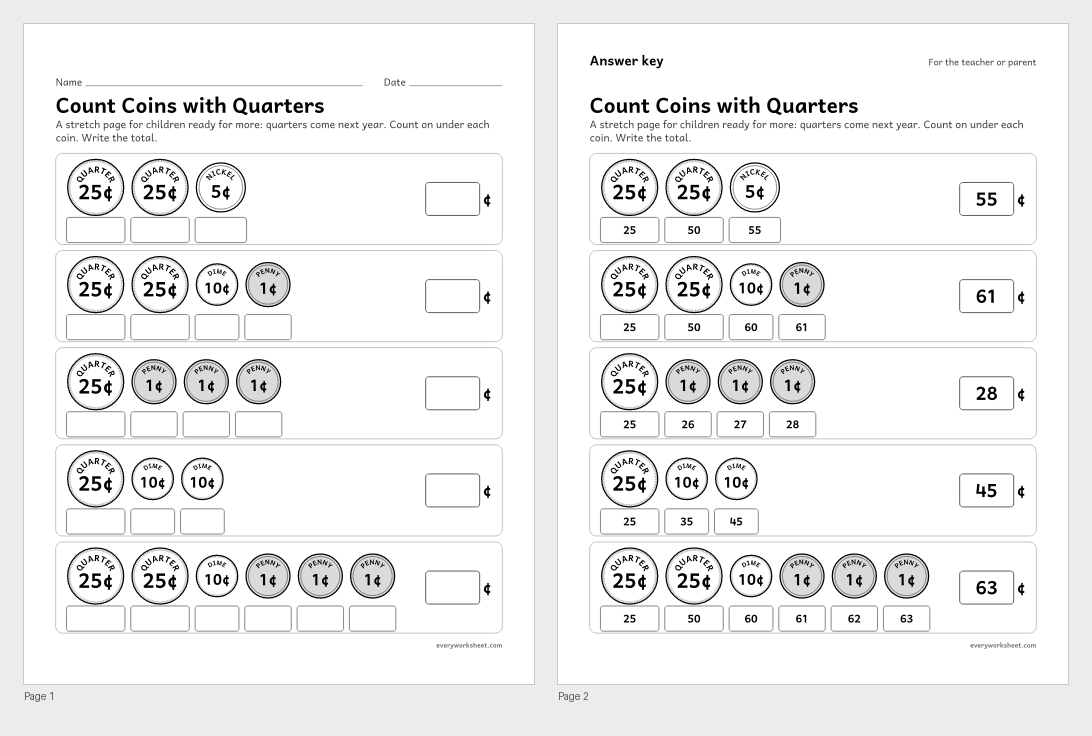
Counting on from a quarter with dimes, nickels and pennies
Answer key on page 2
2 pages71 KB
 View all 2 pages
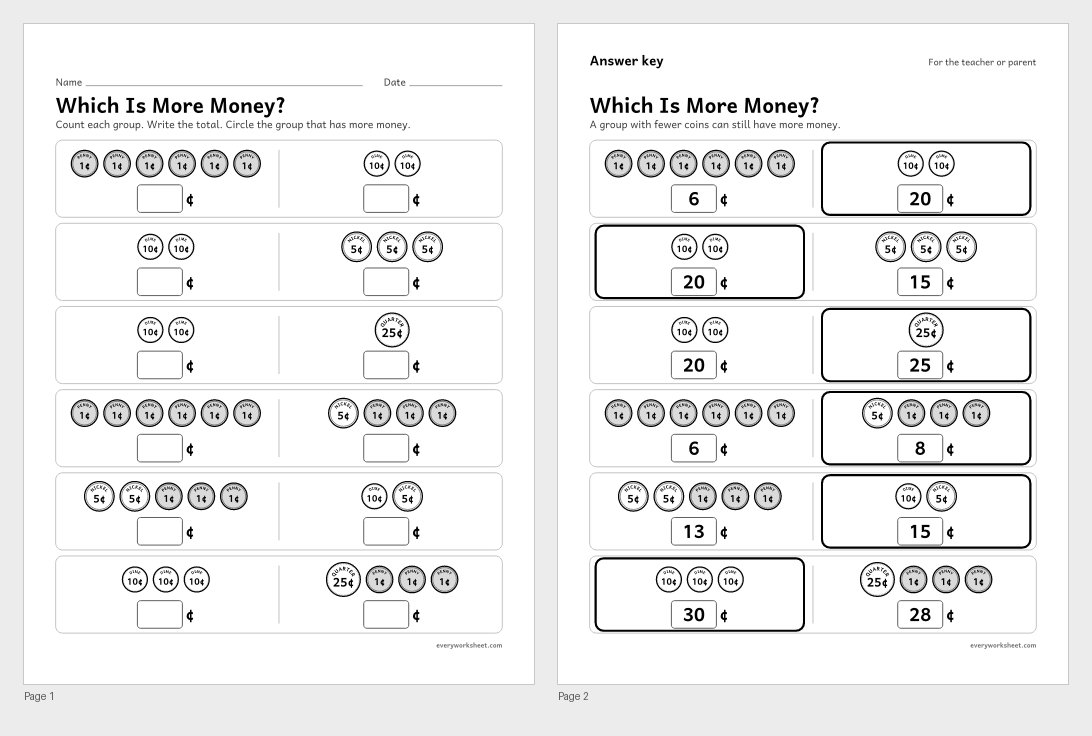
Counting two sets of coins and circling the greater amount
Answer key on page 2
2 pages65 KB
 View all 2 pages
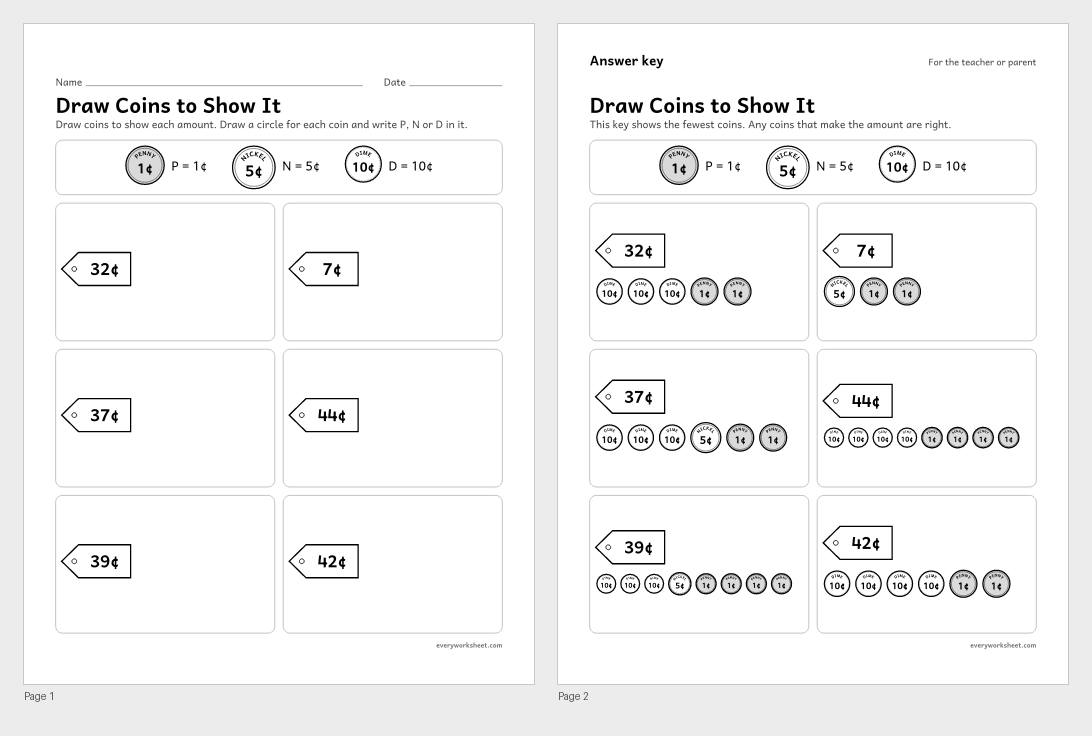
Drawing dimes, nickels and pennies to make an amount
Answer key on page 2
2 pages51 KB
 View all 2 pages
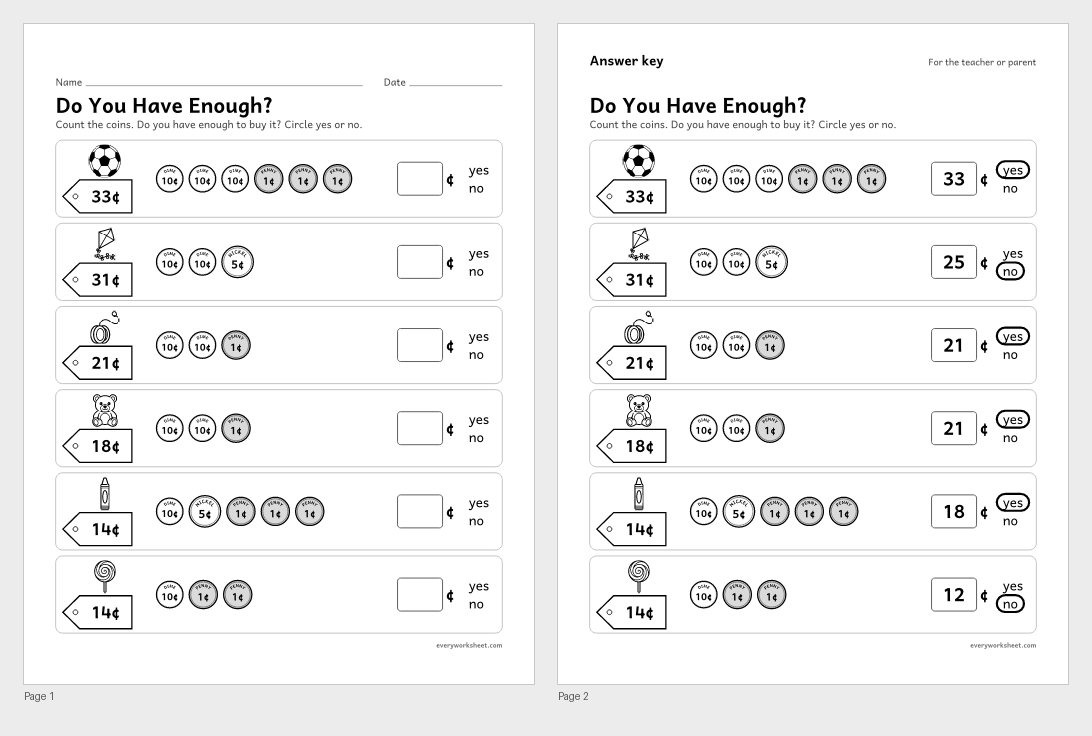
Counting coins and comparing the total to a price
Answer key on page 2
2 pages237 KB
Print at 100% (actual size) for the cleanest tracing lines.
Money brings counting to life. First graders learn the names and values of the penny, nickel, dime and quarter, then count coins by ones, fives and tens. Counting dimes and pennies is also great place value practice: 3 dimes and 4 pennies is 3 tens and 4 ones, 34 cents.
Start with the Coins Chart. Each coin is shown twice, once as a labeled coin with its value and once as a picture of the real back, with notes on color, size and edge. Then children name coins, match each coin to its value, sort and count a pile of coins, and count up rows of coins with a box under each coin for counting on.
Coins are drawn in black and white at their true sizes compared with each other: the dime is the smallest, the quarter the biggest, and the dime and quarter have ridged edges. Counting pages start with labeled coins and move to unlabeled coins, then add quarters for children who are ready. Every page with right answers has an answer key.
CCSS.MATH.CONTENT.2.MD.C.8Solve word problems involving dollar bills, quarters, dimes, nickels, and pennies, using $ and ¢ symbols appropriately. Example: If you have 2 dimes and 3 pennies, how many cents do you have?CCSS.MATH.CONTENT.1.NBT.A.1Count to 120, starting at any number less than 120. In this range, read and write numerals and represent a number of objects with a written numeral.CCSS.MATH.CONTENT.1.NBT.B.2Understand that the two digits of a two-digit number represent amounts of tens and ones. Understand the following as special cases:CCSS.MATH.CONTENT.1.NBT.B.3Compare two two-digit numbers based on meanings of the tens and ones digits, recording the results of comparisons with the symbols >, =, and <.CCSS.MATH.CONTENT.1.NBT.C.4Add within 100, including adding a two-digit number and a one-digit number, and adding a two-digit number and a multiple of 10, using concrete models or drawings and strategies based on place value, properties of operations, and/or the relationship between addition and subtraction; relate the strategy to a written method and explain the reasoning used. Understand that in adding two-digit numbers, one adds tens and tens, ones and ones; and sometimes it is necessary to compose a ten.Most first graders learn to name the penny, nickel, dime and quarter, know what each is worth, and count small groups of coins, starting with pennies, nickels and dimes. Counting dimes and pennies also practices tens and ones.
The money standard (2.MD.C.8) is in 2nd grade, but many schools start coins in 1st grade. These pages also practice the 1st grade counting and place value standards.
Yes. The coins are drawn at their true sizes compared with each other, and the chart shows them at real size too, so the dime is the smallest and the quarter is the biggest.
Labeled coins ("10¢") help children who are still learning values. "Count the Coins B" shows the real coin designs with no labels, the next step toward counting real coins.
Yes. Every page with right answers has an answer key on page 2, including the running count under each coin.